Apparel Search Guide Series
Airline Uniforms by Airline
No garment works harder, or is seen by more people, than an airline uniform. It is designed by couturiers, coded with rank and role, regulated down to the colour of a nail — and at its best it becomes a national symbol that outlives the aircraft it was designed for. This series takes one airline at a time and explains its uniform properly: the designer, the components, the colours and what they mean.
Search Apparel Search
Start Here
Why an Airline Uniform Is a Fashion Story
Airlines are among the few organisations left that dress thousands of people in a single, deliberate design — and they have known for seventy years that the clothing is the brand. When a new uniform launches, it makes the news like a fashion collection, because it often is one: Pierre Balmain dressed Singapore Airlines, Christian Lacroix dressed Air France, Vivienne Westwood dressed Virgin Atlantic, and Zac Posen dressed Delta. The commission is a couture problem with industrial constraints — one design must flatter every body that wears it, survive years of daily wear and dry cleaning, satisfy safety rules, and still be recognisable across a crowded terminal.
A uniform is also a language. Rank, role and seniority are coded into colour, stripes, scarves and ties, so that a passenger — or another crew member — can read the hierarchy at a glance. And it is national dress of a kind: the sarong kebaya, the saree, the kilt-inspired tailoring and the desert-toned palettes of the Gulf carriers all carry a country’s identity into every airport on earth. Add the grooming rules that complete the look — prescribed hairstyles, makeup palettes that change with rank, jewellery measured in millimetres — and the airline uniform becomes one of the most completely designed outfits in modern life.
Each guide in this series covers one airline in depth: the designer and the debut, the full list of components for women and men, the rank code, the grooming rules as they are publicly documented, and how the uniform has evolved — or, in the most famous cases, refused to. Every guide links onward to the airline’s home country in our World Clothing Industry directory and to its designer’s Apparel Search profile, and those pages link back. Start with the most famous uniform in the sky: the Singapore Airlines sarong kebaya.
The Guides
Asia-Pacific
Singapore Airlines
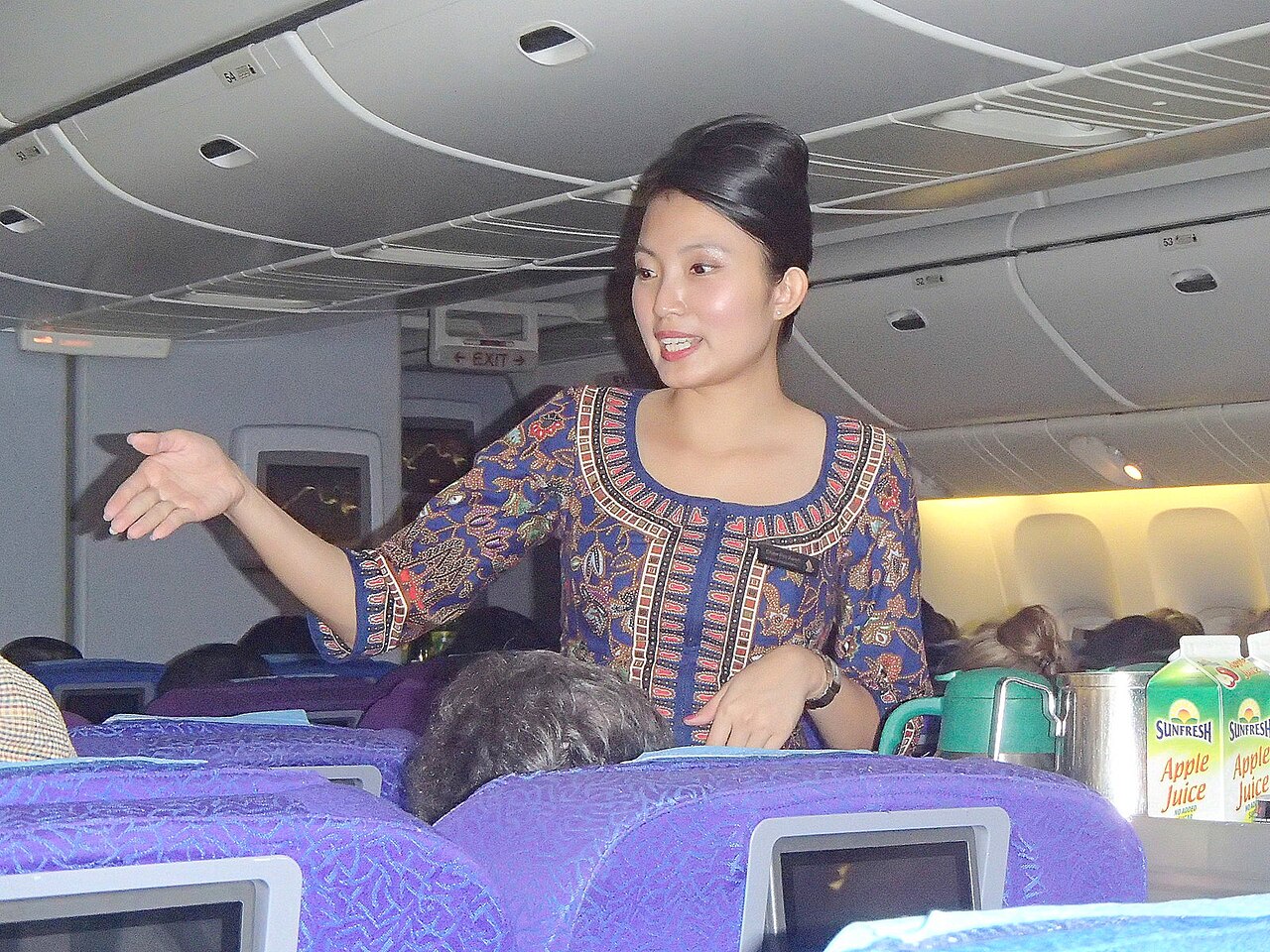
The sarong kebaya designed by Pierre Balmain in 1968 — a batik uniform whose four colours spell out the wearer’s rank, and the most famous cabin dress in the world. Our first guide in the series.
Read the guide ↑ANA — All Nippon Airways
Japan’s tenth-generation uniform, designed by Prabal Gurung — the airline’s first foreign uniform designer — with light-blue accents drawn from the ANA palette.
Read the guide ↑Japan Airlines
A crisp navy wardrobe by creative director Yasutoshi Ezumi, adopted in 2020, with working coveralls by Descente and outer coats by mont-bell for the ground teams.
Read the guide ↑Cathay Pacific
Hong Kong couturier Eddie Lau has designed three generations of the Cathay uniform; the current red-accented wardrobe dates from 2011.
Read the guide ↑Qantas
Martin Grant’s navy, red and fuchsia wardrobe of 2013, worn by 12,600 staff — with a successor by Rebecca Vallance already announced for 2027.
Read the guide ↑Air India
Manish Malhotra’s 2023 collection of ombré sarees — aubergine-to-burgundy for senior crew, red-to-purple for junior crew — launched with the airline’s new era.
Read the guide ↑The Guides
Middle East
Emirates
The beige suit, red hat and white veil — one of aviation’s most recognised silhouettes, in its current form since 2008, designed in-house with uniform maker Simon Jersey.
Read the guide ↑Qatar Airways
A deep burgundy wardrobe dating from 2008, attributed to Danish design firm Olino — formal, tailored and deliberately understated.
Read the guide ↑Etihad Airways
Ettore Bilotta’s 2014 “inflight couture”: chocolate brown with deep purple for the cabin and burnt orange for ground staff, cut in his Milan atelier.
Read the guide ↑The Guides
Europe
Air France
Christian Lacroix’s 2005 wardrobe — around a hundred combinable pieces in navy with red touches — still flying more than twenty years on.
Read the guide ↑Lufthansa
The crane’s sixth uniform generation dates from 2002; a seventh, created with BOSS for the airline’s centenary, was unveiled in 2026 and begins rolling out this year.
Read the guide ↑British Airways
Ozwald Boateng’s 2023 collection — five years in development, with a jumpsuit option for women crew and tailoring that nods to Savile Row.
Read the guide ↑Virgin Atlantic
Vivienne Westwood’s 2014 wardrobe in the airline’s signature red — punk’s tailor dressing 7,500 staff, with sustainability built into the fabrics.
Read the guide ↑Turkish Airlines
Ettore Bilotta’s deep-red and anthracite collection, unveiled in 2018 for the airline’s 85th anniversary and the move to the new Istanbul Airport.
Read the guide ↑The Guides
North America
Delta Air Lines
Zac Posen’s “Passport Plum” collection of 2018 for 64,000 employees — and its announced successor, the navy-and-burgundy Distinctly Delta wardrobe due in 2027.
Read the guide ↑United Airlines
A programme years in the making — Tracy Reese and Brooks Brothers for the customer-facing teams, Carhartt below the wing — finally rolled out across the airline in 2025.
Read the guide ↑The Uniform Is the Brand
In 1972 a small new airline from a small island asked an advertising man to make it famous, and he built the whole campaign on the uniform: the “Singapore Girl,” in her Balmain sarong kebaya, with the promise “A Great Way to Fly.” Fifty years later the aircraft have changed beyond recognition and the kebaya has not — it has been modelled in wax at Madame Tussauds and catalogued by a national museum. That is the power this series is about. Read how it happened in our Singapore Airlines uniform guide.
Airlines refresh their uniforms from time to time, so the details here describe the uniform as documented for this guide — the airline’s own site always carries the latest version.
Keep Exploring
Explore Fashion for Travel
The crew are only half the fashion on a flight — the other half is what the passengers are wearing. Our travel guides cover the traveller’s side of the same subject, and they link back here.
Outfits for Flying
Travel Outfits
What to wear when you are going somewhere — outfit systems built for transit days.
Read ↑Airport Outfits
Security-friendly shoes, cabin layers and the full airport dressing system.
Read ↑What to Wear on a Long Flight
Dressing for the overnight haul — comfort, warmth and arriving presentable.
Read ↑What to Wear When Traveling
The destination-rules guide to building a travel wardrobe that works on arrival.
Read ↑Business Travel Wardrobe Guide
A working wardrobe that travels — suits, wrinkle strategy and boardroom-ready arrivals.
Read ↑Packing & Capsule Wardrobes
Travel Capsule Wardrobe Guide
A small set of pieces that combine into a trip’s worth of outfits.
Read ↑Travel Packing Guide
The complete packing method — lists, order and wrinkle control.
Read ↑How to Pack a Suit
Getting a tailored jacket and trousers across the world without the creases.
Read ↑Carry-On Packing Guide
Everything in one bag — the carry-on-only system, piece by piece.
Read ↑Travel Comfort & Accessories
Related Features
More Signature Looks on Apparel Search
Airline crews are not the only people whose single outfit became a public identity. Our signature-look features tell the same story from the technology world — one person, one uniform, worn so consistently it became a trademark:
Steve Jobs’ Black Turtleneck
How a mock turtleneck, jeans and sneakers became the most famous personal uniform in business.
Read ↑Mark Zuckerberg’s Gray T-Shirt
The deliberate sameness of the gray tee — decision fatigue, branding, or both.
Read ↑Jensen Huang’s Leather Jacket
NVIDIA’s founder turned a black leather jacket into a keynote uniform recognised worldwide.
Read ↑Common Questions
Common Questions
What is this series about?
Airline Uniforms by Airline is an Apparel Search guide series that takes one airline at a time and explains its uniform properly: who designed it, what the components are, how rank and role are shown, what rules govern how it is worn, and how the design became part of the airline's identity.
Why do airlines hire famous fashion designers?
Because a uniform is the most-seen piece of design an airline owns. Cabin crew wear it in every cabin, every airport and every advertisement, so airlines commission couturiers and fashion designers — Pierre Balmain, Christian Lacroix, Vivienne Westwood, Zac Posen and others — to give the clothing the same care as the brand itself. A great uniform has to flatter thousands of different bodies, survive years of daily wear and still read instantly as that airline.
How can you tell a crew member's rank from their uniform?
Every airline codes rank into the clothing somehow: a colour, a stripe, a scarf or a tie. Singapore Airlines is the most elegant example — the colour of the sarong kebaya itself shows the wearer's rank, blue for a flight stewardess up to the senior supervisor's deep purple-burgundy, and the men's ties repeat the same code. Other airlines use sleeve stripes borrowed from naval and pilot tradition, different scarf patterns, or distinct outfits for pursers and supervisors.
How do these guides connect to the rest of Apparel Search?
In both directions. Every guide links to its airline's home-country page in the World Clothing Industry directory and to the designer's Apparel Search profile where one exists, and those pages link back. The series also links to our travel fashion guides — what passengers wear — under Explore Fashion for Travel, and the travel guides link back here, so crew fashion and passenger fashion sit side by side.
Keep Exploring