Airline Uniforms by Airline · United States
Two Blues: The United Airlines Uniform
United's new uniform took eight years, three design teams, one leaked 'Star Trek' draft, a pandemic and thousands of employee objections to reach the cabin. On 28 May 2025 it finally arrived: Tracy Reese and Brooks Brothers above the wing, Carhartt below it, TUMI in hand. This is the wardrobe, piece by piece.
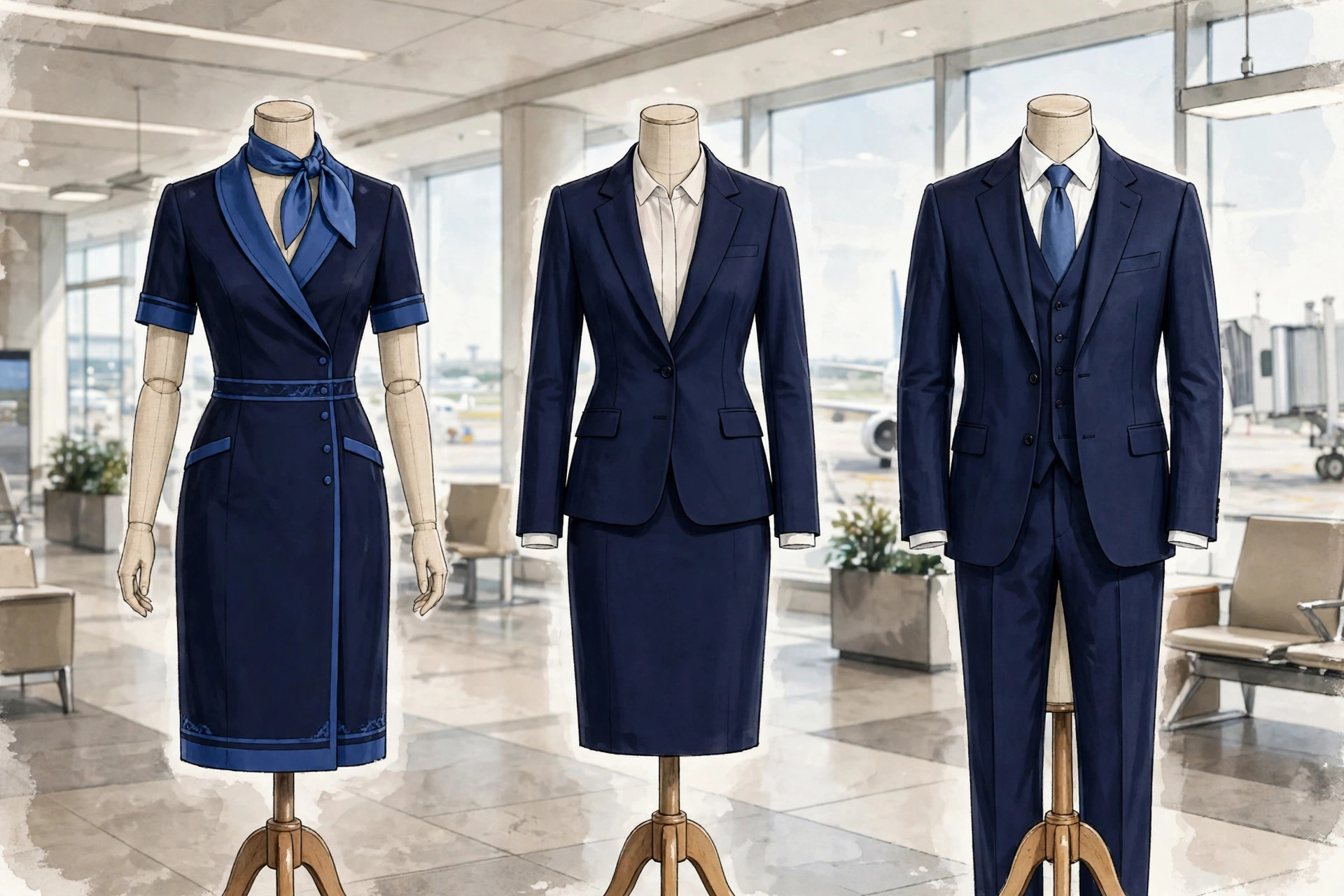
The Design
Three American Brands, One Wardrobe
United did not hire a designer; it hired a team, and divided the airline among them by expertise. When the programme was announced in August 2017, the brief was cohesion: more than 70,000 frontline employees — flight attendants, pilots, customer service representatives and the below-wing workforce — were to look like one airline, in high-quality fabrics with improved breathability and fit. New York designer Tracy Reese, celebrated for colourful, feminine womenswear, would design the women's uniforms in partnership with Brooks Brothers; Brooks Brothers — America's oldest clothier, the house of the button-down shirt — would design and manufacture the pilots' and men's uniforms, and manufacture the women's as well. Carhartt, the workwear maker, took the ramp, technical operations and catering uniforms, and TUMI became the official luggage provider for United's 24,000 flight attendants, who would choose between two-wheel and four-wheel bags.
The process was research-heavy even by the standards of this series: some 17,000 survey responses, 35 in-person focus groups, observation sessions at airports around the world and a standing committee of more than 120 employees. The designs were shown publicly in January 2019. "United should stand toe-to-toe with any global airline in terms of how good their employees look and the quality of their uniforms," Reese said at the reveal; Brooks Brothers designer Brian Lane added the clothier's own test — "We wanted them to be proud of what they're wearing, but I also didn't want to be cookie-cutter like the typical uniforms that are out there." What happened next is the evolution story below: the road from that reveal to a worn uniform took six more years. The collection that finally entered service on 28 May 2025 is quieter than the 2019 reveal — the purples, greys and blues of the early palette refined down to two signature blue tones drawn from the airline's own branding — but it is recognisably the same programme, finished by the feedback that delayed it.

The Components
The Outfit, Piece by Piece
- The Palette
- The base colour is Rhapsody Blue, United's brand blue. The 2019 collection dressed it with named accents — Pacific Blue, Premium Purple, Atlantic Amethyst and Runway Gray — including a purple-hued women's dress and amethyst ties. Employee feedback and brand discipline then narrowed the scheme: the uniform in service today is built on two blue tones, with colour used sparingly and deliberately.
- The Women's Collection — Tracy Reese
- Reese's flight attendant and customer service wardrobe centres on tailored dresses — the best-known a blue dress whose early form carried a curving light-blue stripe — with skirt and trouser options, blouses, blazers and knitwear, and the neck scarf that has anchored United's women's uniform for decades. The final fabrics are OEKO-TEX certified, tested for harmful substances, after the fabric reactions that had plagued the previous uniform became a central design concern. Concealed pockets and flexible closures were built in for the physical reality of cabin work.
- The Men's Collection — Brooks Brothers
- For men, Brooks Brothers applied two centuries of American tailoring: suits and separates for flight attendants and customer service staff, ties carrying the palette's accent colour, and knit options including the mock turtleneck seen in the final collection. Early details that read as costume — piping on the men's blazer, a grey stripe on the women's skirt — were removed after the first wear tests, a small history of the programme's feedback loop written in trimmings.
- The Pilots' Uniform
- Brooks Brothers also dresses the flight deck: the classic dark pilot's uniform of jacket, white shirt and tie, distinguished as everywhere in aviation by wings and by the stripes of rank — the one part of the wardrobe where hierarchy, not brand, does the designing.
- Customer Service
- At the gates and check-in, the collection wears its brightest version of the brand: Rhapsody Blue as the main colour, with the palette's lighter blue as the accent — the terminal face of the same system the cabin wears.
- Below the Wing — Carhartt
- Ramp service, technical operations and catering staff wear Carhartt workwear: garments from a maker whose reputation is durability rather than fashion, in United's blues and built for weather, tarmac and hangar. This part of the programme finished first, rolling out in 2020 while the rest of the wardrobe was still being argued over.
- The Luggage
- Uniquely in this series, the uniform includes the bag: TUMI rollerboards for every flight attendant, a two-wheel or four-wheel choice per crew member. From the 2025 rollout, using the company-issued TUMI luggage is part of uniform compliance — the suitcase is uniform kit, inspected like a scarf.
The collection's quietest innovation is choice. United's modernised standards treat the wardrobe as a set of garments crew select and combine — the dress or the trousers, the blazer or the knit — within one unmistakable blue system, rather than a single prescribed silhouette per gender.
Reading the Uniform
Who Is Who in Two Blues
United's system identifies people first by work group — the tailoring tells you which of the programme's three makers dressed them — and then by the small insignia of the job itself.
| Role | What you see | What it means |
|---|---|---|
| Pilots | Dark Brooks Brothers tailoring, white shirt, tie, wings | The flight deck. Rank is read the traditional way, from sleeve and shoulder stripes — captain and first officer are distinguished at a glance. |
| Flight Attendants | Two-tone blue dresses, suits and scarves; TUMI rollerboard | The cabin crew. Since 2023 the wings and name badge are a single combined piece, on which crew may also display their pronouns. |
| Customer Service | Rhapsody Blue with lighter-blue accents | Gates, check-in and lounges — the brightest application of the palette, made to be found in a terminal. |
| Below-Wing Staff | Carhartt workwear in United blues | Ramp, technical operations and catering — workwear, not tailoring, signals the tarmac and the hangar. |
One small badge changed with the new uniform, and it was much discussed: from the 28 May 2025 rollout, the only flag pin permitted on the uniform is the United States flag. Crew had long worn small flag pins signalling the languages they spoke and the countries they came from; the new rule ended that tradition in favour of standard language identification, and it arrived as part of the same compliance push — skirts at the knee, regulation footwear, issued luggage — with which United launched the wardrobe.
The Star Trek Draft
Every long uniform programme has a version it would rather forget. United's surfaced in May 2018, when images from a confidential preview leaked: a futuristic design flight attendants immediately dubbed "Star Trek." The reaction was swift and unsparing, and the design was binned. The episode set the pattern for everything that followed — a workforce that had been promised a say intended to use it, and a programme that would be redesigned in public, repeatedly, until the people wearing it stopped objecting. Eight years is a long time to design a uniform; it is also what designing one by committee of 70,000 actually takes.
The Rules
Grooming: The Most Inclusive Code in America
If Delta's rules are the strictest in this series, United's are the most deliberately liberal — and, unusually, the airline announced them as a point of pride. On 15 September 2021, new appearance standards took effect for customer-facing staff, developed with employee Business Resource Groups and later extended to pilots, ramp staff and other groups. United described them as modernised and more gender-inclusive, intended to let employees be "their authentic selves at work" — and the specifics backed the language.
The separate men's and women's rules were abolished. Makeup became a choice open to every employee, worn natural-looking; nail polish likewise, understated and complementary to the uniform. Hair may be worn down by anyone, provided it is shoulder length or shorter; longer hair is worn fully pulled up in public view, in a ponytail, braid, bun or updo. Tattoos may be visible on the arms, wrists, legs and feet — each no larger than the employee's own name badge, the badge itself serving as the measuring tool — but never on the face, neck, chest or hands, and never with offensive content. One small nose stud is permitted. The crew guidebook that accompanies the new uniform keeps the professional frame around the freedom: nails clean and no more than a quarter-inch past the fingertip, polish chip-free and all one colour, hair colour in natural human shades, jewellery and eyewear understated and uniform-appropriate.
Set beside the grooming chapters elsewhere in this series — Singapore's assigned eyeshadow palettes, Delta's dime-sized studs — United's code marks the opposite pole of modern uniform philosophy: the uniform itself carries the brand, identically for everyone, and the person inside it is allowed to remain visibly a person. That the same airline simultaneously tightened uniform compliance itself — correct pieces, correct lengths, issued luggage — is not a contradiction but the settlement the eight-year programme reached: strict about the clothes, relaxed about the human.
Evolution
From Ellen Church's Cape to the Two Blues
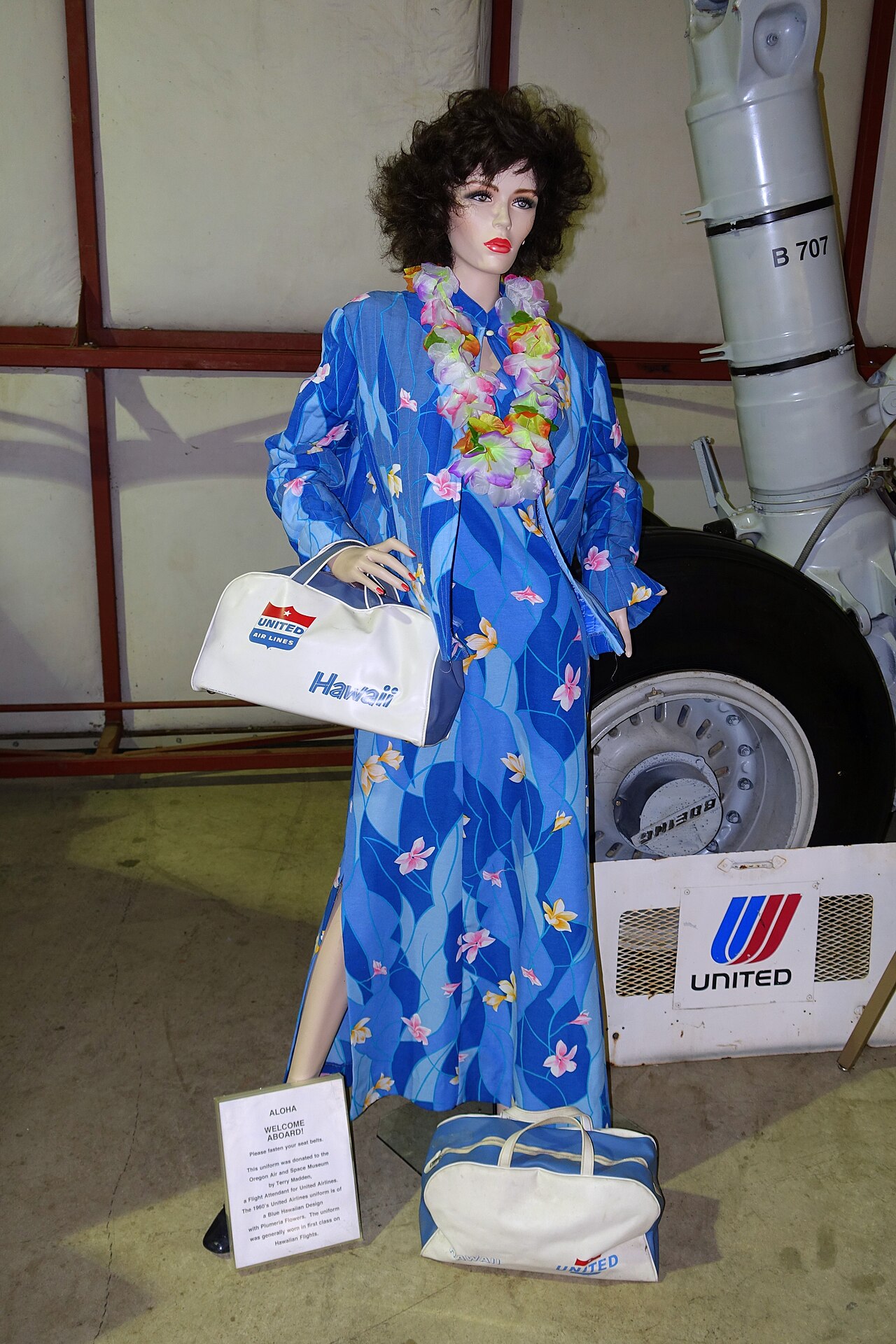
United is where the flight attendant's uniform began. In 1930 the airline's predecessor hired Ellen Church and the "Original Eight" — the world's first stewardesses — and dressed them in dark green wool with a matching green and grey wool cape, a nurse's reassurance tailored for the sky. The decades that followed made United a recurring name in uniform design history: Raymond Loewy in the late 1950s, William Travilla in the mid-1960s, and in 1968 the Hollywood costumer Jean Louis, whose A-line dresses came in colour stories with names like Hawaiian Sunset and Maliblue, at a choice of hem lengths — the tailored "Typical" at the knee or the Quant-inspired "Tiny" above it. For Hawaiian services there was a uniform of another kind entirely: a blue floral holomu'u-style dress with plumeria flowers, worn with a lei — the leisure shirt's elegant cousin, dressing the route as a destination.
Stan Herman dressed the bicentennial-era airline in 1976, and the designs settled into the long navy decades: a 1991 uniform aligned to the globe livery, then — after the Continental merger — a unified post-merger uniform in 2013 that the airline's crews wore, with growing dissatisfaction about fit and fabrics, for over a decade. That dissatisfaction is the true origin of the Reese and Brooks Brothers programme: announced in 2017, leaked and mocked in 2018, revealed and sent back in 2019 (piping removed, skirt stripe removed, athletic-fit shirts and more trouser lengths added, fabrics reworked with the unions to avoid chemical reactions), paused by the pandemic in 2020 even as the Carhartt below-wing wardrobe rolled out, revived in new colours in May 2023, and previewed to passengers in the May 2024 safety video. The final rollout on 28 May 2025 still had ragged edges — some crew were missing pieces, winter coats followed later, and a sleeve on one dress option restricted arm movement badly enough that United funded tailoring allowances and treated the fix as a top priority — with full adoption completing through late 2025. The airline's own uniform-history exhibit tells the story as a single line of mannequins, 1930 to today: the two blues are simply the latest, and hardiest, entry in it.
The Settlement
A Uniform the Workforce Voted Into Existence
United's uniform will never be an icon like Singapore's kebaya; it was never meant to be. Its significance is procedural, and in the long run that may matter more. This is the uniform that proved a modern mega-airline cannot simply issue a design — not when the wearers have group chats, unions and a decade of grievances about the last one. What survived eight years of leaks, redesigns, a pandemic and a final argument about sleeves is a wardrobe with its authorship genuinely distributed: a women's designer, a heritage clothier, a workwear brand and a luggage maker, edited continuously by the 70,000 people inside it, and paired with grooming rules that treat individuality as compatible with uniformity. The result looks like what it is — a compromise that works, in the airline's own blue. For more on the country whose brands — Reese, Brooks Brothers, Carhartt, TUMI — dressed it, see our World of Clothing hub.
Airlines refresh their uniforms from time to time, so the details here describe the uniform as documented for this guide — the airline’s own site always carries the latest version.
Common Questions
Common Questions
Who designed the United Airlines uniform?
The women's uniforms were designed by Tracy Reese in partnership with Brooks Brothers; Brooks Brothers designed and manufactured the pilots' and men's uniforms and manufactured the women's. Workwear brand Carhartt supplied the below-wing uniforms for ramp, technical operations and catering staff, and TUMI supplied the flight attendants' luggage.
When did United's new uniform enter service?
The customer-facing rollout took place on 28 May 2025, when flight attendants, pilots and customer service staff across the network switched to the new collection. The programme had been announced in 2017 and the designs first shown publicly in January 2019; the below-wing Carhartt uniforms had already rolled out in 2020.
Did Cole Haan design United's uniform?
No. Cole Haan designed the post-merger uniform for American Airlines, not United. United's uniform is the work of Tracy Reese and Brooks Brothers, with Carhartt below the wing and TUMI luggage — the Cole Haan attribution is a common mix-up between the two airlines' designer programmes.
Can United flight attendants have visible tattoos?
Yes, within limits. Since United's inclusive appearance standards took effect on 15 September 2021, customer-facing staff may show tattoos on their arms, wrists, legs and feet provided each is no larger than a United name badge, is not offensive, and is not on the face, neck, chest or hands. Larger tattoos must stay covered by the uniform.
Why did United's uniform take eight years to arrive?
A leaked first design in 2018 was derided as Star Trek-like and dropped; the publicly revealed 2019 designs drew enough employee complaints to force further redesigns; and the pandemic then shelved the programme for three years. It restarted in 2023, was previewed in the airline's 2024 safety video, and — after extended wearer trials and final fit work — rolled out on 28 May 2025.
Keep Exploring
More to Explore
In This Series
Airline Uniforms by Airline
The series hub — every airline's guide, the designers behind them, and the ones in preparation.
Read ↑World of Clothing
The hub for clothing and dress around the world — United's home country, the United States, is covered here.
Read ↑Go Deeper
Uniforms — Definition
What a uniform is, and why organisations dress their people alike.
Read ↑Scarf — Definition
The neck scarf of United's women's uniform, defined.
Read ↑Necktie — Definition
The tie of the Brooks Brothers men's and pilots' uniforms, and the necktie's wider history.
Read ↑Blazer — Definition
The tailored jacket at the heart of the above-wing uniform.
Read ↑Keep Exploring
Explore Fashion for Travel
The crew are only half the fashion on a flight — the other half is what the passengers are wearing. Our travel guides cover the traveller’s side of the same subject, and they link back here.
Outfits for Flying
Travel Outfits
What to wear when you are going somewhere — outfit systems built for transit days.
Read ↑Airport Outfits
Security-friendly shoes, cabin layers and the full airport dressing system.
Read ↑What to Wear on a Long Flight
Dressing for the overnight haul — comfort, warmth and arriving presentable.
Read ↑What to Wear When Traveling
The destination-rules guide to building a travel wardrobe that works on arrival.
Read ↑Business Travel Wardrobe Guide
A working wardrobe that travels — suits, wrinkle strategy and boardroom-ready arrivals.
Read ↑Packing & Capsule Wardrobes
Travel Capsule Wardrobe Guide
A small set of pieces that combine into a trip’s worth of outfits.
Read ↑Travel Packing Guide
The complete packing method — lists, order and wrinkle control.
Read ↑How to Pack a Suit
Getting a tailored jacket and trousers across the world without the creases.
Read ↑Carry-On Packing Guide
Everything in one bag — the carry-on-only system, piece by piece.
Read ↑Travel Comfort & Accessories
Search Apparel Search