Airline Uniforms by Airline · United States
Passport Plum: The Delta Air Lines Uniform
In May 2018, America's most traditional airline walked into its terminals wearing purple. Zac Posen's Passport Plum collection — shadowed, tested and amended by the people who wear it — replaced twelve years of midnight blue with the boldest colour in US aviation. This is the uniform, piece by piece, and the story of what comes next.
The Design
A Couturier in the Cabin: Zac Posen at Delta
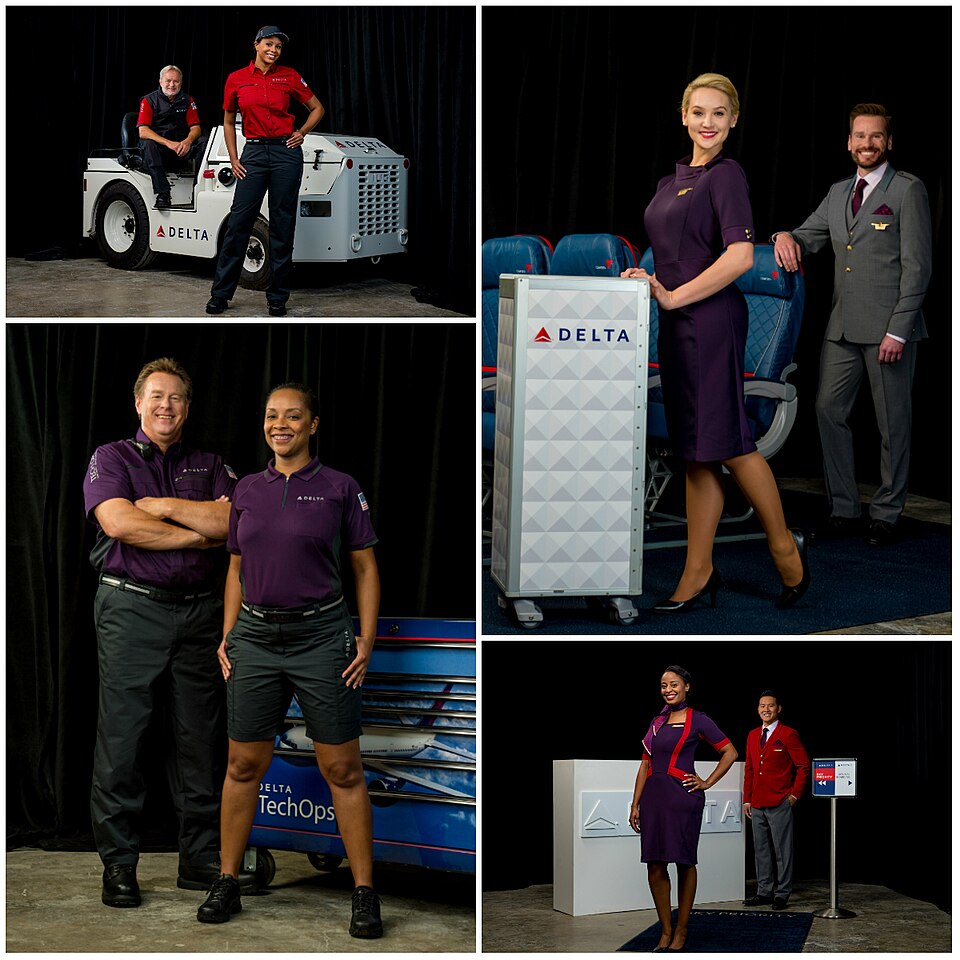
Delta's current uniform began with a piece of colour mixing. New York designer Zac Posen — a red-carpet couturier known for sculptural gowns, and at the time also creative director of Brooks Brothers' women's collection — was commissioned to re-dress the airline, and while experimenting with Delta's red and blue he combined them into a deep purple the whole team fell for. It was named Passport Plum, and it became the centre of the first complete Delta wardrobe redesign in a generation. The collection was unveiled on 18 October 2016 and launched across the airline on 29 May 2018, when some 64,000 employees — flight attendants, airport customer service agents, ramp agents and technicians — reported for work in plum and graphite, with more than a million individual garments distributed in the weeks before.
Posen designed from the job outward. He spent months shadowing employees across the company — serving food in the cabin, working check-in desks, loading bags on the ramp — and a cross-divisional committee of employees fed into every stage. A dedicated team of 1,000 employee ambassadors then wear-tested the garments from December 2016 into early 2017, and the testing changed the clothes: the men's Groundspeed Graphite was darkened, the women's blouse was reworked and cargo pockets were restructured, among many adjustments. "We wanted Delta employees to look glamorous on the job without sacrificing functionality and style," Posen said at the unveiling — glamour being a deliberate word for an airline whose chief executive, Ed Bastian, called the result "classically influenced, yet modern." The garments themselves were manufactured by Lands' End, the Wisconsin outfitter, which also developed the below-wing workwear with design inspiration and colour consultation from Posen. Read more about the designer in our Zac Posen designer profile.

The Components
The Outfit, Piece by Piece
- The Palette
- Five named colours hold the whole system together: Passport Plum, the signature purple; Cruising Cardinal, a rich red; Groundspeed Graphite, the charcoal of the men's suiting; and the accents Skyline Slate and Traveling Thistle, a pale pink-lavender. One palette dresses every work group, so a technician and a flight attendant read as one airline.
- The Signature Dresses
- The women's line is built around dresses: a feminine Passport Plum V-neck signature dress, a wrap dress, and shift dresses with Posen details such as red trim. Airport customer service agents have their own colourblock dress with a Cruising Cardinal accent. Dresses and skirts are worn at professional length, and a warming sweater layers over them.
- Skirt Suit and Separates
- Women who prefer separates choose from a skirt, trousers, blouse, vest and blazer — including an ottoman skirt suit, a swing jacket and a peplum sweater. The blouse carries the collection's signature detail: a winged collar on the Traveling Thistle blouse, its shape inspired by an aircraft wing. Our scarf definition covers the widget-print scarves that finish the look.
- The Men's Three-Piece Suit
- Men wear a three-piece suit in Groundspeed Graphite — jacket, waistcoat and trousers — with a thistle-pink button-up shirt and a widget-printed tie, or dress it down with a Passport Plum crew-neck sweater, a cardigan or a mock turtleneck. Pocket squares repeat the widget motif that runs through the whole collection.
- Accessories
- Posen completed the look rather than stopping at the clothes: widget-emblazoned ties, pocket squares and scarves, sunglasses and leather handbags in plum, and European-style leather gloves. The Delta widget — the airline's triangular logo — is accented throughout the collection.
- Cold Weather and Maternity
- Wool coats cover winter stations, and the collection includes maternity outfits, so the uniform accommodates a full career rather than a single body at a single moment.
- Below the Wing
- For ramp and TechOps staff, Lands' End built workwear in the same colours: a mid-layer sweater, a three-in-one ANSI-rated jacket and a rapid-dry polo shirt, with reflective Delta widgets on high-visibility outerwear — plum polos on the ramp, slate and graphite in the hangar.
- Fabric and Underpinnings
- The cloth is engineered workwear: breathable, antimicrobial, moisture-wicking, stretch, wrinkle-resistant and machine-washable. Delta even partnered with Atlanta shapewear brand Spanx on compression undergarments for women, and issued compression socks to flight attendants — the invisible half of a uniform designed for twelve-hour days.
Each employee received three to five standard-issue garments, with the option to buy more — a wardrobe system, not a single outfit.
Reading the Uniform
Who Is Who: Colour Does the Talking
Delta does not read rank off its cabin crew the way Singapore Airlines does; instead, the Posen system identifies role by colour family and garment, and reserves its sharpest signal for the people passengers need to find first. The widget, the wings pin and the name badge are the common marks; everything else is casting.
| Role | What you see | What it means |
|---|---|---|
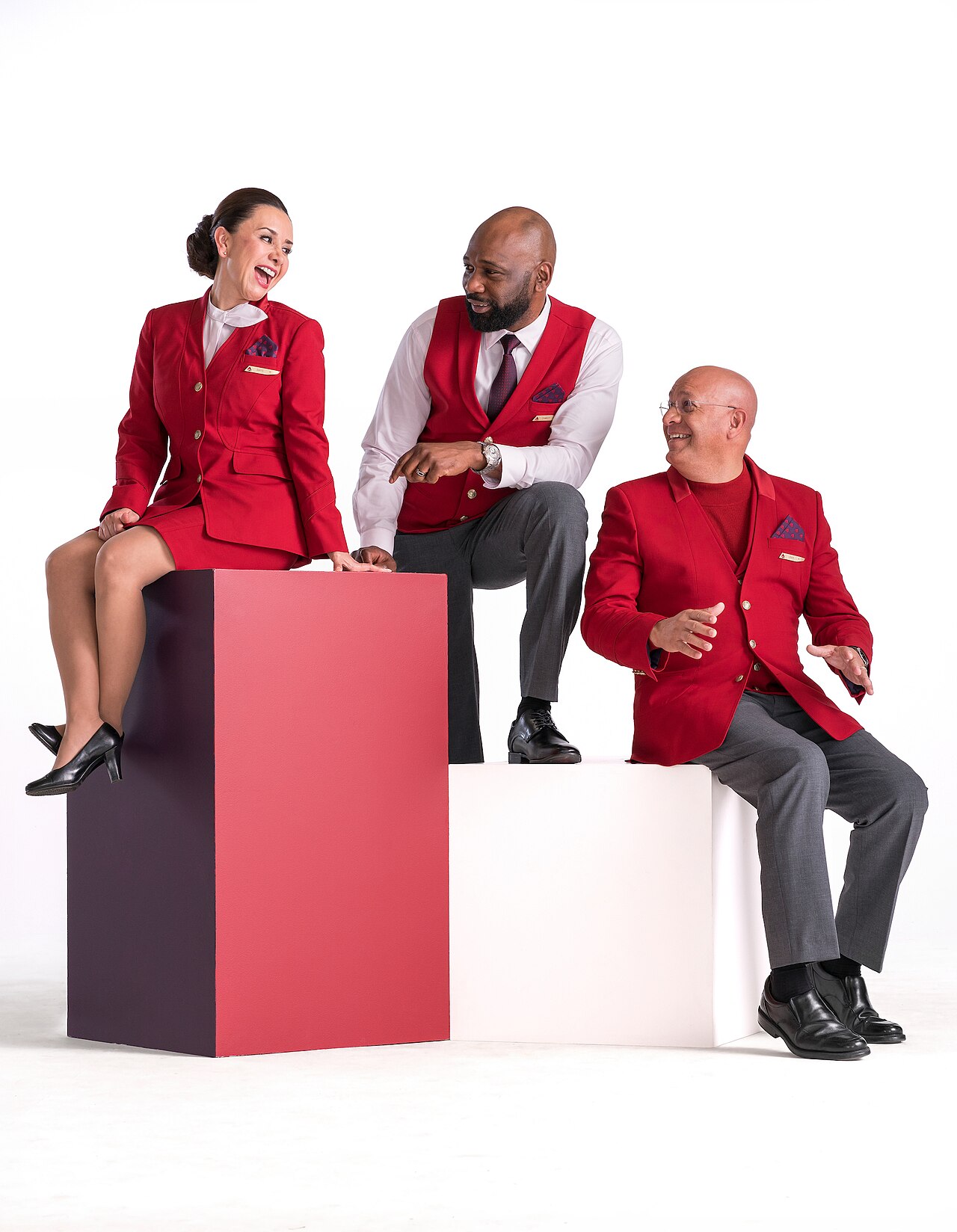
| Red Coats | Head-to-toe Cruising Cardinal red | Delta's roving airport problem-solvers, dressed to be spotted instantly in a chaotic terminal — a Delta tradition since the 1960s that Posen kept and turned up. |
| Flight Attendants | Passport Plum dresses, skirt suits and sweaters; graphite suiting for men | The cabin crew — the plum dress with a widget scarf is the image the whole redesign was built around. |
| Airport Customer Service | Cardinal and plum tailoring, colourblock dresses | Check-in, gates and lounges: the same palette as the cabin, cut for the terminal. |
| Ramp and TechOps | Skyline Slate and graphite workwear, plum polos, reflective widgets | Below-wing staff, in ANSI-rated, high-visibility versions of the same colour story. |
There is one scheduled exception to the palette. Since 2008, Delta crews have worn a pink version of the uniform's red dress during October for the airline's Breast Cancer Research Foundation partnership — a tradition the successor collection formalises with its own named shade, Powerful Pink. On the flight deck, pilots keep the traditional language of the profession — dark tailoring, wings and rank stripes — standing slightly apart from the Posen wardrobe worn by every other work group.
The Colour That Broke the Flag
American airline uniforms run, almost without exception, in the colours of the flag: navy, red and white. Posen's plum was a deliberate break with that — Delta's leadership wanted a look that read as global rather than national, in the company of the world's more daring uniforms. "It was hard to identify Delta employees before, but we want our people to be instantly recognizable," chief executive Ed Bastian said at the launch. In a domestic terminal full of navy suits, the airline in purple is the one you can find — which, for a uniform, is rather the point.
The Rules
Grooming: Published, Precise, Non-Negotiable
Delta is unusual among US airlines in publishing its flight attendant appearance requirements openly, as part of the hiring process — candidates acknowledge them before training, and the full standard is issued after hire. The documented rules are among the strictest of the US majors, and they complete the design: Posen's tailoring assumes a particular presentation underneath it.
Tattoos set the tone: visible tattoos are not permitted at all, and must be fully covered at all times by clothing or by waterproof makeup. Bandages — including adhesive bandages and fabric sleeves — are explicitly ruled out as a covering method. Hair must be a natural-looking hue, dry, clean and neat, kept out of the eyes; hair touching or longer than the shoulder must be pulled completely back and secured in a ponytail, bun or braid. Jewellery is measured like the Singapore system, if less famously: a maximum of two earrings per ear, studs only, no larger than a dime; no hoops; no ear-stretching gauges; and exactly one facial piercing is allowed — a single side-nose piercing with a pinhead stud, in gold, silver, white pearl or clear diamond tones. No other facial or visible body piercings are permitted.
Facial hair must be neatly trimmed with clean, defined lines, sideburns may not pass the bottom of the earlobe, and nails must be clean, uniform in colour, free of neon shades, glitter, adornments and painted designs, and no more than half an inch past the fingertip — a French manicure passes; nail art does not. Makeup itself is not required, and may be worn by any gender; the standard is polish, not paint. Dresses and skirts sit at or below the knee, ties are required with the collared shirts of the men's uniform, and proper undergarments must be worn but never visible. Delta will accommodate dress or appearance requirements arising from religious beliefs unless they create a safety hazard or undue burden — the one flexibility in an otherwise exact code.
Evolution
From Pillbox Hats to Plum — and Back to Navy
Delta's first flight attendant uniforms, in the 1940s, were formal and military in inspiration: a neutral jacket, a less-fitted pencil skirt and a pillbox hat, the standard silhouette of early commercial aviation. The 1950s softened the line — a light-blue uniform with a fitted, ruched-sleeve jacket in the spirit of Dior's New Look — and in 1959 the airline's uniforms were produced under the guidance of Edith Head, Paramount's legendary costume designer. The 1960s brought the era's airline glamour in full: crisp whites, green, yellow, blue and red, gold and resin belts, tricolour hats. The 1970s made the practical revolutions that stuck — trousers became an option for women for the first time, hats stopped being required, and silhouettes flared and pleated with the decade.
The modern era arrived in 2006, when Los Angeles designer Richard Tyler — celebrated for immaculate tailoring and eveningwear — redesigned the above-wing uniform in midnight blue with bold red accents. (Delta's below-wing uniform had last been updated in 2000.) Tyler's look served for twelve years and is still sometimes mistaken for the current one; it is worth stating plainly that Tyler designed the previous uniform, not a new one. Posen's plum replaced it in 2018 — Delta's first above-wing redesign since Tyler, and the airline's boldest colour statement since the 1960s.
The Posen years were not untroubled. After the launch, some employees reported skin and fabric reactions, complaints that became litigation against the manufacturer, Lands' End, and a long-running problem the airline worked through with replacements and accommodations — an episode later coverage describes frankly as prompting a costly rethink. The lesson was engineered into what came next. On 3 November 2025, in its centennial year, Delta unveiled Distinctly Delta: four collections produced by Lands' End — with prototypes developed alongside GPS Apparel by Gap Inc. — returning the airline to its signature Navigator Navy, Boarding Burgundy and Runway Red, with Powerful Pink each October. The Italian house Missoni designs the accessories — scarves, ties and pocket squares — Bombas supplies the socks, every piece meets the STANDARD 100 by OEKO-TEX fabric-safety certification, and an Elite Collection with widget-jacquard patterning unifies Red Coats, Sky Club ambassadors and onboard pursers under one look for the first time. The beloved wrap dress, an employee favourite from the early 2000s, returns. Wear-testing starts in summer 2026, and every Delta employee is due to be in Distinctly Delta in 2027 — at which point Passport Plum, like Tyler's midnight blue before it, becomes history.
The Statement
Why Plum Mattered
Most uniform redesigns are exercises in not offending anyone. Delta's 2018 redesign did the opposite: it gave a century-old airline a colour it could own, in the way Singapore Airlines owns a kebaya print or Emirates owns a red hat. For nearly a decade, a purple dress in an American airport has meant Delta before a single logo is read — recognition no advertising buy can replicate, earned one concourse at a time. That the airline is now retiring the colour for its heritage navy says less about plum's failure than about its success: it proved a US major could treat a uniform as a fashion statement, hire a couturier, and be talked about for it. Posen took his place in the line of designers who have dressed the skies — Balmain, Pucci, Cardin — and Delta's people, who shadowed, tested and amended his clothes before wearing them, got a uniform that was glamorous because it was also, pocket by pocket, theirs. For the country whose dress culture produced both the designer and the outfitter, see our World of Clothing hub.
Airlines refresh their uniforms from time to time, so the details here describe the uniform as documented for this guide — the airline’s own site always carries the latest version.
Common Questions
Common Questions
Who designed the Delta Air Lines uniform?
New York designer Zac Posen. His collection — built around the colour Passport Plum and manufactured by Lands' End — was unveiled in October 2016, wear-tested by 1,000 employee ambassadors, and launched across the airline on 29 May 2018 for some 64,000 employees.
What is Passport Plum?
Passport Plum is the signature colour of Delta's current uniform: a deep purple Zac Posen arrived at by mixing Delta's red and blue. It anchors a five-colour palette with Cruising Cardinal, Groundspeed Graphite, Skyline Slate and Traveling Thistle, and it made Delta's staff instantly recognisable in terminals where most US airline uniforms are red, white and blue.
Who designed Delta's uniform before Zac Posen?
Richard Tyler. The Los Angeles-based designer created the uniform Delta introduced in 2006 for its above-wing staff — flight attendants and airport customer service — in midnight blue with red accents. It was worn for twelve years, until the Posen collection replaced it in 2018. Tyler is sometimes wrongly described as the designer of a new Delta uniform; his collection is the previous one.
What is Distinctly Delta?
Distinctly Delta is the successor collection unveiled on 3 November 2025. Produced by Lands' End with accessories — scarves, ties and pocket squares — by the Italian fashion house Missoni, it returns Delta to Navigator Navy, Boarding Burgundy and Runway Red, adds an Elite Collection for Red Coats, Sky Club ambassadors and pursers, and brings back the wrap dress. Wear-testing begins in summer 2026, with all employees in the new collection in 2027.
Can Delta flight attendants have visible tattoos?
No. Delta's published appearance requirements say visible tattoos are not permitted and must be fully covered at all times, either by clothing or by waterproof makeup. Bandages are explicitly not an acceptable way to cover a tattoo.
Keep Exploring
More to Explore
In This Series
Airline Uniforms by Airline
The series hub — every airline's guide, the designers behind them, and the ones in preparation.
Read ↑World of Clothing
The hub for clothing and dress around the world — Delta's home country, the United States, is covered here.
Read ↑Zac Posen
The designer behind Passport Plum — his career, his house and his red-carpet work, in our designer profile.
Read ↑Go Deeper
Uniforms — Definition
What a uniform is, and why organisations dress their people alike.
Read ↑Scarf — Definition
The widget-print scarves that finish the Delta look, defined.
Read ↑Necktie — Definition
The widget-printed tie of the men's suit, and the necktie's wider history.
Read ↑Blazer — Definition
The tailored jacket at the heart of the above-wing uniform.
Read ↑Keep Exploring
Explore Fashion for Travel
The crew are only half the fashion on a flight — the other half is what the passengers are wearing. Our travel guides cover the traveller’s side of the same subject, and they link back here.
Outfits for Flying
Travel Outfits
What to wear when you are going somewhere — outfit systems built for transit days.
Read ↑Airport Outfits
Security-friendly shoes, cabin layers and the full airport dressing system.
Read ↑What to Wear on a Long Flight
Dressing for the overnight haul — comfort, warmth and arriving presentable.
Read ↑What to Wear When Traveling
The destination-rules guide to building a travel wardrobe that works on arrival.
Read ↑Business Travel Wardrobe Guide
A working wardrobe that travels — suits, wrinkle strategy and boardroom-ready arrivals.
Read ↑Packing & Capsule Wardrobes
Travel Capsule Wardrobe Guide
A small set of pieces that combine into a trip’s worth of outfits.
Read ↑Travel Packing Guide
The complete packing method — lists, order and wrinkle control.
Read ↑How to Pack a Suit
Getting a tailored jacket and trousers across the world without the creases.
Read ↑Carry-On Packing Guide
Everything in one bag — the carry-on-only system, piece by piece.
Read ↑Travel Comfort & Accessories
Search Apparel Search