Airline Uniforms by Airline · Japan
The Japan Airlines Uniform: The Crane, Worn
Every airline puts its logo on the uniform. Japan Airlines went further: it shaped the uniform as its logo — a dress cut to the curve of a crane's neck, with a balloon sleeve the industry had never seen. This is Yasutoshi Ezumi's 2020 uniform for JAL, the programme that also put cabin crew in trousers for the first time and handed the overalls to a sportswear company and the coats to a mountaineering brand.
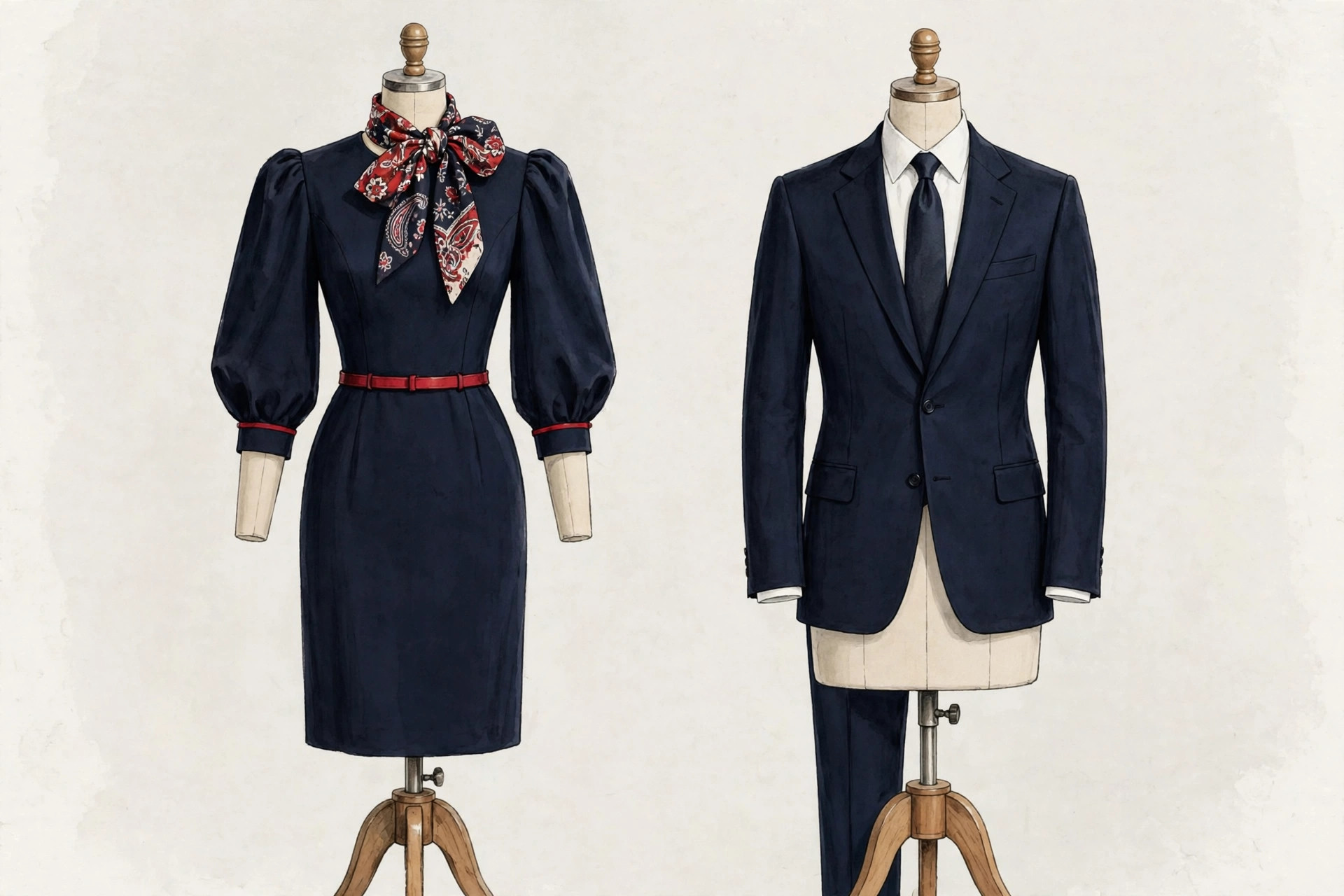
The Design
Ezumi, the Public Survey and “Hybrid Beauty”
The Ezumi uniform began with a question. In early 2019 Japan Airlines asked its customers and fans for comments and opinions on the uniforms its people were wearing. The answers came back with two recurring phrases — stylish and modern — and two practical proposals: attention to sleeves, and the ability for female staff to wear trousers. Both proposals were approved. JAL fed the responses to its designer, a committee of currently uniformed staff made the final selection with cost in view, and the new designs were unveiled in July 2019 and officially adopted in April 2020, in time for the Tokyo Olympic year.
The designer was Yasutoshi Ezumi, creative director of the programme. Born in Hiroshima in 1981, Ezumi graduated from Central Saint Martins in London, worked as an assistant designer for foreign brands, launched his own label in 2010, won Japan Fashion Week's Best Debutant of the Year and DHL Designer awards in 2014, and renamed his brand EZUMi in 2018. For JAL he worked from two stated concepts — Refined Hybrid Beauty and Hybrid Modern Beauty — using what the airline calls a hybrid technique, combining different materials in a single garment, and building the design around the company's two oldest assets: the Tsurumaru crane logo and the corporate colour red.
The programme was also designed as an environmental statement. Timed to the Tokyo 2020 Games, JAL committed the uniforms to the Tokyo 2020 Sustainable Sourcing Code, using recycled materials so that wearing the uniform itself became, in the airline's words, an opportunity for employees to be part of the SDGs movement. And it was a whole-workforce programme, not a cabin makeover: cabin crew, ground staff, pilots, engineers and ground handlers were all redressed at once — the specialists behind those working clothes are part of this uniform's story, and they get their due in the components below.
The Components
The Outfit, Piece by Piece
- The One-Piece Dress
- The centrepiece of the cabin uniform: a three-dimensionally shaped one-piece dress whose silhouette represents the curve of a crane — the bird folded into JAL's logo — finished with a balloon-shaped sleeve, a feature JAL itself notes is rare in the airline industry. The shape was engineered, on customer feedback, so that it does not interfere with the crew's daily work.
- The Trousers Option
- New in 2020: female cabin crew may wear trousers instead of the dress or skirt — the change the public survey asked for, and the most consequential single alteration in the programme. What had been a skirt-only uniform became a choice.
- Scarf and Apron
- Scarves and aprons are styled differently for each JAL Group airline, so the group carriers share one uniform with individual accents. The scarf — tied, as JAL's own demonstrations show, into a soft floral knot — is the cabin uniform's signature flourish; our scarf definition traces the garment behind it.
- The Ground Staff Dress and Scarf
- Ground staff wear a modern, functional one-piece dress cut with movement in mind, with a longer scarf carrying flowers drawn by Ezumi himself in more than twenty colours. Lounge staff are distinguished by a subtle pink-beige jacket, reception staff by a cream-beige jacket.
- The Flight Crew Uniform
- A unisex design evolved from the previous model with changes to improve movement. For the first time, a uniform was designed specifically for female pilots: a single-button jacket, with an Ezumi scarf in an origami crane motif that may be worn in place of the necktie.
- Engineering Coveralls — Descente
- The engineering staff coverall was designed by Descente Japan, the sportswear maker, and built like performance gear: stylish, logo-bearing and highly functional. Our coverall definition explains the garment class Descente was working in.
- The Outdoor Coats — mont-bell
- Over the coveralls, outer coats by mont-bell, the Japanese outdoor brand, engineered for severe weather — heavy rain and blizzards. The engineering coat is dark, in JAL's words depicting “the determination to achieve safe and secure flights”; the ground-handling coat is an energetic red.
- Ground Handling and the Summer Polo
- Ground-handling gear, also by Descente, comes in versions matched to different working styles — and the programme introduced a polo shirt uniform for the severe heat of summer, a working-clothes concession no fashion designer was asked to make.
- Kariyushi — Okinawa's Own Uniform
- For summer in Okinawa, JAL's island subsidiaries wear Kariyushi, the traditional Okinawan summer shirt, designed by Ezumi with five Okinawan flowers including the deigo in brilliant colours — all made in Okinawa, expressing the islands' omotenashi hospitality. In 2020 the Kariyushi was extended to pilots for the first time.
Reading the Uniform
One Group, Many Roles — Read the Details
JAL's system does not grade cabin rank by colour. What it encodes, precisely, is role and workplace — a passenger who learns the code can read an airport at a glance.
| Who | How to read it |
|---|---|
| Cabin crew | The crane-curve one-piece dress (or the trousers option) with balloon sleeves, group-airline scarf and apron, and corporate red accents. |
| Ground staff | A movement-cut one-piece dress with the long, twenty-colour floral scarf drawn by Ezumi. |
| Lounge and reception staff | Jacket colour is the tell: pink-beige for the lounge's formality, cream-beige for reception. |
| Flight crew | The unisex pilot uniform; female pilots by the single-button jacket and the option of the origami-crane scarf in place of a tie. |
| Engineering staff | Descente performance coveralls under a dark mont-bell weather coat. |
| Ground handling staff | Descente work gear in job-matched versions, a red mont-bell coat, and the summer polo in hot weather. |
| Okinawa-based crews (summer) | The Kariyushi shirt — five Okinawan flowers, Ezumi-designed, Okinawa-made — now including pilots. |
Within the cabin, differentiation runs the other way: not between ranks but between airlines, with each JAL Group carrier's scarves and aprons styled its own way under one shared silhouette. Our apron definition covers the service garment that carries part of that code.
The Men’s Uniform
Dark Tailoring in the Same Language
Male cabin crew wear the programme's tailored counterpart to the dress: a dark, slender suit in the same corporate language of deep tones and red accents, cut — as the previous generation's release put it, in words the Ezumi programme kept as its brief — to allow easy movement of arms and legs while holding an elegant silhouette. Male pilots wear the unisex flight-crew uniform described above. The men's story of this programme is really the working story: it is among the men-heavy engineering and ground-handling teams that the Descente coveralls, the mont-bell storm coats and the summer polo did their quiet revolution, dressing ramp work with the same design seriousness as the cabin.
The Crane That Came Back
The Tsurumaru — tsuru, crane; maru, circle — is a red crane with its wings spread, folded into a ring. It was created in 1958, as JAL prepared for the jet age, with a brief that mixed speed with traditional Japanese design, and in Japanese culture the crane carries wishes of longevity and good fortune. JAL retired it in the 2000s for a modern sun-arc identity — then, rebuilding after bankruptcy, brought the crane back in 2011 as the symbol of the airline's return. Ezumi's uniform completes the homecoming: the crane is no longer only painted on the tail and printed on the scarf. Cut into the curve of the dress itself, it is worn.
The Rules
Grooming and the New Freedoms: What Is Publicly Documented
JAL does not publish a grooming manual, and this guide reports only what is on the public record. The best-documented change is structural rather than cosmetic: the trousers option of April 2020, granted after the public survey proposed it, ended the skirt-only rule for female cabin crew — a change widely reported in Japan in the context of the wider debate about women's workplace dress codes, and one JAL built into the uniform rather than bolting on.
For makeup and presentation, JAL's own travel magazine has put two serving flight attendants on the record about the house style: the key, in their words, is to be modest and elegant — “not too flashy, but not so unobtrusive that it makes a good impression” — with technique aimed at a clean look that survives flights of more than ten hours: careful moisturising skin preparation, primer-led base makeup, and application pressed in with a sponge so the finish holds in dry cabin air. That is the documented face of the uniform: restrained, durable, and designed — like the dress — to keep working long after take-off.
Evolution
From Hanae Mori's Miniskirt to the Crane Curve
Hanae Mori defined JAL's classic era, designing three consecutive cabin uniforms. The first, worn 1967–1970, was sky blue — blazer, knee-length skirt, white gloves and a rounded sky-blue hat. The second, from 1970, became one of the famous uniforms of the jet age: a dark blue mini-dress worn with a glossy red belt whose disc-like buckle echoed the rising sun of the Japanese flag, with dark blue shoes, a two-tone scarf and a wide rounded hat; a surviving dress, held by the SFO Museum, is recorded as polyester knit with a back zip and the logotype embroidered at the breast. Mori's third generation followed from 1977 into the late 1980s. JAL's own corporate history marks the renewals plainly — October 1970, for instance, is entered as “JAL renews the female cabin attendants uniform (designed by Hanae Mori / dark blue one-piece dress)” — a designer credited in the company chronicle like an aircraft type.
The uniform Ezumi replaced was itself a considered design: the 2013 Keita Maruyama programme, unveiled in December 2012 for some 26,700 staff as the rebuilt JAL relaunched its brand. Maruyama set cabin crew in a noble dark blue with JAL red linings at the women's cuffs and jacket hem and the men's pocket lip, a one-piece dress with half-length sleeves, white collar and cuff accents, an outlined breast pocket and a red belt; group airlines were standardised and told apart only by scarf colour, and pilots kept traditional black double-breasted suits with gold arm stripes. Ezumi kept that programme's discipline — its dark base, its red, its group standardisation — and changed its shape, its materials and its rules: hybrid fabrics, a crane for a silhouette, recycled content, and trousers for anyone who wanted them.
Read whole, the JAL line runs from couture gesture (Mori's miniskirt as national symbol) through brand reconstruction (Maruyama's standardised navy) to something newer: a uniform designed by consultation, built partly from recycled materials, and extended with genuine specialists — a sportswear house for the hangar, a mountaineering house for the ramp. The crane, meanwhile, has outlasted every designer: drawn in 1958, dropped, restored, and now sewn into the very cut of the clothes.
The Icon
Why the Crane Curve Matters
Ezumi's uniform is the fullest expression in this series of the modern idea of a uniform programme: not a dress but a system, consulted on in public, built for sustainability targets, and specialised by trade all the way down to a summer polo for the ramp. It is also a lesson in how much identity a silhouette can carry. Singapore's kebaya says it with cloth and colour; JAL says it with a curve — the shape of the bird Japan has folded into paper, painted onto tails and wished upon for a thousand years, translated into the line of a working dress. For the country behind both the designer and the dress, see our Japan clothing industry page.
Airlines refresh their uniforms from time to time, so the details here describe the uniform as documented for this guide — the airline’s own site always carries the latest version.
Common Questions
Common Questions
Who designed the Japan Airlines uniform?
Japanese designer Yasutoshi Ezumi, as creative director. His cabin and ground designs were unveiled in July 2019 and officially adopted in April 2020. Within the same programme, Descente Japan designed the engineering and ground-handling coveralls and mont-bell designed the outdoor coats.
What is distinctive about the JAL cabin crew dress?
Its silhouette: a three-dimensionally shaped one-piece dress whose curve represents the curve of a crane — the bird in JAL's Tsurumaru logo — finished with a balloon-shaped sleeve that JAL itself calls rare in the airline industry. Corporate red accents and the crane mark complete the design.
Can Japan Airlines cabin crew wear trousers?
Yes — the option arrived with the Ezumi uniform in April 2020. JAL had asked customers and fans for their views in early 2019; alongside calls for a stylish, modern design, the proposal that female staff be able to wear trousers was made and approved, and it was built into the new uniform from the start.
What is the Tsurumaru?
JAL's corporate logo: a red crane with outstretched wings folded into a circle — tsuru means crane and maru means circle. Created in 1958 for the jet age, it was retired in the 2000s and restored in 2011. Ezumi's uniform works the crane into the clothes themselves, from the dress silhouette to the origami-crane scarf offered to female pilots.
Who designed JAL's earlier uniforms?
Most famously Hanae Mori, who designed three consecutive generations between 1967 and 1988, including the 1970 navy mini-dress with its red belt. The uniform Ezumi replaced was the 2013 design by Keita Maruyama — dark blue tailoring with red linings, standardised across the JAL Group.
Keep Exploring
More to Explore
In This Series
Airline Uniforms by Airline
The series hub — every airline’s guide, the designers behind them, and the ones in preparation.
Read ↑Japan Clothing Industry
The airline’s home country in the World Clothing Industry directory.
Read ↑Go Deeper
Uniforms — Definition
What a uniform is, and why organisations dress their people alike.
Read ↑Scarf — Definition
The scarf defined — from the cabin crew's floral knot to the pilot's origami crane.
Read ↑Coverall — Definition
The one-piece working garment Descente redesigned for JAL's engineers, defined.
Read ↑Apron — Definition
The service apron defined — the garment that carries each JAL Group airline's own styling.
Read ↑Keep Exploring
Explore Fashion for Travel
The crew are only half the fashion on a flight — the other half is what the passengers are wearing. Our travel guides cover the traveller’s side of the same subject, and they link back here.
Outfits for Flying
Travel Outfits
What to wear when you are going somewhere — outfit systems built for transit days.
Read ↑Airport Outfits
Security-friendly shoes, cabin layers and the full airport dressing system.
Read ↑What to Wear on a Long Flight
Dressing for the overnight haul — comfort, warmth and arriving presentable.
Read ↑What to Wear When Traveling
The destination-rules guide to building a travel wardrobe that works on arrival.
Read ↑Business Travel Wardrobe Guide
A working wardrobe that travels — suits, wrinkle strategy and boardroom-ready arrivals.
Read ↑Packing & Capsule Wardrobes
Travel Capsule Wardrobe Guide
A small set of pieces that combine into a trip’s worth of outfits.
Read ↑Travel Packing Guide
The complete packing method — lists, order and wrinkle control.
Read ↑How to Pack a Suit
Getting a tailored jacket and trousers across the world without the creases.
Read ↑Carry-On Packing Guide
Everything in one bag — the carry-on-only system, piece by piece.
Read ↑Travel Comfort & Accessories
Search Apparel Search