Airline Uniforms by Airline · Hong Kong
The Cathay Pacific Uniform by Eddie Lau
Red, a standing collar, and a blouse patterned with the brushwing: Hong Kong couturier Eddie Lau has designed Cathay Pacific’s uniform three times — 1999, 2004 and 2011 — and the third generation, rolled out to 13,000 staff from 8 July 2011, is still the uniform today. This guide covers Lau’s story, the components for women and men, the burgundy code that marks seniority, and ten uniforms’ worth of evolution.
The Design
Eddie Lau: The Tailor’s Apprentice Who Dressed Hong Kong
Most airline uniforms are designed by fashion houses; Cathay Pacific’s is designed by a man who learned clothing from the needle up. Eddie Lau was apprenticed at eleven years old to a Shanghainese master tailor in Tsim Sha Tsui’s Mirador Mansion, saved enough by his early twenties to study at London’s Central Saint Martins, and in 1978 became the first Hong Kong designer to show at London Fashion Week. His 1979 collection “East is Red” — Eastern silhouettes cut with Western tailoring — made his international reputation, and to the Hong Kong public he is best known for dressing its icons: the extravagant stage costumes he created for Anita Mui, and clothes for Roman Tam and Leslie Cheung. “As a couturier, the key is to read a person like a book,” he says.
Cathay Pacific first commissioned Lau in 1999, for the uniform that still underlies today’s. Built on the airline’s then slogan, “The Heart of Asia,” it adopted red as the dominant colour, with a raised, standing collar whose line echoed a plane taking off — ideas, the Hong Kong Memory project records, that met with an enthusiastic response from the client. Lau renewed the design in 2004, and again in 2011, when the current generation was unveiled at a Hong Kong gala and rolled out from 8 July 2011 to 13,000 staff worldwide — more than 8,000 cabin crew and some 4,000 airport, reservations and cargo staff. It was the airline’s tenth uniform, two years in development, consulted on with more than 100 Marco Polo Club members and 1,000 uniformed staff, and put through a six-week wearer trial before launch.
Lau’s principle, stated in Cathay Pacific’s own profile of him, is that “before beauty and impeccable tailoring, a garment must never burden the person wearing it.” The 2011 design is that principle applied: an evolution, not a rupture — the airline kept red, the brushwing, the standing collar and cuffs and the long skirts, because each Cathay uniform “has to last a minimum of 10 years.” This one has now lasted well beyond that.
The Components
The Outfit, Piece by Piece
- The Red Jacket
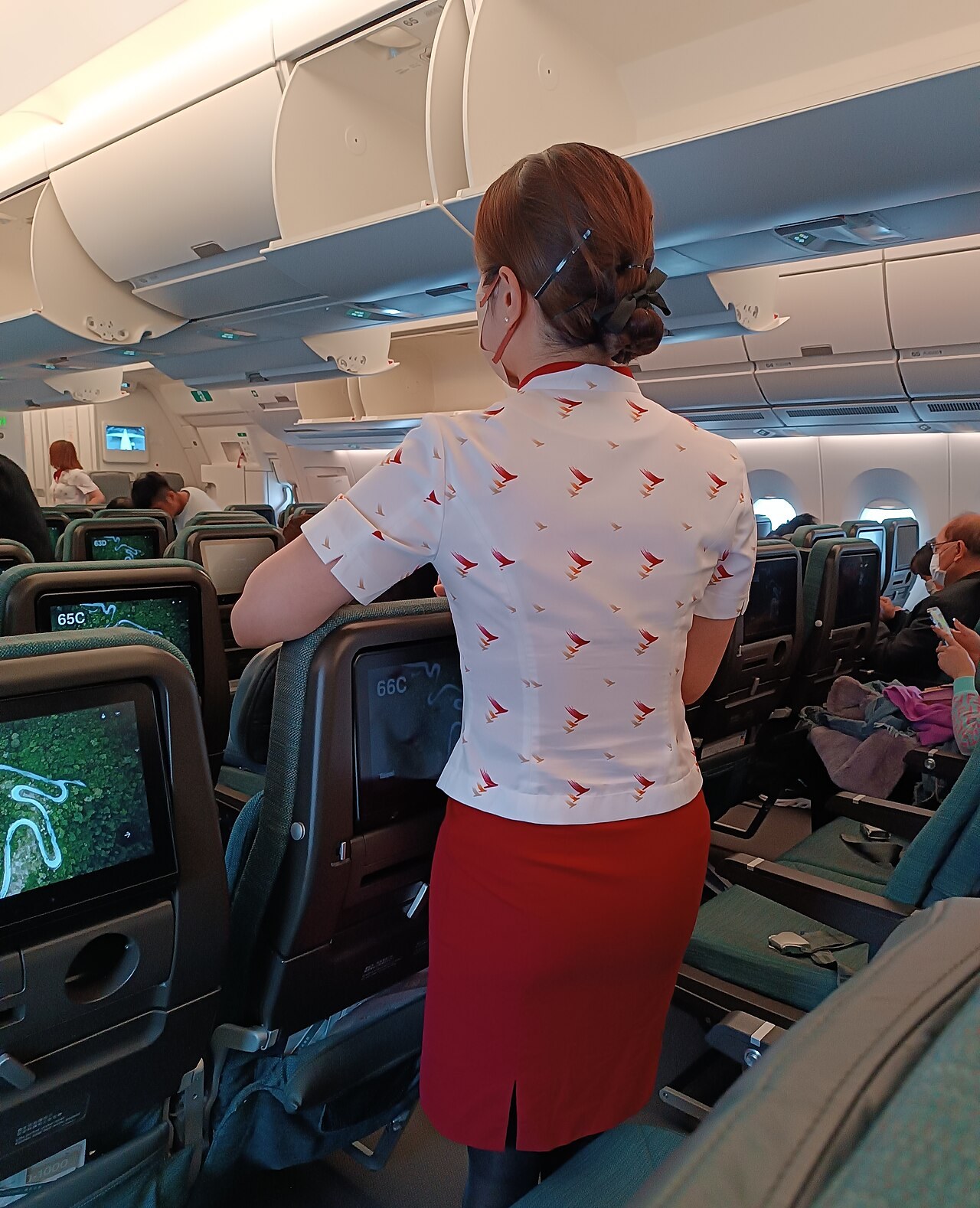
- The women’s signature: a fitted red jacket with an open collar and a brushwing badge. For 2011 Lau shortened it and added vents, after watching crew work on real flights, so it moves when they bend and stretch. The 2011 red itself was new — a rose red, chosen, in the Hong Kong Memory account, to represent love.
- The Brushwing Blouse
- A white blouse patterned all over with the brushwing — the calligraphy-stroke emblem Cathay adopted in the 1990s — worn under the jacket and as the in-cabin layer without it. The 2011 blouse is made in a more comfortable stretch fabric; mechanical-stretch cloth was introduced across a number of uniform items that year for ease of movement.
- The Skirt
- A red skirt whose single front slit Lau replaced with two slits at the back — the change was made specifically so attendants could move more comfortably while working. Senior frontline staff wear the long-skirt version, one of the signature elements the airline lists as retained across generations.
- Standing Collar and Cuffs
- The uniform’s Chinese-tailoring signature: the raised collar, present since Lau’s 1999 design, and matching cuffs. It is the detail that ties the uniform to Hong Kong’s own dress traditions — the same family of collars found on the qipao — rather than to the Western lounge suit.
- The Service Apron
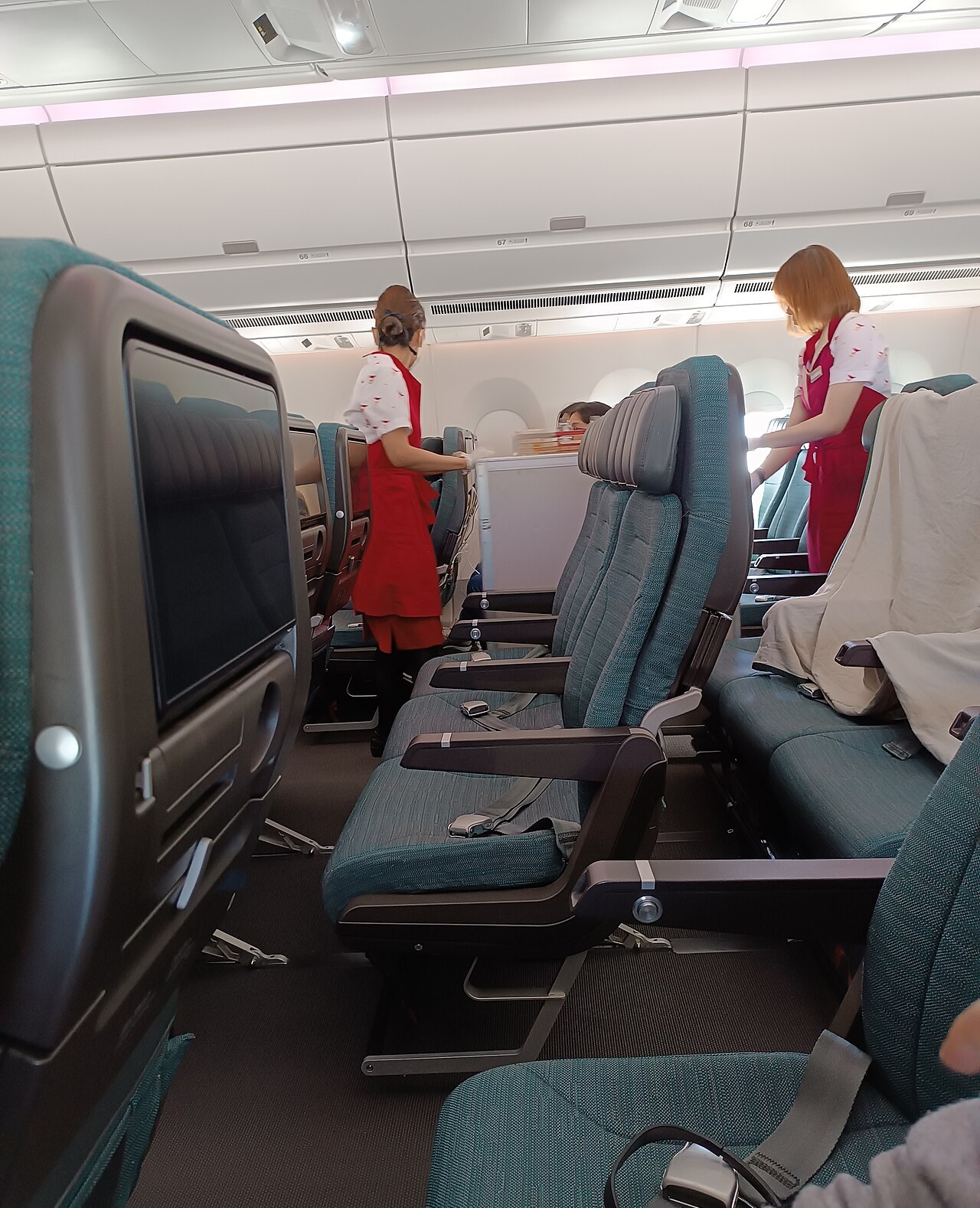
- A redesigned apron was among the new elements of 2011: in service, crew wear the red apron over the brushwing blouse, as the photograph below shows — the uniform’s working dress, distinct from its airport dress of jacket and skirt.
- The Men’s Waistcoat and Tunic Jacket
- Male cabin crew wear olive-toned waistcoats with striped ties, and a stand-collar jacket inspired by the Zhongshan — the Chinese tunic suit — Lau’s deliberate move beyond conventional Western tailoring for the men’s side (see the men’s section below).
Reading the Uniform
Burgundy, Champagne and the Senior Grades
Cathay’s rank code is a darkening and gilding of the standard red. The base uniform — red jacket, white brushwing blouse — is the flight attendant’s. Promotion changes the palette:
| Palette | Worn by | Reading |
|---|---|---|
| Rose red jacket, white brushwing blouse | Flight attendants | The standard 2011 uniform — the red the airline calls its brand heritage colour. |
| Burgundy jacket, champagne jacquard blouse | Senior pursers | The senior cabin grade is distinguished, in the airline’s words, by burgundy jackets and champagne jacquard blouses — red deepened, blouse gilded. |
| Champagne gold, black and red | Inflight service managers | For the most senior cabin role, Lau designed to a palette of champagne gold, black and red — see the darkband below for his reasoning. |
Length speaks too: long skirts are the senior frontline staff’s version of the uniform, one of the signature elements Cathay lists as carried through every Lau generation. Between palette and hemline, an experienced passenger can read the cabin’s hierarchy at a glance — without a single stripe or bar.
The Men’s Uniform
An Olive Waistcoat and a Zhongshan Collar
Lau refused to give the men a plain Western suit. For the 2011 generation he built the male cabin uniform around an olive-green waistcoat — Hong Kong Memory called the colour choice “truly refreshing” when the related tunic coat appeared — worn with a striped tie, and a stand-collar jacket inspired by the Zhongshan suit, the Chinese tunic that is the region’s own answer to formal tailoring. Male crew had already worn mandarin-collar jackets in the 2004–2010 generation; the 2011 design kept that Eastern line and paired it with the waistcoat that is now the men’s most recognisable piece.
The result is a crew that matches without mirroring: the women’s red and brushwing print on one side of the aisle, olive, stripes and a standing collar on the other — two dialects of the same Hong Kong tailoring language, both unmistakably Lau.
Champagne, Caviar and Roses
Asked about the inflight service managers’ palette, Lau explained it like a menu: champagne gold, black and red are “the essence of champagne, caviar and roses” — the colours of premium hospitality itself. “Black is hard to work with, but elegant,” he says. “First class calls for something that can genuinely hold the room.” It is a couturier’s way of thinking about rank: not stripes for the most senior person in the cabin, but the colours of the finest things the cabin serves.
The Rules
Grooming and the Skirt Rule’s Long Goodbye
Cathay Pacific does not publish its grooming manual, so the public record of its uniform rules is mostly the record of one famous rule and its ending. From the airline’s founding in 1946 until 2018, all frontline female employees — flight attendants and ground agents alike, at Cathay Pacific and sister airline Cathay Dragon — were required to wear skirts. The uniform’s presentation ideal was part of the brand: polished, made-up, skirted. Crew unions campaigned against the skirt-only rule from 2014, arguing the image was dated; the Cathay Pacific Flight Attendants Union’s chairwoman called the stereotype “very old-style already: looking pretty, full make-up and wearing a skirt.”
In March 2018 the airline agreed that at the next uniform refresh, female employees would have the option of wearing trousers instead of skirts — “there is no progress without change,” its spokesman said. Because the change was tied to a refresh of the Lau uniform rather than made immediately, the red skirt remained the standard issue for years after the agreement; the episode is a useful reminder that at Cathay, uniform change moves at the pace of the uniform cycle itself — a design life the airline sets at a minimum of ten years. What the 2011 launch documentation does show is the practical side of the rules: the uniform was designed for varied climates, cultural and religious sensitivities, and health, safety and security requirements across the network, and wearer-trialled for six weeks before a single passenger saw it.
Evolution
Ten Uniforms: From Air Force Blue to Lau Red
Cathay Pacific was founded in 1946, and its first uniform was military in spirit: for women a double-breasted wool gabardine jacket in Air Force blue with an A-line skirt and a box hat; for men a blue double-breasted jacket with wide peaked lapels and brass buttons; pilots in Eisenhower jackets borrowed from the US Army. Red arrived in 1962 — a rose-hued jacket and pencil skirt chosen for warmth, confidence and its auspicious place in Chinese culture, with frog fastenings on the blouse and cheongsam-inspired slits in the skirt. The jet-age decades swung with fashion: scarlet minidresses in 1969, then a run of Paris houses — Balmain’s wave-print “Tung Hoi” blouse in the 1970s, Hermès’s tailplane-print blouse in the 1980s, Nina Ricci’s padded power suit in the 1990s.
Read in sequence, those Paris decades are a fashion history of the late twentieth century told in one airline’s wardrobe: the minidress when hemlines rose, the printed blouse when pattern was everything, the power suit when shoulders did the talking. Each was right for its moment and dated by the next — which is precisely the problem the Lau commissions set out to solve. A flag carrier that changes its uniform with every fashion cycle spends a fortune and keeps no face; Cathay’s answer, from 1999 on, was a Hong Kong designer with a permanent identity to sell.
The Lau era brought the swings to an end by fixing an identity. 1999 set the template — red, the raised collar, the brushwing-patterned blouse — as the airline leaned into its Hong Kong heritage at the millennium. 2004 sharpened the tailoring and gave male crew their mandarin-collar jackets. 2011 refined rather than replaced: a slimmer silhouette and subtler palette, rose red used for the first time on the women’s uniform, purple giving way to champagne and black, the jacket shortened with vents, the skirt’s front slit becoming two at the back, and stretch in the blouse — every change traced to watching crew actually work. That the 2011 uniform is still in service, a decade and a half on, makes it the longest-lived expression of the Lau idea — and means the next refresh, whenever it comes, will also finally deliver the trousers option agreed in 2018.
The Icon
Hong Kong, Worn
Every element of this uniform points home: a Hong Kong designer, trained in the city’s tailoring trade; a collar from Chinese dress; a brushwing drawn like a calligraphy stroke; a red that is both brand colour and cultural good fortune. Cathay calls its crew the first and last thing a passenger sees on a flight, and Lau’s uniform is built to make that sight say one thing — Hong Kong, premium and self-assured. Three generations from one designer is almost unheard of in aviation, where uniforms are usually competitions won and lost. It worked because Lau designed the way he was trained — as a tailor first. The ten-year minimum life Cathay sets each uniform rewards exactly that: clothes cut to be worn, altered and repaired for a decade, not a look assembled for a launch photograph. In an industry of navy suits, it remains one of the few uniforms a passenger can name from across a terminal. For the city behind it, see our Hong Kong clothing industry page.
Airlines refresh their uniforms from time to time, so the details here describe the uniform as documented for this guide — the airline’s own site always carries the latest version.
Common Questions
Common Questions
Who designed the Cathay Pacific uniform?
Hong Kong couturier Eddie Lau. He has designed three generations of the uniform — unveiled in 1999, 2004 and 2011 — and the 2011 generation is the basis of the uniform worn today. Lau is known for his “East is Red” collection and the stage costumes he created for Anita Mui.
When was the current Cathay Pacific uniform introduced?
It was rolled out from 8 July 2011 to 13,000 staff worldwide, including more than 8,000 cabin crew. It is the airline’s tenth uniform, took two years to develop, and was designed to last a minimum of ten years.
What is the brushwing on the Cathay Pacific uniform?
The brushwing is Cathay Pacific’s emblem — a single calligraphy-like stroke suggesting a wing in flight. On the uniform it appears as the all-over print of the white blouse, as a badge on the red jacket, and in the line of the standing collar.
How can you tell a senior Cathay Pacific crew member?
By colour and length. Senior pursers wear burgundy jackets with champagne jacquard blouses instead of the standard red and white, inflight service managers wear a champagne gold, black and red palette, and senior frontline staff wear the long-skirt version of the uniform.
Can Cathay Pacific female crew wear trousers?
Not yet as standard issue. Female frontline staff were required to wear skirts from 1946; in March 2018, after a union campaign, the airline agreed to add a trouser option at the next uniform refresh. The 2011 uniform remains in service, so the skirt is still the standard.
Keep Exploring
More to Explore
In This Series
Airline Uniforms by Airline
The series hub — every airline’s guide, the designers behind them, and the ones in preparation.
Read ↑Hong Kong Clothing Industry
The airline’s home country in the World Clothing Industry directory.
Read ↑Go Deeper
Uniforms — Definition
What a uniform is, and why organisations dress their people alike.
Read ↑Traditional Dress — Qipao & Hanfu
The Chinese dress traditions behind the uniform’s standing collar and cheongsam details.
Read ↑Suit — Definition
The tailored suit — the frame Lau’s men’s waistcoats and tunic jackets reinterpret.
Read ↑Keep Exploring
Explore Fashion for Travel
The crew are only half the fashion on a flight — the other half is what the passengers are wearing. Our travel guides cover the traveller’s side of the same subject, and they link back here.
Outfits for Flying
Travel Outfits
What to wear when you are going somewhere — outfit systems built for transit days.
Read ↑Airport Outfits
Security-friendly shoes, cabin layers and the full airport dressing system.
Read ↑What to Wear on a Long Flight
Dressing for the overnight haul — comfort, warmth and arriving presentable.
Read ↑What to Wear When Traveling
The destination-rules guide to building a travel wardrobe that works on arrival.
Read ↑Business Travel Wardrobe Guide
A working wardrobe that travels — suits, wrinkle strategy and boardroom-ready arrivals.
Read ↑Packing & Capsule Wardrobes
Travel Capsule Wardrobe Guide
A small set of pieces that combine into a trip’s worth of outfits.
Read ↑Travel Packing Guide
The complete packing method — lists, order and wrinkle control.
Read ↑How to Pack a Suit
Getting a tailored jacket and trousers across the world without the creases.
Read ↑Carry-On Packing Guide
Everything in one bag — the carry-on-only system, piece by piece.
Read ↑Travel Comfort & Accessories
Search Apparel Search