Airline Uniforms by Airline · Japan
The ANA Uniform: A Blue Line by Prabal Gurung
From the front, it is a quiet uniform: a light grey jacket, a charcoal skirt, a floral scarf. From behind, it is unmistakable — a single bold line of ANA blue running down the back. This is the tenth-generation uniform of All Nippon Airways, the first in the airline's history designed outside Japan, and the story of how a New York couturier restyled one of the world's most service-obsessed airlines.
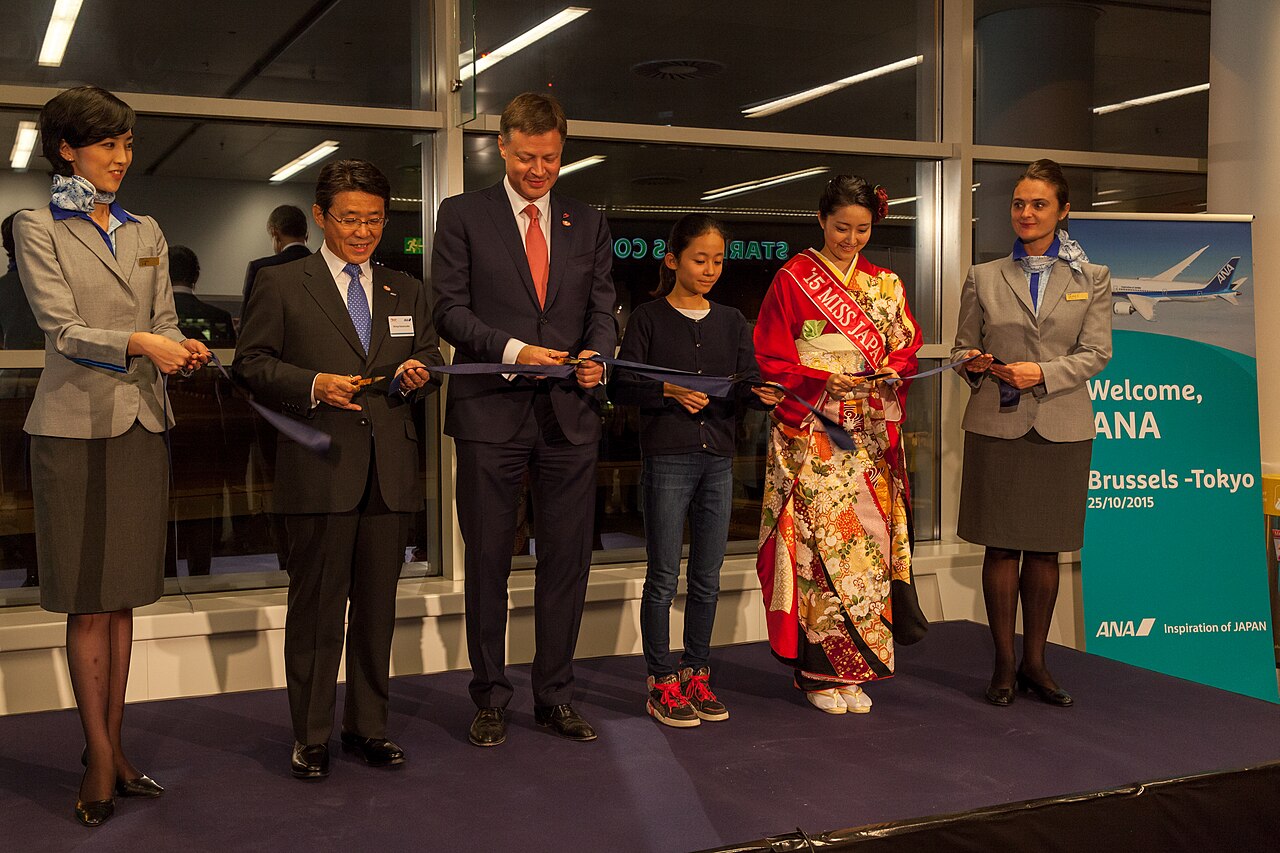
The Design
A First Foreign Designer, for the Sixtieth Anniversary
ANA announced the commission in May 2013, as the group marked its sixtieth anniversary and moved to a new corporate structure: the new uniforms for cabin attendants and ground staff would be designed by Prabal Gurung, the Nepal-born, New York-based designer whose clothes had been worn by First Lady Michelle Obama, the Duchess of Cambridge and Lady Gaga. It was a deliberate break with six decades of practice. Every previous ANA uniform had come from Japanese designers — Jun Ashida, Issey Miyake and Atsuro Tayama among them — and ANA's own uniform history records the point plainly: with Gurung, a foreign designer was appointed for the first time; for the ground staff line it adds that this was the first time a Japanese airline had appointed a foreign uniform designer at all.
The designs were unveiled in Tokyo on 24 April 2014 and entered service in 2015 — the tenth generation of ANA cabin uniforms and the seventh for ground staff — worn by more than 13,000 employees across the flight attendant, ground and lounge teams. Gurung described his aim in the airline's release: “ANA pays such close attention to detail and I wanted to celebrate this throughout the designs. My objective was a balance of elegance and timelessness with a modern, fresh appeal.” He also set a second objective that shapes everything about how the uniform is worn: that crew members should be able to “express their individuality while representing the brand well” — an unusual brief for a Japanese uniform programme, and one the components below put into practice. ANA's president and CEO Osamu Shinobe called the result “beautifully designed uniforms” that would present “a rejuvenated and energetic image.” Contemporary coverage summed up the design keywords as joy, passion and excitement — delivered, characteristically, inside a very disciplined grey suit.
The design language is ANA's own brand aesthetic, translated into cloth: clean, modern and minimalist, with the airline's trademark blue used sparingly and therefore unmistakably. Where earlier ANA generations had worn blue as the main colour — sometimes head to toe — Gurung demoted it to an accent, and in doing so made it more recognisable than ever.
The Components
The Outfit, Piece by Piece
- The Jacket
- A light grey tailored jacket, worn over the blouse. Its party trick is at the back: a bold blue line in ANA's corporate colours runs down the back of the jacket, with blue striping carried onto the sleeves, so the uniform reads as ANA from every angle — including from behind, across a crowded terminal.
- Skirt and Trousers
- Charcoal skirts and trousers form the base of the uniform. The skirt carries the blue line down its back as well, continuing the jacket's stripe into a single vertical signature.
- The Blouses
- Cabin attendants choose from three blouse styles, worn with the jacket or with a vest. Blouses come in blue or pink — the wearer's choice — a small, deliberate pocket of individuality inside a standardised uniform. Ground staff blouses have their own character: three-quarter sleeves with a feminine tweed pattern.
- The Scarf
- A brightly coloured scarf in modern Japanese flower patterns, matched to the blouse colour. The scarf is the uniform's softening device — the point where Japanese floral tradition meets the grey tailoring — and, with the apron, one of the pieces Gurung created to differentiate the uniform families. Our scarf definition covers the garment's long history as a uniform accent.
- The Service Apron
- For cabin service, crew add an apron in the same modern Japanese flower patterns — dress-like in cut for ground staff, brightly patterned for cabin crew. It protects the tailoring during meal service and gives the working phase of the flight its own, softer look.
- The Vest Option
- Both cabin and ground uniforms can be worn with a vest in place of the jacket. The ground staff vest has a round collar and tucked waist pockets, cut for a softer impression than the jacket's tailoring.
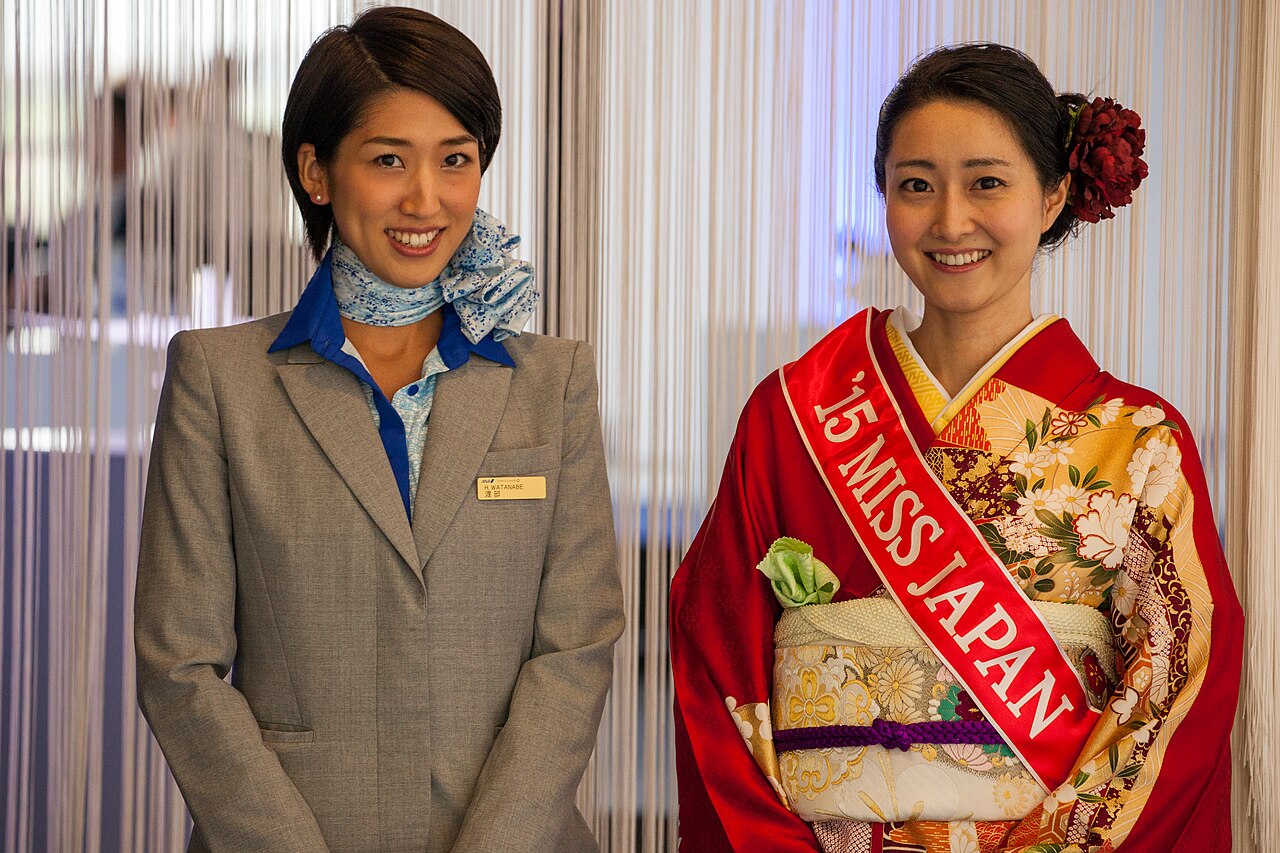
The pairing in that photograph is a useful reminder: the floral scarf is ANA's nod to a much older Japanese dress culture. Our kimono definition and traditional dress guide to the kimono trace the garment tradition the uniform's flowers quietly salute.
Reading the Uniform
Roles at a Glance — No Rank Colours
ANA does not run a colour-coded rank ladder of the kind Singapore Airlines uses. Seniority in the cabin is a matter of titles and insignia rather than a different dress, and the whole Gurung system is deliberately unified: one grey-and-charcoal family across the airline. What the uniform does tell you is where a person works. Gurung used the scarves, aprons and small construction details to differentiate the uniform families while keeping the overall look single and recognisable.
| Family | How to read it |
|---|---|
| Cabin attendants | Light grey jacket or vest with the blue line down the back of jacket and skirt; three blouse styles in blue or pink with a matching floral scarf; floral apron added for cabin service. |
| Ground staff | The same grey family and blue line, with distinguishing construction: jackets cut with extra pockets — a deliberate difference from the flight attendant jacket — tweed-pattern three-quarter-sleeve blouses, round-collar vests and dress-like aprons. |
| Lounge staff | The third family in the 2014 programme, issued in the same jacket-and-vest system, so the premium ground experience carries the identical blue-line identity as the aircraft door. |
The blue line itself does the rest of the communicating. ANA's uniform history says of the ground staff version that the corporate-colour line is “boldly incorporated into the back of the uniform, making ANA recognizable at a glance” — branding designed for the view passengers actually get most often: a crew member walking away down the terminal, leading the way.
The Men’s Uniform
Grey Tailoring, a Blue Tie
Men wear the same light grey and charcoal system: a grey jacket — or vest — with trousers, and a tie in ANA colours designed by Gurung, carrying the blue accent that the women's uniform wears as its back line and scarf. For male ground staff the shirt is a button-down chosen for ease of movement, and the men's ground jacket, like the women's, is cut with the extra pockets that mark the ground family apart from the flight attendant uniform. The effect is a single workforce read: passengers are not meant to see separate men's and women's designs, but one ANA uniform in two cuts.
Recognisable From Behind
Most uniform branding faces forwards: a logo on the chest, a scarf at the throat. Gurung put ANA's signature where the work actually happens — on the back. A cabin attendant stowing a bag, a ground agent leading passengers to a gate, a lounge host turning to a desk: each shows the blue line. It is a small piece of design intelligence, and it explains why a uniform built from such quiet colours photographs so recognisably. The grey is the canvas; the line is the airline.
The Rules
Grooming and Choice: What Is Publicly Documented
ANA does not publish its grooming manual, so this guide reports only what the airline and the designer have put on the record. What is documented is less a list of prohibitions than a philosophy built into the clothes themselves. Gurung stated at the unveiling that crew should be able to express their individuality within the uniform, and the issue system delivers that in specific, limited ways: a choice of three blouse styles for cabin attendants, a choice of blue or pink for blouse and scarf, and the choice of jacket or vest. Individuality at ANA is not improvised — it is designed, offered in defined options, and identical in range for everyone.
The rest of the presentation follows the pattern visible in every photograph of the uniform in service: hair worn neat and clear of the face, the scarf tied at the neck as the uniform's single soft element, and the name badge worn on the jacket. Beyond that, the airline keeps its standards internal — and this guide does not invent rules ANA has not published.
Evolution
Ten Generations, From a Beret to the Blue Line
ANA's uniform history is one of the best documented in aviation — the airline publishes the full line, generation by generation — and it reads as a history of post-war Japanese fashion in miniature.
1955, the first generation. Uniforms were prepared for the first six cabin attendants of ANA's predecessor, Japan Helicopter Transport, as the DC-3 entered service: a blue two-piece, an open-collared shirt and a beret, modelled on the uniforms of women in the U.S. Air Force and designed to suggest a “reliable woman.” 1958 softened it into elegance — a collarless jacket and tight skirt in navy. 1966, designed by Nobuo Nakamura for the jet age, introduced the bright sky blue that became ANA's image colour, later carried onto the aircraft themselves.
1970 brought the first one-piece dress, designed by Jun Ashida for the Osaka World's Fair year, with an A-line miniskirt. The 1974 “Tristar Look” (Tatsuya Ito) offered blue, beige and orange variations and pantaloons — the only trouser-style generation until the modern era. In 1979 Issey Miyake produced an innovative, casual design the airline itself describes as uncharacteristic of a uniform. The 1982 generation (Ashida again) returned to a solid dark blue double suit and introduced the scarf for the first time. 1990 went mannish and striped, with blouses and scarves selectable in three colours — and, from October 1998, no uniform cap. The 2005 ninth generation (Atsuro Tayama) was chosen from three candidate designs by customer vote, to unify the group under a single brand.
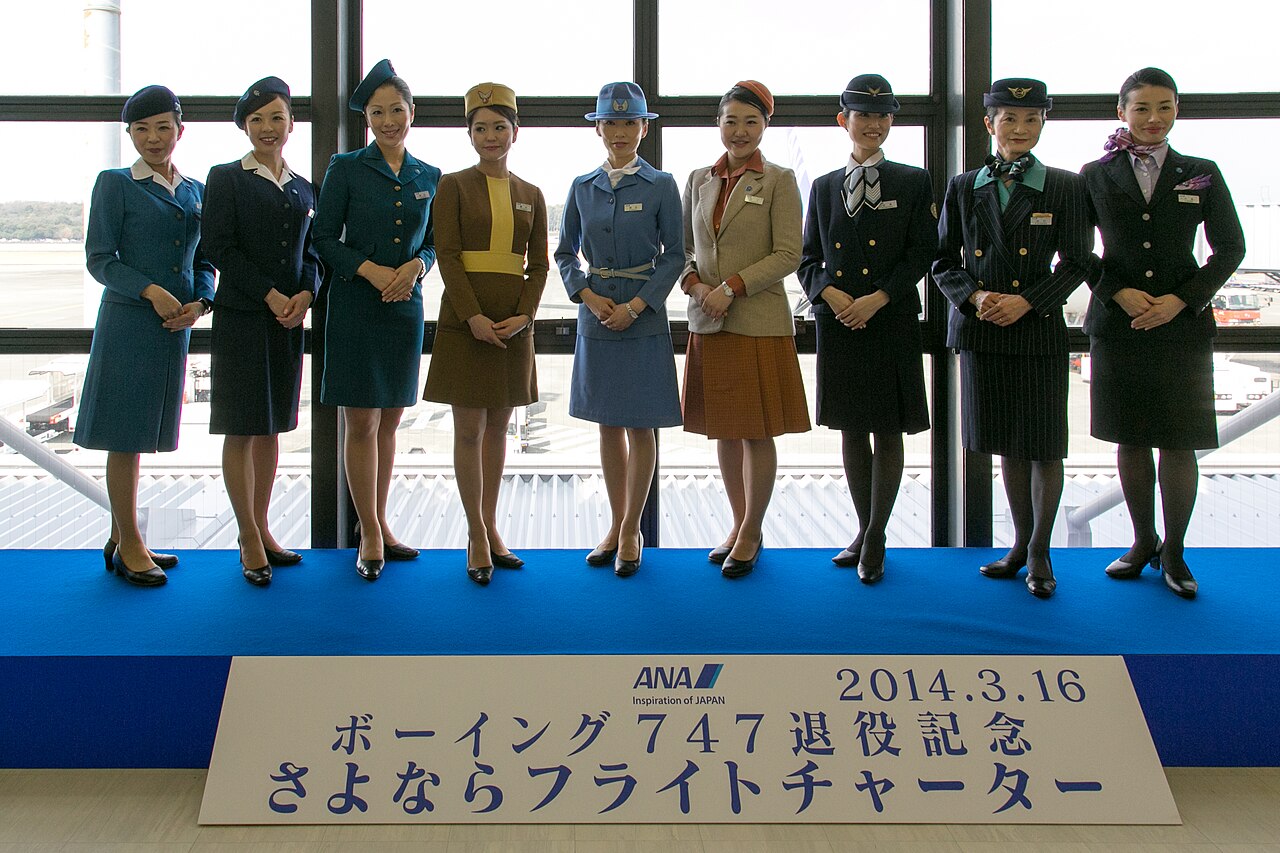
Against that restless history, the tenth generation's restraint is the statement. Gurung did not give ANA a new colour or a new silhouette so much as a new discipline: keep the grey, keep the tailoring, and let one line of blue do the talking. A decade in service, it remains the uniform ANA flies in — the longest-serving lesson of the set being that the airline which changed its uniform nine times in sixty years finally found one it wanted to keep.
The Icon
Why the Blue Line Matters
The Gurung uniform matters for three reasons. It proved a Japanese flag carrier could hand its most visible tradition to an outside designer without losing itself — the flowers, the hospitality brief and the blue all survived the crossing. It reframed what a uniform refresh can be: not a fashion moment but a recognition system, engineered around a single stripe. And it quietly modernised the contract between airline and crew, building sanctioned individual choice — of blouse, of colour, of jacket or vest — into a uniform culture not known for offering it. For the country whose designers dressed ANA for its first sixty years, and whose flower patterns still ride on every scarf, see our Japan clothing industry page.
Airlines refresh their uniforms from time to time, so the details here describe the uniform as documented for this guide — the airline’s own site always carries the latest version.
Common Questions
Common Questions
Who designed the ANA uniform?
New York fashion designer Prabal Gurung. His design is ANA's tenth-generation uniform, unveiled on 24 April 2014 and worn from 2015. Gurung was ANA's first foreign uniform designer — every earlier generation had been designed in Japan.
What does the ANA uniform look like?
A light grey jacket with charcoal skirts or trousers, brightened by accents of ANA's trademark blue — most distinctively a blue line running down the back of the jacket and skirt. Cabin crew choose between blue and pink blouses with matching floral scarves, and wear brightly patterned floral aprons for cabin service.
What is the blue line on the back of the ANA uniform?
It is Gurung's signature device: a bold stripe in ANA's corporate blue set into the back of the jacket and skirt (and the sleeves), so the wearer is recognisable as ANA at a glance, even from behind. ANA's own uniform history calls it the 'impressive blue line' of the tenth generation.
How many ANA uniform generations have there been?
Ten for cabin attendants, from the first uniform prepared for six cabin attendants in 1955 to the Gurung design of 2015. Earlier designers included Jun Ashida, Issey Miyake and Atsuro Tayama. Ground staff uniforms run on their own count, reaching their seventh generation with the same Gurung redesign.
Do ANA crew choose any part of their uniform?
Yes. Gurung designed the uniform so crew could express individuality within a unified look: cabin attendants have three blouse styles to combine with the jacket or vest, and blouses and scarves come in blue or pink. The scarves and service aprons carry modern Japanese flower patterns that also differentiate the uniform families.
Keep Exploring
More to Explore
In This Series
Airline Uniforms by Airline
The series hub — every airline’s guide, the designers behind them, and the ones in preparation.
Read ↑Japan Clothing Industry
The airline’s home country in the World Clothing Industry directory.
Read ↑Go Deeper
Uniforms — Definition
What a uniform is, and why organisations dress their people alike.
Read ↑Kimono — Definition
Japan's iconic wrapped garment, defined — the tradition behind the uniform's floral patterns.
Read ↑The Kimono — Traditional Dress of Japan
The kimono in full: its history, construction and place in Japanese dress.
Read ↑Scarf — Definition
The scarf defined — the soft accent at the centre of the ANA look.
Read ↑Keep Exploring
Explore Fashion for Travel
The crew are only half the fashion on a flight — the other half is what the passengers are wearing. Our travel guides cover the traveller’s side of the same subject, and they link back here.
Outfits for Flying
Travel Outfits
What to wear when you are going somewhere — outfit systems built for transit days.
Read ↑Airport Outfits
Security-friendly shoes, cabin layers and the full airport dressing system.
Read ↑What to Wear on a Long Flight
Dressing for the overnight haul — comfort, warmth and arriving presentable.
Read ↑What to Wear When Traveling
The destination-rules guide to building a travel wardrobe that works on arrival.
Read ↑Business Travel Wardrobe Guide
A working wardrobe that travels — suits, wrinkle strategy and boardroom-ready arrivals.
Read ↑Packing & Capsule Wardrobes
Travel Capsule Wardrobe Guide
A small set of pieces that combine into a trip’s worth of outfits.
Read ↑Travel Packing Guide
The complete packing method — lists, order and wrinkle control.
Read ↑How to Pack a Suit
Getting a tailored jacket and trousers across the world without the creases.
Read ↑Carry-On Packing Guide
Everything in one bag — the carry-on-only system, piece by piece.
Read ↑Travel Comfort & Accessories
Search Apparel Search