Airline Uniforms by Airline · India
The Air India Ombré Saree
When Air India reinvented itself under the Tata Group, it kept the garment it had flown in for sixty years — the saree — and handed it to India’s best-known couturier. Manish Malhotra’s uniform, unveiled on 12 December 2023, is a ready-to-wear ombré saree whose gradient itself shows seniority, worn with a blazer, and optionally with trousers. This guide covers the design, every component, the colour code, and the tradition behind it.
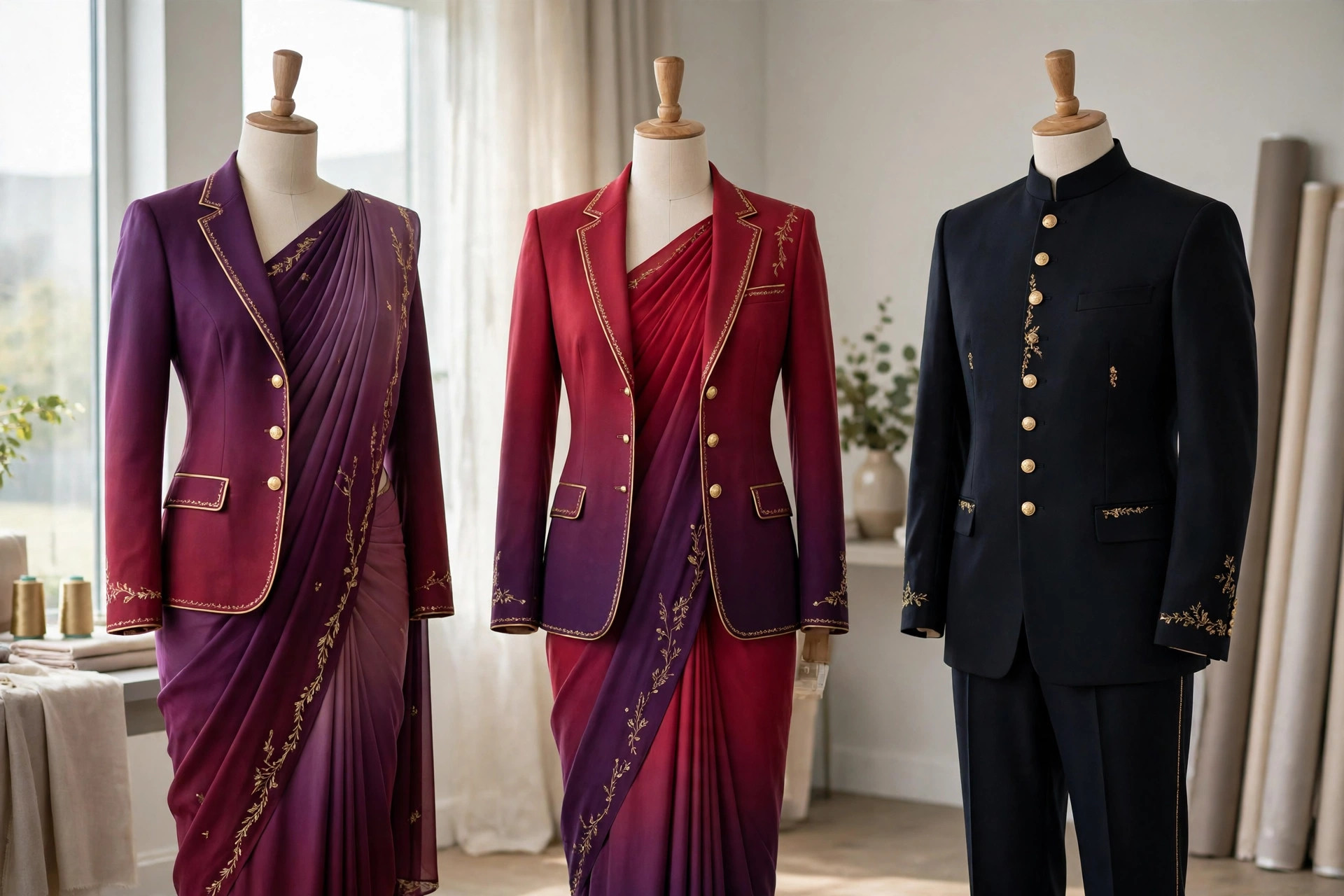
The Design
A Couturier, a New Brand and a Saree Reimagined
The uniform arrived as part of a total reinvention. After the Tata Group’s takeover, Air India unveiled a new global brand identity in August 2023 — deep red, aubergine and gold, with a new logo icon, the Vista, drawn from the peak of the Indian jharokha window. The crew uniform was to be that identity, worn. Air India announced its partnership with Manish Malhotra on 28 September 2023, and the collection was unveiled on 12 December 2023 in Gurugram, crafted in Malhotra’s Mumbai atelier and introduced in phases over the following months, debuting with the airline’s first Airbus A350 as it entered commercial service.
Malhotra is India’s celebrity couturier — the designer whose name is shorthand for Bollywood glamour and for the modern Indian bridal and festive wardrobe. His signature device is the ombré: colour graded from one hue to another across a garment, a technique the airline’s release calls a hallmark of his work, “reflecting his deep-rooted fondness for traditional attire and gradients.” For Air India he built the whole women’s uniform around it. “My aim was to create uniforms that capture the essence of India’s diverse culture and traditions while also embodying a modern and sophisticated look,” he said. “By incorporating quintessential hues that are symbolic to India, I hope that these uniforms not only make the crew feel proud but also leave a lasting impression on the guests, representing the warmth and hospitality that India is known for.”
The designs were not imposed from the atelier. They were developed in close consultation with Air India’s cabin crew representatives and its in-flight services team, who also put the garments through an extensive testing exercise before the unveiling — a necessary discipline for a uniform whose centrepiece is a draped garment that must survive a long-haul service. All fabrics and garments in the collection are sourced and tailored in India. CEO Campbell Wilson framed the stakes at the launch: “Air India’s crew uniforms are amongst the world’s most storied in aviation history, and we firmly believe that Manish Malhotra’s innovative ensemble will script an exciting new chapter for Air India’s future narrative.”

The Components
The Outfit, Piece by Piece
- The Ready-to-Wear Ombré Saree
- The centrepiece: a saree engineered to be put on like a uniform, not draped from six yards of cloth each morning. Its patterning is intricate, “reminiscent of Indian heritage architecture (jharokha) and the Vista” — the new logo icon worked into the cloth itself. Our sari / saree definition explains the traditional garment it re-engineers.
- The Blouse
- A comfortable blouse designed to be worn with both the saree and the pant version — in the airline’s own description of the collection, the saree looks are completed with boat-neck blouses — tucked in, fitted for work, and made to sit cleanly under the blazer.
- The Blazer
- A tailored blazer worn over the saree, colour-matched to the wearer’s gradient: aubergine with the senior saree, red with the junior. It is the blazer that turns a traditional drape into a unmistakably corporate uniform — the East-meets-West gesture in a single garment.
- The Pant Saree Option
- The ready-to-wear sarees can optionally be worn with comfortable pants instead of the wrapped lower drape — a saree-pantsuit that, in the airline’s words, “provides greater flexibility to female cabin crew to choose the style they most identify with and brings a unique East-meets-West look.” Choice, here, is itself a design feature.
- The Bandhgala (Men)
- Male cabin crew wear the bandhgala — the closed-neck, buttoned Indian formal jacket — tailored as a uniform suit. Its colours vary with seniority, extending the women’s gradient code to the men’s side of the crew (see the rank section below).
- The Cockpit Suit
- For pilots, a classic black double-breasted suit with a print inspired by the Vista — deliberately timeless, “signifying professionalism, timelessness, and the gravitas of the flying profession.”
- Footwear and Accessories
- Malhotra curated the finishing pieces as part of the collection: dual-tone (black and burgundy) block heels for female cabin crew, comfortable black brogues for male crew, and pearl earrings and sling bags for the women — jewellery and bag designed into the uniform rather than left to chance.
Beyond the cabin, Malhotra also designed uniforms for Air India’s ground staff, engineers and security personnel, which were still to be unveiled when the crew collection launched.
The Rank Code
Two Gradients, Two Grades
Air India’s rank system is written into the dyeing. The ombré of a female crew member’s saree — and the blazer worn with it — tells you her grade before she says a word:
| Saree gradient | Blazer | Grade | Reading |
|---|---|---|---|
| Aubergine → burgundy | Aubergine | Senior cabin crew | The darker, wine-deep gradient — in the airline’s words, “a balance of authority and sophistication.” |
| Red → purple | Red | Junior cabin crew | The brighter gradient — “youthfulness and energy,” in the same official description. |
The palette as a whole — deep red, burgundy, aubergine and accents of gold — is the new brand’s palette, chosen, the airline says, in homage to India’s rich cultural heritage. The men’s bandhgalas follow the same principle, their colours varying with seniority, though Air India has not published which colour maps to which grade. It is one of the most legible rank codes in the sky: not a stripe or a badge added to the uniform, but the uniform’s own colour, graded like the ombré itself.
The Men’s Uniform
The Bandhgala and the Black Suit
For male cabin crew, Malhotra chose the other great formal garment of Indian menswear: the bandhgala, the high, closed collar jacket that descends from court dress and is now India’s default for formal occasions. As a uniform it does several jobs at once — it is unmistakably Indian without being a costume, it reads as formal as a Western lounge suit, and its closed neck gives the crew a clean, jewellery-free line that suits cabin work. Worn with trousers and the collection’s black brogues, and colour-graded by seniority to match the women’s system, it makes the men’s half of the crew part of the same design sentence as the sarees.
The cockpit crew stand deliberately apart. Their black double-breasted suit, with its Vista-inspired print, belongs to the international visual language of the flight deck — authority first, brand second — while still carrying the new identity in its cloth. Between the bandhgala in the cabin and the black suit up front, the men’s wardrobe covers the same ground as the women’s: heritage where passengers see service, convention where they look for command.
The Saree That Stayed
Before the unveiling, reporting in India suggested the new uniform might drop the saree altogether, ending a tradition that began in the 1960s. It didn’t. Malhotra kept the saree — pre-pleated, ready to wear, graded in ombré — and added trousers as an option rather than a replacement. The decision matters beyond one airline: the Air India saree is one of the last national-dress uniforms in world aviation, a flag carrier wearing its country’s clothing rather than a version of the international suit. The 2023 design argues that tradition and a modern uniform are not opposites — the tradition just has to be engineered.
The Rules
Grooming: Shade Cards and a 40-Page Circular
Air India does not publish its grooming manual, but the standard it expects became public in November 2022, when the Tata-era airline issued a grooming circular of more than forty pages for all crew — reported in detail across the Indian press — and the discipline it describes is the backdrop against which the Malhotra uniform is worn. Foundation and concealers must match the skin tone; eyeshadow, lipstick, nail polish and hair colour must follow company shade cards, with no personal shades permitted in those four products, and nail polish colours are matched to the uniform being worn.
The saree itself was regulated to the inch: worn on the natural waistline with not more than an inch of midriff visible, with skin-toned stockings and formal court shoes. Hair rules were equally specific — the bun centred on the crown and made round with a doughnut, covered only by a thin, sheer, invisible net; no high top-knots or low buns; no more than four black bobby pins, all of the same size and type; grey hair coloured to a natural shade, with blonde colour and streaks prohibited. Jewellery was minimal: plain round gold or diamond studs (pearls, notably, were not permitted under the old uniform’s rules — the Malhotra collection reverses that, issuing pearl earrings of its own), one plain bangle or bracelet, and an optional bindi with the saree of no more than half a centimetre. For men, the circular required hair gel, banned personal tie pins, and allowed a single plain ring and, for Sikh crew, one plain kada. The Malhotra wardrobe brought its own service-wear specifications when it rolled out — but the philosophy is continuous: at Air India, grooming is not advice, it is specification.
Evolution
From Berets to Ombré: Sixty Years of the Saree
Air India’s first uniforms looked west. In the 1940s the cabin crew wore smart dresses with tilted, beret-style caps in the European manner, and that Western influence continued through the 1950s, in step with international carriers. The break came in the 1960s, when the airline decided to project India itself as the destination: the saree made its debut as the uniform — exquisite silk sarees worn with the bouffant hairstyles of the day — and became an instant icon of the golden age of flying. The same era experimented around it, with ghagra choli and salwar-suit variations in some roles, but the saree was the keeper.
For the next half-century the saree simply continued, mirroring Indian fashion as it went: the bold printed sarees of the 1970s, the muted hues of the 1980s, and successive standardisations in the decades after, with crew also offered tunic-and-trouser alternatives in matching colours in later years. What never changed was the proposition: the flag carrier of India dressed its crew in India’s national garment, and the image — a saree in an aircraft doorway — became one of the most recognisable in aviation.
The Malhotra collection is therefore best read as a redesign of a classic, not a replacement of one. It keeps the saree, industrialises it (ready-to-wear, pre-pleated, tested by crew), brands it (jharokha patterning, the Vista, the new palette), codes it (ombré by seniority) and liberalises it (the trouser option) — all at once, and timed to the aircraft that symbolised the new airline, the A350. Few uniform launches have had to carry a rebrand, a merger-era workforce and a sixty-year tradition simultaneously; this one chose to carry them in a single drape.
The Icon
A National Dress, at 35,000 Feet
Singapore has the kebaya; Air India has the saree — the two great national-dress uniforms of Asian aviation, and the measure of each other. What Malhotra’s design adds to that lineage is authorship: a named couturier’s signature technique, the ombré, made to do the bureaucratic work of showing rank while looking like pure fashion. It is a uniform that could only belong to this airline, in this country, at this moment of reinvention — which is exactly what a flag carrier’s uniform is for. Our Traditional Dress guide to the Indian sari covers the garment’s wider history, and for the country behind the airline, see our India clothing industry page.
Airlines refresh their uniforms from time to time, so the details here describe the uniform as documented for this guide — the airline’s own site always carries the latest version.
Common Questions
Common Questions
Who designed the Air India uniform?
Indian couturier Manish Malhotra, working in his Mumbai atelier. The partnership was announced on 28 September 2023 and the collection was unveiled on 12 December 2023, to be introduced in phases starting with the airline’s first Airbus A350.
What do the two Air India saree colours mean?
They show seniority. Senior female cabin crew wear aubergine-to-burgundy ombré sarees with aubergine blazers; junior female cabin crew wear vibrant red-to-purple ombré sarees with red blazers. The men’s bandhgala colours also vary with seniority.
Can Air India crew wear trousers instead of a saree?
Yes. The ready-to-wear sarees can optionally be worn with comfortable pants — a saree-pantsuit the airline describes as an East-meets-West look, giving female crew the flexibility to choose the style they most identify with.
What do Air India’s male crew and pilots wear?
Male cabin crew wear bandhgalas — the closed-neck Indian formal jacket — with black brogues. Cockpit crew wear a classic black double-breasted suit with a print inspired by the Vista, the airline’s logo icon.
How long has Air India crew worn the saree?
Since the 1960s, when silk sarees replaced the European-style dresses and caps of the airline’s first decades. The saree continued through the printed styles of the 1970s and the muted hues of the 1980s to the present day — the Malhotra design is a ready-to-wear reinvention of that tradition, not a break with it.
Keep Exploring
More to Explore
In This Series
Airline Uniforms by Airline
The series hub — every airline’s guide, the designers behind them, and the ones in preparation.
Read ↑India Clothing Industry
The airline’s home country in the World Clothing Industry directory.
Read ↑Go Deeper
Uniforms — Definition
What a uniform is, and why organisations dress their people alike.
Read ↑Sari / Saree — Definition
The draped garment at the heart of the uniform, defined.
Read ↑Traditional Dress — The Indian Sari
The sari in Indian dress tradition — history, draping and regional styles.
Read ↑Indian Fashion Designers
The designers of India, in our fashion directory — Malhotra’s world.
Read ↑Keep Exploring
Explore Fashion for Travel
The crew are only half the fashion on a flight — the other half is what the passengers are wearing. Our travel guides cover the traveller’s side of the same subject, and they link back here.
Outfits for Flying
Travel Outfits
What to wear when you are going somewhere — outfit systems built for transit days.
Read ↑Airport Outfits
Security-friendly shoes, cabin layers and the full airport dressing system.
Read ↑What to Wear on a Long Flight
Dressing for the overnight haul — comfort, warmth and arriving presentable.
Read ↑What to Wear When Traveling
The destination-rules guide to building a travel wardrobe that works on arrival.
Read ↑Business Travel Wardrobe Guide
A working wardrobe that travels — suits, wrinkle strategy and boardroom-ready arrivals.
Read ↑Packing & Capsule Wardrobes
Travel Capsule Wardrobe Guide
A small set of pieces that combine into a trip’s worth of outfits.
Read ↑Travel Packing Guide
The complete packing method — lists, order and wrinkle control.
Read ↑How to Pack a Suit
Getting a tailored jacket and trousers across the world without the creases.
Read ↑Carry-On Packing Guide
Everything in one bag — the carry-on-only system, piece by piece.
Read ↑Travel Comfort & Accessories
Search Apparel Search