Airline Uniforms by Airline · Singapore
The Singapore Airlines Sarong Kebaya
One garment has represented an airline — and, in a sense, a country — for well over half a century: a batik sarong kebaya designed by a Paris couturier, tailored to each woman who wears it, in four colours that spell out her rank. This is the story of the most famous uniform in aviation, piece by piece.
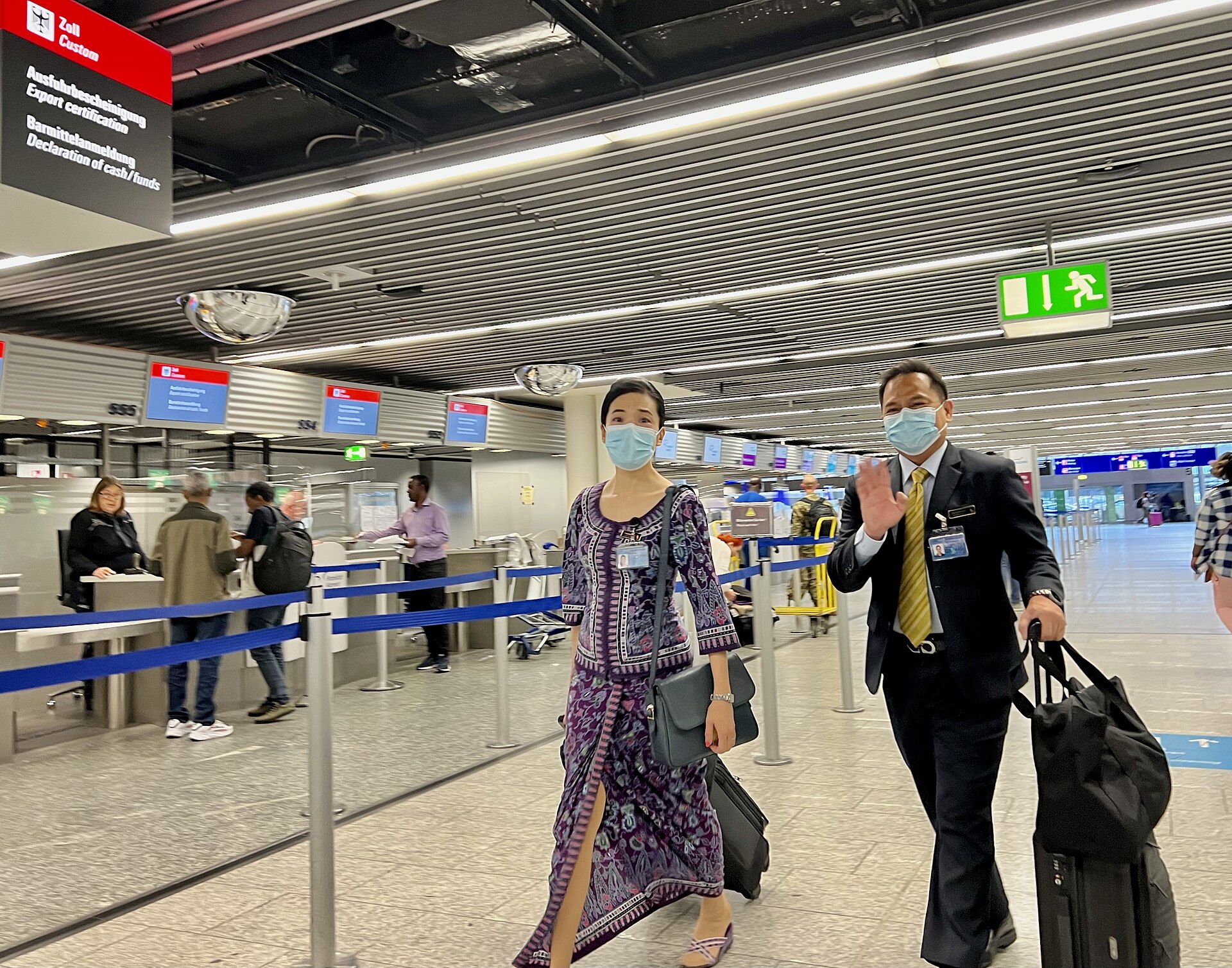
The Design
From Malayan Airways to a Balmain Commission
The sarong kebaya was flying before Pierre Balmain ever saw it. Stewardesses with Malayan Airways, the region’s predecessor carrier, were already wearing a sarong kebaya — modelled on the traditional two-piece dress of the Malay world, with a V-neck lapel — from 1963. What Balmain did, when Malaysia-Singapore Airlines (MSA) brought him in, was to reimagine that regional garment as couture: refining the silhouette, designing its batik print, and setting the pattern, lines and hues that are still worn today. His version debuted in 1968, the date Singapore Airlines itself celebrated at the uniform’s 50th anniversary in 2018 and the date given by Singapore’s National Heritage Board and National Library Board.
The commission made sense. Balmain was one of the great Paris couturiers, and he knew the region: through the 1960s he had been designing the wardrobe of Queen Sirikit of Thailand. The fitting process had a personal touch that became part of the legend — MSA stewardess See Biew Wah was flown to Paris to model the kebaya at the House of Balmain while the design was finalised. (The historical record has its wrinkles: some accounts describe Balmain revisions around the new airline’s formation in 1972 and a narrower update in 1974, when ground staff received three-piece outfits. What is not in dispute is the 1968 debut, or that the flying kebaya’s design was set then.)
When MSA split and Singapore Airlines began operations on 1 October 1972, the new carrier kept the kebaya — and then, remarkably, kept it unchanged. Airlines redesign uniforms the way they repaint aircraft, on a cycle; Singapore Airlines instead turned consistency itself into the brand, as the Singapore Girl story below explains. Read more about the designer in our Pierre Balmain designer profile.

The Components
The Outfit, Piece by Piece
- The Kebaya Blouse
- A fitted batik blouse with a rounded scoop neckline, three-quarter sleeves and a front zip. The neckline is a small feat of tailoring: it begins as a straight piece of cloth and is shaped to its curve with more than twenty darts, custom-fitted to each wearer.
- The Sarong Skirt
- A long skirt in the same batik, with a pleated centre panel running down the front and the print’s colourful border framing it. The front slit is functional, not decorative: it lets the wearer tie the skirt up for mobility in an emergency.
- The Batik Print
- Balmain’s own design: bright floral motifs on a deep-blue ground, finished with a colourful border whose pattern recalls the sawtooth edging of traditional batik. The motif colours — blue, red, brown and green — echo through the whole uniform system, including the men’s ties. The cloth is an industrially printed batik-style fabric in cotton, chosen for practicality, easy care and comfort in a tropical cabin. Our batik definition explains the technique the print imitates.
- Made to Measure
- There are no standard sizes. Balmain insisted that every sarong kebaya be tailored to the individual crew member, and that is still how the uniform is issued — each one made to fit its wearer.
- Cold-Weather Issue
- For winter stations the uniform gains a batik-print scarf, gloves and a dark blue topcoat, so the silhouette survives a Frankfurt January as well as a Singapore afternoon.
- Footwear
- The one component that has genuinely evolved: Balmain’s original open-toe sandals with batik detailing, joined in 2001 by closed-toe safety shoes — and replaced entirely from January 2027, as the evolution section below explains.
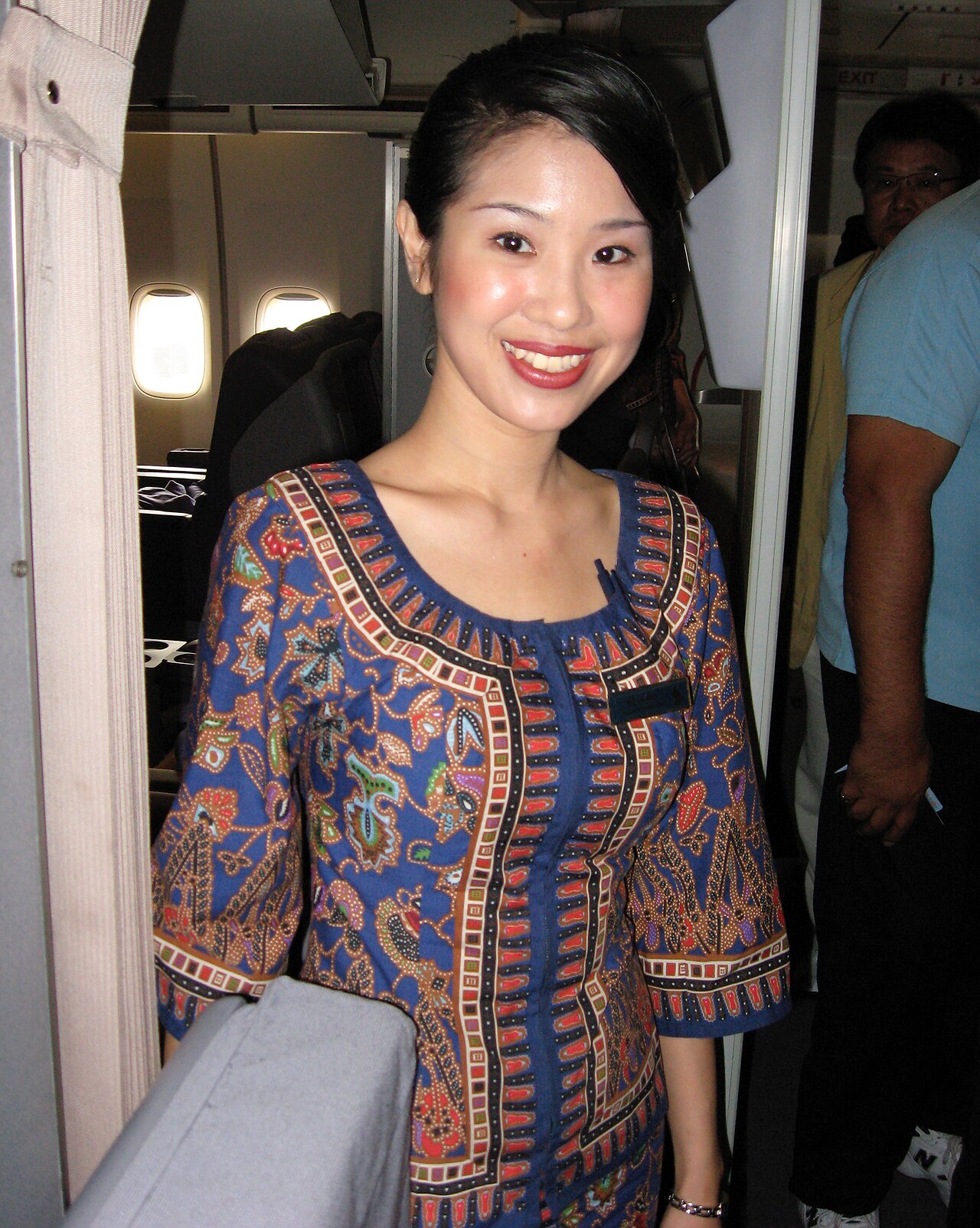
The kebaya itself belongs to a much older dress tradition, shared across the Malay world and Indonesia; our kebaya guide and sarong definition cover the garment’s wider history.
The Rank Code
Four Colours, Four Ranks
Most airlines announce rank with stripes or insignia. Singapore Airlines does it with the dress itself: the ground colour of a stewardess’s kebaya tells you exactly where she stands in the cabin hierarchy. It is the most elegant rank system in aviation — no badges, no braid, just colour.
| Kebaya colour | Rank | Role |
|---|---|---|
| Blue | Flight Stewardess | The entry rank — the blue kebaya is the one most passengers know. |
| Green | Leading Stewardess | The first promotion, taking on senior duties within a cabin section. |
| Red | Chief Stewardess | Senior cabin crew, supervising a cabin or a class of service. |
| Burgundy / Purple | In-flight Supervisor (Inflight Manager) | The most senior crew member in the cabin, responsible for the whole flight’s service. |
A note on the senior colour: archival sources — the National Library Board and the National Archives — call it burgundy, while the airline’s modern material calls it purple. It is the same deep wine-purple cloth and the same rank; only the word has drifted. The code does not stop with the women’s uniform: the men’s striped ties repeat exactly the same four colours, so a steward’s tie announces his rank just as his colleague’s kebaya announces hers.
The Men’s Uniform
A Suit from the Same House
The men’s uniform stayed with the same design house. In 2008 the House of Balmain’s uniform division, Balmain Uniformes, under its artistic director Christophe Galibert — who had worked with Pierre Balmain himself for over twenty-five years — redesigned the stewards’ wardrobe. Out went the old scheme, in which rank had been shown by the colour of the jacket itself (a ladder of light blue, sky blue, navy and grey). In came a single, sharper uniform for every rank: a single-breasted navy blue suit, a sky-blue shirt and a striped tie, the tie’s colours drawn from details of the kebaya print.
The redesign made the men’s system match the women’s in logic as well as looks: with every steward in the same suit, rank is shown only by tie colour — blue, green, red and purple, mirroring the kebaya ladder rung for rung. Male crew complete the uniform with black leather shoes, which are not affected by the women’s footwear change described below.
“A Great Way to Fly”
When Singapore Airlines launched in 1972, Batey Advertising built the new airline’s identity not on its aircraft but on its crew — the “Singapore Girl,” in her Balmain kebaya, promising a standard of care the slogan called A Great Way to Fly. It became one of the longest-running and most recognised campaigns in travel. It has also drawn criticism over the years for trading on an image of subservient femininity — a debate the airline has answered mainly by changing nothing at all: the girl, the kebaya and the promise are still flying.
The Rules
Grooming: The Other Half of the Uniform
A uniform this famous is only half the look; the other half is grooming, and Singapore Airlines regulates it with a thoroughness that matches the tailoring. The airline does not publish its grooming manual, but the system has been documented in detail by journalists given access to its training centre and by former crew.
During training, each crew member’s hairstyle and makeup colours are assigned by an in-house beauty consultant and recorded on an official grooming card — a personal specification that superiors can check against the crew member in flight. Trainees spend a day and a half on hair and makeup alone. There are five approved hairstyles, and each woman is told which of them she may wear. Even eyeshadow is rank-coded: flight stewardesses wear blue or brown palettes, leading stewardesses olive green, plum or brown, chief stewardesses plum or brown, and supervisors blue, plum or brown.
Jewellery is minimal and measured: necklaces are not permitted at all, and earrings — silver, gold, pearl or diamond only — may be no larger than 0.75 cm across. A full face of makeup is required on duty, and the manicure must match the lip colour, chosen from an approved list of pink and red shades (a list that has widened over the past decade from the original bright reds to include deep pinks). The effect is deliberate: thousands of individuals, one unmistakable presentation — the grooming rules are as much a part of the design as the batik.
Evolution
What Changed — and What Never Has
The headline is what did not happen. In the airline’s own words, the kebaya “flies unchanged”: its pattern, lines, hues and fabric remain as Balmain designed them, and the airline confirmed the point in 2021 when it refreshed its brand batik motif — a new design inspired by ten flowers native to Singapore — and stated explicitly that the new motif would not replace the original on the crew uniform. The changes, when they came, happened at the edges.
Footwear, 2001. Balmain’s open-toe sandals were joined in April 2001 by closed-toe slingback safety shoes, worn for take-off and landing after the SQ006 accident in Taipei in October 2000 raised concerns that sandals could hinder an evacuation. For a quarter of a century crew have worked with two pairs: slingbacks for the critical phases, sandals in between.
The men’s suit, 2008. The Balmain Uniformes redesign described above — the one full wardrobe change of the modern era, and it kept the design in the same house.
Footwear, 2027. In October 2026 the airline confirmed the biggest practical change in decades: from January 2027, crew will progressively move to a single closed-toe shoe for the whole flight — a leather wedge developed with Singapore footwear brand PAZZION over 31 months of design and wear-testing, with lambskin insoles, a widened toe box and the signature batik motif worked into it, in colour variations by rank. The new shoe retires both the 2001 slingbacks and Balmain’s original sandals, closing a design thread that runs back to 1968.
The Icon
Why This Uniform Became an Icon
Plenty of uniforms are admired; very few become cultural property. The sarong kebaya crossed that line early. In 1993 Madame Tussauds in London unveiled a wax figure of stewardess Lim Suet Kwee in the uniform — the museum’s first figure of a commercial, non-celebrity subject, chosen purely because the image was already famous worldwide. A second figure, modelled on flight stewardess Nur Surya Binte Mohamed Ambiah — selected from among some 4,500 female crew — followed at Madame Tussauds Singapore in 2015. Museums, not just marketers, keep the record now: Singapore’s Asian Civilisations Museum holds a 1970s sarong kebaya in its collection and featured the uniform in its Batik Kita exhibition on dress in port cities.
The deeper reason is the refusal to change. Every other symbol of 1972 aviation has been retired, repainted or redesigned out of recognition; the kebaya simply continued, flight after flight, until consistency itself became the message — heritage, reliability and a national identity carried in cloth. It is why this series starts here: whatever an airline uniform can be, this one already is. For the country behind it, see our Singapore clothing industry page.
Airlines refresh their uniforms from time to time, so the details here describe the uniform as documented for this guide — the airline’s own site always carries the latest version.
Common Questions
Common Questions
What is the Singapore Airlines uniform called?
The women's uniform is the sarong kebaya: a fitted batik blouse with a scoop neckline and three-quarter sleeves, worn with a long sarong skirt. It is based on the traditional dress of the Malay world and has been the airline's signature since the Balmain version debuted in 1968. The men's uniform is a navy suit with a sky-blue shirt and a striped tie.
Who designed the Singapore Airlines uniform?
French couturier Pierre Balmain. His version of the sarong kebaya debuted in 1968 for Malaysia-Singapore Airlines, the predecessor carrier, and Singapore Airlines kept it when the airline was formed in 1972. Some sources describe further Balmain revisions in the early 1970s, but the pattern, lines, hues and fabric in use today are the ones Balmain set. The men's suit was redesigned by the House of Balmain's uniform division in 2008.
What do the four kebaya colours mean?
The colour of the kebaya shows the wearer's rank. Blue is worn by flight stewardesses, green by leading stewardesses and red by chief stewardesses. The most senior colour — called burgundy in archival sources and purple in the airline's modern material — is worn by the in-flight supervisor, also titled inflight manager. The men's ties repeat the same four-colour code.
Has the Singapore Airlines uniform ever changed?
The kebaya itself has never been substantively redesigned — the airline says its pattern, lines, hues and fabric remain as Balmain designed them. The changes have happened around it: the men's suit was redesigned in 2008, closed-toe safety shoes were added for take-off and landing in 2001, and from January 2027 new closed-toe wedge shoes by Singapore brand PAZZION will replace both the original sandals and the safety shoes.
Why is the Singapore Girl so famous?
Because in 1972 the new airline built its entire brand on her. The Singapore Girl campaign, created by Batey Advertising with the slogan 'A Great Way to Fly', sold the service and the kebaya-clad crew rather than the aircraft. The figure became so recognisable that Madame Tussauds made her its first commercial wax figure in 1993, and a 1970s kebaya is held in the collection of Singapore's Asian Civilisations Museum.
Keep Exploring
More to Explore
In This Series
Airline Uniforms by Airline
The series hub — every airline’s guide, the designers behind them, and the ones in preparation.
Read ↑Singapore Clothing Industry
The airline’s home country in the World Clothing Industry directory.
Read ↑Pierre Balmain
The couturier behind the kebaya — his house, his career and his other work, in our designer profile.
Read ↑Go Deeper
Batik — Definition
The wax-resist dyeing tradition that Balmain’s print imitates.
Read ↑Kebaya Guide
The garment itself — its history, styles and place in Southeast Asian dress.
Read ↑Sarong — Definition
The wrapped skirt at the heart of the uniform, defined.
Read ↑Uniforms — Definition
What a uniform is, and why organisations dress their people alike.
Read ↑Keep Exploring
Explore Fashion for Travel
The crew are only half the fashion on a flight — the other half is what the passengers are wearing. Our travel guides cover the traveller’s side of the same subject, and they link back here.
Outfits for Flying
Travel Outfits
What to wear when you are going somewhere — outfit systems built for transit days.
Read ↑Airport Outfits
Security-friendly shoes, cabin layers and the full airport dressing system.
Read ↑What to Wear on a Long Flight
Dressing for the overnight haul — comfort, warmth and arriving presentable.
Read ↑What to Wear When Traveling
The destination-rules guide to building a travel wardrobe that works on arrival.
Read ↑Business Travel Wardrobe Guide
A working wardrobe that travels — suits, wrinkle strategy and boardroom-ready arrivals.
Read ↑Packing & Capsule Wardrobes
Travel Capsule Wardrobe Guide
A small set of pieces that combine into a trip’s worth of outfits.
Read ↑Travel Packing Guide
The complete packing method — lists, order and wrinkle control.
Read ↑How to Pack a Suit
Getting a tailored jacket and trousers across the world without the creases.
Read ↑Carry-On Packing Guide
Everything in one bag — the carry-on-only system, piece by piece.
Read ↑Travel Comfort & Accessories
Search Apparel Search