Airline Uniforms by Airline · Turkey
The Turkish Airlines Uniform by Ettore Bilotta
Deep flag red against anthracite grey, calligraphy worked into silk foulards, and an entire airline — cabin, cockpit, chefs and ground — dressed under one design for the first time. Ettore Bilotta's uniform, unveiled in 2018 for Turkish Airlines' 85th anniversary and its vast new Istanbul home, is a national showcase cut as couture. This guide reads it piece by piece.
The Design
An 85th Birthday, a New Airport, a New Elegance
Turkish Airlines unveiled its new uniform in September 2018, and the timing was the message. The flag carrier was celebrating its 85th anniversary — it was founded in 1933 as the State Airlines — and preparing to move into the new Istanbul Airport, the mega-hub that would become its home when it opened in 2019. A new era, the airline decided, needed a new elegance to match.
The designer was Ettore Bilotta, the Milan-based Italian haute couturier whose atelier had already dressed Etihad Airways' crew in 2014 and worked on Alitalia's uniforms. Bilotta started, by his own account, not with the aircraft but with the city: “When I started to design for Turkish Airlines, the first thing that inspired me was Istanbul. This city has been a melting pot for art and civilisation for centuries and has a rare richness as a common heritage of many cultures. I wanted to bring elements from traditional calligraphy and mosaics together with new interpretations of Turkish motifs, which emphasise modern lines, into foulards and ties to reflect a contrast and duality.”
The collection was a Turkish production as well as an Italian design: the uniforms were specially sewn by Vakko, the Istanbul fashion house that had dressed the airline's crew for the previous two decades, with the main fabrics produced by Altınyıldız to flight standards. In total the wardrobe was tailored for some 25,000 employees. Before launch, the designs were tested where it mattered — on long-haul trial flights in different climates, in consultation with the airline's own cabin crew. To present the collection, Turkish Airlines commissioned British photographer and artist Miles Aldridge to shoot it at locations around Istanbul. The uniform entered service on long-haul flights in 2019, as the new airport opened — the in-service date, not the design date; the design itself belongs to 2018.
The airline's chairman at the launch, M. İlker Aycı, framed the stakes plainly: “The elegance and comfort of our cabin crews, which constitute the most important element of our unrivalled service quality, are of great importance for our brand that continues to fly at the top of its industry. I believe that our brand's presence in the skies will be much more impressive when the new cabin uniforms, which bear elements of our culture, are combined with the elegance of our cabin crews.” The uniform, in other words, was never a side project: at an airline whose service reputation is its chief asset, the crew's dress was treated as core infrastructure.
The Components
The Outfit, Piece by Piece
- The Palette
- Everything hangs on two colours: a deep red — the flag red of the Turkish flag — and anthracite grey. The pairing was chosen to be instantly recognisable across a terminal: red carries the national identity, anthracite gives it the tailored, urban weight of Istanbul itself.
- Women's Tailoring
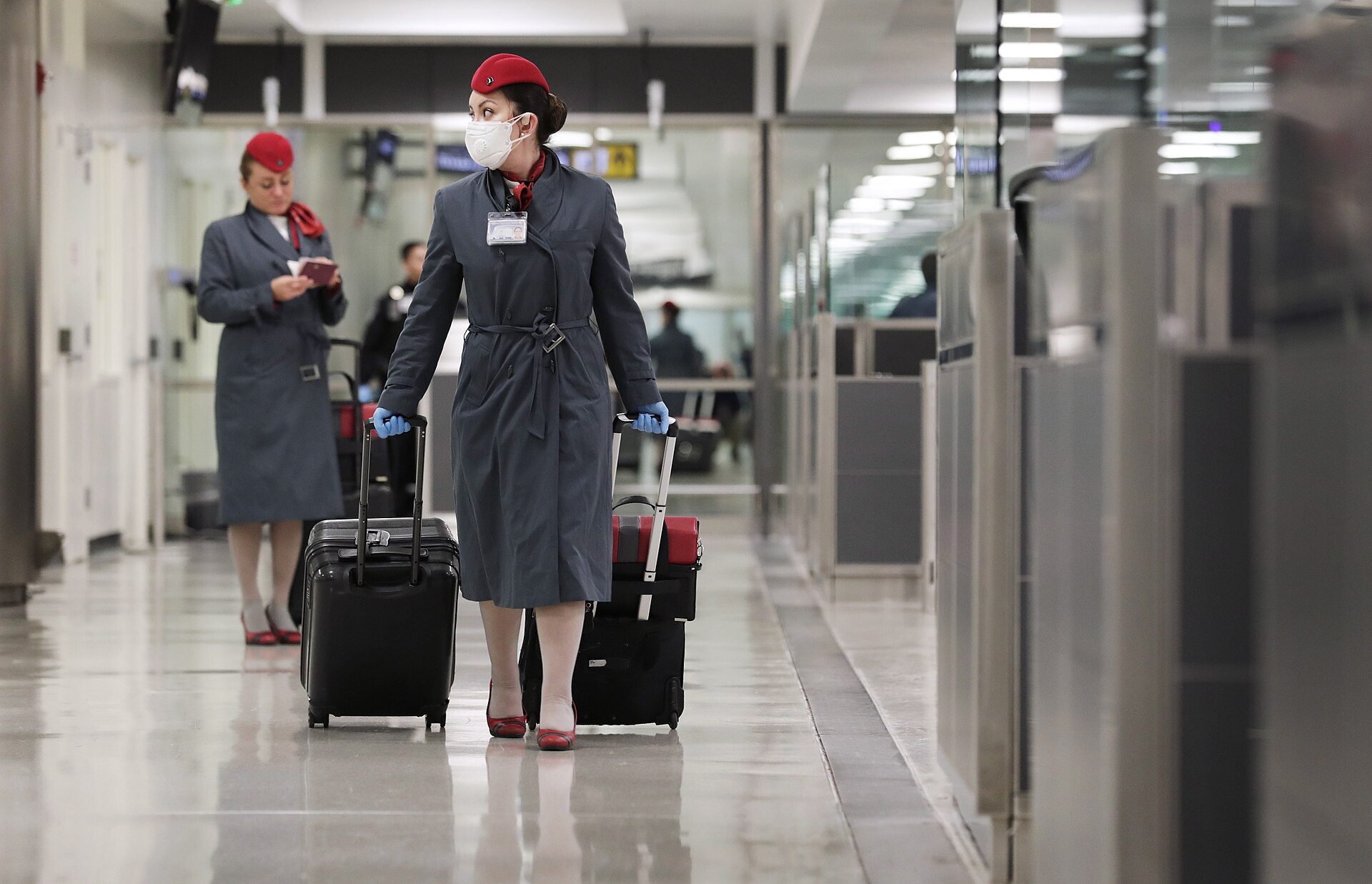
- Dresses and tailored separates in the red-and-anthracite palette, cut with the modern lines Bilotta set against his traditional motifs. The hero photograph above shows the travelling form of the wardrobe: the belted anthracite overcoat worn over the uniform for arrivals and departures.
- The Hat
- A red hat completes the women's uniform — in service it is worn as the neat pillbox-style cap visible in photographs of the crew, carrying the airline's emblem. Headwear was designed as part of the collection from the start, not added to it.
- The Foulard
- The signature accessory. The women's foulards carry Bilotta's reinterpreted Turkish motifs — traditional calligraphy and mosaic patterns, drawn from artisanal glassware and ceramics, restated in contemporary lines. Our scarf definition traces the garment the foulard belongs to.
- Gloves, Bag and Accessories
- The collection was conceived head-to-toe: hats, gloves, dresses, bags and accessories were all in the launch list, so the crew member's whole silhouette — not just the suit — belongs to the design.
- Men's Tailoring
- For men, tailored suiting in the same deep red and anthracite system, with ties carrying the same calligraphy and mosaic motifs as the women's foulards — the duality Bilotta described, East and West, tradition and modern line, worn at the neck by both halves of the crew. Our tie definition covers the garment's history.
- The Flow Detail
- Running through the collection is a new “flow detail”, created to symbolise the effortless, dynamic energy of the Bosphorus currents and of Istanbul itself — the city as an intersection between East and West. It is the design's abstract signature, the way a stripe or a check works for other airlines.
One design decision sits above all the individual pieces: for the first time, the cabin crew, cockpit crew, ground services and Flying Chefs were brought under a single design approach, so that passengers experience one holistic brand from check-in desk to dinner service — a system the “Reading the Uniform” section below unpacks.
Reading the Uniform
One Airline, One Design — Reading Roles, Not Ranks
Turkish Airlines reads differently from carriers that colour-code their cabins. The Bilotta programme's whole point was unification: no separate design languages for separate departments, and no published colour ladder of ranks within the cabin. What the passenger reads instead is role — told by the type of garment, within one red-and-anthracite family.
| Role | How to spot them |
|---|---|
| Cabin crew | The deep red and anthracite tailoring, the red hat and the motif foulard for women, the motif tie for men — the uniform most passengers mean when they picture the airline. |
| Flying Chefs | The exception that proves the system: the onboard chefs of the airline's celebrated catering keep the classic white chef's uniform and tall white hat, working the business-class cabin as restaurant staff — a role read instantly, in any language. |
| Cockpit crew | Flight-deck tailoring within the same Bilotta design approach, so the pilots who greet passengers at the door belong visibly to the same wardrobe as the cabin behind them. |
| Ground services | The airport teams were redesigned in the same programme and palette, extending the single brand experience to check-in, gates and lounges. |
Within the cabin itself, seniority is a matter of the crew's own organisation rather than a change of dress: the design deliberately presents the cabin team as one body. It is a considered contrast with airlines that stripe or colour their hierarchies — here, the uniform says one airline first, and leaves rank to name badges, announcements and the crew's own chain of command.
Where East Meets West, Worn
Every element of the Bilotta design points back to one city. The shapes and colours come from the Bosphorus; the patterns from the glassware, ceramics and calligraphy of Turkish artisans; the “flow detail” from the currents that run between two continents through the middle of Istanbul. Bilotta called the result a study in “contrast and duality” — old motifs in modern lines, a European couturier dressing the flag carrier of a country that sits in both Europe and Asia. It is why the launch photography was shot not in a studio but at Istanbul's own landmarks: the uniform was designed as the city's travelling portrait.
The Rules
Grooming: The Documented Record
Turkish Airlines does not publish its grooming manual, so this guide records only what has been publicly documented — and the most documented episode predates the current uniform. In 2013, under the previous navy wardrobe, the airline issued guidance that cabin crew should avoid lipstick and nail polish in red, dark pink and similar shades, explaining that because the uniform did not include those colours, wearing them “impairs visual integrity”; the stated aim was crew who looked “artless and well-groomed with make-up in pastel tones”, a natural look the airline said improved communication with passengers. The guidance was widely reported at the time — a reminder that at most airlines, grooming rules are written to serve the uniform's palette, exactly as this one was.
The same period shows the rules moving with the culture around them: the airline had lifted its former ban on headscarves for staff shortly before, and 2013 also saw it step back from a proposed Ottoman-style uniform with ankle-length dresses after the leaked designs drew public debate — the Bilotta collection, when it came five years later, kept faith with tailored modernity instead. What is documented about the current wardrobe's wear is practical rather than cosmetic: it was wear-tested by crew on long-haul trial flights in different climates before a single passenger saw it, and tailored to 25,000 individuals to be worked in, not just looked at.
Evolution
From State Airlines Red to Vakko Navy — and Back to Red
Turkish Airlines was founded in 1933, only a decade after the Republic of Turkey itself, and its stewardess uniforms have tracked the country's story ever since — generally in the national colours of red and white, as befits a flag carrier. The airline's own retrospective of its cabin uniforms shows the parade of post-war styles: a 1968 red suit with gold buttons and a black beret, a 1973 beige suit with a red neckerchief, a 1979 bright red suit with a polka-dot blouse, and a 1982 turquoise suit with a white collar — each decade's fashion, flown.
The modern era before Bilotta belonged to Turkish fashion houses. From the 1990s the airline worked with names such as Vakko, Beymen and Cemil İpekçi; in 1998 Vakko set the template that would last twenty years: a navy blue skirt suit and trouser suit, hemlines below the knee, a white shirt and a blue scarf. Through the 2000s the Vakko wardrobe was renewed in detail — buttons carrying the airline's logo, scarf and tie patterns harmonised with the brand, extra safari-style jackets and skirt options added by 2008 — but the navy silhouette endured, and it is the uniform long-haul passengers of the 2010s remember.
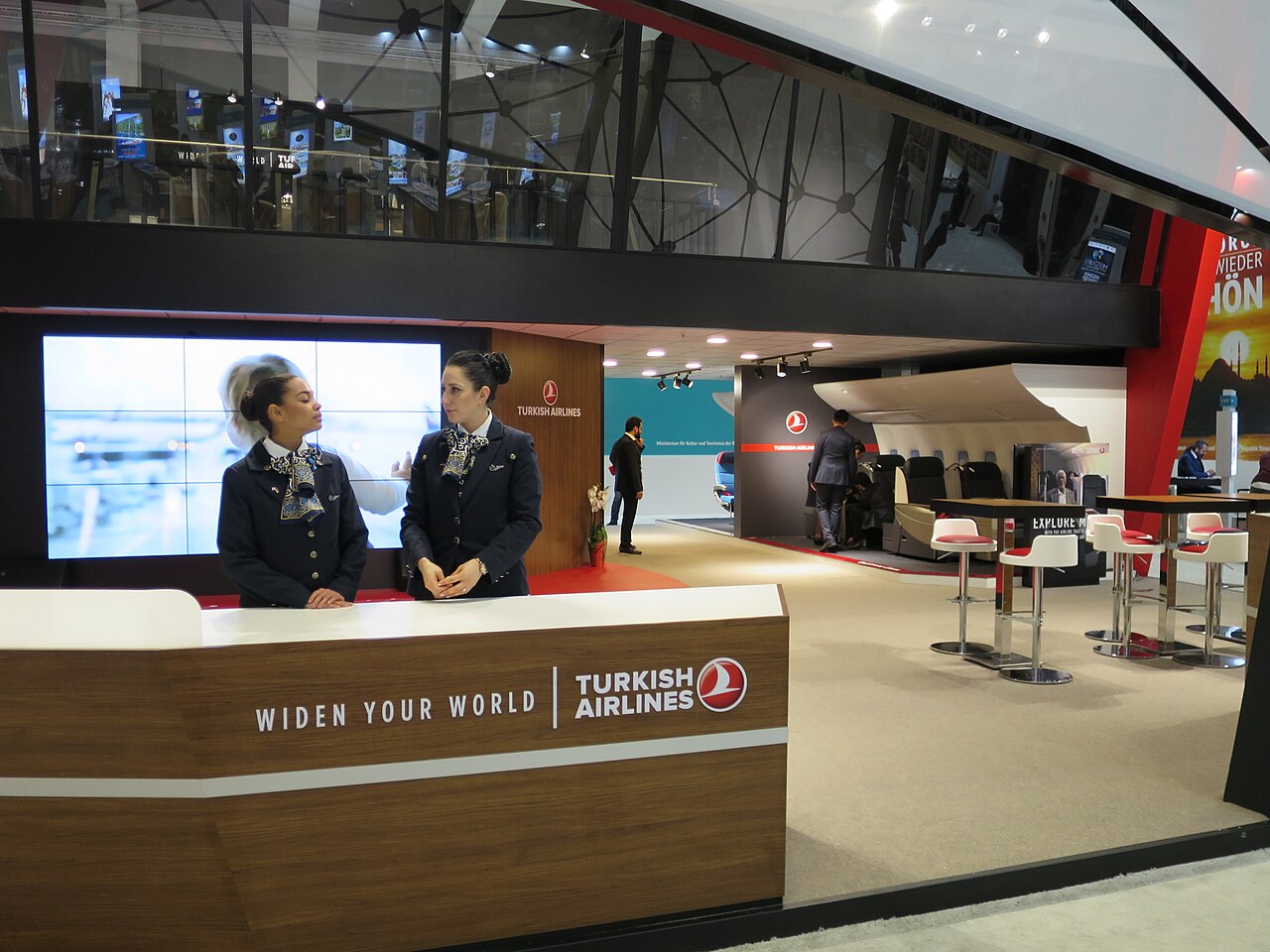
The Bilotta redesign of 2018 therefore closed a circle as well as opened an era. Navy gave way to the flag's own red; the Italian couturier's collection was sewn by Vakko itself, so the house of the old uniform manufactured the new one. What changed was the language — from corporate navy to national red-and-anthracite, from department-by-department dress to one design for the whole airline — timed to the two biggest statements the carrier could make: its 85th birthday, and a new airport built to be the world's crossroads.
The Icon
A Flag Carrier Dressed as One
Turkish Airlines describes itself, with justification, as the airline that flies to more countries than any other — which makes its uniform one of the most widely seen national outfits on earth, a piece of Turkey present in more than a hundred countries every day. The Bilotta wardrobe was designed to be worthy of that reach: not a corporate suit with a logo pinned on, but a considered piece of cultural dress, its patterns borrowed from the same glassware, ceramics and calligraphy that fill the country's museums.
Its deeper significance is organisational. By dressing cabin, cockpit, ground and galley under a single design for the first time, the airline treated the uniform as what it really is — the brand, worn by 25,000 people at once. The red hat and the anthracite coat in our hero photograph are recognised from Dulles to Dhaka precisely because the system behind them is unified. For more on the industry that sewed it, see our Turkey clothing industry page.
Airlines refresh their uniforms from time to time, so the details here describe the uniform as documented for this guide — the airline’s own site always carries the latest version.
Common Questions
Common Questions
Who designed the Turkish Airlines uniform?
Milan-based Italian haute couturier Ettore Bilotta, who had previously designed uniforms for Etihad Airways and Alitalia. His Turkish Airlines collection was unveiled in September 2018, was sewn by Turkish fashion house Vakko with main fabrics from Altınyıldız, and was tailored for some 25,000 employees.
When did the Turkish Airlines uniform change?
The Bilotta uniform was unveiled in September 2018 to celebrate the airline's 85th anniversary and to open its new home at Istanbul Airport. It entered service on long-haul flights in 2019 as the new airport opened, replacing the navy Vakko wardrobe the crew had worn, in evolving versions, since 1998.
What colours and motifs does the Turkish Airlines uniform use?
A deep flag red paired with anthracite grey. The design draws on Istanbul and the Bosphorus: traditional patterns from artisanal Turkish glassware, ceramics and calligraphy, with mosaic and calligraphy motifs reinterpreted in the women's foulards and the men's ties, and a 'flow detail' symbolising the energy of the city where East meets West.
What does the Turkish Airlines women's uniform include?
Tailored dresses and separates in deep red and anthracite, a red hat, a patterned foulard carrying the calligraphy and mosaic motifs, gloves, a bag and matching accessories — a complete head-to-toe collection rather than a single outfit, tested on long-haul trial flights in different climates before launch.
Who wears the Ettore Bilotta design at Turkish Airlines?
Almost everyone the passenger meets. For the first time the cabin crew, cockpit crew, ground services and the airline's Flying Chefs were brought under a single design approach, so the whole journey presents one holistic brand — with the chefs keeping their distinctive white chef's uniform and hat within the system.
Keep Exploring
More to Explore
In This Series
Airline Uniforms by Airline
The series hub — every airline's guide, the designers behind them, and the ones in preparation.
Read ↑Turkey Clothing Industry
The airline's home country in the World Clothing Industry directory.
Read ↑Go Deeper
Uniforms — Definition
What a uniform is, and why organisations dress their people alike.
Read ↑Scarf — Definition
The foulard that carries Bilotta's calligraphy and mosaic motifs, defined.
Read ↑Tie (Necktie) — Definition
The men's tie in the same Turkish motifs — the duality at the neck, defined.
Read ↑Hat — Definition
Headwear, from the crew's red hat to the Flying Chef's tall white toque.
Read ↑Keep Exploring
Explore Fashion for Travel
The crew are only half the fashion on a flight — the other half is what the passengers are wearing. Our travel guides cover the traveller’s side of the same subject, and they link back here.
Outfits for Flying
Travel Outfits
What to wear when you are going somewhere — outfit systems built for transit days.
Read ↑Airport Outfits
Security-friendly shoes, cabin layers and the full airport dressing system.
Read ↑What to Wear on a Long Flight
Dressing for the overnight haul — comfort, warmth and arriving presentable.
Read ↑What to Wear When Traveling
The destination-rules guide to building a travel wardrobe that works on arrival.
Read ↑Business Travel Wardrobe Guide
A working wardrobe that travels — suits, wrinkle strategy and boardroom-ready arrivals.
Read ↑Packing & Capsule Wardrobes
Travel Capsule Wardrobe Guide
A small set of pieces that combine into a trip’s worth of outfits.
Read ↑Travel Packing Guide
The complete packing method — lists, order and wrinkle control.
Read ↑How to Pack a Suit
Getting a tailored jacket and trousers across the world without the creases.
Read ↑Carry-On Packing Guide
Everything in one bag — the carry-on-only system, piece by piece.
Read ↑Travel Comfort & Accessories
Search Apparel Search