Airline Uniforms by Airline · France
The Air France Uniform by Christian Lacroix
No airline has treated its uniform as couture for longer — and none has kept a couturier's wardrobe flying for longer either. In 2005 Christian Lacroix gave Air France a system of around a hundred combinable pieces in navy touched with red, from the knot-belted dress to the famous scarlet gloves. Two decades on, it is still the uniform at the gate. This is its story, piece by piece.
The Design
A Couturier's Wardrobe, Built With the Crew
Air France has been commissioning couturiers since before the jet age, so when the airline decided at the start of the 2000s to give every employee a single, unified identity, it went where it has always gone: to a Paris fashion house. The choice was Christian Lacroix, the Arles-born couturier famous for opulent colour and historicist detail — an unexpected hand, perhaps, for a working uniform, and exactly why the result still turns heads. Read more about him in our Christian Lacroix designer profile.
The wardrobe was not drawn in isolation. Air France's own anniversary history records that it was worked on for three years in a co-construction format with staff before Lacroix unveiled it in 2005 — crew and ground teams voting and feeding back on pieces, as Air France designers' briefs have long required, with comfort, ease and practicality written into the specifications alongside the aesthetics. The finished wardrobe runs to a hundred or so combinable pieces: not one outfit but a system, from which each wearer builds combinations for season, route and role.
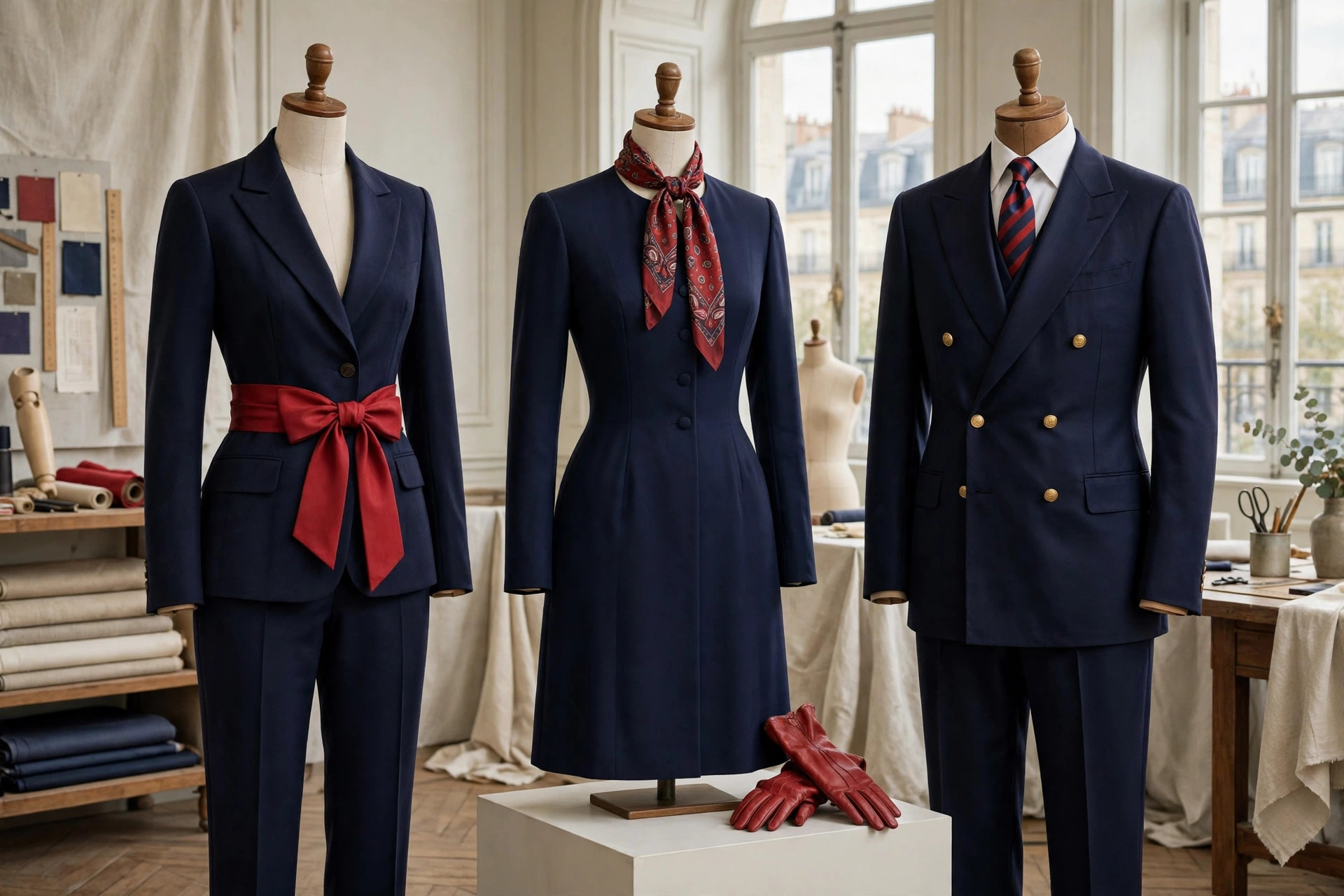
Lacroix's formula is restraint punctuated by red. The base is a deep navy blue — the colour Air France lightened and darkened across the decades before settling here — "enhanced by touches of red", in the airline's words: a belt, a scarf, a glove, a flash of piping. "You can recognize an Air France crew in any airport in the world," Lacroix said, "not just by their 'colours', of course, but by this inexpressible blend of allure and style." More than twenty years on, the airline's corporate heritage page still presents the 2005 wardrobe as the endpoint of its uniform story: it has never been replaced.

The Components
The Outfit, Piece by Piece
- The Dress
- The centrepiece for women: a navy dress with a neat stand collar, finished at the waist with the wardrobe's signature — a red belt in the form of a Japanese-style knot, a flat bow that reads instantly across a terminal. Topstitched seams trace the cut, a Lacroix signature carried across every tailored piece.
- The Tailored Suit
- Women may equally wear the tailored jacket with a skirt or trousers — the modular system is the point. Jackets and coats carry the same topstitching on their tabs and fronts, and gold and silver buckles finish the leather belts.
- The Scarf
- A printed silk scarf at the neck supplies the Gallic flourish every account of this uniform mentions — the soft counterpoint to the tailoring, and one of the pieces that lets the same suit read differently from wearer to wearer. Our scarf definition covers the garment's long career as uniform punctuation.
- The Red Gloves
- The most quoted accessory in European aviation: bright red leather gloves, topstitched like the tailoring. Worn for service — most famously in the premium cabins — they turn a drinks round into a small ceremony and give the navy wardrobe its exclamation mark.
- Hidden Details
- The couture is inside as well as out: inside pockets are piped in red, linings carry the Air France branding — the winged seahorse inherited from Air Orient appears in the linings — and even the purse is lined in red, the press kit noted, for easier visibility of what is inside.
- Outerwear & Knitwear
- Coats and jackets for the ground and the jet bridge, knit scarves and bob hats for winter stations: the hundred pieces dress staff, as the launch press kit put it, "from head to toe for every phase of their professional life" — the collection even included maternity wear.
- The Men's Suit
- For men, straight or double-breasted navy jackets with trousers, shirt and tie — the same navy, the same red points, the same topstitched discipline. Tie clips and knit scarves appear in the men's accessories just as gloves and belts do in the women's.
- Footwear & Bag
- Pumps for women and classic shoes for men complete a wardrobe designed as a total look; nothing in it is an afterthought, which is precisely what distinguishes a couturier's uniform from a catalogue issue.
Reading the Uniform
Braid, Stripes and the Red Gloves
Air France read rank off its uniforms from the very beginning: the airline's heritage page notes that the earliest men's uniforms — borrowed from the wardrobe of luxury-hotel sleeping-car staff — carried braids and insignia to mark a hierarchy, "a military style that the men's civil aviation uniform has kept intact to this day". The Lacroix wardrobe keeps that logic but softens its expression: this is a uniform you read by role and detail rather than by a ladder of different outfits.
| Who | What you see | What it tells you |
|---|---|---|
| Captain | Four stripes on the epaulettes and sleeves | Command of the aircraft — the convention of the epaulette system across European aviation. |
| First Officer | Three stripes | The captain's deputy on the flight deck. |
| Cabin crew | The same Lacroix wardrobe for the whole cabin | Seniority in the cabin is carried in role and title — the purser leads the service — rather than in a different costume; the uniform stays one family. |
| Premium-cabin service | Red leather gloves worn for service | The wardrobe's red rises to full strength where the service is most formal. |
Our epaulette definition explains where the stripe system came from. The subtler point of the Lacroix design is that it democratised the look: where Singapore Airlines (elsewhere in this series) colours the dress itself by rank, Air France dresses the whole team in the same navy and lets function — gloves on for the premium service, braid on the flight deck — do the talking.
The Men's Uniform
One Designer, Both Wardrobes
For most of Air France's history the men's and women's uniforms had different authors, or the men were simply issued a sober suit while the couturiers dressed the stewardesses. The Lacroix commission treated the whole company as one wardrobe. The men's collection is built from the same cloth logic: navy tailoring in straight or double-breasted jackets, worn with trousers, a shirt and a tie that carries the red point, and finished with the same accessories discipline — tie clips, knit scarves and bob hats for cold stations all appear in the hundred-piece list.
Because the system is modular for men too, the same jacket serves a January departure to Montreal and a July one to Dakar with different layers beneath and over it. The flight deck keeps its own older language — the braid and stripes the airline has carried since the sleeping-car era — but on the ground and in the cabin, men and women now read as one crew in a way no earlier Air France uniform had quite managed.
A Paris Catwalk at 35,000 Feet
Read the names in sequence and Air France's uniform history sounds like a fashion-week programme: Georgette Renal, Georgette de Trèze, Marc Bohan for Dior, Cristóbal Balenciaga, Jean Patou, then Carven, Nina Ricci, Grès and Louis Féraud — and finally Christian Lacroix. No other airline has spent ninety years treating its crew's clothing as a branch of national couture. The Lacroix wardrobe is best understood as the moment that tradition grew up: the couturier stayed, but the crew got a vote, the maternity wear went in, and the result has outlasted every fashion cycle since.
The Rules
Grooming: Polish, Taught Not Published
Air France does not publish its cabin-crew image charter — the standard is internal, assessed at the recruitment jury interview and taught during initial training at Paris, so what follows is the documented outline rather than a leaked manual. Recruitment guidance for Air France cabin crew has long required no visible tattoos or piercings in uniform, and the presentation expected is the classic French one: hair neat, off the collar and in a natural colour, styled to survive a long-haul rotation; makeup understated and coordinated with the uniform's navy and red rather than prescribed product by product.
Jewellery stays discreet and minimal — small, plain pieces that sit alongside the signature scarf rather than competing with it — and nails are kept clean, short and discreet. Travel writing about the uniform frequently adds one flourish: a red manicure echoing the gloves and belt. Whether prescribed or simply adopted, it captures the system's spirit — the grooming is not a separate rulebook bolted onto the clothes, but the same design, extended to the wearer. The angle of a scarf and the shine of a shoe are trained details, because in this uniform the details are the brand.
Evolution
From Renal to Lacroix: Ninety Years of Couture
1945–1951. The first stewardesses, recruited in 1945, wore a wardrobe of basics — suit, summer dress and coat — chosen from the Georgette Renal fashion house; in 1951 Georgette de Trèze modernised and feminised the look for the new decade.
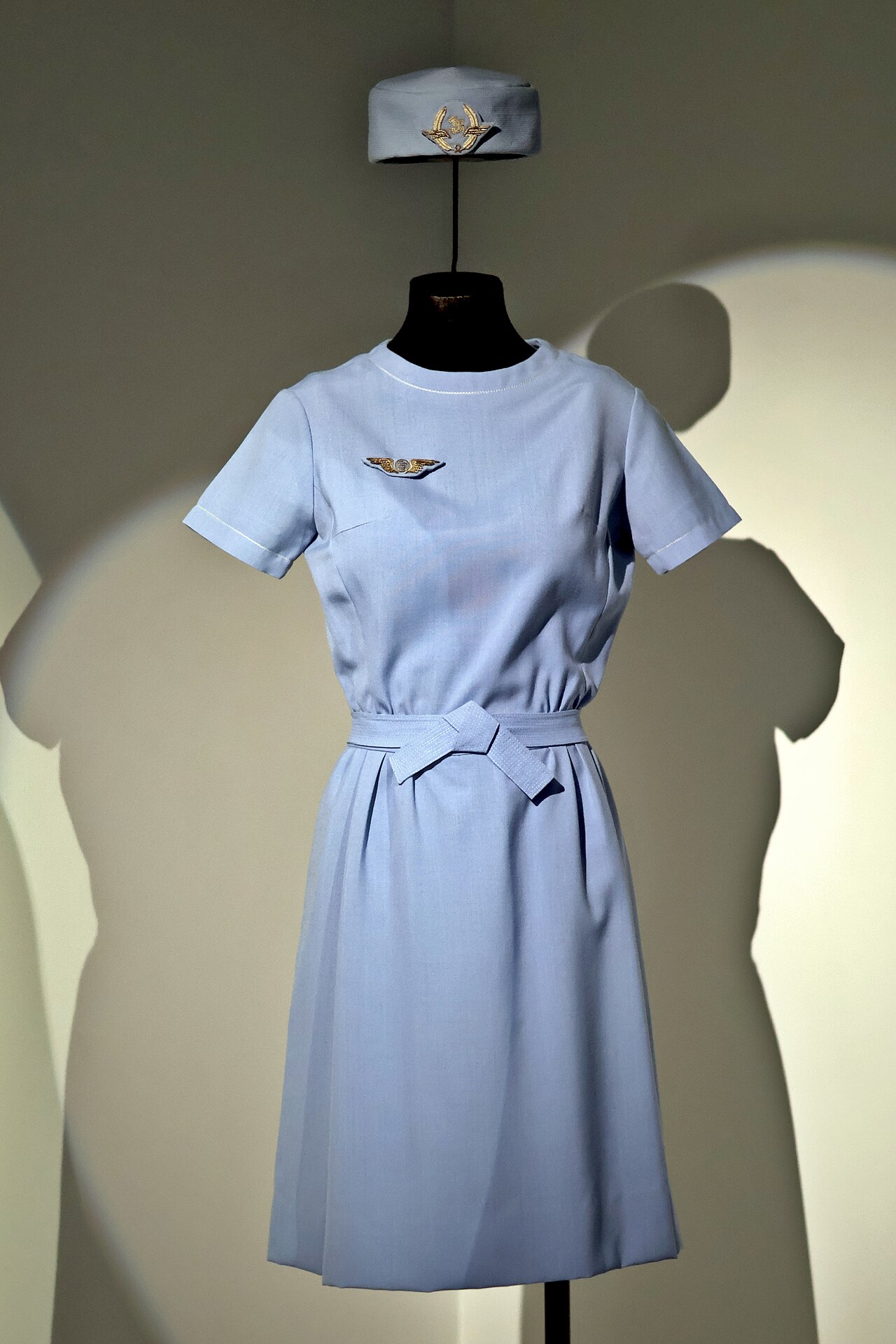
1962. The landmark: Marc Bohan at Dior designed the "Air France" model and showed it in his haute couture collection — the first couture uniform, in a lightened "Marceau blue", with a navy tambourine hat bearing the crest in place of the beret. A surviving example is held by the Air France Museum, photographed below.
1968–1976. Cristóbal Balenciaga designed the winter suits at the end of the 1960s, in a very "aeronautical" style, adding ground outfits in 1971 — though stewardesses complained the designers paid too little attention to working conditions, a lesson the 2005 co-construction answered. For Concorde's arrival in 1976, Jean Patou dressed the supersonic crews.
1978–1990s. Blue and white were "energized" by red in 1978, in a multi-faceted wardrobe shared between Carven, Nina Ricci and Grès; in 1987 the cabin wardrobe was split again — coat by Nina Ricci, main elements by Carven, summer dress by Louis Féraud. The 1990s then demanded the opposite: one identity for all agents after years of mergers, which set the brief Lacroix inherited.
2005–today. Lacroix's hundred-piece wardrobe unified the company under one couturier and one colour story. Its achievement is its lifespan: uniforms elsewhere in this series have been replaced two or three times in the same period, while the Lacroix navy and red — confirmed as current in the airline's own heritage material — simply continues.
The Icon
Why the Lacroix Wardrobe Endures
Most uniforms date; this one compounded. By refusing both the corporate-catalogue look and the seasonal redesign, Air France turned a 2005 wardrobe into a piece of national dress — the red knot belt and scarlet gloves are as much a shorthand for France in an airport as the tricolore on the tail. The design also proved a serious point about workwear: a hundred combinable pieces, built with the people who wear them, can satisfy a couturier's eye and a crew's working day at the same time, for decades. For the country whose fashion industry made it possible, see our France clothing industry page.
Airlines refresh their uniforms from time to time, so the details here describe the uniform as documented for this guide — the airline’s own site always carries the latest version.
Common Questions
Common Questions
Who designed the Air France uniform?
French couturier Christian Lacroix. His wardrobe was unveiled in 2005 after three years of co-construction with Air France staff, and it remains the airline's current uniform: around a hundred combinable pieces in navy blue enhanced by touches of red.
How many pieces are in the Air France uniform wardrobe?
Around a hundred combinable pieces, in Air France's own description. The system covers dresses, tailored suits, coats, knitwear, scarves, hats and accessories — including maternity wear — so crew build combinations for season, route and role rather than wearing a single fixed outfit.
What are the red belt and red gloves in the Air France uniform?
They are Christian Lacroix's signature accents on the navy wardrobe. The women's dress is finished with a red belt in the form of a Japanese-style knot, and bright red leather gloves — topstitched like the tailoring — are worn for service, most famously in the premium cabins.
Has the Air France uniform changed since 2005?
No successor has replaced it. Air France's corporate heritage page presents the 2005 Christian Lacroix wardrobe as the endpoint of its uniform story, and the airline's anniversary history calls it 'the current Air France uniform designed by Christian Lacroix in 2005' — a lifespan of over twenty years, exceptional for a designer uniform.
Which designers created Air France uniforms before Lacroix?
A roll-call of Paris couture: Georgette Renal dressed the first stewardesses in 1945, Georgette de Trèze followed in 1951, Marc Bohan designed the first couture uniform for Dior in 1962, Cristóbal Balenciaga created the winter suits at the end of the 1960s, Jean Patou dressed the Concorde crews in 1976, and Carven, Nina Ricci, Grès and Louis Féraud shared the wardrobes of 1978 and 1987.
Keep Exploring
More to Explore
In This Series
Airline Uniforms by Airline
The series hub — every airline’s guide, the designers behind them, and the ones in preparation.
Read ↑France Clothing Industry
The airline's home country in the World Clothing Industry directory — the fashion capital behind the uniform.
Read ↑Christian Lacroix
The couturier behind the wardrobe — his house, his career and his work, in our designer profile.
Read ↑Go Deeper
Uniforms — Definition
What a uniform is, and why organisations dress their people alike.
Read ↑Scarf — Definition
The accessory that gives the Lacroix tailoring its Gallic flourish, defined.
Read ↑Tie & Necktie — Definition
The men's wardrobe's red point, defined.
Read ↑Christian Lacroix — Designer Definition
The designer in brief, from our fashion definitions.
Read ↑Keep Exploring
Explore Fashion for Travel
The crew are only half the fashion on a flight — the other half is what the passengers are wearing. Our travel guides cover the traveller’s side of the same subject, and they link back here.
Outfits for Flying
Travel Outfits
What to wear when you are going somewhere — outfit systems built for transit days.
Read ↑Airport Outfits
Security-friendly shoes, cabin layers and the full airport dressing system.
Read ↑What to Wear on a Long Flight
Dressing for the overnight haul — comfort, warmth and arriving presentable.
Read ↑What to Wear When Traveling
The destination-rules guide to building a travel wardrobe that works on arrival.
Read ↑Business Travel Wardrobe Guide
A working wardrobe that travels — suits, wrinkle strategy and boardroom-ready arrivals.
Read ↑Packing & Capsule Wardrobes
Travel Capsule Wardrobe Guide
A small set of pieces that combine into a trip’s worth of outfits.
Read ↑Travel Packing Guide
The complete packing method — lists, order and wrinkle control.
Read ↑How to Pack a Suit
Getting a tailored jacket and trousers across the world without the creases.
Read ↑Carry-On Packing Guide
Everything in one bag — the carry-on-only system, piece by piece.
Read ↑Travel Comfort & Accessories
Search Apparel Search