Airline Uniforms by Airline · United Arab Emirates
The Etihad Chocolate-and-Purple Uniform
On 18 December 2014, in a hangar in Abu Dhabi, Etihad Airways did something no other airline had quite done: it launched a uniform the way fashion houses launch a collection — catwalk, couturier, desert photo shoot and all. Italian haute couturier Ettore Bilotta’s chocolate-brown, purple-accented wardrobe replaced everything the young airline had worn since 2003, and it is still the uniform today. This guide tells its story, piece by piece.
The Design
Ettore Bilotta and the Couture Relaunch of 2014
The Etihad uniform was created by Ettore Bilotta, the Italian haute couturier, at his atelier in Milan, working with the airline’s Guest Services and Guest Experience teams. It was revealed on 18 December 2014 at a catwalk show in Abu Dhabi — staged alongside the arrival of the airline’s first Airbus A380 and Boeing 787-9 — and introduced system-wide from 27 December 2014. It was the airline’s first major uniform relaunch since its formation in 2003, and it was conceived as a brand event, not a wardrobe change: the colours were drawn from the new brand identity that was simultaneously appearing on the aircraft livery and in the cabins.
Bilotta’s stated language for the collection was a merger: “dramatic elements of old world haute couture from 1960s Paris and Rome” with the contemporary runways of London, New York, Milan and Tokyo. His relationship with the airline was not new — “Since the launch of Etihad in 2003, I have come to know the airline, its teams and management very intimately,” he said at the reveal, “and have developed a style which has evolved as the airline has grown. For me it has essentially been about dressing a brand and an ethos.” The airline’s own framing went further still: its guest services chief called the result “not just a uniform… a prêt-à-porter concept — a future lifestyle statement and homage to the golden age of glamorous flight.”
The reveal itself was staged as fashion, not logistics: a catwalk fashion show at which 22 Etihad cabin crew modelled the collection for global media, held as the finale of the A380 and 787 launch event. The airline’s chief commercial officer, Peter Baumgartner, framed the ambition plainly at the launch: Ettore, working with the airline’s teams, had delivered a uniform that would “showcase our brand with characteristic flair at every city on our ever-growing network” — a uniform intended, from its first day, to be read as the brand itself in every airport it entered.
The brief Bilotta was given — timeless sophistication, glamour and elegance — produced the most deliberately fashion uniform of the three Gulf carriers: where Emirates held a 1985 silhouette still and Qatar tailored a flag, Etihad commissioned a couturier to dress an ambition. The collection covered far more than cabin crew: Butlers in The Residence by Etihad, First Class Inflight Chefs, Business Class Food & Beverage Managers, Cabin Managers, Cabin Crew, Flying Nannies, and the airport and lounge teams all received new designs in the same collection.

The Components
The Outfit, Piece by Piece
Read the collection as Bilotta assembled it and two things stand out. The first is how complete it is: this was not a jacket-and-skirt update but a total wardrobe, running from the butler’s tailcoat to the lounge agent’s service dress, every role re-drawn in one palette and one pattern language. The second is the specification level — couture cloth, hand-finishing, accessories designed as objects in their own right. The components below are the ones the airline itself documented at the launch.
- The Women’s Skirt Suit
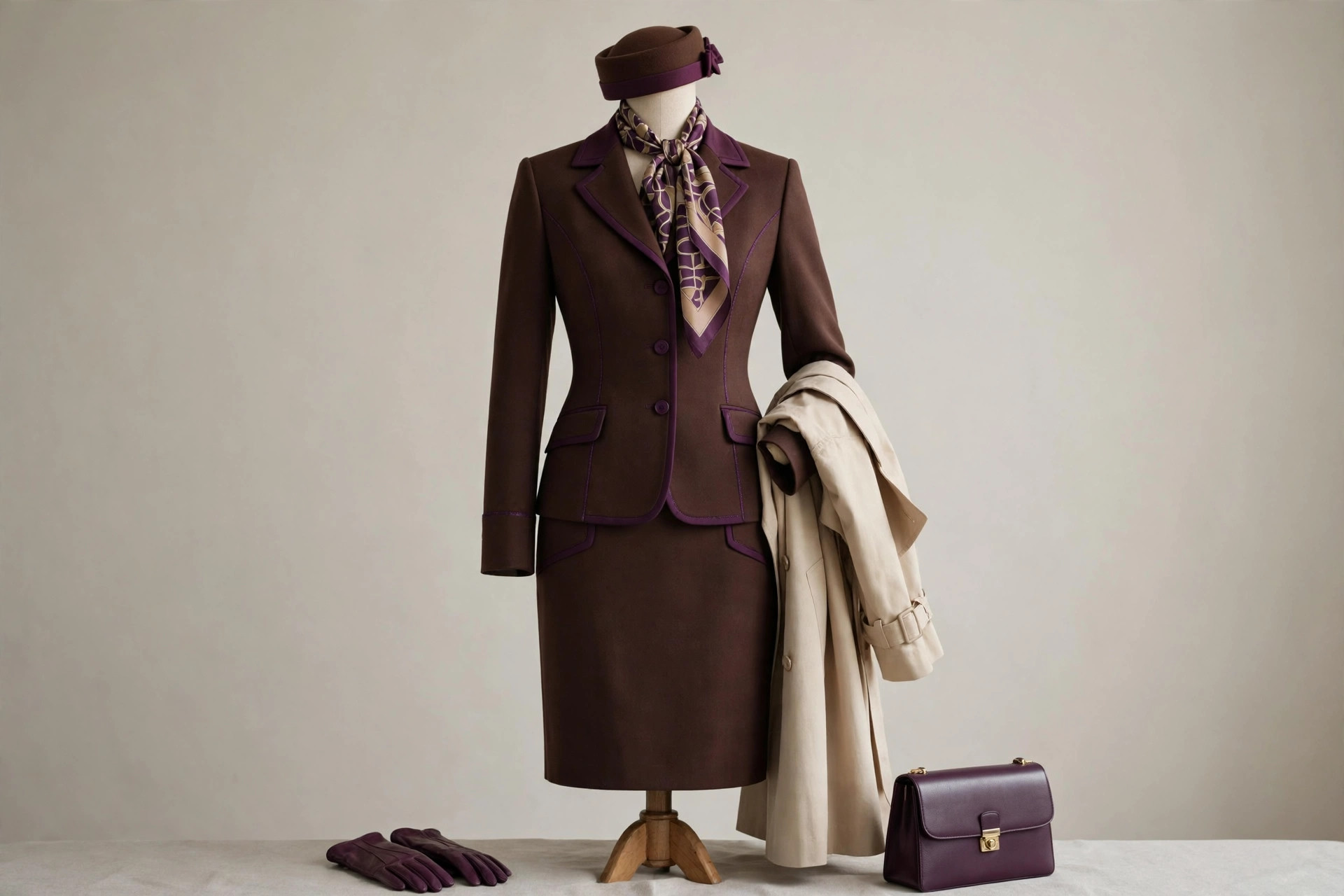
- Female cabin crew, ground and lounge teams wear a tailored skirt suit in the collection’s warm chocolate brown, cut and fitted for ease of movement. The cloth is 100 per cent Italian wool with an intricate jacquard design woven through it — a couture specification, made across Italy with further manufacturing in Shanghai, Tunis and Bucharest by a team of some 400 people, with roughly 30 per cent of each outfit handmade or hand-stitched.
- The Retro Hat
- The signature headpiece: a more aerodynamic, “retro” hat inspired jointly by the stars of Hollywood’s Silver Screen and by the sweeping formations of the Emirati desert sand dunes — the collection’s two muses, glamour and home, in a single garment.
- The Scarf
- Worn with the hat and suit, the scarf carries the collection’s pattern language: intricate geometric patterns and fretwork, repeated across gloves and neckties. Our scarf definition covers the garment’s wider history.
- Gloves, Belt and Bag
- The women’s ensemble is accessorised with fitted gloves and a belt, and finished with a slim-line handbag made — in a detail that dates the design to its exact moment — to the dimensions of a tablet device.
- The Trench Coat
- A classic trench adds, in the airline’s words, “a sense of catwalk drama” to every variation of the uniform. Lightweight, foldable and wearable in all weathers, it is the collection’s outer layer across roles. See our trench coat definition for the garment’s own long history.
- The Butler’s Uniform
- The collection’s most theatrical commission: for the Butlers of The Residence by Etihad, historic British butler attire was combined with the airline’s modern style — warm brown for the long-tailed jackets and ties, ivory for the trousers and waistcoats, white for shirt and gloves, in tones echoing The Residence cabin itself and the “Facets of Abu Dhabi” livery.
Reading the Uniform
Purple Flies, Orange Meets: The Role Colours
Bilotta built the whole collection on one base and two signals. Almost the entire Etihad brand palette appears somewhere in the wardrobe, but the primary code a passenger needs is simple: the accent colour tells you where a person works.
| Accent | Who wears it | Where they work |
|---|---|---|
| Chocolate brown (base) | Everyone | The shared ground of every variation in the collection. |
| Deep purple | Cabin crew and lounge teams | The flying and lounge-facing grades — the colour of the cabin. |
| Burnt orange | Ground crews and Special Services teams | The airport-facing grades — check-in, gates and special assistance. |
Beneath that primary code sits a subtler one: Bilotta broke up the main shades by introducing all of the brand’s secondary colours as accents on blouses and accessories, so the collection rewards a close look — a blouse tint here, a patterned tie there — while remaining instantly legible at the distance of a departure hall. It is colour-coding designed the way a fashion designer, rather than a uniform supplier, would do it: hierarchy expressed as palette.
The Men’s Uniform
Three Pieces in the Cabin, Two on the Ground
Male cabin crew wear a three-piece suit in the chocolate-brown collection cloth; male ground crew wear a two-piece suit. Belts and gloves complete both, and the trench coat layers over either. Male lounge agents received their own variation — new Food & Beverage uniforms aligned with those of the onboard Food & Beverage Managers, so that the service style of the lounge and the cabin match.
The men’s neckties carry the same geometric patterns and fretwork as the women’s scarves and gloves — the collection’s pattern language is deliberately unisex, so that a crew standing together reads as one designed wardrobe rather than two separate ones. In a collection built from a couture atelier, that coherence was the point: Bilotta described his task as dressing a brand, and the men’s suiting is where the brand’s tailoring is most literally on display.
Photographed on the Dunes
Airlines usually photograph a new uniform in a cabin mock-up. Etihad commissioned Norman Jean Roy — a New York photographer known for Vogue and Vanity Fair work — and took the collection to the sand dunes of Abu Dhabi’s Liwa desert and the Qasr al Sarab desert resort. The images set chocolate-brown couture tailoring against the landscape the brand calls home: the same desert that inspired the hat’s sweeping lines. It remains the most fashion-editorial launch imagery any airline uniform has received.
The Rules
Style and Image: The MAC Recalibration
Etihad treated grooming as part of the 2014 design, not an afterthought. “Style and image have been re-examined in line with the new collection,” the airline announced: the bold, fiery makeup and lipstick tones of the previous era were replaced with calmer shades chosen to complement the new earthy palette. To deliver the look, Etihad collaborated with makeup experts MAC, whose products crew use at the airline’s dedicated “Style & Image Suites” at its Training Academy and its Innovation Training Academy — grooming infrastructure built into the training estate itself.
The airline does not publish its full grooming manual. Beyond the launch-documented recalibration, the standards described in crew guidance and crew accounts include a complete makeup face coordinated with the uniform palette; hair in a French twist, a low bun, or a short cut kept off the collar; nails polished in neutral tones — beige, pale pink or a French manicure; jewellery limited to small plain earrings and plain rings with a simple watch; and no tattoos visible in uniform. Male crew present clean-shaven under the documented standard. As with its Gulf neighbours, the principle is the same: the grooming is not separate from Bilotta’s design — it is the part of the design the wearer supplies.
Evolution
A Young Airline, Two Uniform Eras
2003 — formation. Etihad Airways began operations in 2003 as the new flag carrier of Abu Dhabi. Its first uniforms belonged to an airline inventing itself quickly; Bilotta, by his own account, knew the airline from its launch and developed his style for it as it grew — a long couturier relationship behind the scenes of the young carrier.
2003–2014 — the first era. For its first decade the airline wore its founding-generation wardrobe, with the bolder makeup palette — the “fiery” lipstick tones the 2014 relaunch would deliberately retire. As the network, fleet and ambitions expanded, the case for a uniform that matched the airline Etihad had become grew with them.
18–27 December 2014 — the relaunch. The Bilotta collection was revealed at the A380 and 787 launch show on 18 December and worn system-wide from 27 December: chocolate brown, purple and burnt orange; Italian wool and jacquard; hats modelled on Hollywood and the dunes; trench coats, tablet-sized bags and a butler’s uniform for a three-room suite in the sky. It was, as the airline itself noted, the first major uniform relaunch since 2003 — and it was staged to be noticed.
Since 2014 — the collection endures. The Bilotta wardrobe remains Etihad’s uniform today, the second era now longer than the first. For an airline founded only in 2003, that stability is itself a statement: the 2014 collection was designed as a classic — “timeless sophistication” was the brief — and a decade in service is the first real evidence that the brief was met.
The Statement
Couture as a National Airline’s Language
Etihad’s uniform matters because of what it attempted. The other Gulf wardrobes in this series grew — one held still for forty years, one tailored a national flag. Etihad, the youngest of the three, reached for the oldest language in fashion: a Milan atelier, a named couturier, wool and jacquard and hand-stitching, a catwalk in a hangar and a photo shoot in the desert. It treated a uniform not as corporate clothing but as a collection — and in doing so set the high-water mark for how far an airline uniform can go toward fashion before it stops being a uniform at all. That it has remained in service, essentially as launched, for over a decade suggests the balance was struck: glamorous enough to launch on a catwalk, practical enough — fitted, flexible, easy to move in, in the airline’s own launch description — to work a long-haul roster. Few uniforms are asked to be both. For the country behind it, see our UAE clothing industry page.
Airlines refresh their uniforms from time to time, so the details here describe the uniform as documented for this guide — the airline’s own site always carries the latest version.
Common Questions
Common Questions
Who designed the Etihad Airways uniform?
Italian haute couturier Ettore Bilotta, at his atelier in Milan, working with the airline’s Guest Services and Guest Experience teams. The collection was revealed on 18 December 2014 and introduced system-wide from 27 December 2014 — the airline’s first major uniform relaunch since its formation in 2003.
What do the Etihad uniform colours mean?
A warm chocolate brown is the base colour for every variation. Deep purple accents mark cabin crew and lounge teams; burnt orange accents mark ground crews and Special Services teams. Secondary brand colours appear as smaller accents on blouses and accessories.
What is the Etihad uniform made from?
100 per cent Italian wool with an intricate jacquard design. The uniforms were made in various locations across Italy, with additional manufacturing in Shanghai, Tunis and Bucharest by a team of around 400 people — and approximately 30 per cent of each outfit was handmade or hand-stitched.
What do male Etihad crew wear?
Male cabin crew wear a three-piece suit and male ground crew a two-piece suit, both in the collection’s chocolate brown, with belts, gloves and patterned neckties. A lightweight trench coat can be worn over any variation of the uniform.
Has the Etihad uniform changed since 2014?
The Bilotta collection remains the airline’s uniform. Its launch also reset the grooming that goes with it: the previous bold, fiery makeup tones were replaced with calmer shades developed with MAC, delivered through the airline’s Style & Image Suites at its training academies.
Keep Exploring
More to Explore
In This Series
Airline Uniforms by Airline
The series hub — every airline’s guide, the designers behind them, and the ones in preparation.
Read ↑UAE Clothing Industry
The airline’s home country in the World Clothing Industry directory.
Read ↑Go Deeper
Keep Exploring
Explore Fashion for Travel
The crew are only half the fashion on a flight — the other half is what the passengers are wearing. Our travel guides cover the traveller’s side of the same subject, and they link back here.
Outfits for Flying
Travel Outfits
What to wear when you are going somewhere — outfit systems built for transit days.
Read ↑Airport Outfits
Security-friendly shoes, cabin layers and the full airport dressing system.
Read ↑What to Wear on a Long Flight
Dressing for the overnight haul — comfort, warmth and arriving presentable.
Read ↑What to Wear When Traveling
The destination-rules guide to building a travel wardrobe that works on arrival.
Read ↑Business Travel Wardrobe Guide
A working wardrobe that travels — suits, wrinkle strategy and boardroom-ready arrivals.
Read ↑Packing & Capsule Wardrobes
Travel Capsule Wardrobe Guide
A small set of pieces that combine into a trip’s worth of outfits.
Read ↑Travel Packing Guide
The complete packing method — lists, order and wrinkle control.
Read ↑How to Pack a Suit
Getting a tailored jacket and trousers across the world without the creases.
Read ↑Carry-On Packing Guide
Everything in one bag — the carry-on-only system, piece by piece.
Read ↑Travel Comfort & Accessories
Search Apparel Search