Airline Uniforms by Airline · United Arab Emirates
The Emirates Red Hat and Veil
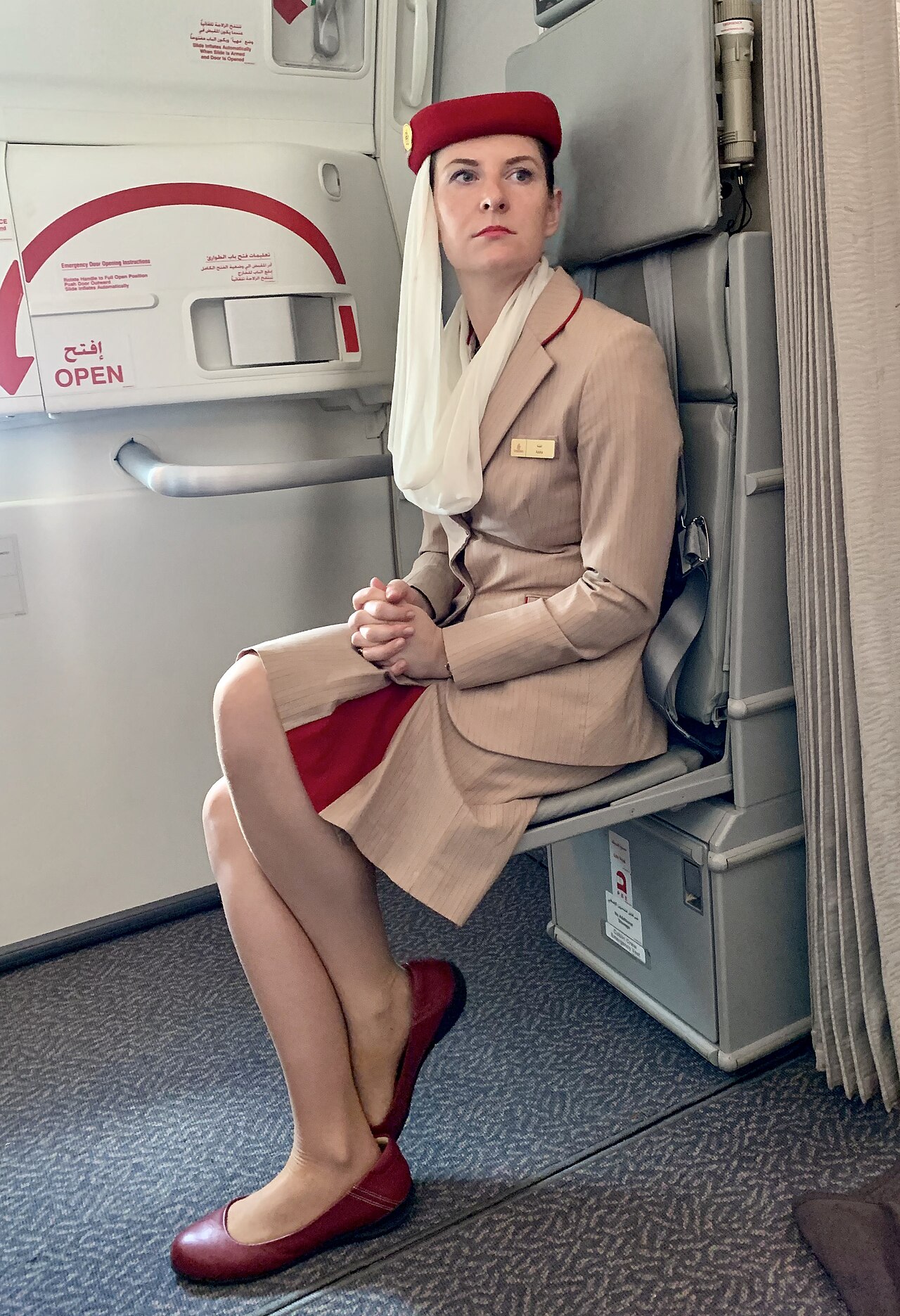
You can identify an Emirates crew member across the largest airport on earth, at a glance, from behind: a beige pinstripe suit, a small red hat, and a cream scarf draped from it like a flag. The look has barely changed since 1985 — and the version worn today, created for the arrival of the Airbus A380 in July 2008, is the most considered of all. This guide takes it apart piece by piece.

The Design
Designed In-House, with Simon Jersey, for the A380
The current Emirates uniform was introduced in July 2008, timed to the delivery of the airline’s first Airbus A380 at a ceremony in Hamburg — the A380 crews wore it first, and the full rollout to some 16,000 uniformed cabin crew and ground staff was completed by May 2009. It was the product of a two-year project, and unusually for a Gulf carrier it did not go to a couture house: it was designed by Emirates’ own in-house team in collaboration with Simon Jersey, the British uniform manufacturer. The brief, in the words of the airline’s service delivery chief at the launch, was to modernise the look while retaining “the iconic and instantly recognizable hallmark of our uniform worldwide” — and to make one wardrobe work across climates, for cabin crew and ground staff alike, using a mix-and-match catalogue approach.
That restraint is the design’s real story. Where other airlines treat a new uniform as a rebrand, Emirates treated it as a refinement: the beige-and-red palette that had identified the airline since 1985 was preserved exactly, and the changes were tailored ones — a subtle pinstripe through the suiting, red trims, a reworked hat, deeper maroon-red accessories. A famous name does appear in this uniform’s history, but earlier: Paco Rabanne redesigned the wardrobe in 1997, and his cleaner 1990s cut is part of the lineage the 2008 team inherited. The 2008 uniform itself, however, is an in-house and Simon Jersey creation, and it is the one still flying today.
The colour logic is national as much as corporate. Emirates itself describes the sandy beige as the sunlight on the desert dunes of its home, the United Arab Emirates, with red — the colour of the hat, the pleats and the lipstick — as the accent that carries the brand. The airline has kept faith with that reading for forty years, rejecting, in its own words, fast fashion and trends in favour of timeless style.

The Components
The Outfit, Piece by Piece
- The Jacket
- A tailored, single-breasted jacket in the signature sandy beige, woven with a subtle pinstripe and finished with red trim. It is the formal layer: worn in the terminal, for boarding and for disembarkation, and the anchor of the whole silhouette.
- The Skirt and Its Red Pleats
- A straight, below-the-knee skirt in the same pinstripe — with the uniform’s cleverest detail built in: four kick pleats that open to reveal Emirates red as the wearer walks. Standing still, the suit is all beige; in motion, it flashes the brand colour with every step.
- The Blouse
- A fitted cream blouse worn beneath the jacket, its trim colour quietly carrying rank information — see the rank section below. The 2008 redesign made the blouses more fitted and “chic” in the airline’s own launch description.
- The Red Hat
- The most recognisable hat in aviation: a small red pillbox, redesigned in 2008 with the Emirates logo repositioned on the side in a wing shape and a beige piping detail. It is formal dress — worn in public, for boarding and disembarkation, and stowed once the doors close and service begins.
- The Cream Scarf — the “Veil”
- Draped from the hat is a cream chiffon scarf, worn like a veil over the hair and around the neck. It carries the uniform’s best-known piece of symbolism: its seven pleats represent the seven emirates of the UAE. Our veil definition and scarf definition cover both garments in their wider dress history; the scarf is a styling and cultural element of the uniform rather than a religious garment — compare our hijab definition for the distinction.
- Accessories
- Shoes, belts and handbags were set in a slightly darker maroon-red than the hat in 2008, to complement the trims; in 2023 the bags and belts moved to a brighter red that matches the skirt pleat and the hat more assertively.
- Footwear — and the 2023 Choice
- The 2023 update was about feet. Female crew were offered a personal choice of 15 shoe styles — Spanish-manufactured, all-leather, in a range of heights, widths and shapes — with a matching range for men, so that a uniform built on identical appearance could finally accommodate individual feet on ultra-long-haul duties.
- The Cloth Itself
- The current uniform uses nano-coated fabrics for stain and crease resistance — a practical technology choice the airline highlights as the reason the beige suit can still look immaculate at the end of a fourteen-hour sector.
Reading the Uniform
Red Hats, Brown Hats: The Purser Code
Emirates does not use sleeve stripes for its cabin crew. Rank is read from small colour swaps inside the same wardrobe — you have to know where to look. The system documented for the 2008 Simon Jersey wardrobe works like this:
| Who | What changes | How to read it |
|---|---|---|
| Female cabin crew | Red hat; blouse trimmed in red | The standard uniform most passengers know. |
| Female pursers | Chocolate-brown hat; blouse trimmed in cream | The senior woman in the cabin swaps the red hat for brown. |
| Male cabin crew | Striped tie in caramel, honey and red | The standard men’s tie, drawn from the brand palette. |
| Male pursers | Brown-and-cream tie | The quiet swap that marks the man in charge of the cabin. |
It is a discreet code — appropriate for a service culture that prefers its hierarchy invisible to passengers — but a consistent one: hat, trim and tie all change together, so a trained eye can read the cabin’s chain of command from the galley door.
The Men’s Uniform
Chocolate Brown, Cream and a Striped Tie
The men’s 2008 uniform is a deliberate counterpoint to the women’s beige: a rich chocolate-brown pinstripe suit with subtle red trim, a cream shirt and a striped tie in gold, brown and red — described at the launch as a luxurious reflection of the airline’s success. The contrast is functional as well as aesthetic: in a terminal, the dark-suited men and beige-suited women read instantly as one team in two registers, tied together by the shared red and the shared pinstripe.
The men’s wardrobe has its own history inside the evolution below — grey suits and red ties in 1985, navy jackets with beige trousers under Paco Rabanne in 1997 — and its own share of the 2023 footwear change, when the all-leather shoe choice was extended to male crew as well.
Seven Pleats, Seven Emirates
The most poetic detail in modern uniform design is hidden in a fold of cream chiffon. The scarf draped from the Emirates hat is pleated seven times — once for each of the seven emirates that make up the United Arab Emirates: Abu Dhabi, Dubai, Sharjah, Ajman, Umm Al Quwain, Ras Al Khaimah and Fujairah. The hat itself carries the Emirates name in Arabic calligraphy. A uniform is usually a company’s flag; this one is, quite literally, a federation worn on the head.
The Rules
Grooming: Red Lipstick and a Dedicated Training Day
Emirates does not publish its full grooming manual, but the standards that surround this uniform are extensively documented in the airline’s own training descriptions and in crew accounts. Presentation is taught, not assumed: cabin crew training devotes a dedicated day to uniform and appearance, covering hair, makeup, skincare, nails and the correct wearing of every item.
The hat has a correct position — worn neatly, slightly forward above the eyebrows — and the scarf a correct drape, carefully folded with its end tucked in. The signature makeup element is red lipstick matched to the hat, the single most imitated detail of the “Emirates look”; nails are kept to the documented palette of clear, French manicure or the same signature red. Jewellery is discreet, tattoos must not be visible in uniform, and shoes are approved styles, clean and polished. The hat itself is a public-facing garment: it is worn for boarding, disembarkation and appearances, and can be removed once the work of service begins inside the closed cabin.
Read together, the rules explain the effect passengers notice: thousands of crew from well over a hundred nationalities presenting as one unmistakable figure. The grooming standard is not decoration added to the uniform — at Emirates it is treated as part of the uniform, inspected with the same seriousness as the tailoring.
Evolution
1985 to Today: Change Around a Constant
1985 — the look is born. Emirates dressed its first 80 cabin crew in warm sandy-beige jackets with red piping and subtle shoulder pads, a straight skirt just below the knee with a single pleat, a cream blouse with a red ribbon bow at the collar — and already the red hat, with the Emirates Arabic logo, and the white scarf with its seven pleats. The men wore a classic grey suit with a red tie and white shirt. Almost everything that matters was present on day one.
1987 — culture in tasteful touches. The women’s uniform was refreshed as a double-breasted beige jacket with gold buttons, a longer skirt with an extended pleat and a white blouse patterned with a subtle Emirates logo; the red hat and veil stayed. The same year brought a lighter “Summer Safari” dress, and First Class crew served Arabic coffee and dates in a traditional Arabic dress, the Thoub — an early sign of how deliberately this airline dresses its service rituals.
1997 — Paco Rabanne. With a decade of growth behind it, Emirates commissioned Spanish designer Paco Rabanne, who kept the beige and red but recut the wardrobe in the clean aesthetic of the 1990s: a shapely skirt, a round-neck blouse with a jacquard logo print, a slimline jacket with a mandarin collar, and brown bags and shoes. The men moved to navy jackets with beige trousers. This is the redesign Rabanne is remembered for — and the one the current uniform replaced.
2008 — the signature settles. The in-house and Simon Jersey wardrobe described in this guide: pinstripe, four red-revealing kick pleats, the wing-logo hat, chocolate-brown suits for the men. It has now been in service longer than any previous Emirates generation.
2023 — choice arrives. The palette did not change; the fit philosophy did. Fifteen shoe styles to choose from, brighter red leather bags and belts, and nano-coated cloth: evolution at Emirates now happens in comfort and technology, while the silhouette — the thing passengers recognise — is held deliberately still.
The Icon
Why the Beige Suit Endures
Most airline uniforms are remembered as periods — the sixties look, the nineties look. The Emirates uniform is remembered as a constant, and that is a design achievement of a particular kind: it required an airline to decide, early, that recognition was worth more than novelty, and then to hold that decision through four decades of growth from 80 crew to tens of thousands. The beige that symbolises the dunes, the red that carries the brand, the veil that counts the nation’s seven emirates — the uniform is a small, wearable piece of national storytelling, which is why it belongs in a series about clothing as much as aviation. For the country it represents, see our UAE clothing industry page.
Airlines refresh their uniforms from time to time, so the details here describe the uniform as documented for this guide — the airline’s own site always carries the latest version.
Common Questions
Common Questions
What does the Emirates cabin crew uniform look like?
A sandy-beige pinstripe suit — tailored jacket and below-the-knee skirt with four kick pleats that reveal Emirates red as the wearer walks — worn with a cream blouse, a small red hat, and a cream chiffon scarf draped from the hat like a veil. The scarf’s seven pleats represent the seven emirates of the UAE. Men wear a chocolate-brown pinstripe suit with a cream shirt and a striped tie in gold, brown and red.
Who designed the current Emirates uniform?
Emirates’ in-house team, in collaboration with British uniform manufacturer Simon Jersey. It was introduced in July 2008 for the arrival of the airline’s first Airbus A380. The famous designer name in the uniform’s history is Paco Rabanne — but he designed the previous, 1997 generation, not the current one.
Why does the Emirates scarf have seven pleats?
The seven pleats represent the seven emirates that make up the United Arab Emirates: Abu Dhabi, Dubai, Sharjah, Ajman, Umm Al Quwain, Ras Al Khaimah and Fujairah. The beige of the suit likewise symbolises the desert dunes of the airline’s home country.
What shoes do Emirates cabin crew wear?
Since 2023, female crew choose their own shoes from a range of 15 styles — Spanish-manufactured, 100 per cent leather, in different heights, widths and shapes — with a matching choice for male crew. The 2023 update also brought brighter red leather handbags and belts to match the skirt pleat and hat.
How can you tell an Emirates purser from other cabin crew?
By small colour swaps in the same wardrobe. A female purser wears a chocolate-brown hat instead of red, and her blouse is trimmed in cream rather than red. A male purser wears a brown-and-cream tie instead of the standard caramel, honey and red striped tie.
Keep Exploring
More to Explore
In This Series
Airline Uniforms by Airline
The series hub — every airline’s guide, the designers behind them, and the ones in preparation.
Read ↑UAE Clothing Industry
The airline’s home country in the World Clothing Industry directory.
Read ↑Go Deeper
Veil — Definition
The draped head covering the Emirates scarf echoes, defined and traced.
Read ↑Scarf — Definition
The scarf as a garment — the piece that carries the uniform’s seven-pleat symbolism.
Read ↑Hijab — Definition
The head covering the Emirates veil is often compared with — and how it differs.
Read ↑Uniforms — Definition
What a uniform is, and why organisations dress their people alike.
Read ↑Keep Exploring
Explore Fashion for Travel
The crew are only half the fashion on a flight — the other half is what the passengers are wearing. Our travel guides cover the traveller’s side of the same subject, and they link back here.
Outfits for Flying
Travel Outfits
What to wear when you are going somewhere — outfit systems built for transit days.
Read ↑Airport Outfits
Security-friendly shoes, cabin layers and the full airport dressing system.
Read ↑What to Wear on a Long Flight
Dressing for the overnight haul — comfort, warmth and arriving presentable.
Read ↑What to Wear When Traveling
The destination-rules guide to building a travel wardrobe that works on arrival.
Read ↑Business Travel Wardrobe Guide
A working wardrobe that travels — suits, wrinkle strategy and boardroom-ready arrivals.
Read ↑Packing & Capsule Wardrobes
Travel Capsule Wardrobe Guide
A small set of pieces that combine into a trip’s worth of outfits.
Read ↑Travel Packing Guide
The complete packing method — lists, order and wrinkle control.
Read ↑How to Pack a Suit
Getting a tailored jacket and trousers across the world without the creases.
Read ↑Carry-On Packing Guide
Everything in one bag — the carry-on-only system, piece by piece.
Read ↑Travel Comfort & Accessories
Search Apparel Search