Copenhagen Fashion Week
The Nordic fashion week that made sustainability a condition of showing — its seasons, its rules, its brands, and how to follow it.
Copenhagen Fashion Week (CPHFW) is the fashion week of Copenhagen, Denmark, and the leading fashion week of the Nordic region. Held twice a year, it presents Danish and Nordic designers — alongside international guests — in runway shows, presentations, installations and talks across the Danish capital. It is the anchor event of Denmark's fashion week landscape, and the only entry a reader needs to understand how the Danish industry shows itself to the world.
What separates Copenhagen from every other week on the calendar is not its size but its rules. Since 2023, a brand cannot simply be invited or apply its way onto the official schedule: it must first meet Copenhagen Fashion Week's Sustainability Requirements, a set of binding minimum standards covering everything from the materials in the collection to the waste produced by the show itself. That single policy turned a well-regarded regional week into the fashion week whose methods the rest of the industry — including far older fashion capitals — now borrow.
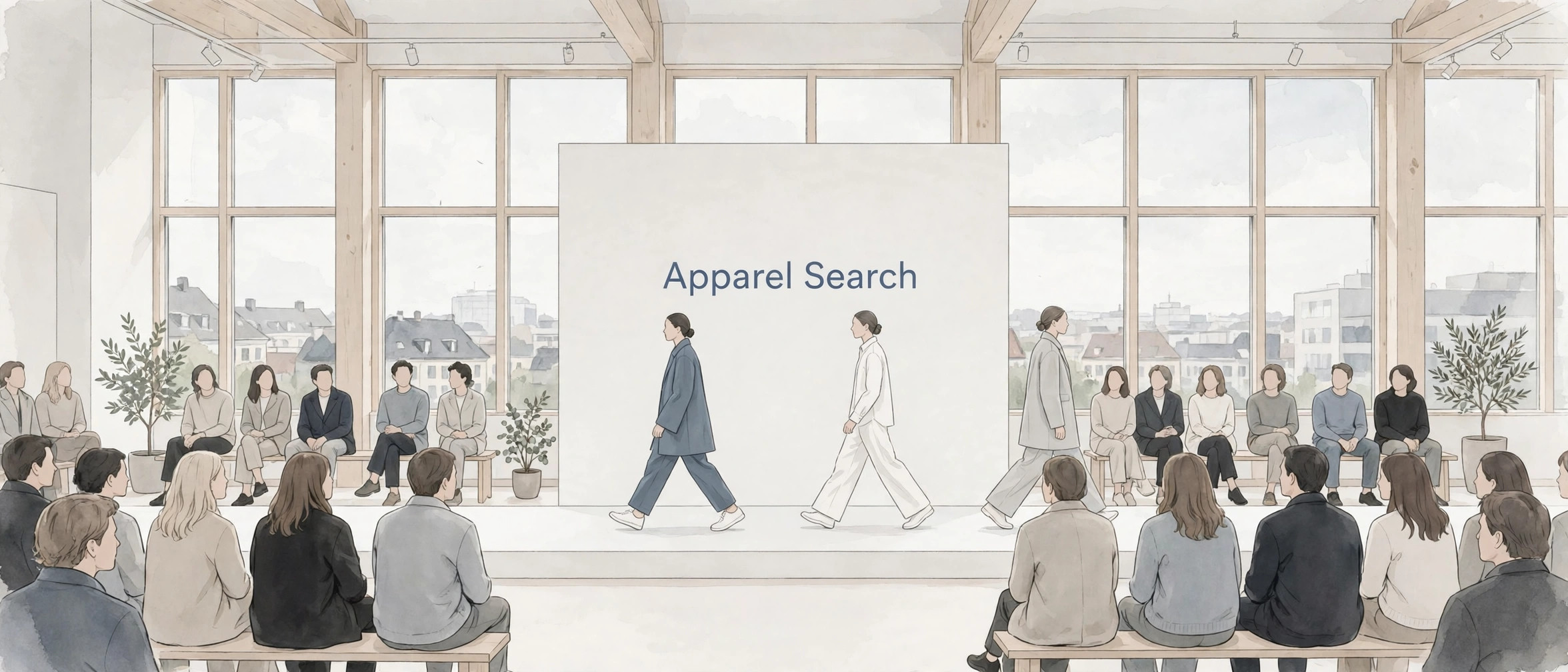
Illustrative image created for this guide — an artistic impression, not photographs from this show.
Search Apparel Search
Denmark Fashion Week Pages
- Denmark Fashion Weeks — the country guide: Denmark's fashion week landscape and design identity.
- Netherlands Fashion Weeks — Amsterdam's alternative week, a fellow adopter of Copenhagen's sustainability framework.
- Germany Fashion Weeks — Berlin's runway-and-trade-fair model, whose fashion council has also adopted the framework.
From Trade Fairs to a Fashion Week: 2006 and After
The first Copenhagen Fashion Week was held in 2006, following the merger of the Danish clothing trade fairs Dansk Modeuge and Dansk Herremodeuge, which dated back to the 1950s. The new event replaced a pair of trade fairs with a single, unified fashion week for the Danish and wider Nordic industry — and the trade-fair DNA never left it. Copenhagen remains a week where buyers write orders, where trade activity runs alongside the runway schedule, and where the collections are expected to work commercially as well as photograph well.
Across the two decades since, the event grew steadily in international standing, carried by the rise of Danish brands with global followings and by Copenhagen's street style, which fashion media adopted as a story of its own: guests cycling between shows in long coats, tailoring and knitwear, dressing for a real northern city rather than for the cameras alone. In 2026 the organisation marked its twentieth anniversary across both of that year's editions, using the milestone to document twenty years of Nordic fashion and to underline the role it intends to keep playing. The event is run as a non-profit organisation, and its chief executive since 2018 is Cecilie Thorsmark — the leader under whom the event's defining policy, its sustainability framework, was built.
The Twice-Yearly Rhythm
Copenhagen Fashion Week runs two editions a year. The autumn/winter edition falls in late January or early February, when the collections for the following winter are shown in a city deep in its cold season; the spring/summer edition falls in August, in long northern daylight. The rhythm matters to the industry's calendar: Copenhagen's August edition opens the spring/summer season ahead of the September circuit of New York, London, Milan and Paris, which is one reason its shows are watched for early signals of where the season is heading.
The most recent completed edition as this guide is written was spring/summer 2027, held 3–7 August 2026 as part of the twentieth-anniversary year. The event's official site lists the next edition, autumn/winter 2027, for 1–5 February 2027. Readers planning around future seasons should confirm dates on the official site, since edition dates are set season by season — but the shape of the year, winter in late January or early February and summer in August, is the event's settled pattern.
The Sustainability Requirements: No Proof, No Show
Copenhagen's signature is its Sustainability Requirements, and understanding them is understanding the modern event. The story runs in three steps. In January 2020, under Cecilie Thorsmark, Copenhagen Fashion Week launched its first Sustainability Action Plan and announced that brands would be given three years to meet a set of minimum standards. From the autumn/winter 2023 edition, those standards became binding: for the first time at a major fashion week, meeting sustainability criteria was a condition of admission to the official show and presentation schedule, not a voluntary pledge. Then, in March 2024, the organisation published the framework's first revision — new minimum standards added, existing ones raised from commitment to implementation, and a stronger focus on social sustainability — which became the mandatory admission criteria from January 2025 and was fully implemented across the 2026 editions.
The framework is organised in six focus areas that together cover the whole life of a collection and of the show itself: strategic direction (whether the brand has a real sustainability strategy, owned at leadership level); design (durability and circular design principles); smart material choices (preferred, certified, recycled, upcycled, deadstock and new-generation materials — the original standards required at least half of a collection to be made from such materials); working conditions (due diligence through the supply chain, so chains are free of child labour and factories provide safe, fair conditions); consumer engagement (honest information for customers, without misleading green claims); and show production (how the show itself is staged). The revised framework in force since January 2025 sets 19 minimum standards across those areas, alongside a larger set of additional actions brands are scored against.
Individual standards from the original set show how concrete the rules are. Brands must not destroy unsold clothing. Fur is banned from collections. Single-use plastic is banned, show sets must be zero-waste, and props and set materials must be reused rather than built and discarded. Brands answer through a screening survey with documentation, assessed by an external sustainability committee led by the consultancy Rambøll — and a brand that fails to meet the minimum standards does not show. Copenhagen is careful, and readers should be too, about what this is: the organisation states plainly that the requirements are an application framework, not a certification scheme or an audit, and meeting them is not an official stamp declaring a brand "sustainable." It is a floor, not a halo — a minimum a brand must clear before the fashion conversation starts.
The Brands: A Danish Roll Call
The schedule is anchored by the Danish brands that built the week's international reputation. Ganni, the Copenhagen label whose printed dresses and knitwear made "Scandi style" a global retail category, has been one of the week's defining names and showed under the new sustainability regime from its first enforced season. Stine Goya, known for colour and print against the Danish minimalist grain, is a returning name on the official schedule, including the spring/summer 2027 edition. Samsøe Samsøe, the Copenhagen-born contemporary label, has shown and presented at the week across many seasons. Saks Potts, whose colourful fur-trimmed coats became a street-style fixture, and Gestuz, with its rock-inflected tailoring, both appear on recent official schedules, as does ROTATE, the party-dress label from Birger Christensen. Around them sits a deep bench of Nordic names — among them Baum und Pferdgarten, Munthe, Rabens Saloner, Skall Studio and Henrik Vibskov — and a NewTalent programme that gives emerging Nordic designers a supported place on the schedule.
Two cautions belong with any such list. Schedules change every season: brands sit out editions, return, or show off-schedule, so treat this roll call as the week's regular company across recent seasons, not as the line-up of any single edition. And showing at Copenhagen now means something specific — every brand on the official schedule has passed the sustainability screening described above, which is part of what buyers and press are reading when they read the list of names.
How to Attend — and How to Watch
The official show schedule is primarily a trade and media event: seats at shows are mainly reserved for industry professionals and press, by invitation or accreditation, rather than sold as public tickets. That is the normal economy of a fashion week — the audience in the room is there to buy, stock, photograph and report the collections. Visitors in Copenhagen during the week will still feel the event across the city, in exhibitions, installations, store events and the street style between venues, and trade fairs running alongside the week serve registered industry visitors.
For everyone else, the week is built to be followed from a distance. Shows and talks are livestreamed and published through the event's official site, runway coverage appears across fashion media within hours, and the week's own channels document the schedule as it happens. Following Copenhagen remotely is not a lesser version of the event: the livestream audience is part of how a mid-sized northern week punches at the weight it now does.
Copenhagen and the Big Four
The traditional centre of the fashion week system is the big four — New York, London, Milan and Paris — and Copenhagen is not one of them, in age, scale or institutional weight. Its claim is different, and by now familiar enough that press coverage routinely discusses it in the language of a "fifth" fashion capital. What Copenhagen has that the big four were slower to build is a rulebook: it was the first fashion week organisation to introduce binding minimum sustainability standards, and the weeks and councils adopting its framework include bodies inside the big four's own cities. Read alongside this site's Denmark clothing industry directory, the picture completes itself: a small country's industry that decided its fashion week would compete on standards rather than scale, and found the industry willing to follow.
Common Questions
When is Copenhagen Fashion Week held?
Copenhagen Fashion Week is held twice a year: an autumn/winter edition in late January or early February and a spring/summer edition in August. The most recent completed edition, spring/summer 2027, ran 3-7 August 2026, and the official site lists the next edition for 1-5 February 2027.
What are Copenhagen Fashion Week's Sustainability Requirements?
They are binding minimum standards that brands must meet to be admitted to the official show and presentation schedule. First enforced for the autumn/winter 2023 season, the framework covers six focus areas — strategic direction, design, smart material choices, working conditions, consumer engagement and show production — and the revised framework in force since January 2025 sets 19 minimum standards.
Can the public attend Copenhagen Fashion Week?
The official show schedule is mainly for industry professionals and press, by invitation or accreditation. Everyone else can follow the week through the livestreams and coverage published on the event's official site, and through the public events and exhibitions that run in Copenhagen during the week.
Who runs Copenhagen Fashion Week?
Copenhagen Fashion Week is a non-profit organisation. Its chief executive since 2018 is Cecilie Thorsmark, who introduced the Sustainability Action Plan in 2020.