Fashion Museums of the World · Santiago
Museo de la Moda
In a glass-walled modernist house in Santiago's Vitacura district, a textile heir turned his mother's wardrobe into the foundation of a world-class private fashion collection — dresses worn by Princess Diana, the corset Jean Paul Gaultier made for Madonna, rock and film icons by the roomful. South America's essential fashion museum comes with one honest condition, stated up front in this guide: it opens for exhibitions, not forever, so check what is on before you travel.
Museum Label
- Institution
- Museo de la Moda — a private fashion museum of the Fundación Museo de la Moda
- Home
- The Yarur Bascuñán family residence, Avenida Vitacura 4562, Vitacura, Santiago, Chile
- Founded
- Foundation established 1999 by Jorge Yarur Bascuñán; museum opened to the public July 2007
- Collection
- Around 15,000 pieces of Western dress, textiles, accessories, decorative arts and documents, 17th century to the present (published figures vary; see the guide)
- Founder
- Jorge Yarur Bascuñán, heir to the Yarur textile family
- Known for
- Princess Diana dresses; Madonna's Gaultier cone corset and other rock and screen memorabilia; the Back to the 80s exhibition; a 1962 modernist house that is itself an exhibit — and an intermittent, exhibition-only opening pattern: check before visiting
The Institution
A Private Museum Built by One Collector's Obsession
South America has exactly one fashion museum of international standing, and it exists because one man decided his family's house should become it. The Museo de la Moda — the name means simply "the Fashion Museum" — is a private institution in Santiago's Vitacura district, founded by Jorge Yarur Bascuñán, heir to the Yarur textile dynasty, whose family firm was once among the largest textile companies in South America. Where the other museums in this series grew inside universities, cities and great encyclopedic collections, this one grew out of a single collector's buying, funded privately and driven by his eye.
That eye made international news long before most fashion lovers had heard of Santiago's museum. Through the 2000s, Yarur bought at the world's costume auctions with a determination that the established museums felt directly: Harold Koda of the Met's Costume Institute remarked that some of the most glamorous pieces coming to market had been driven up in price by Jorge Yarur, and the Met's curators were known to have been outbid by him. Andrew Bolton, visiting before the museum opened, described the experience of the converted house as poetic. The collection that resulted is commonly put at around 15,000 pieces — published figures vary, and this guide uses the figure given in the audit of sources closest to the museum — spanning Western dress of the last four centuries: textiles, costumes and accessories, alongside decorative arts, sketches, photographs and historical documents.
The museum organises those holdings, in its own published structure, into four sectors: a Documentary Collection, a Decorative Arts Collection, a Textile Collection and an Accessories Collection — plus a notable sports collection devoted to tennis and football, in a country that hosted the 1962 World Cup. Its stated mission is to collect, preserve and promote the most important fashion of each historical period, building nothing less than a historiography of fashion — a history of the subject told through objects, assembled on the far side of the world from the auction rooms where so many of them were won.
Behind the exhibitions sits serious infrastructure, most of it invisible to visitors. The museum maintains its own Conservation and Restoration Centre, dedicated — in the museum's words — to preserving the collections through preventive conservation and the restoration of textile pieces, and a reference library of fashion publications, photographs and archives that supports its curatorial work. Reporting at the museum's creation described some 15,000 fashion publications and sketches held in the reference centre beneath the house; whatever the exact current count, the intent is plain: this was built from the start as a research collection, not a display cabinet, and its books, catalogues and published volumes are how its holdings reach scholars who may never get to Santiago.
The heart of it, though, is personal. The collection began with the legacy of Yarur's parents: the clothing and decorative arts of the 1950s and 1960s that filled the family house, including, by the accounts of those who have written about the museum, more than 500 dresses that had belonged to his mother, Raquel Bascuñán. A son who could not bear either to live in the house or to sell it turned it into the vessel for her wardrobe — and then kept buying until the vessel held a world collection.
History in Brief
1999 to 2007: From Family Legacy to Public Museum
The Fundación Museo de la Moda, the museum's foundation, was established in 1999 by Jorge Yarur Bascuñán, and the collection took shape from that year around his parents' legacy. The conversion of the house was thorough and conservation-led: the museum's own account describes a dedicated Conservation and Restoration Centre for preventive conservation and textile restoration built into the project, and contemporary reporting described state-of-the-art storage and a reference centre installed beneath the house, an indoor swimming pool remade as a two-story exhibition space, and the garage turned into a café. The family's rooms themselves — bedrooms, living rooms, even a bar room that visitors compare to a film set of the swinging sixties — were kept as part of the exhibit: the house is both container and collection.
The museum opened to the public in July 2007 (some contemporary coverage anticipated a late-May opening that year; the foundation's own dating, and the reference sources that follow it, give July 2007). Recognition came quickly: in 2011 The New York Times highlighted the Museo de la Moda among Santiago's principal attractions in its ranking of places to visit, and returned to it in 2013 in coverage of the worldwide fashion-museum boom. In 2019 the museum stepped onto the international publishing stage with Museo de la Moda: Musings on Fashion & Style, a Rizzoli volume edited by Kate Moss — herself a veteran vintage collector — who had visited in 2018 to open an exhibition and returned to edit the archives into chapters on the trends that shaped her own style.
The family's story frames all of it. The Yarurs built their fortune in textiles — the museum's own site places the museum explicitly in that family tradition of textile enterprise — and the house itself was built for them at the height of that fortune, between 1960 and 1962. A museum of fashion founded by a textile family, in its own modernist home, around the matriarch's wardrobe: no other institution in this series is so completely a family memoir, and none wears the fact so openly.
The Collection on View
Diana's Dresses, Rock Jackets, and the Eighties
What the museum shows, when it shows, is temporary exhibitions only — there is no permanent fashion display — and its subjects swing between couture reverence and popular culture with a freedom few state museums would attempt. Its best-documented themes show the range:
| Exhibition theme | What it showed |
|---|---|
| Diana | Dresses worn by Diana, Princess of Wales — the museum holds several, including a black strapless gown of 1981 and a pink dress later writers singled out — shown, in one celebrated staging, before the dresses' auction in London. |
| War and Seduction | Fashion in wartime: how the world wars changed what men and women wore, and what dress meant under pressure. |
| Tennis and sport | The evolution of sportswear, drawing on the museum's dedicated sports holdings, including football material from the 1962 World Cup era in Chile. |
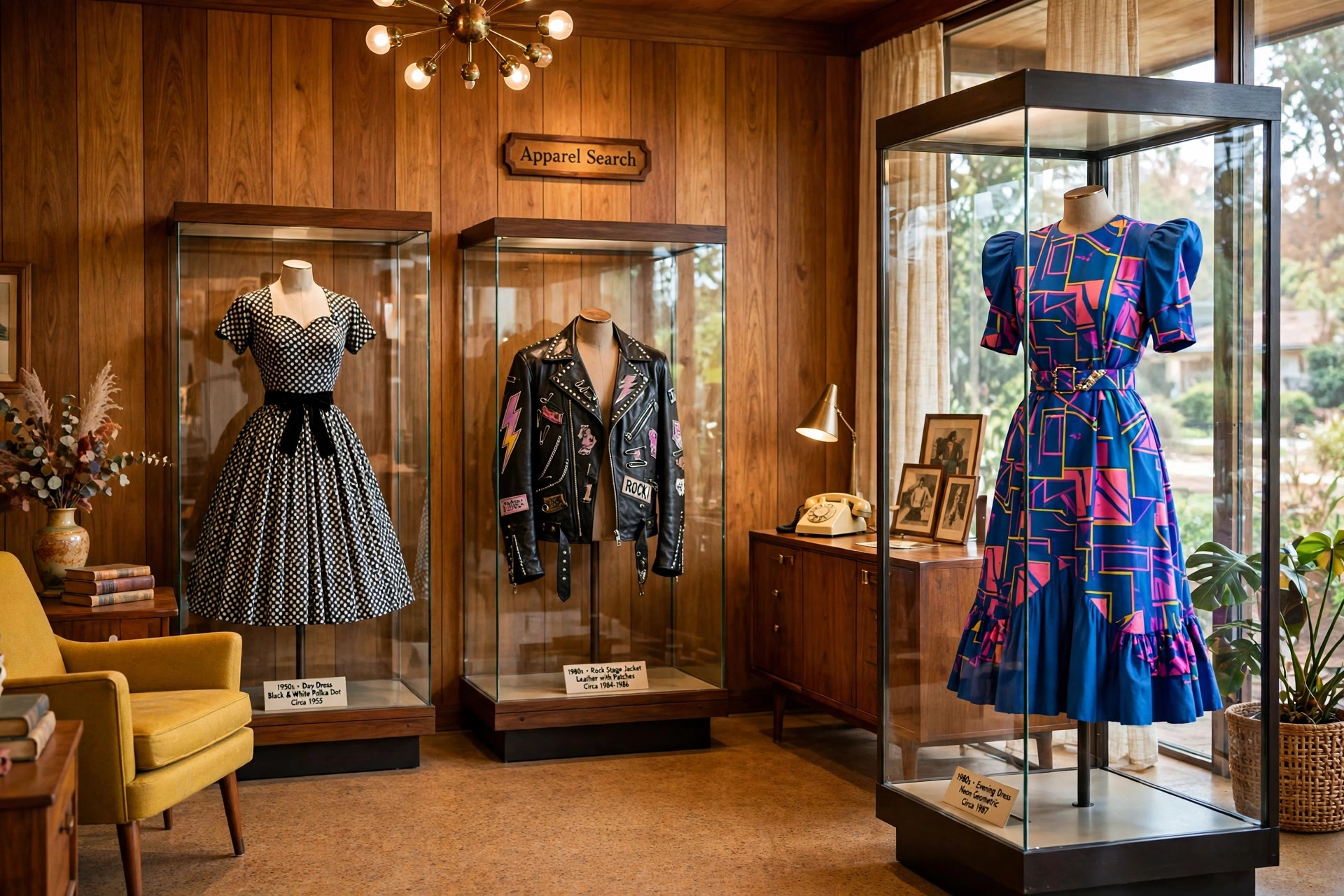
| Back to the 80s (Volver a los 80) | The museum's signature deep-dive: some 500 pieces on 1980s fashion and culture in Chile and the world — Gaultier's cone corset made for Madonna, Michael Jackson jackets, Dynasty dresses, and a finale room dressed as a Santiago nightclub of the era. |
| Music and screen icons | Rock and film memorabilia woven through the fashion story: John Lennon's 1966 jacket, Marilyn Monroe's red dress, and screen-worn pieces from Back to the Future and The Terminator among the museum's famous holdings. |
The eighties exhibition explains the museum's method better than any manifesto. In Santiago, the decade's fashion cannot be separated from the Pinochet dictatorship under which it was worn: the curators showed rebellious, boundary-pushing dress emerging under a conservative regime, fed by the American music, film and magazines that market opening let pour in. Costumes came with their context attached — magazines, videos, music, a hallway papered floor to ceiling with VHS cassettes — and the finale rebuilt an upscale Chilean nightclub of the period, disco ball and all, hung with the party clothes of Santiago's elite. It is fashion history written from inside one country's experience, and it is the kind of exhibition only a museum rooted in its own city could have made.
Notice, too, what the exhibition list says about the museum's idea of fashion. A state museum tends to organise dress by designer and decade; Santiago organises it by the forces that move it — war, sport, music, monarchy, television. The Dynasty dresses are here not as costume trivia but as evidence of how an American soap opera dressed a decade, including in Chile; the football shirts belong beside the couture because in 1962 the World Cup was Chile's own moment on the world stage. It is a populist historiography, deliberately so, and writers who have walked the exhibitions praise exactly that: curation and exhibition design executed at a level that makes the argument physical, room by room.
The star objects, meanwhile, do the work star objects do everywhere: they pull visitors across the world. Diana's dresses, the Gaultier cone corset Madonna wore on the Blond Ambition tour, Michael Jackson's jackets, Lennon's jacket — pieces with auction-room biographies that connect this house in Vitacura to the same market in which the Met and the V&A compete. The difference is the setting: here the icons hang in a family's converted bedrooms, in cases like reliquaries, a few rooms away from the founder's mother's own dresses.
The Home
The Yarur House: A Modernist Mansion as Exhibit One
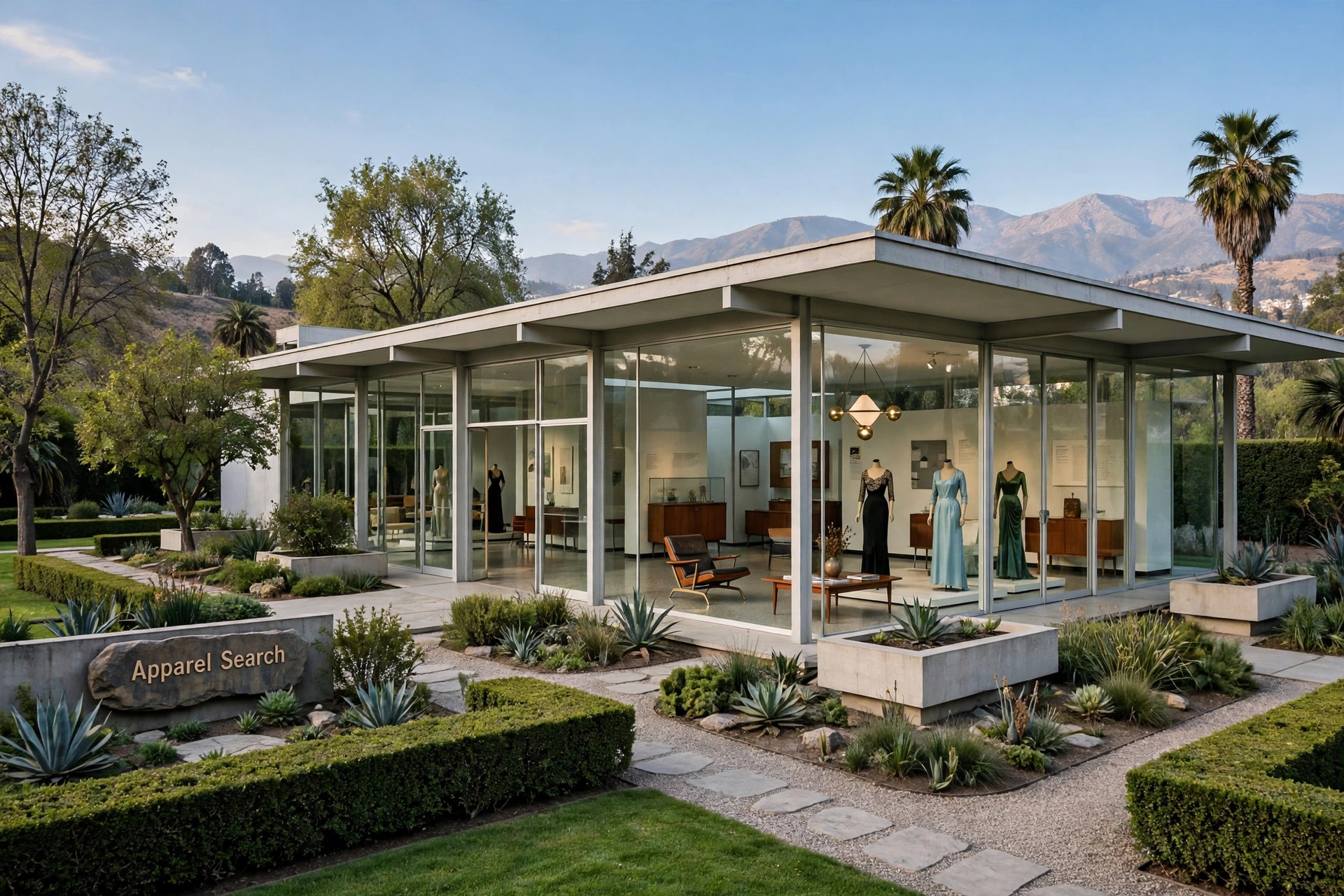
The museum's own site gives the house its due: the residence was built between 1960 and 1962 by the Chilean architects Carlos Bolton, Sergio Larraín, Luis Prieto and Jaime Lorca, is considered an example of modern architecture with a clear influence of Frank Lloyd Wright's avant-garde ideas, and was decorated by Mario Matta Echaurren. Glass walls, low horizontal lines and a Japanese-inflected minimalism made it a showpiece of Santiago modernism before it held a single museum label, and guidebooks still describe the visit as part historic home, part fashion museum.
That doubleness is the experience. The principal rooms keep their original furnishings; the pink 1958 Ford Thunderbird driven by the founder's mother stands in a courtyard; gardens surround the glass house in the park-like streets of Vitacura. Visitors who come for Diana's dresses find themselves also reading a document of how Chile's textile aristocracy lived in the early 1960s — on the eve, as one guidebook puts it, of the upheavals that would transform the country. The museum does not hide that social history inside its fashion story; the house insists on telling both at once.
A textile family's glass house, a mother's wardrobe of five hundred dresses, and one son's refusal to let either go: the Museo de la Moda is a family memoir that grew into a world collection.
Visiting
Visiting — and Checking First, Honestly
This guide must be plain with you, because the museum's own pattern demands it: the Museo de la Moda does not keep a regular, always-open schedule. It mounts temporary exhibitions and closes between them — guidebooks warn that closures between exhibitions can run for months at a time — and it has had quiet periods with no exhibition on view at all. The last public exhibition verified in the research for this guide ran in May 2025. None of that makes the museum closed or finished: its foundation, its conservation centre and its website — museodelamoda.cl — are live, and new exhibitions are its established way of returning. It does mean a visit must be planned around what is actually on.
So the honest advice is this: before you build any Santiago itinerary around the Museo de la Moda, check the museum's own website and channels for a current exhibition and current opening arrangements, and treat any older guidebook listing — this one included — as history until the museum itself confirms otherwise. If an exhibition is on, go: the combination of a world-level private collection, immersive exhibition-making and the Yarur house itself is unlike anything else in South American fashion. If nothing is on, Santiago still rewards the fashion traveller — and the museum's published books carry its collection to readers anywhere in the world. What this guide will not do is promise you open doors we cannot verify.
Exhibitions change and galleries are rehung, so the details here describe the Museo de la Moda as documented for this guide — the museum's own site always carries the latest version.
Common Questions
Common Questions
Is the Museo de la Moda open all the time?
No — and plan accordingly. The museum mounts temporary exhibitions and closes between them, sometimes for months, and it has quiet periods with no exhibition on view. The last public exhibition verified in the research for this guide ran in May 2025. The museum and its foundation are operating, but always check the museum's own website, museodelamoda.cl, for a current exhibition before travelling to see it.
Who founded the Museo de la Moda?
Jorge Yarur Bascuñán, heir to the Yarur family textile fortune. He established the Museo de la Moda Foundation in 1999 and converted his family's residence in Vitacura, Santiago, into the museum, which opened to the public in July 2007. The collection began with his parents' legacy, including his mother Raquel Bascuñán's wardrobe.
How big is the Museo de la Moda collection?
Published figures vary; sources closest to the museum put it at around 15,000 pieces. The holdings span Western dress of the last four centuries — textiles, costumes and accessories, plus decorative arts, sketches and documents — organised into documentary, decorative arts, textile and accessories collections, with a further sports collection covering tennis and football.
What is the Museo de la Moda known for?
For star objects with auction-room biographies: dresses worn by Diana, Princess of Wales; the cone corset Jean Paul Gaultier designed for Madonna; Michael Jackson jackets; John Lennon's 1966 jacket; and Marilyn Monroe's red dress — and for immersive themed exhibitions such as Back to the 80s, War and Seduction and its Diana show, staged inside a preserved 1960s family house.
What building is the Museo de la Moda in?
The Yarur Bascuñán family residence in Vitacura, Santiago, built between 1960 and 1962 by Chilean architects Carlos Bolton, Sergio Larraín, Luis Prieto and Jaime Lorca, with decoration by Mario Matta Echaurren. It is a celebrated modernist house, influenced by Frank Lloyd Wright, kept with its original furnishings — the house itself is part of the visit.
In This Series
Every guide in Fashion Museums of the World, from the section hub.
Museums & Exhibitions on Apparel Search
The site's existing museum coverage, including the term guide this series grows from.
Related on Apparel Search
No Chile country page exists on Apparel Search, so this guide links instead to the site's dress traditions coverage.
Search Apparel Search