01The Three Forms
Cropped, Long and Vest: Pick Your Volume
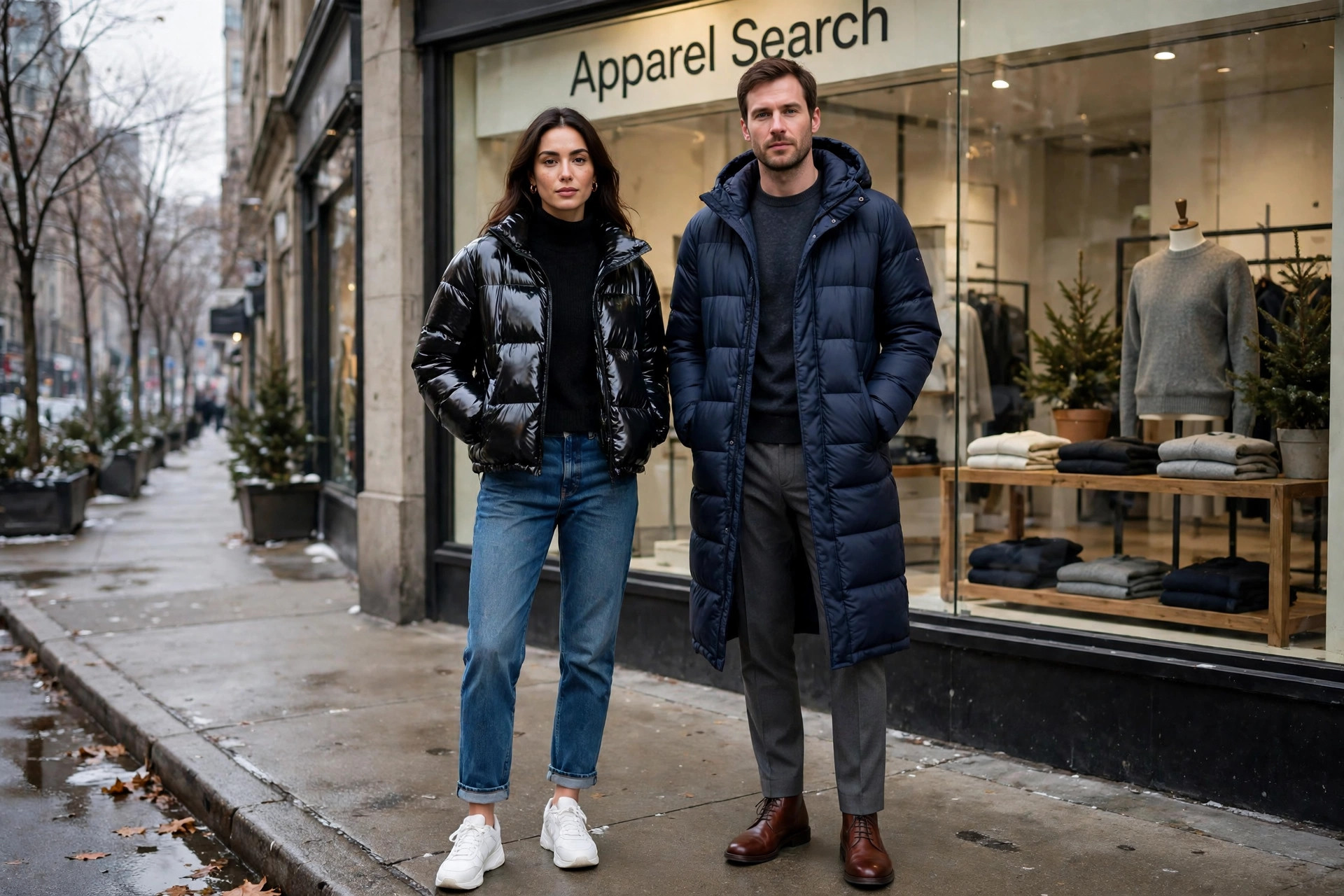
A puffer jacket is insulation you can see: rows of quilted chambers filled with down or synthetic fill, built to trap warm air. Styling one is not really about the jacket — it is about managing the volume the jacket adds, and each of the three main forms adds it in a different place.
The cropped puffer ends at or above the waist and is the easiest to style, because it leaves the whole lower half of the outfit visible and keeps the waistline in play. It works over high-rise jeans, trousers and skirts, and it is the form that dresses up most readily. The long puffer runs to mid-thigh or the knee and behaves like a coat: it becomes the outfit, so what shows below the hem and at the neck matters more than anything underneath. The puffer vest adds warmth without sleeve volume, which makes it a layering piece — worn over knitwear, hoodies and shirts, or under a coat in serious cold. The fill and construction behind each form are covered in the men’s down jackets guide and the women’s coats guide.
02Proportion Rules
The Volume Rule: Big on Top, Clean Below
Every successful puffer outfit obeys one exchange: the jacket supplies the volume, so the rest of the outfit supplies the line. Under a cropped or standard puffer, that means straight, slim or tapered trousers and jeans rather than wide legs — two wide shapes together erase the body’s outline entirely. A long puffer reverses the logic slightly: because the jacket covers the hips and thighs, a slimmer leg below the hem, or a boot with some presence, stops the silhouette reading as a single column.
Three smaller rules support the main one. Show a waist somewhere — a cropped jacket does it automatically; a long one does it with a belt, a half-tucked layer at the opening, or a scarf that marks the neckline. Mind the hem meeting point: a standard puffer should end at the hip bone or clearly below it, not hover at the widest point of the hip. Let one layer peek out — a hem of knitwear or a shirt below a cropped puffer adds the horizontal break that keeps the look assembled rather than zipped-up. These are the same length-and-layer mechanics worked through in how to style layers, applied to the bulkiest layer of all.
03Dressed Down
Weekends: Denim, Leggings and Knitwear
Casual is the puffer’s home ground. A cropped puffer over a hoodie or a chunky knit, with straight-leg jeans and sneakers, is the reliable winter weekend formula for women and men alike — the hood or the knit collar fills the jacket’s open neck and the denim keeps the bottom half structured. With leggings, follow the long-top logic in reverse: choose a standard or long puffer so the jacket itself supplies the coverage, and finish with chunky sneakers or boots so the leg line ends with some weight. A puffer vest earns its keep here too, over flannel shirts and sweatshirts on days that are cold but not bitter, where a full jacket would overheat by midday.
Color does quiet work in casual outfits. A black or navy puffer disappears into almost any wardrobe; a bright or glossy puffer is the outfit’s statement and asks the rest of it — denim wash, knit, shoes — to stay plain. Metallic and high-shine finishes sit at the dressiest end of casual and pair best with dark denim and clean sneakers, the combination covered in how to style sneakers.
04Dressed Up
Evenings and Work: Dressing a Puffer Up
A puffer can dress up further than its reputation suggests, provided the form and finish are right. The recipe is a cropped or neatly long puffer in a matte, dark color, worn open or closed over a deliberately polished base: a knit dress and heeled boots, tailored trousers with a fine turtleneck, or a satin midi skirt with a slim knit. The contrast is the point — the jacket reads as an intentional outer layer over an evening outfit rather than as gym clothing, in the same way a leather jacket sharpens a dress in how to style a leather jacket.
For work, treat the long puffer as you would a wool coat: it arrives over a blazer or a suit and comes off indoors, so its job is a clean line over tailoring, which a matte finish and a not-too-oversized fit deliver. What keeps a puffer firmly casual is the combination of shine, logos and extreme oversizing — remove those three and the jacket moves up a full formality level. For men, a dark long puffer over a suit or over tailored trousers and a roll-neck is now a standard cold-weather commute; for women, the belted long puffer over a knit dress does the same work.
Questions
Common Questions
Can you wear a puffer jacket with a dress or skirt?
Yes — it is one of the most useful cold-weather contrasts. Choose a cropped puffer over a knit or satin dress so the waist stays visible, or a long puffer worn open over a midi dress with boots. Keep the jacket matte and dark for evening, and let the dress supply the polish.
How do you stop a puffer jacket looking bulky?
Balance its volume with a clean line below: straight, slim or tapered trousers instead of wide legs, a visible waist from a cropped cut, a belt or a layer peeking out at the hem, and a fit that ends at the hip bone or clearly below it rather than at the widest point of the hip.
Can a puffer jacket look smart enough for work?
A matte, dark, long puffer in a regular fit can. Worn over a blazer, suit or tailored trousers it works like a winter coat for the commute. Shine, large logos and extreme oversizing are what keep a puffer casual, so avoid all three for work.
More to Explore
Search Apparel Search