Before You Pin
Placement Starts With the Pin Itself
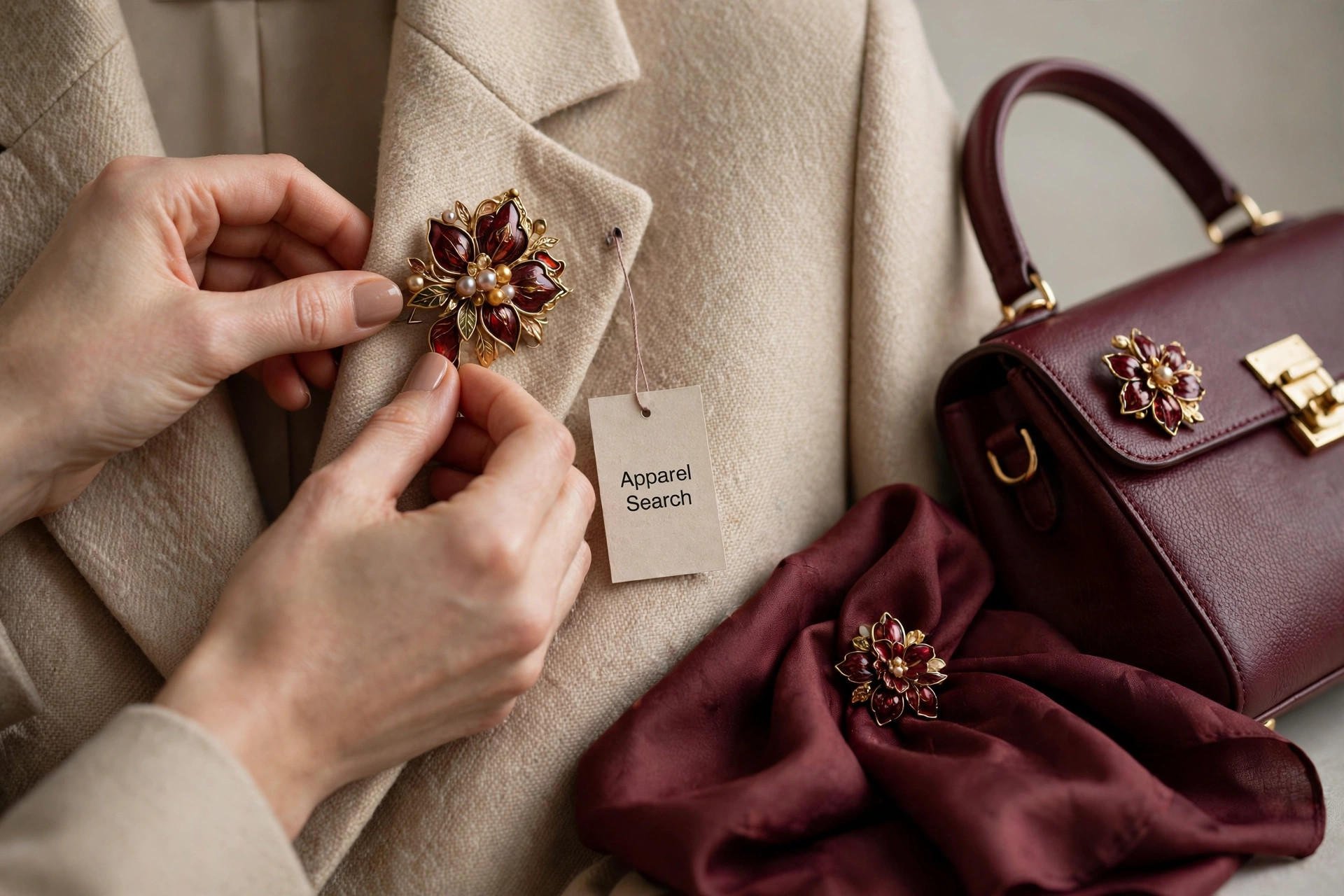
Wearing a brooch well is two skills at once: choosing the spot, and fastening the pin so it sits flat, stays put and leaves the fabric unharmed. The brooch styling guide covers types and sizes; this page is the practical method — seven placements, garment by garment, and the fastening rules that protect everything from a tailored coat to a silk scarf.
Start with three checks. First, weight: hold the brooch against the garment — if the cloth visibly strains, choose a stronger spot or a lighter pin. Second, layers: a pin that passes through two layers, such as a lapel and its facing, is far more secure than one in a single layer. Third, movement: pin, then walk, sit and reach. A brooch that tips forward or swings needs repositioning, a backing pad, or both.
The Placement Guide
Seven Places to Wear a Brooch
The classic home. Pin on the left lapel of a blazer or coat, roughly at the height of the top button, following the lapel’s angle rather than sitting dead horizontal. Structured lapels carry almost any weight, which is why the women’s blazers guide wardrobe is the natural starting point.
Pin at the shoulder seam of a dress, sweater or jacket for a dramatic, slightly vintage line. Shoulder placement suits larger brooches and keeps them clear of necklaces. Anchor through the seam allowance where possible — it is the strongest part of the garment.
A brooch at the centre or side of a neckline replaces a necklace entirely. On a V-neck, pin at the point of the V to close it slightly or decorate it; on a round neckline, pin just off-centre. Keep earrings simple, and check the spacing logic in the necklace layering guide if you wear both.
Pin at the waist of a dress, jumpsuit or belted coat to mark the narrowest point and gather soft fabric elegantly. A brooch can also decorate a plain belt buckle area or close a wrap dress with more security than its tie alone.
A brooch pins a scarf in place and turns it into jewelry. Gather the scarf, pass the pin through all its layers, and let the brooch sit at the throat or shoulder. Silk needs a light pin or a magnetic converter — the fabric range in the women’s scarf guide shows which scarves can take a pin and which cannot.
Pin a brooch to a fabric tote, a canvas bag strap or the flap of a structured handbag to personalise it instantly. Leather deserves caution: a pin leaves permanent holes, so clip or magnet-mount brooches on leather, or pin only to a fabric strap or charm loop.
A small brooch on a hat band, beret or beanie adds a focal point near the face. Felt and knitted hats take pins well; straw does not forgive holes, so use a light pin in the band rather than the crown, or a magnetic mount.
Fastening Without Damage
Pin Weight, Backings and Magnetic Converters
Pin weight is the first protection. Every brooch has a fabric it can honestly sit on: heavy metal and stone pieces on coats and tailoring, medium pieces on knits and shirting, and only the lightest pins on silk, chiffon and fine jersey. When in doubt, move the brooch to a stronger garment rather than forcing the pairing — a sagging, tipping brooch looks worse than none.
Backings do quiet, essential work. A small foam or silicone pad, a piece of felt, or a wide clutch placed behind the fabric spreads the pin’s load across more threads, stops tipping and reduces hole size. Pinning through a seam, a facing or a doubled layer achieves the same support from the garment itself. Always check that the clasp has closed fully — a safety or rollover clasp should click or roll shut, and a loose vintage clasp is worth a jeweler’s attention before the piece is worn over pavement.
Magnetic converters remove the pin from the equation entirely. The brooch’s stem is held in a converter fitting, and strong magnets sandwich the fabric between the brooch and a backing magnet — no holes at all. Converters suit silk blouses, fine scarves and leather bags. Their limit is weight and movement: a heavy brooch or a long, active day can shift a magnetic mount, so test at home first, and keep magnets away from items that magnets can harm.
Finally, removal matters too. Unpin slowly, support the fabric with one hand, and store the brooch closed. For the history behind the fastenings themselves, the brooch definition traces the clasp back to the ancient fibula — the original safety pin.
Questions
Common Questions
Where is the correct place to pin a brooch on a blazer?
On the left lapel, roughly level with the top button, angled to follow the lapel rather than sitting perfectly horizontal. Pin through the lapel and, where possible, its facing for support, and check that the brooch sits flat and does not tip forward when you move.
How do you wear a brooch without damaging delicate fabric?
Use the lightest pin the fabric can carry, place a small foam, felt or silicone pad behind the cloth to spread the load, or skip the pin entirely with a magnetic converter, which sandwiches the fabric between magnets and leaves no holes. Silk, chiffon and fine jersey should never carry a heavy brooch.
Can you wear a brooch and a necklace together?
Yes, with clear spacing. Keep the brooch at the lapel, shoulder or waist — away from the necklace’s line — or let a neckline brooch replace the necklace altogether. If the two pieces sit close together they compete; separated, each reads as a deliberate choice.
More to Explore
Search Apparel Search