Enzyme Washing Contractors
Contractors that enzyme wash apparel and fabrics.
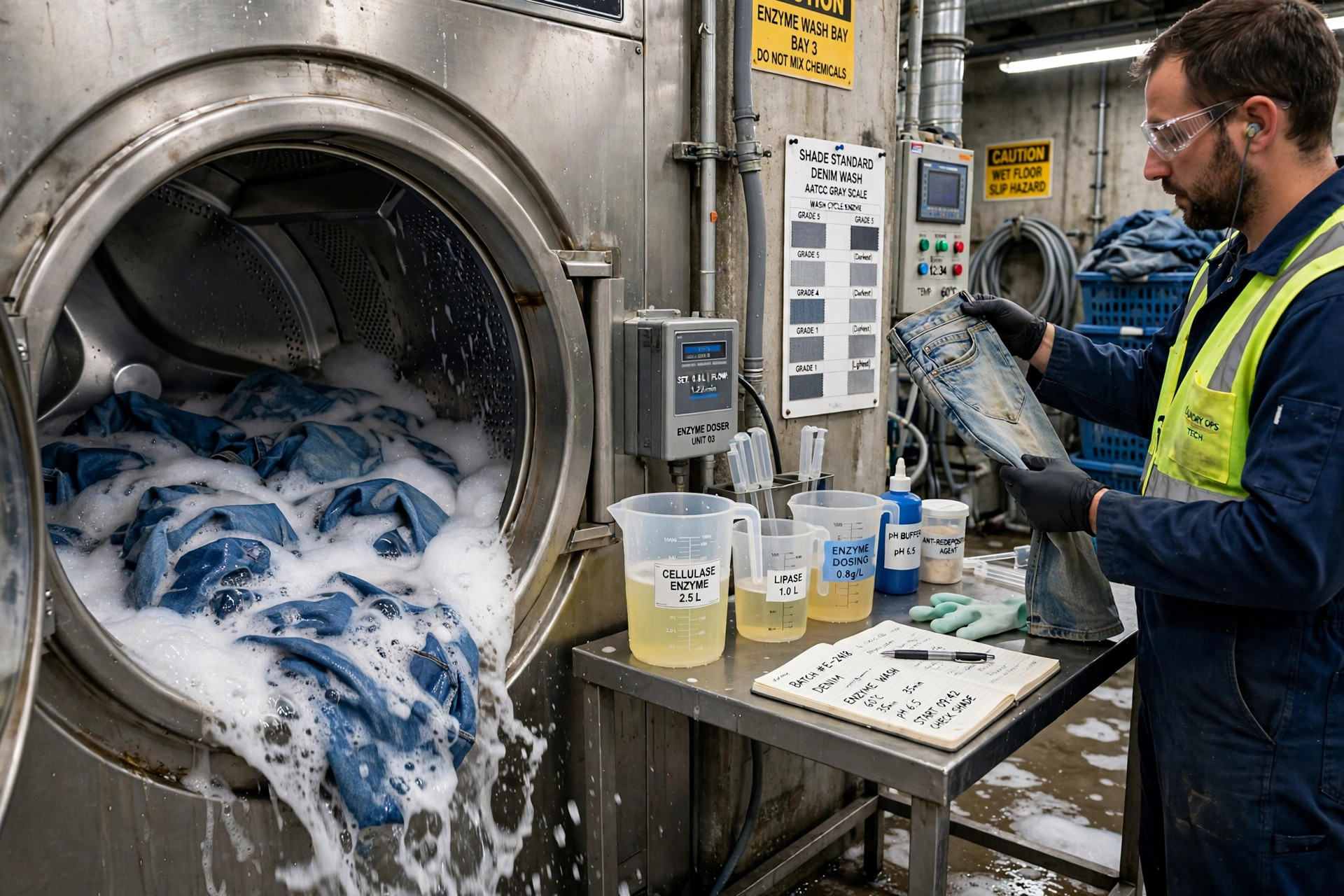
Enzyme washing is the process that let the denim industry keep its favorite look while giving up some of its roughest habits. Cellulase enzymes — biological catalysts that digest cellulose — do in a wash bath what pumice stones used to do by brute abrasion: they loosen indigo from the surface of denim yarns and strip away protruding fibers, producing a faded, soft, worn garment with far less damage to fabric, machines and wash water. The same enzymes depill cotton garments and give them a clean, smooth surface.
This page explains how enzyme washing works, the difference between acid and neutral cellulases, the controls that decide whether a batch comes out even or streaked, and how to order the process. Contractors offering enzyme washing are listed below.
Enzyme Wash Resources
How Enzyme Washing Works
Cellulases attack the cellulose at the fiber surface. On denim, that surface carries most of the indigo dye, so as the enzyme trims micro-fibers away, color leaves with them and the garment fades — evenly across the load rather than only where stones happen to strike. After the target shade is reached, the bath is drained or the enzyme is deactivated by raising the pH or temperature, and the garments are rinsed. Because the action is chemical rather than mechanical, seams, rivets and embroidery survive far better than in a full stone wash, and machines suffer a fraction of the wear.
Enzyme wash is also used for depilling garments and for biopolishing cotton: the same surface trimming that fades denim removes the fuzz and loose fibers that make cotton knitwear look tired and form pills. A single enzyme stage can therefore be doing two jobs in one bath — shade work on denim, surface cleaning on cotton jersey — which is why it appears in so many of the wash recipes in the listings below.
Acid, Neutral and Hybrid Cellulases
Acid cellulases work at around pH 4.5–5.5 and act fast and aggressively, giving high contrast fading; their drawback is back-staining, where loosened indigo redeposits on white pocketing and the garment’s light areas, dulling the contrast the brand wanted. Neutral cellulases work near pH 6–7, act more gently and cause much less back-staining, at the cost of longer cycles. Modified acid and hybrid products combine characteristics of both, and a laundry chooses among them by the shade target, the fabric, and how much pumice, if any, will share the load.
Enzymes rarely work entirely alone in fashion denim. Many recipes pair a reduced pumice load with enzymes: the stones give mechanical highlights on seams and thighs while the enzymes even out the overall shade and protect the fabric. The balance between the two is the laundry’s craft, and it is set during sample development, then locked into the recipe for production.
Controls, Risks and Ordering
Enzyme action depends on dose, pH, temperature, time and load ratio, and it does not stop on its own when the timer ends — the bath must be actively deactivated, or the last loads out of the drum keep fading. Over-treatment weakens cotton measurably, so contractors track strength on test pieces and hold the process at the mildest settings that reach the shade. Uneven loading or a cold corner of the drum shows up as streaks, which is why trial loads on the production machine matter more than lab dips.
To order enzyme washing, provide a shade target from an approved garment, state the hand feel wanted, and ask whether the recipe uses enzymes alone or an enzyme-and-stone combination. Approve a production-size trial, and confirm the contractor’s deactivation and rinsing steps in writing — those steps are what make the shade you approved the shade that ships.
Enzyme Washing Contractor Listings
Contractors and laundries offering enzyme washing for apparel and fabrics.
Bennett Dye Co
(USA) Bennett Dye Co. has been an established dye house for over 75 years, and has specialized in garment finishing since 1983. They offer many garment enhancements, including direct, reactive and pigment dyeing. In addition they do enzyme wash, garment wash, stone and acid wash (denim or cotton garments) as well as tie-dyeing.
Services: dyeing textiles (direct dyeing, reactive dyeing, pigment dyeing, tie dye), enzyme wash, garment wash, stone wash, acid wash, depilling garment wash, anti-microbial garment washing, water repellant garment wash, stain resist garment finishing.
Address: 2552 N. 3rd St., Philadelphia, PA 19133, USA. Phone: 215-739-0432. Fax: 215-426-3120. E-mail: Bennettdye@aol.com. Contact: Lee Sunderland.
Hytex
The latest addition to their production process is laundering or wet processing — they offer specialized services to fit the needs of the apparel industry. They provide a full service garment dyeing facility with on-site testing, a full color lab, product development, and quality control throughout the finishing of each garment. For denim wet processing they offer all types of wash, including prewash, stonewash, bleached wash, enzyme washes, antique and sandblasting finishes, and more. Hytex started operating in 1981 as a company that does contract silkscreen printing in a rented shop-house; the business was then confined to manual silkscreen printing using long wooden tables.
Services: garment printing, garment dyeing, garment washing, enzyme wash, stonewash, bleaching, sandblasting.
Laundry Specialties
Laundry Specialties is a commercial laundry which specializes in processing garments for the apparel industry. Some of the services they provide are garment washing, enzyme washing, stone washing, bleaching (denims etc.), fix wash (crocking etc.) and silicone wash. They also provide rework services and packaging.
Services: commercial laundering, garment washing, enzyme washing, bleaching, fix wash, silicone wash, stone washing, refurbishing.
Contact: Richard or Chuck. Address: 431 N. Jordan Street, Allentown, PA 18102, USA. Phone: 610-351-3860. Fax: 610-770-1785. E-mail: richard@laundryspecialties.com
Magna Cleaners Inc
(Pennsylvania) Magna Cleaners provides commercial laundry service to a variety of clientele. Their facility is equipped with the latest washing, drying and finishing equipment. They process everything from bulk commercial laundry down to single piece sample lots. They also provide garment washing, enzyme washing, stone washing, bleaching (denims etc.), fix wash and silicone wash. They also do rework services and packaging.
Services: commercial laundering, garment washing, enzyme washing, bleaching, fix wash, silicone wash, stone washing, refurbishing.
Address: 361 W. Gordon St., Allentown, PA 18102, USA. Phone: 484-894-8906. E-mail: sales@magnacleaners.com. Contact: Al Fodero.
More Manufacturing Resources
Common Questions
What does enzyme washing do to denim?
Cellulase enzymes digest a microscopic layer of the cotton fiber surface, carrying indigo dye away with it, so the garment fades and softens with a worn look — with less fabric damage, less machine wear and cleaner pocketing than a traditional stone wash.
What is the difference between acid and neutral cellulase?
Acid cellulase works at low pH, acts quickly and gives strong contrast but can cause back-staining of loosened indigo onto light areas. Neutral cellulase works near neutral pH, is gentler with far less back-staining, and takes longer. Hybrids sit between the two.
Can enzyme washing damage garments?
Yes, if it is over-run. Enzymes keep working until the bath is deactivated, and excessive treatment weakens cotton. Contractors control dose, pH, temperature and time, deactivate the bath at the target shade, and check strength on test pieces.