Sandblasting Fabric
Sandblasting finishes for apparel and textiles.
Sandblasting fades denim the direct way: a jet of abrasive, driven by compressed air, is played over the garment where the designer wants wear to appear — the whiskers at the hips, the thighs, the seat, the honeycombs behind the knees. Done well, a pair of jeans comes off the mannequin form looking as if it has been worn for a year in exactly the right places, something no all-over wash can imitate. No other finishing process gives such precise, localized control of fading.
No other finishing process carries a heavier responsibility, either. This page explains how sandblasting works, the silicosis hazard that led many countries and brands to ban silica sand blasting outright, and the safer abrasives and alternative techniques a responsible contractor uses today. A wet-processing contractor that lists sandblasting finishes among its services appears below.
Sandblasting Resources
How Sandblasting Fades a Garment
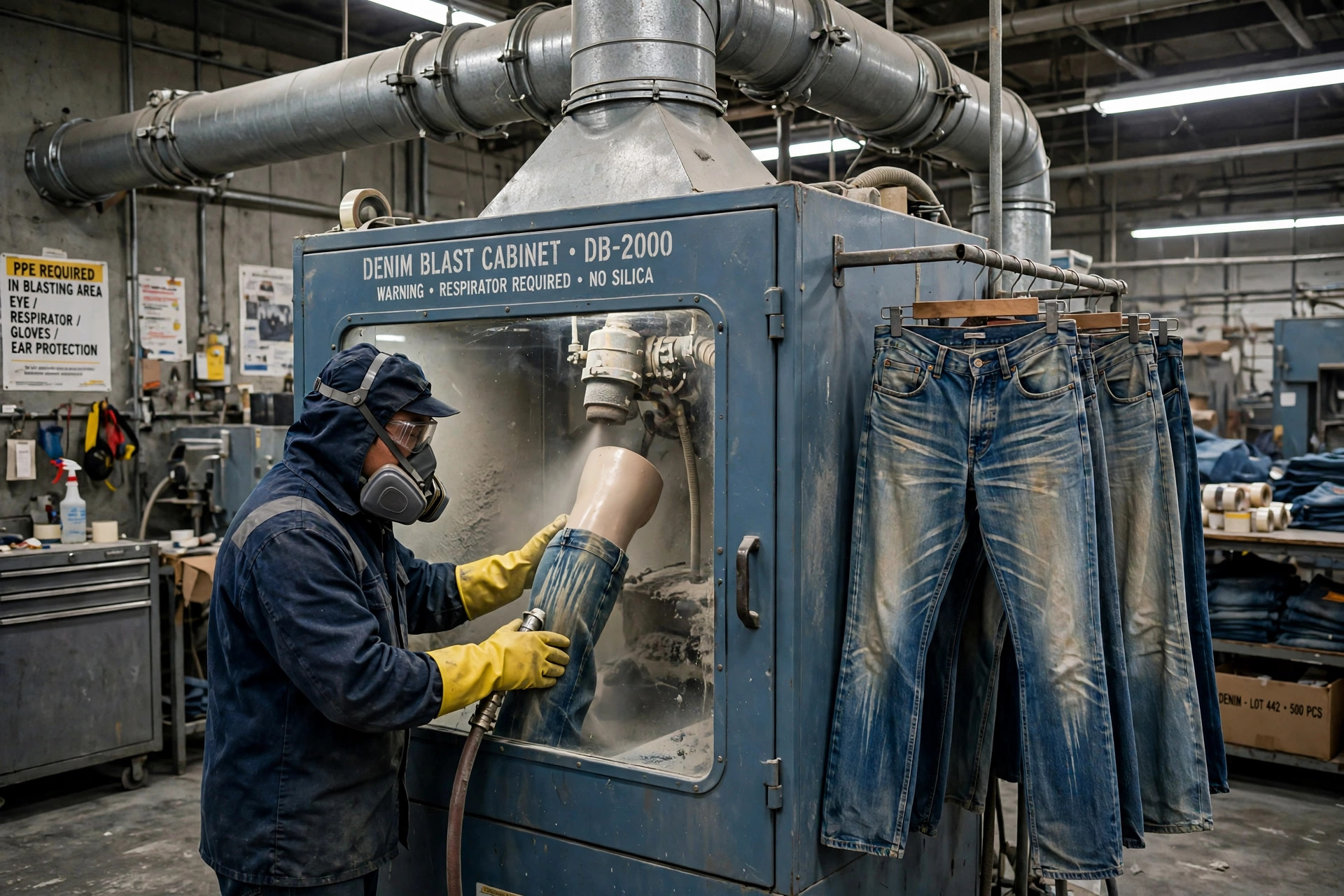
The garment is dressed on an inflatable mannequin form that holds it in wearing shape, and the operator works the blasting nozzle across the target zones inside a cabinet or booth with extraction. The abrasive stream strips indigo from the yarn surface on contact, so the fade builds pass by pass and the operator judges it by eye against the approved sample — which is why two operators can produce noticeably different results from the same instruction, and why brands approve operator samples, not just garment samples.
Blasting is normally one step in a sequence. After the localized fade is created, the garment goes through a wash — often an enzyme wash — that softens the blasted areas, removes dust and debris, and blends the sharp local fade into the garment’s overall shade. Without that wash, sandblasted areas look raw and dusty rather than worn.
The Silica Hazard and the Bans
Traditional sandblasting used silica sand, and the fine respirable dust it generates causes silicosis, a progressive and incurable lung disease that struck garment workers severely in countries where blasting was done in small, unprotected workshops. Turkey banned sandblasting in garment production in 2009 after a public health campaign by affected workers, and many major brands and retailers prohibited silica sandblasting in their supply chains entirely; several other producing countries followed with bans or strict controls.
The consequence for buyers is a sourcing rule, not just a style choice: ask any contractor offering a blasted look exactly what abrasive media they use and what extraction and respiratory protection the operators have. Silica-free media such as aluminum oxide, used in enclosed cabinets with proper extraction and protective equipment, is a different risk class from open silica blasting — and laser fading and hand scraping now reproduce most blasted effects with no abrasive dust at all.
Specifying Blasted Effects Today
Specify the effect, not the method. Give the contractor an approved sample or a detailed fade map showing whiskers, thigh fade and any other zones, with the intensity graded from light to strong. Then let the contractor propose the safest process that reaches it — silica-free blasting in a cabinet, laser, or hand abrasion — and require the proposal in writing as part of the order. If a quote seems to assume old-style open sandblasting, that is a reason to walk away, whatever the price.
The contractor below is a full-service wet processor whose denim program lists sandblasting finishes among its wash options, alongside prewash, stonewash, bleached wash, enzyme washes and antique finishes — the combination that lets blasted garments be washed and softened in the same plant.
Sandblasting Contractor Listings
Contractors offering sandblasting finishes for apparel and textiles.
Hytex
The latest addition to their production process is laundering or wet processing — they offer specialized services to fit the needs of the apparel industry. They provide a full service garment dyeing facility with on-site testing, a full color lab, product development, and quality control throughout the finishing of each garment. For denim wet processing they offer all types of wash, including prewash, stonewash, bleached wash, enzyme washes, antique and sandblasting finishes, and more. Hytex started operating in 1981 as a company that does contract silkscreen printing in a rented shop-house; the business was then confined to manual silkscreen printing using long wooden tables.
Services: garment printing, garment dyeing, garment washing, enzyme wash, stonewash, bleaching, sandblasting.
More Manufacturing Resources
Common Questions
Why was sandblasting banned in many countries?
Traditional sandblasting used silica sand, whose fine dust causes silicosis, a serious and incurable lung disease, in unprotected workers. Turkey banned garment sandblasting in 2009, many brands prohibited silica blasting in their supply chains, and other producing countries added bans or strict controls.
How is a sandblasted look achieved more safely today?
With silica-free abrasives such as aluminum oxide in enclosed, extracted cabinets with respiratory protection — or with no abrasive at all: laser fading and hand scraping reproduce whiskers and worn areas without generating silica dust.
What is sandblasting used for on jeans?
Localized fading that imitates natural wear: whiskers at the hips, faded thighs, seat wear and honeycombs behind the knees. The garment is blasted on a mannequin form, then washed to soften and blend the effect.