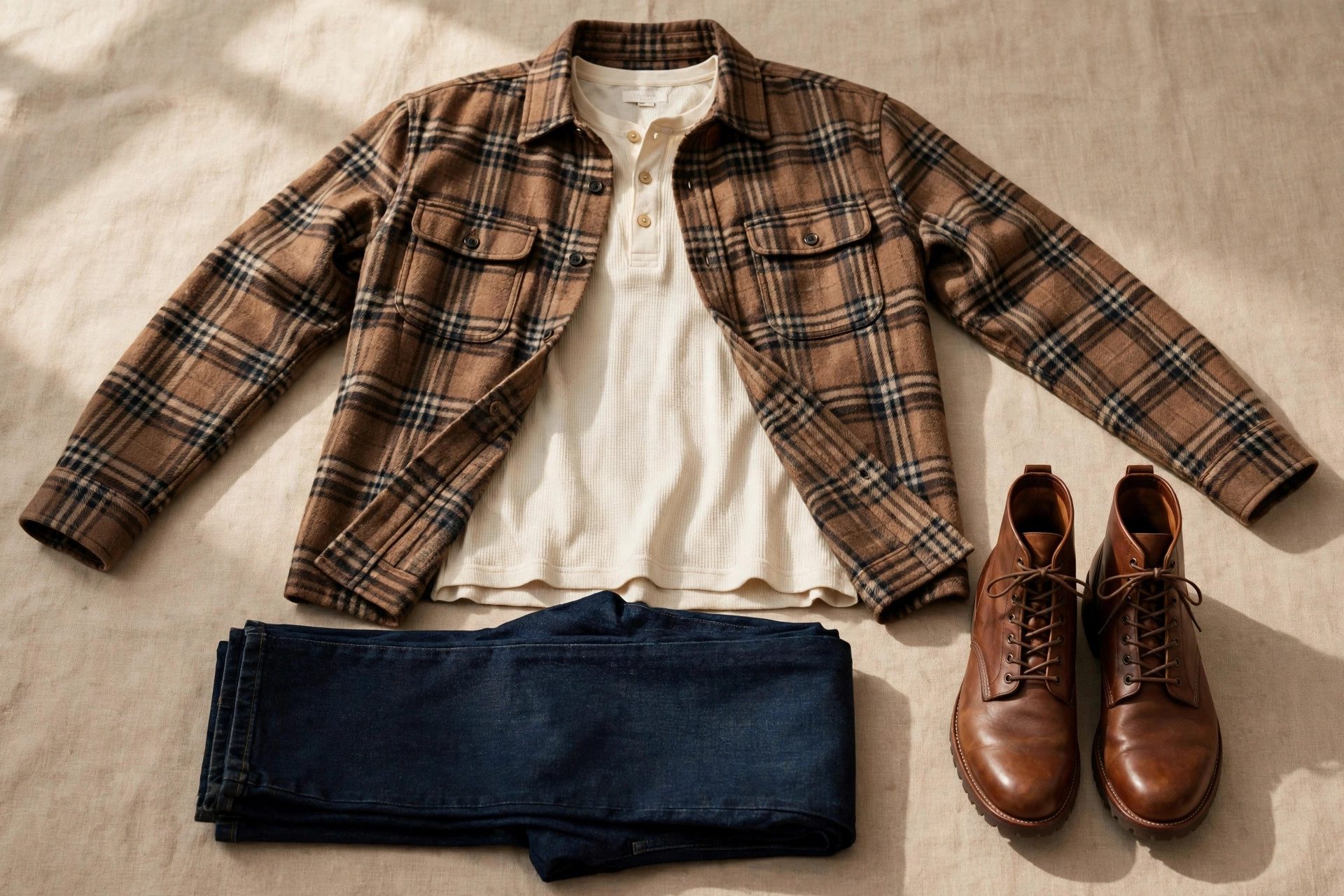
For men, the shacket and the overshirt have quietly become the default light jacket: a shirt-pattern layer in flannel, wool, twill or canvas that handles the long stretch of weather that is too cold for a shirt and too warm for a coat, and that reads as dressed rather than geared-up. Men's versions lean on workwear roots — plaid wool overshirts, CPO-style wool shirt-jackets, canvas shackets with chore pockets — and their rise tracks a real change in men's dressing: fewer suits, more layers, and offices where a shirt-jacket over an Oxford is the correct amount of dressed. This page covers how men wear the family: the fit rules, the fabrics in order of warmth, and the outfits the layer completes.
The Layer That Replaced the Light Jacket
Men's light jackets used to mean a Harrington, a denim jacket or a bomber — all good, all unmistakably jackets. The shacket and overshirt took the slot by being less: a collar and buttons like the shirts men already wore, in fabrics warm enough to matter. The result is a layer that works in more settings than any of its rivals — over a tee on a cool evening, over knitwear through autumn, under an overcoat in January, and across the smart-casual office without looking like outerwear that wandered indoors.
The fabrics in warmth order: linen-cotton and light twill overshirts for summer evenings; brushed flannel and canvas for the shoulder seasons — the plaid flannel shacket is the family's emblem; wool and wool-blend overshirts, CPO-style, for real cold short of a coat; and quilted shackets at the top, functionally light jackets. One of each of two rungs — a flannel and a wool — covers most men from September to April.
Fit: Room for a Sweater, Shape at the Shoulder
The buy decision is made over a jumper. A shacket or overshirt must button over your standard knitwear without the placket straining or the sleeves binding when you reach forward; if it only fits over a T-shirt, it is a heavy shirt, whatever the label claims. Shoulder seams should sit at or a fraction beyond your shoulder point — this is a relaxed garment, but dropped, sloppy shoulders turn it into a blanket. Length lands at the hip for overshirts and hip-to-mid-thigh for shackets worn as light coats.
Wear it open by default over tees and henleys — the two verticals of the button placket frame the outfit — and buttoned when it is the main layer or the setting is smarter. Sleeves take a single roll at the cuff in workwear mode. Pattern discipline is the one styling law: plaid is the pattern of the outfit, so everything under and beneath a checked shacket stays plain. Solid overshirts invert the rule and can carry a patterned shirt or knit underneath.
Outfits: Jeans, Chinos and Boots
The standard formula is the one on every high street: plaid flannel shacket, plain henley or tee, dark jeans, boots — Chelsea or lace-up — with the shacket open. It works because every element matches the layer's workwear register. The smarter formula: solid wool or twill overshirt, Oxford shirt, chinos, loafers or suede Chelseas, the overshirt worn like an unstructured blazer. Between the two sit corduroy trousers, knit polos and crew-neck jumpers, all of which the layer was practically designed to cover.
Under an overcoat, a shacket becomes the mid-layer that makes winter dressing look considered — collar and cuffs showing, plaid or texture visible at the chest when the coat is open. Colours that do the most work are the workwear neutrals: olive, navy, charcoal, brown plaid, stone. Buy those first, and let the layer's job — finishing outfits without thinking — happen by itself.
Common Questions
- Can men wear a shacket to the office?
- In most modern offices, yes — a solid or subtly checked wool or twill shacket over an Oxford shirt and chinos sits comfortably in business-casual territory. Keep the plaid boldness for casual days, choose a clean, pressed garment, and treat it as you would a soft blazer: it is a layer with a collar, not a lumberjack costume.
- Shacket or overshirt for winter — which is warmer?
- For warmth, the shacket: it is the jacket-first branch — heavier fabrics, sometimes lined or quilted. An unlined overshirt over a thick sweater gets closer than the labels suggest, and layering order matters more than the name. In deep winter both become mid-layers under a real coat, where they perform about equally.
- What shoes go with a shacket?
- The footwear follows the outfit's other half. Boots are the natural partner — Chelsea, lace-up or work boots all suit the layer's workwear roots — and clean trainers work for the casual end. With chinos and an overshirt in smart mode, loafers carry it toward dressed. Avoid anything more formal than the layer itself.
- How many buttons should you fasten on a shacket?
- Wear it open over a tee or henley, or fasten the middle buttons only — the relaxed norm. Buttoning every button to the collar reads as wearing a shirt, which is sometimes the intent with a smart overshirt over an Oxford. Cuffs follow the same logic: buttoned for smart, rolled once for workwear.
Shacket & Overshirt Guides
This page is part of our shacket and overshirt series — the shirt-weight layers between shirts and jackets.