Men's Field Jacket Guide
Four bellows pockets, a stand collar and a drawstring waist, direct from the M-65: the field jacket is military design at its most wearable.
Shop Men's Field Jackets Now
Shop Men's Field Jackets on Amazon Shop Men's Field Jackets on eBayThe Amazon and eBay links on this page are affiliate links. If you make a purchase through them, Apparel Search may earn a commission.
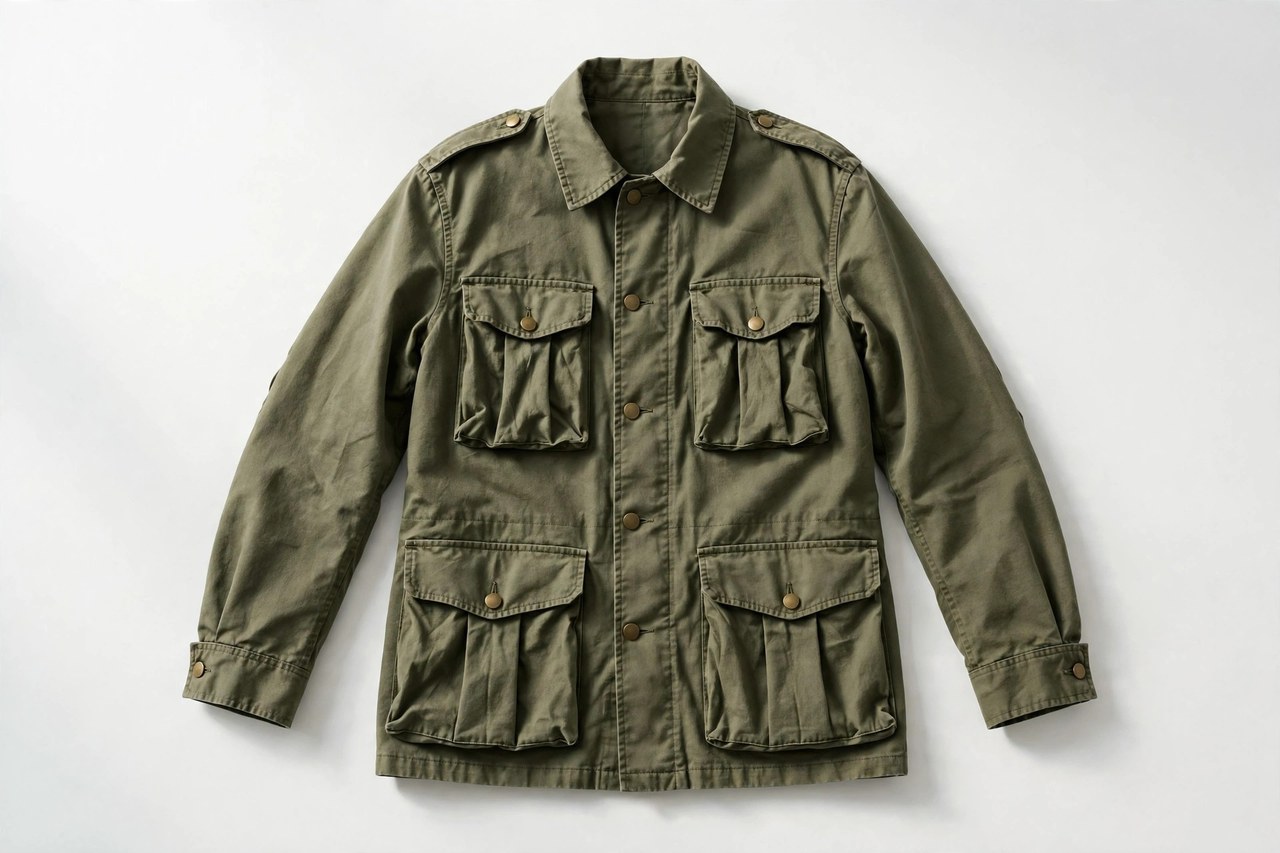
The field jacket is the military's answer to a simple problem: a soldier needs a windproof, water-shedding layer with room for everything he must carry, that works from autumn cold to spring rain. The American M-43 of the Second World War set the pattern, the M-51 refined it, and the M-65 of 1965 — olive cotton-nylon sateen, stand collar with a concealed hood, four bellows pockets, button-in liner — became the definitive version, worn through Vietnam and into civilian life on the backs of veterans, protesters and, eventually, everyone.
Civilian field jackets keep the architecture and adjust the attitude. The four front pockets, the drawstring at waist and hem, the storm flap and the bi-swing or gusseted back all survive because they are genuinely useful off duty: this is a jacket with a place for gloves, map, phone and wallet, that shrugs off weather a fashion jacket would flee.
Construction: Four Pockets and a System
Count the pockets first — four is the field jacket's signature, arranged as two bellows pockets at the chest and two at the hip, each expanding on pleats to swallow real cargo and closing with flaps and snaps or buttons. Bellows construction is the detail cheap copies skip, substituting flat patch pockets that look similar and carry nothing. Inside, better jackets keep the M-65's button-in liner points, so a quilted liner can be added for winter and stripped for spring, making the jacket a system rather than a single-season garment.
The collar stands to seal the neck and, on faithful versions, zips open to release a thin concealed hood. A storm placket covers the main zip — brass on the original — cuffs adjust with tabs, and drawstrings at the waist and hem let the wearer pull the jacket close against wind or wear it loose over layers. The shoulder often carries epaulettes, a pure inheritance from uniform dress that civilian makers retain as a style marker.
Fabrics: Sateen, Twill and Waxed Cotton
The M-65's cloth was a windproof cotton-nylon sateen in olive drab, dense enough to shed a shower and hard-wearing enough for field use, and modern versions in cotton-rich sateen remain the most authentic choice. Cotton twill and ripstop give lighter, softer civilian jackets; waxed cotton versions trade military accuracy for genuine rain resistance and a country look shared with shooting jackets, whose four-pocket layout is a close cousin.
Colour is a style decision disguised as a fabric one. Olive is the original and the most versatile with denim and earth tones; black urbanises the jacket completely; navy and stone read almost like casual blazers at a distance; camouflage states the heritage loudest and pairs best with very plain clothes underneath. Unlined jackets suit spring and autumn; accept the button-in liner, or a fixed light quilting, if the jacket must work into winter.
Fit and Styling
A field jacket should fit like a layer, not a shirt: enough room for a sweater, sleeves to the wrist bone with arms forward, and length covering the seat — the original was cut long to protect the hips, and short fashion versions lose both warmth and the pocket layout's balance. Use the waist drawstring: pulled in slightly, it gives the military silhouette its shape; left loose, the jacket is a straight utility layer.
It is the natural partner of the whole casual wardrobe — jeans, chinos, boots, and the knitwear drawer — and it can stand in for a blazer over an untucked Oxford shirt in relaxed settings, which is why stylists keep returning to it. Compare it with the bomber jacket if you want military heritage in a shorter, cleaner form, or the motorcycle jacket for the leather branch of the family. Care is workwear care: wash cold when needed, re-proof waxed versions, and let the cloth fade honestly.
Common Questions
What is an M-65 field jacket?
The M-1965 is the US Army's definitive cold-weather field coat, introduced in 1965: olive cotton-nylon sateen, stand collar with concealed hood, four bellows pockets, drawstring waist and hem, and points inside for a button-in liner. Nearly every civilian field jacket copies its pattern in whole or in part.
How should a field jacket fit?
Roomy enough to layer a sweater under, with sleeves covering the wrist and length over the seat. It should not be tailored tight — the ease is functional — but the waist drawstring should be used to give the silhouette shape rather than letting the jacket hang as a box.
Is a field jacket waterproof?
No — the dense sateen sheds showers and blocks wind, and waxed-cotton versions resist rain longer, but sustained rain will soak any of them. It is a windproof utility layer, not rain gear; for real rain, a trench coat or a technical shell is the right garment.
More Men's Outerwear & Wardrobe Basics Guides
All thirteen guides in this cluster, in alphabetical order — classic coats, jackets, tailoring, trousers and shoes:
More to Explore on Apparel Search
Looking for Men's Clothing Stores?
This guide helps you choose a men's field jacket with the classic four-pocket pattern. To browse where to buy, visit our mens clothing store directory, where you can find retailers that carry them.