Men's Jackets Guide
A men's jacket is a mid-stomach-length garment for the upper body: it typically has sleeves, fastens in the front or slightly on the side, and is generally lighter, closer-fitting and less insulating than a coat, which is heavier outerwear. Some jackets are pure fashion, while others serve as protective clothing - and one distinction organizes the whole category: if it ends around the waist or hip, opens down the front and is built to layer over a shirt or sweater rather than replace your whole defense against winter, you are looking at a jacket, whatever the label calls it.
Shop Men's Jackets Now
Shop Men's Jackets on Amazon Shop Men's Jackets on eBayThe Amazon and eBay links on this page are affiliate links. If you make a purchase through them, Apparel Search may earn a commission.
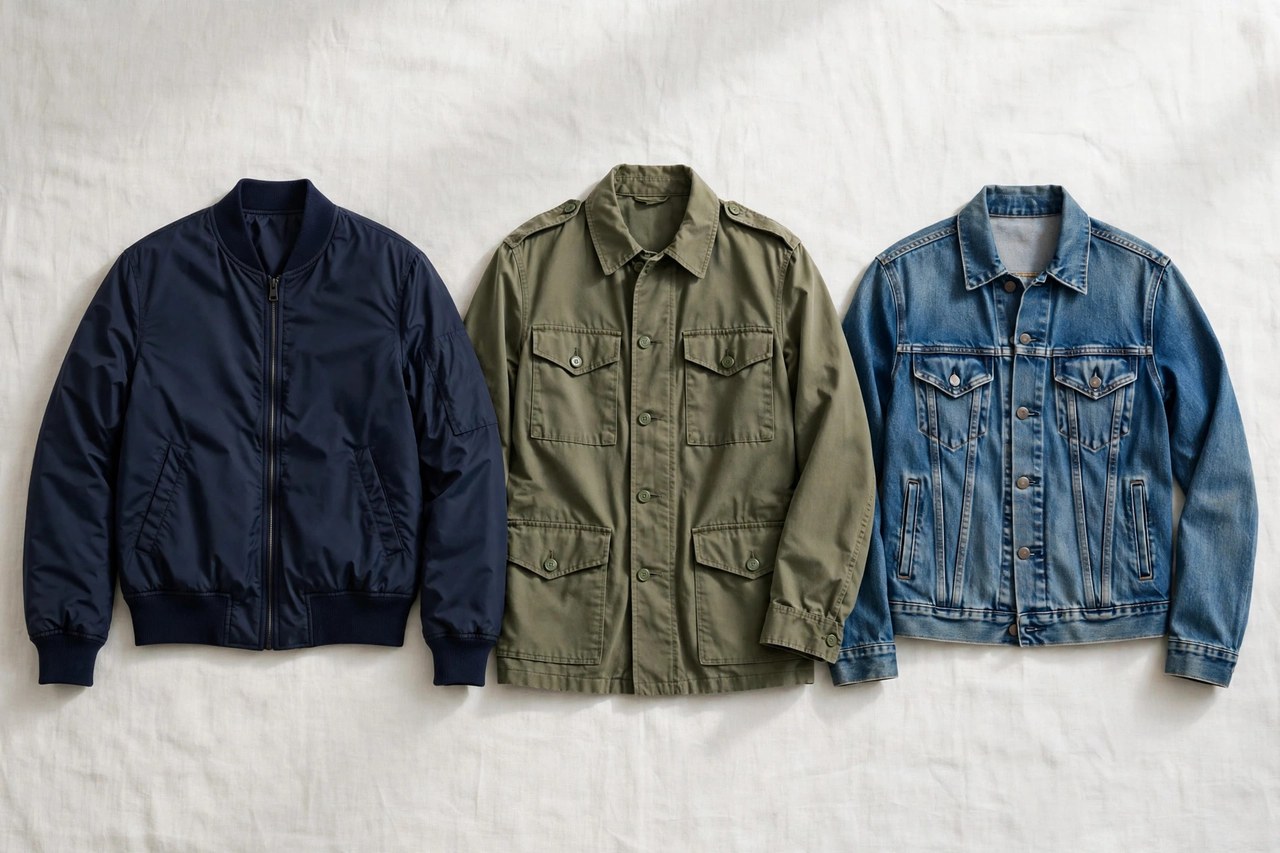
A men's jacket is a mid-stomach-length garment for the upper body: it typically has sleeves, fastens in the front or slightly on the side, and is generally lighter, closer-fitting and less insulating than a coat, which is heavier outerwear. Some jackets are pure fashion, while others serve as protective clothing - and one distinction organizes the whole category: if it ends around the waist or hip, opens down the front and is built to layer over a shirt or sweater rather than replace your whole defense against winter, you are looking at a jacket, whatever the label calls it. This guide is built around the questions buyers actually ask: which style, which size, which fabric, and what will it look like after a year of real use - answered in order, with the trade-offs stated plainly.
Shells, Linings, Closures and Styles
Judge a jacket from the outside in. The shell does the visible work: leather brings abrasion resistance and decades of wear, denim brings a sturdy cotton twill that fades with its owner, nylon and polyester shells bring light weight and water resistance, wool brings structure for blazer-style jackets, and waxed or coated cottons shed weather while looking better with age. Beneath it, the lining decides how the jacket lives - a smooth acetate or cupro lining glides over knitwear, a quilted or fleece lining adds the insulation the shell lacks, and a half-lining keeps a warm-weather jacket breathable. Closures are the third system: zippers should run true under one hand and be sized to the garment's duty, buttons need thread shanks and a spare sewn inside, and snaps should close with a positive click, not a negotiation. Around those systems the styles arrange themselves: the bomber's ribbed cuffs and waist, the field jacket's four bellows pockets borrowed from military dress, the trucker jacket's button front and chest pockets in denim or corduroy, the leather jacket in its cafe racer and flight forms, the quilted puffer whose baffles hold down or synthetic fill in place, and the rain jacket, whose taped seams - not just a water-resistant coating - are what actually keep weather out. At the lightest end of the family sit the shirt-weight layers — the shacket and the overshirt — which have their own guides, including a men's shacket and overshirt styling guide.
Outerwear value hides below the surface: taped versus merely stitched seams, a zipper whose slider runs true under one hand, cuffs and hems that adjust to seal weather out, and a lining slippery enough to glide over the layers beneath. Shoulder build decides the hang over knitwear or a jacket, and pocket engineering decides whether hands and kit ride where your body expects them. Specify for the worst honest day, not the brochure day.
Fit and Sizing Over Layers
Fit a jacket over the bulkiest layer it will honestly cover, because a jacket is a layering garment by definition. The shoulders should echo your own rather than extend past them, the chest should close - zipped, buttoned or snapped - without strain across the back when you reach forward as if driving, and the body should end where the style intends: bombers and truckers at the waistband, field jackets and rain jackets at the hip or below. Sleeves should end at the wrist bone with arms relaxed, showing a sliver of shirt cuff on blazer-style jackets and covering the wrist fully on weather jackets. Then test the working range: arms overhead, sitting with every closure fastened, hands in every pocket. A jacket that only fits standing still in front of a mirror has failed its one job, which is to move with you through weather, work and travel while everything underneath stays comfortable.
Fit outerwear over the bulkiest layer it will honestly cover, and test the working range: arms forward as if driving, arms overhead, sitting with every closure fastened. The coat's shoulders should echo yours rather than extend past them, closures should meet without strain, and the hem must reach the coverage the garment exists to give. A coat fitted over a T-shirt alone belongs to a climate you may not live in.
Wearing and Care
Care follows the shell. Hang every jacket on a broad hanger that carries its shoulders, rest it a day between wears, and spot-clean before reaching for a full wash - most jackets need cleaning far less often than their owners assume. Denim and cotton jackets wash cool and inside out; performance shells wash by the maker's method with the detergent the fabric demands, and their water-repellent finishes get refreshed when rain stops beading on the surface. Leather is a professional relationship: condition it a few times a year, keep it from radiators and plastic covers, and send serious cleaning to a leather specialist. Store nothing dirty or compressed, work every zipper and snap a few times a season so hardware never seizes in storage, and mend a loose button or a fraying cuff while the repair is still a two-minute job.
Hang outerwear on broad hangers that carry the shoulders, rest it between wears, and resist washing it often - spot-clean first, and wash by the maker's method with the detergent the fabric demands when a full clean is due. Refresh water-repellent finishes when rain stops beading, never store a coat dirty or compressed, and send leather and tailored pieces to professionals rather than experimenting at home.
Common Questions
What is the difference between a jacket and a coat?
Length, weight and insulation. A jacket is a mid-stomach-length garment for the upper body, generally lighter, tighter-fitting and less insulating than a coat. Coats run longer, insulate more and are built as your primary cold-weather outerwear; jackets are the lighter layer that handles the shoulder seasons, mild days and everything you wear over a shirt or sweater. If it ends at the waist or hip and layers easily, it is a jacket; if it ends at the knee and anchors a winter outfit, it is a coat.
How should a men's jacket fit over layers?
Buy the fit with the layer on. Try the jacket over the bulkiest sweater or hoodie it will honestly cover, fasten every closure, then reach forward, raise your arms and sit down. The shoulders should match yours, the chest should close without pulling across the back, and the sleeves should still reach your wrist bone with your arms raised. A jacket fitted over a T-shirt alone belongs to a climate you may not live in - and no amount of tailoring adds room that was never cut into the garment.
What actually makes a rain jacket waterproof?
The seams, not just the shell. A water-resistant coating makes rain bead and roll off for a while, but water enters through needle holes, so a genuinely waterproof rain jacket seals those holes with taped or welded seams and protects its main zipper with a storm flap or a water-resistant zipper itself. Check the label for seam sealing, refresh the durable water-repellent finish when rain stops beading, and remember that breathability ratings describe how fast sweat vapor escapes - the comfort feature that keeps a waterproof jacket from feeling like a plastic bag.
More in Men's Clothes Guide J
What a Jacket Is
A jacket is a mid-stomach–length garment for the upper body. A jacket typically has sleeves, and fastens in the front or slightly on the side. A jacket is generally lighter, tighter-fitting, and less insulating than a coat, which is outerwear. Some jackets are fashionable, while others serve as protective clothing. The jacket family’s specialist guides — denim jackets, down jackets and motorcycle jackets — are linked below, along with the coats-versus-jackets question and the men’s outerwear guide that jackets belong to.
More to Explore on Apparel Search
Looking for Men's Clothing Stores?
This guide explains men's jackets. To browse where to buy, visit our men's clothing store directory, where you can find retailers that carry them.