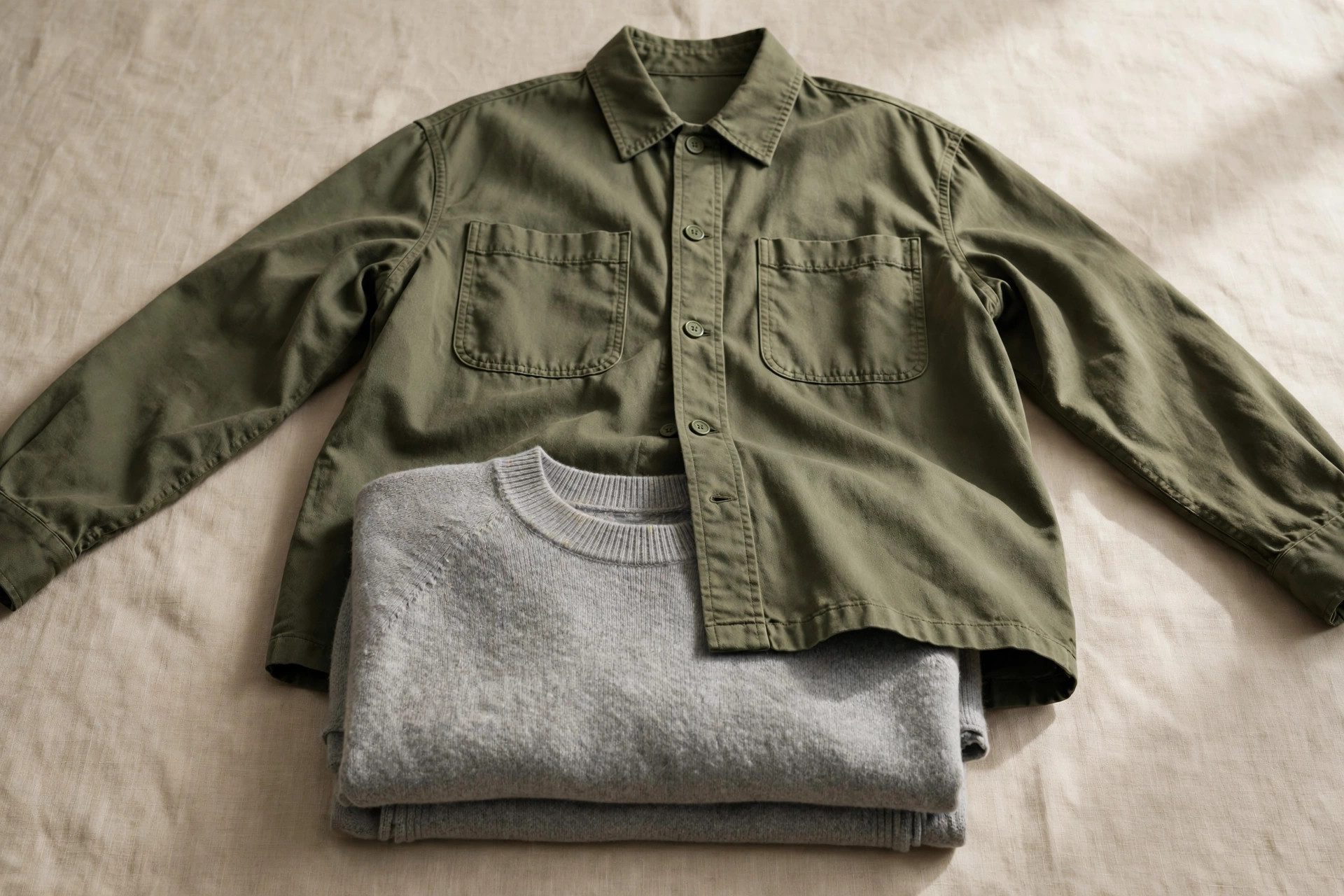
An overshirt is a heavy shirt designed to be worn as a light jacket: cut roomier than a shirt, made from fabric with real substance — twill, canvas, flannel, wool or denim — and finished with the pockets and straight hem of outerwear rather than the tails of a shirt meant to be tucked. It is the lightest true layer in the wardrobe, the garment for the weeks when a jacket is too much and a shirt is not enough. The overshirt descends from workwear — the French chore coat's lighter cousins, military shirt-jackets, and the CPO shirt of the US Navy — and unlike most fashion revivals it never fully disappeared, because the job it does has never gone away.
A Shirt Cut to Be Outerwear
Every detail of an overshirt answers the question: what does a shirt need to work as a jacket? A heavier fabric — cotton twill, canvas, denim, brushed flannel or wool — that holds warmth and shape. A roomier cut through the body and arm so it dresses over knitwear without binding. A straight hem that hangs properly untucked, instead of shirt tails. And pockets with a job: patch or bellows chest pockets, and often side pockets positioned like a jacket's, because a layer worn outdoors is expected to carry things.
The ancestry is workwear. The CPO shirt — a heavy wool shirt-jacket issued by the US Navy, anchor-embossed buttons and all — is the direct ancestor of the modern wool overshirt, and French and military shirt-jackets fill in the family tree. That origin explains the style's plainness: an overshirt is not decorated, it is equipped. In fashion terms it sits between the chore coat, which is a true jacket with a longer cut, and the flannel shirt, which gives up the outerwear hardware.
Overshirt vs Shacket: The Honest Answer
Shops, brands and stylists use the two words with genuine overlap, and the same garment may appear under either name in different catalogues. But the centre of gravity differs. The overshirt is shirt-first: usually unlined, in mid-weight fabrics, with a shirt's construction and a layer's job — think of it as the heaviest shirt you own. The shacket is jacket-first: heavier fabrics, sometimes lined or quilted, styled and sold as outerwear — the lightest jacket you own. Our shacket guide covers that branch.
The practical test when shopping is to ignore the label and handle the garment. Check the fabric weight, whether it has jacket-style side pockets, and whether you could button it over your thickest knit. Those three answers place it on the ladder — heavy shirt, overshirt, shacket, jacket — more truthfully than any product name. Regional vocabulary shifts the words too: what one market calls an overshirt, another sells as a shirt jacket, which is exactly the shacket's long-form name.
Wearing the Overshirt
The overshirt's season is the long transitional middle: the first item reached for in early autumn, the last surrendered in spring, and a mid-layer under coats in winter, when its flat profile slides under outerwear better than any jacket. Wear it open over a tee or henley as a shirt-substitute with structure; buttoned over a fine knit as the outfit's main layer; or under an overcoat, where a twill or plaid overshirt reads as deliberate depth rather than bulk.
Fabrics rotate with temperature — linen-cotton and light twill for summer evenings, flannel and canvas for autumn, wool for the cold months — but the outfit grammar stays: plain layers beneath, the overshirt as the visible frame, trousers from jeans to tailored wool. Fit is decided by the layer beneath: buy the size that buttons over your standard knit without the placket straining, and let the silhouette be relaxed. An overshirt that fits like a dress shirt has simply been bought too small for its job.
Common Questions
- Is an overshirt a jacket?
- Functionally, it is the lightest kind of jacket — but it is built as a shirt: no lining, no structure, a shirt collar and cuffs. Think of it as the first rung of outerwear. If you could tuck it in without absurdity, it is a heavy shirt; overshirts are cut longer and roomier precisely so that they are worn over, not in.
- What do you wear under an overshirt?
- Anything lighter than itself: T-shirts and henleys in mild weather, fine knits and sweatshirts when it is cooler, a shirt when you want the double-collar workwear look. The overshirt's body is cut to fit over a mid-layer without binding the arms — if you cannot comfortably add a jumper under it, size up.
- Overshirt vs shacket — which is warmer?
- The shacket is usually warmer. Both sit on the same ladder, but the overshirt is the lighter, shirt-first rung — unlined, mid-weight fabric — while the shacket is the jacket-first rung: heavier cloth, jacket pockets, sometimes quilted or lined. In equal fabric, they overlap; in a typical shop, the shacket is the warmer garment.
- Can you wear an overshirt in summer?
- Yes — in its lightest fabrics. A linen-cotton or light twill overshirt works as an evening layer in summer, replacing a jacket over a tee or camp shirt. Wool and heavy flannel overshirts are autumn garments. The category spans seasons because the pattern is constant and only the cloth changes.
Shacket & Overshirt Guides
This page is part of our shacket and overshirt series — the shirt-weight layers between shirts and jackets.