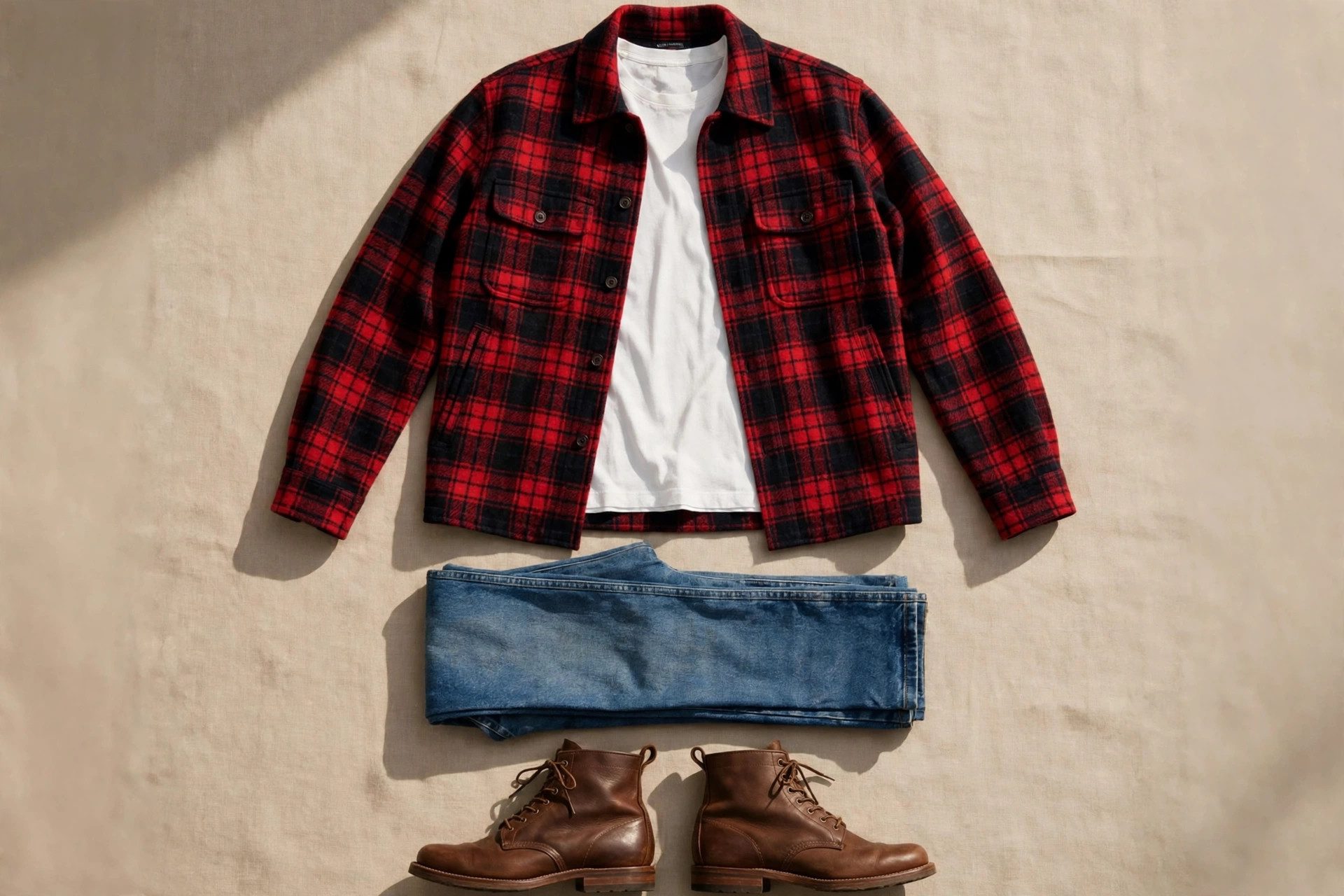
A shacket is a shirt jacket: a garment built on a shirt's pattern — pointed collar, button front, shirt cuffs, often a curved or straight shirt hem — but sewn in jacket-weight fabric, with jacket details like chest pockets, side pockets and sometimes a lining or light quilting. The name is the formula: shirt plus jacket. A shacket is worn as outerwear in the mild middle of the year and as a heavy mid-layer under a coat in winter, and it became a standard category in both men's and women's wardrobes because it fills the gap in the coat closet between a shirt and a real jacket — the layer for every day that is too cold for one and too warm for the other.
Between a Shirt and a Jacket
Read a shacket by its pattern. The top half is a shirt: a soft pointed collar that can be worn open or buttoned, a full button front, buttoned cuffs, and often a pleat or yoke at the back for movement. The fabric, though, belongs to outerwear — wool and wool-blend cloth, heavy brushed flannel, canvas, corduroy or quilted nylon — several times the weight of shirting. Add the jacket signals: patch or bellows chest pockets, side-entry hand pockets a shirt would never have, and in colder versions a quilted lining that turns the garment into genuine outerwear.
That hybrid build is why the shacket layers so well. It has a shirt's low profile — it slides under a coat without fighting it — with enough substance to serve as the outermost layer on its own. Women's and men's versions follow the same formula with different emphases: men's skew workwear (plaid wool, canvas, chore-pocket layouts), women's range wider, from tailored wool shackets worn like soft blazers to long flannel versions worn like light coats.
Shacket vs Overshirt vs Flannel Shirt
The three garments form a ladder of weight, and the vocabulary overlaps, so here are the working distinctions. A flannel shirt is a shirt: shirting-weight brushed cotton, meant to be worn as a shirt — tucked, untucked, or open as the lightest of layers. An overshirt is that shirt made heavier and roomier, cut to be worn over other clothing as the lightest form of jacket; it is shirt-first in character. A shacket is jacket-first: the heaviest fabrics, jacket pockets, sometimes linings and quilting — a shirt in silhouette but a jacket in duty.
In practice, shops use the words loosely, and the same garment may be sold under either name — the honest test is fabric weight and construction, not the label. If it could plausibly be tucked in, it is a shirt. If it has side pockets and can stand as your outermost layer on a cold autumn day, it is in shacket territory. The overshirt guide covers the lighter branch of the family in full.
Fabrics, Fit and Layering
Fabric decides the shacket's season. Wool and wool-blend plaids are the classic: warm, wind-resistant, and patterned in the checks the style is pictured in. Brushed flannel versions are softer and lighter — really an overshirt's heavier brother. Canvas and denim shackets lean workwear and shrug off abrasion; quilted versions with a light fill are the warmest and the closest to a true jacket. Fit should assume layers beneath: room in the chest and sleeve for a knit, shoulder seam near your own, and length anywhere from hip to mid-thigh depending on whether you wear it as a jacket or a light coat.
Wear it open over a T-shirt or henley on the first cool days, buttoned over a fine knit when the temperature drops, and under an overcoat — where its collar and cuffs peek out smartly — in winter. Plaid versions carry the pattern for an outfit of plains; solid versions in camel, olive, navy or grey behave like soft blazers over almost anything. Care follows the fabric: wool shackets brush down and wash rarely, flannel washes like the shirt it resembles.
Common Questions
- What is the difference between a shacket and a jacket?
- Weight and intent. A shacket is a shirt pattern made in jacket fabric, so it is lighter and less structured than a jacket — no padding, minimal lining, a shirt's collar rather than a jacket's stand collar. It is warmer and more weather-capable than any shirt, but it is not a substitute for a proper coat in deep winter.
- Are shackets warm enough for winter?
- As a sole outer layer, a shacket covers the shoulder seasons — most of spring and autumn — and mild winter days over knitwear. In deep cold it becomes a mid-layer under an overcoat, where its insulation and wind resistance still earn their place. Quilted and wool shackets sit at the warm end; unlined flannel ones at the light end.
- How should a shacket fit?
- Like a relaxed shirt, with room to layer: the shoulder seam near your own shoulder, sleeves that allow a knit underneath, and enough chest room to button it over a jumper without pulling. Length usually lands between hip and mid-thigh. If you will mostly wear it open over tees, your normal size works; for knitwear underneath, consider one up.
- Can women wear shackets?
- Yes — the shacket is a genuinely unisex pattern. Women's versions come in the same plaid wool and flannel fabrics, sometimes with a straighter or more shaped cut, longer lengths and softer colours; men's skew to workwear plaids and canvas. Many wearers buy across the aisle for fit and fabric — judge the garment, not the section.
Shacket & Overshirt Guides
This page is part of our shacket and overshirt series — the shirt-weight layers between shirts and jackets.