Men's Quilted Jacket Guide
Diamond quilting, a corduroy collar and country roots: the quilted jacket is the lightest warm layer a man can own that still looks dressed.
Shop Men's Quilted Jackets Now
Shop Men's Quilted Jackets on Amazon Shop Men's Quilted Jackets on eBayThe Amazon and eBay links on this page are affiliate links. If you make a purchase through them, Apparel Search may earn a commission.
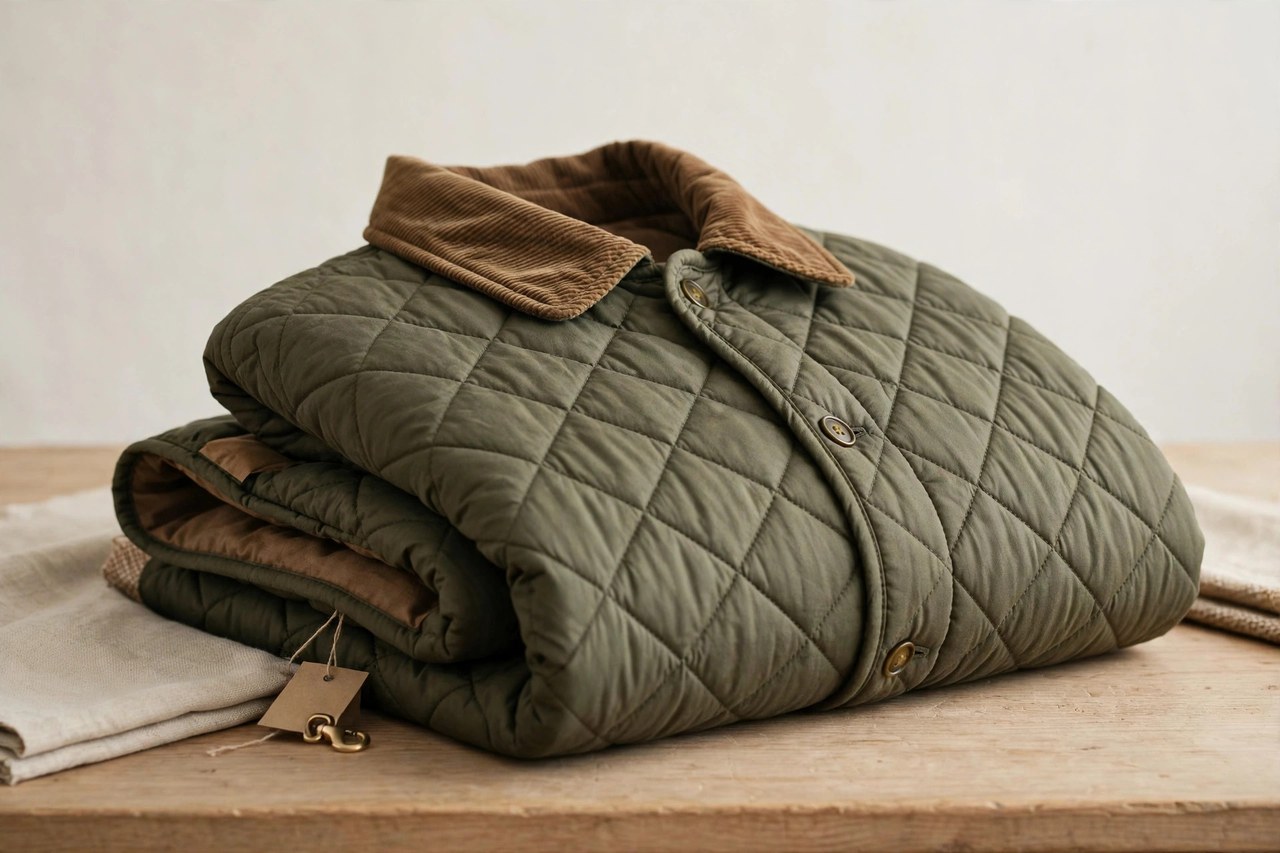
The quilted jacket entered menswear through the stable yard and the shooting field. In 1965 Steve Guylas, an American who had settled in England, founded Husky to sell a short, diamond-quilted nylon jacket with a corduroy collar, adapted from the padded coats of country work; Barbour's Liddesdale version carried the style around the world. The design solved an equestrian problem — warmth without bulk in the saddle — and turned out to solve a general one.
Quilting is a construction, not a fabric: two light shells stitched together through a layer of insulation, the stitch lines forming diamonds, channels or baffles that keep the fill from migrating. That simple idea now spans a whole family, from the classic country quilt in matte nylon to the glossy down puffer's lighter cousins, and choosing among them is mostly a matter of fill, face fabric and how dressed you need the result to look.
Diamond Quilts, Baffles and Fills
Diamond quilting is the country classic: small stitched diamonds distribute a thin layer of polyester wadding evenly, giving modest, even warmth with almost no bulk, which is why these jackets layer under coats and over jumpers equally well. Channel and baffle quilting holds thicker fills — more polyester, or down — in tubes, trading the flat country profile for real loft and cold ratings; that branch of the family shades into the down jacket proper.
Fill decides the warmth-to-weight story. Modern recycled-polyester fills are light, keep insulating when damp and need no special care — the sensible default for a jacket that will see rain, dogs and car boots. Down-filled quilts are warmer per gram and pack smaller, but sulk when wet and ask for gentler washing. Either way, check that stitching is even and dense: widely spaced quilting on a thin jacket is decoration, not insulation management.
The Country Pattern and Its Details
The heritage version is a small checklist: matte nylon or polyester shell, corduroy collar worn up or down, brass press-studs down a storm front, two deep bellows or slash pockets a hand can work in, a longer back hem, and vents or studs at the side so the jacket opens when you sit or ride. Colours are the countryside palette — olive, navy, brown, black — and the finish is deliberately unshiny, which is what separates the country quilt from its urban relatives.
City versions slim the body, drop the bellows for clean welt pockets, swap the cord collar for a stand collar or none, and appear in matte black and charcoal that pass over a blazer as commuter armour. Both branches share the style's core virtue: it is the warmest thing that still reads as a considered jacket rather than sports equipment, short of a wool coat.
Fit, Layering and Care
Fit depends on the jacket's assigned job. A layering quilt should be close — it must slide under an overcoat and over a sweater without bunching — while a standalone country jacket wants room for the knitwear it will actually meet. Length usually sits at the hip or just below; the equestrian original was short for the saddle, and longer quilted coats exist but belong to a different, more urban category.
Wear the country version with cords, moleskins, chinos and boots, and the city version over tailoring on cold commutes or with dark denim at weekends. It is also the traveller's friend: a quilted jacket compresses into a bag corner and emerges uncreased. Care is undemanding — most polyester quilts machine-wash cold and drip-dry — with two cautions: keep the corduroy collar brushed and dry-clean only if the maker insists, and re-proof nothing, since these shells rely on dense weave and a light water-repellent finish that a refresher spray can restore.
Common Questions
How warm is a quilted jacket?
The classic diamond-quilt country jacket is a cool-weather layer — ideal from about 40 to 60 degrees Fahrenheit, and further with knitwear under it. Thicker baffle-quilted and down-filled versions rate as genuine winter jackets. Check the fill type and weight rather than trusting the word 'quilted' alone.
Can a quilted jacket be worn over a blazer?
Yes — the slim city versions are designed for exactly that, and even the country pattern works over an unstructured blazer if both are sized for it. Choose matte black or navy, keep the jacket's hem at or below the blazer's, and it reads as intentional commuter layering rather than a compromise.
How do you wash a quilted jacket?
Most polyester-filled quilts machine-wash on a cold, gentle cycle and drip-dry flat or on a hanger; down fills need a down-specific detergent and thorough drying with dryer balls to restore loft. Always follow the maker's label first — a corduroy collar and leather trims can change the instructions.
More Men's Outerwear & Wardrobe Basics Guides
All thirteen guides in this cluster, in alphabetical order — classic coats, jackets, tailoring, trousers and shoes:
More to Explore on Apparel Search
Looking for Men's Clothing Stores?
This guide helps you choose a men's quilted jacket with the right fill for the season. To browse where to buy, visit our mens clothing store directory, where you can find retailers that carry them.