Men's Duffle Coat Guide
Wooden toggles, rope loops, a hood and a century of naval service: the duffle is the warmest character in the classic coat wardrobe.
Shop Men's Duffle Coats Now
Shop Men's Duffle Coats on Amazon Shop Men's Duffle Coats on eBayThe Amazon and eBay links on this page are affiliate links. If you make a purchase through them, Apparel Search may earn a commission.
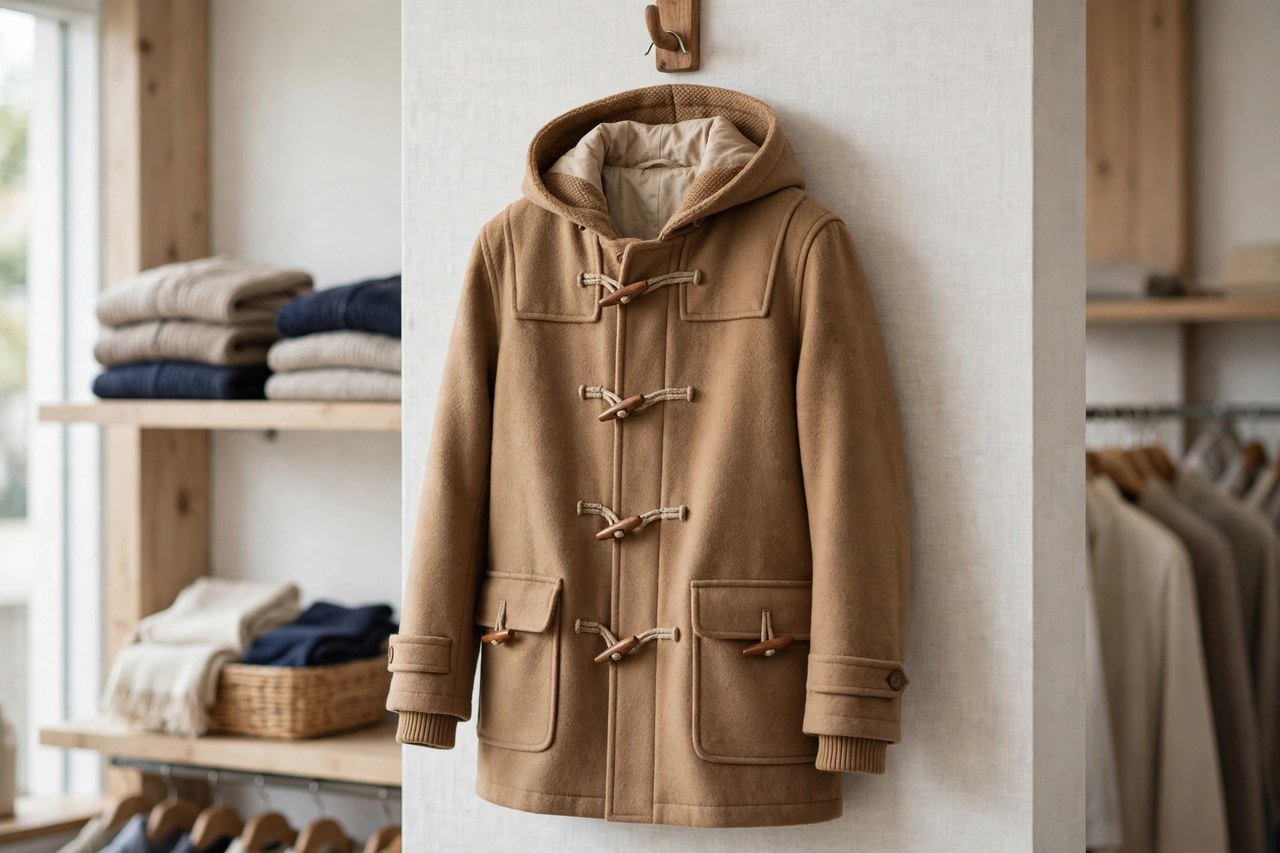
The duffle coat fastens with toggles — carved wooden or horn pegs passed through rope or leather loops — because a sailor in gloves, on a freezing deck, needed a coat he could open and close without fumbling at buttons. The Royal Navy issued duffles through both world wars, Field Marshal Montgomery made the camel version his visual signature, and the surplus coats that flooded civilian shops after 1945 carried the style into student and family wardrobes, where it has stayed.
The cloth takes its name from Duffel, the Belgian town whose heavy, coarse wool was first used for it. A true duffle cloth is thick, densely woven and warm almost to the point of weatherproofness, and the rest of the design follows the same practical logic: a hood big enough over a cap, deep patch pockets a gloved hand can enter, a throat strap against wind, and a loose, straight body that layers over anything.
The Details That Make a Duffle
Start with the fastenings, because copies get them wrong. Traditional toggles are wood — horn on finer coats — shaped to pass easily through loops of rope or leather thong, anchored on reinforced leather or cloth patches that spread the strain. Three or four toggles do the work of buttons, and a concealed zip or a few snaps behind them appears on modern versions for extra wind seal without changing the look.
The hood is integral, not detachable, on the classic pattern, with a small adjustable strap or button tab so it can be snugged down. The body is straight and roomy, the shoulders often carry a double yoke layer across the back and chest where spray and wear hit hardest, and the length is traditionally long — mid-thigh to knee — because the coat was bridge-watch equipment before it was fashion. Cuff adjusters with buttons complete a design in which almost nothing is decoration.
Cloth, Colour and Warmth
Duffel wool is woven heavy and finished with the fibres raised and pressed, giving a dense, slightly fuzzy surface that sheds light rain and blocks wind remarkably well for an uncoated fabric. Modern coats sometimes blend in recycled wool or a little synthetic fibre for weight; a high wool content still wears warmest and ages best. Because the cloth is so thick, most duffles are unlined or half-lined — the cloth is its own insulation.
Camel is the historic colour, tied to the Navy issue and to Montgomery's desert and European campaigns alike. Navy and charcoal are the city alternatives, olive and loden green the country ones, and bright reds and mustards appear whenever the style cycles through fashion. Warmth is genuine mid-winter level: over a sweater, a duffle handles the cold that sends a topcoat indoors, though in hard rain a trench coat or a technical shell remains the right tool.
Fit and How to Wear It
A duffle should fit like equipment: room through the body for knitwear, sleeves long enough to cover gloves at the wrist, and toggles that close without the fronts pulling apart. If it fits like a tailored overcoat it is too small — the ease is the point, and it is what lets the coat read relaxed rather than merely big. Length at mid-thigh suits shorter men and drivers; the full knee length is the classic silhouette.
Style it as the informal anchor of a winter wardrobe: with cords or jeans, a chunky roll-neck or Shetland sweater, and boots. It also has a long, honourable history over student blazers and scarves, and it softens a suit surprisingly gracefully on a casual Friday — but it is never a black-tie coat. Care is simple: brush the raised cloth, air the coat, mend a loosened loop early before the patch tears, and store it clean, since thick wool is prime moth territory.
Common Questions
Why do duffle coats use toggles instead of buttons?
So the coat can be fastened and opened with gloved or frozen hands. A toggle is a large target that works by feel, and the rope loop cannot clog with ice the way a buttonhole can fill and freeze. The fastening is naval engineering that happened to become a style signature.
How warm is a duffle coat?
Properly made in heavy duffel wool, it is a genuine winter coat — comfortable through most northern city winters over a sweater. The dense cloth blocks wind well and tolerates light snow and drizzle, but it is not waterproof, so sustained heavy rain calls for a different outer layer.
Should a duffle coat fit loose or slim?
Loose, by design. The pattern was cut to go over uniforms and heavy knitwear, and the straight, roomy body is part of its character. Choose your normal coat size bought for layering; a duffle that hugs the body loses both its function and its look.
More Men's Outerwear & Wardrobe Basics Guides
All thirteen guides in this cluster, in alphabetical order — classic coats, jackets, tailoring, trousers and shoes:
More to Explore on Apparel Search
Looking for Men's Clothing Stores?
This guide helps you choose a men's duffle coat with proper toggles and real wool cloth. To browse where to buy, visit our mens clothing store directory, where you can find retailers that carry them.