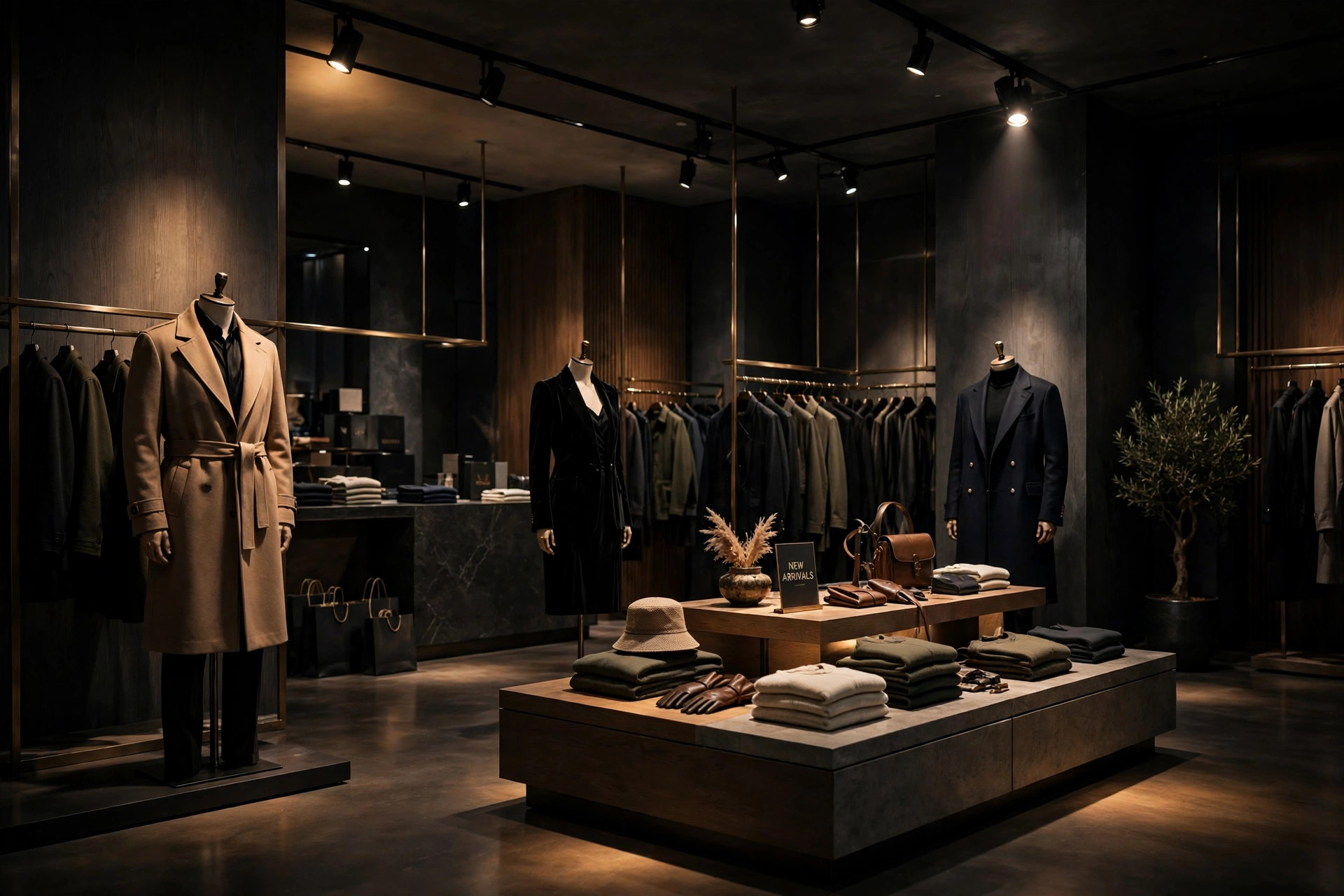
Lighting decides what looks expensive and what looks tired, what color a garment appears to be, and whether a customer likes her own reflection enough to buy. It is also the layer of store design most often left to whoever installed the ceiling. This page explains retail lighting for apparel — the layers, the color science, and the zones — as part of our visual merchandising guide.
The Three Layers of Store Light
Ambient lighting is the base: even, general illumination from ceiling panels, recessed downlights, or indirect sources that makes the store navigable and sets its overall mood. Accent lighting is the hierarchy-maker: track heads or adjustable spots, typically delivering three to five times the ambient brightness on their target, aimed at mannequins, focal tables, and feature walls. Without accent light, every fixture shouts at the same volume and none is heard. Task and decorative lighting covers the specifics — light over the cash wrap and in fitting rooms, pendants or chandeliers that signal brand character, and lit signage.
Contrast is the working principle. A store lit uniformly bright feels like a warehouse; a store with a comfortable ambient base and pools of accent light feels curated, and customers' eyes travel exactly where the accent light points — which is why lighting and the focal points in a clothing store layout are planned on the same drawing.
Color Rendering and Color Temperature
Two numbers govern whether garments look truthful. Color rendering index (CRI) measures how accurately a light source shows colors compared with natural light, on a scale to 100. Apparel selling floors and fitting rooms should run at CRI 90 or above. Below that, the classic retail failures appear: navy reads as black, black reads as brown, reds flatten, and the customer discovers the difference at home — a leading, invisible cause of "the color wasn't what I expected" returns.
Color temperature, measured in kelvin, is the warmth of the light itself. Warm light around 2700–3000K flatters skin and suits boutiques and eveningwear; neutral 3500–4000K reads crisp and modern; cool daylight tones can suit athletic and technical stores. Any of these can be right — what is wrong is a mixture, where a replacement lamp of a different temperature turns one corner of the store yellow. Consistency, and high CRI at whatever temperature is chosen, matter more than the exact number.
Lighting by Zone
Windows fight daylight: window spots must be bright, aimed at the merchandise rather than the glass, and left on after closing in many locations, when the lit window works as the store's night advertisement — see window display design for how window light and composition interact. Selling floor light combines the ambient base with accent tracks over focal fixtures and perimeter wall washers that make the walls — and the product on them — glow rather than recede. Feature walls earn the strongest accent, since they carry the story the whole zone is selling.
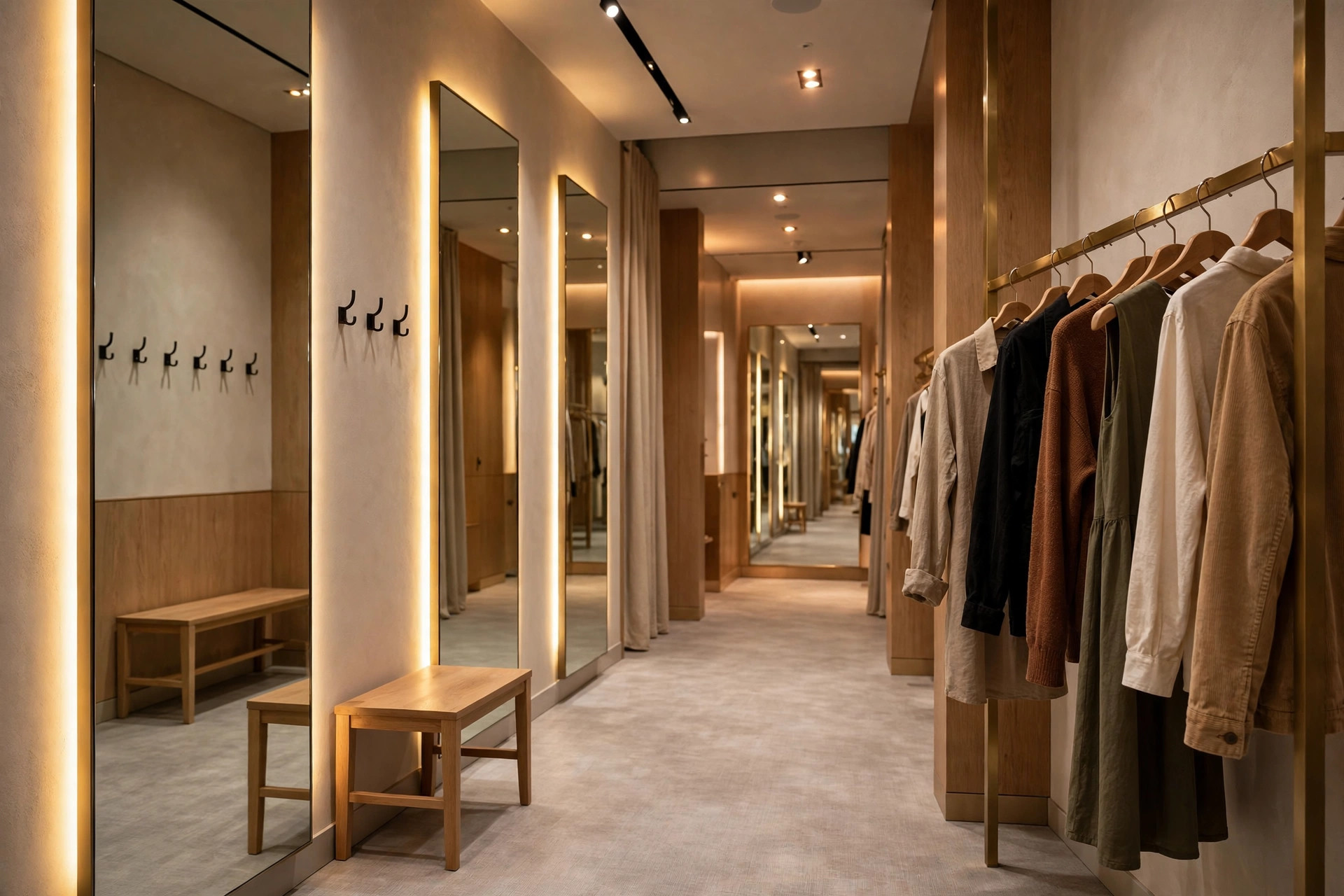
Fitting rooms decide sales: a single overhead downlight casts eye sockets into shadow and makes every customer look exhausted in the mirror. Vertical light at face height on both sides of the mirror, high CRI, and a warm-neutral temperature show the customer as she hopes to look in the garment — which is, not coincidentally, how she decides to buy it.
Modern LED systems have changed the economics: lower heat (a real comfort factor under track lights), long lamp life, tunable temperature in better fixtures, and dimming that lets a store shift mood between day and evening trade. Whatever the system, it needs maintenance — a burned-out accent lamp over a focal display quietly demotes the store's most important story, so lamp checks belong on the same daily walk as display tidying.
Common Questions
- What CRI should clothing store lighting have?
- A color rendering index of 90 or above for selling-floor and fitting-room lighting. Lower CRI light distorts garment colors — navy reads as black, reds go dull — which causes both lost sales and returns when the color looks different at home.
- What is the difference between ambient and accent lighting in a store?
- Ambient lighting is the even, general light that makes the whole store visible and comfortable. Accent lighting is focused light, typically three to five times brighter than the ambient level, aimed at focal displays, mannequins, and feature walls to create hierarchy and draw the eye.
- What color temperature is best for a clothing store?
- Most apparel stores use warm-neutral light between 3000K and 3500K, which flatters skin tones and fabric colors. Cooler light can suit sporty or technical stores, and very warm light suits intimate boutiques — the key is consistency across the whole floor.
- Why does fitting-room lighting matter so much?
- The fitting room is where the purchase decision is made, and harsh top-down light casts shadows that make customers look tired and garments look wrong. Vertical light at face height on both sides of the mirror, with high color rendering, shows the customer and the garment at their best.
Back to the Visual Merchandising & Retail Display Guide
Return to the main guide for the full picture — windows, mannequins, layout, planograms, lighting, and presentation working together.