Bullion Knot · Knotted Stitches
Bullion Knot Stitch
The bullion knot is a long, smooth coil of thread lying flat on the fabric, made by spanning the stitch length with the needle, wrapping the thread around the needle enough times to build a coil of that same length, and pulling the needle through the coil. It is the French knot's principle stretched out — a wrapped bead become a wrapped bar — and it sews the glossy raised petals, roses and lavender of dimensional embroidery.
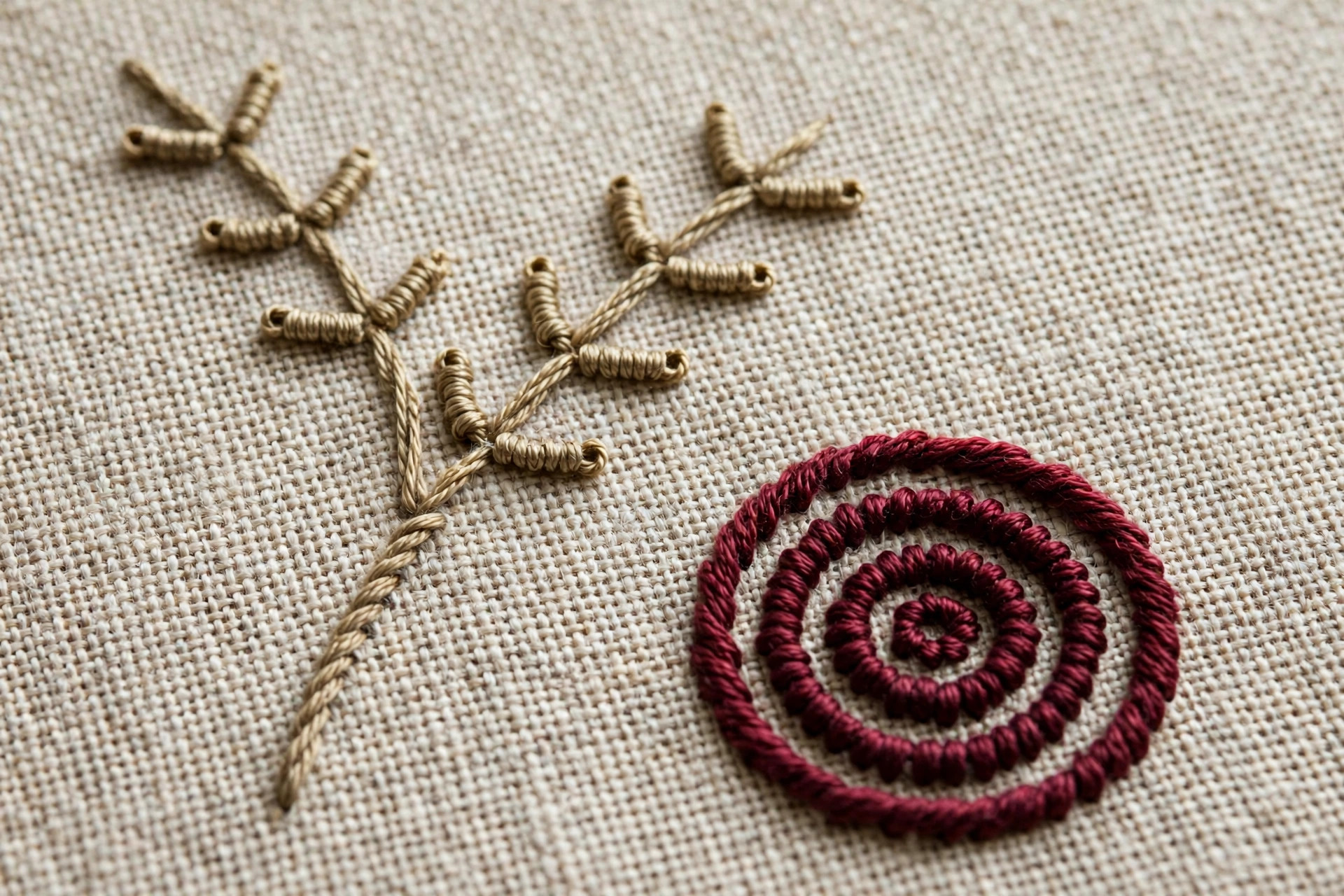
The bullion knot has a reputation as an advanced stitch, and it is only half deserved. The movements are few and none of them is hard. What the bullion demands is one judgement the French knot never asks for: you must decide, before pulling the needle through, whether the coil you have wound is the right length for the stitch you have spanned. That judgement — wraps against length — is the whole craft of the stitch, and this page is built around it. Get the coil length right and the bullion pulls through, lies down and behaves like the smoothest stitch in embroidery. Get it wrong in either direction and the coil twists, buckles or collapses, which is why bullions so often go wrong for stitchers who have been given the steps but not the rule.
How to Work a Bullion Knot
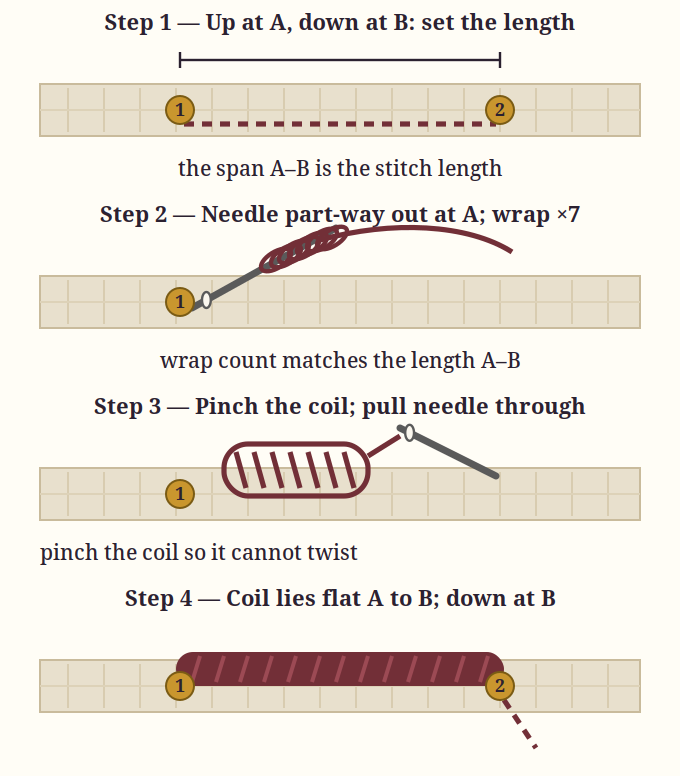
- Set the length. Come up at A, take the needle down at B — the two ends of the finished bullion — and come up at A again. Do not pull the needle right out: leave it part-way through the fabric, with its tip and eye above the surface at A and its point still anchored. The exposed needle now spans roughly the stitch length.
- Wrap the coil. Wind the working thread around the exposed needle, turn by turn, working away from the fabric. Keep the turns snug and side by side. Wrap until the coil on the needle is about as long as the distance from A to B — for a short bullion in floss, about seven turns is the usual starting point.
- Hold the coil and pull through. Pinch the coil gently between the finger and thumb of your free hand so it cannot twist or unravel, and with the other hand draw the needle up and out through the coil. Pull slowly and steadily; the coil should slide off the needle as one piece.
- Lay it flat and secure. Lay the coil down along the line from A to B. If it sits slightly twisted, stroke and roll it gently with the needle tip until the wraps sit evenly. Then take the needle down at B, right at the coil's end, to anchor it.
Bullion knot. Steps 1 and 2 are a pair: the length set in step 1 is the length the coil in step 2 must match. Illustration by Apparel Search.
The Governing Rule: Wrap Count Versus Stitch Length
Everything about the bullion knot follows from one relationship: the coil must be about as long as the stitch it fills. The coil is built on the needle, wrap by wrap, and its length is simply the number of wraps multiplied by the thickness of one wrap of your thread. The stitch length is the distance from A to B. When the two match, the coil drops into its bed and lies flat with its wraps side by side, like the segments of a caterpillar. When they do not match, geometry does the damage:
Too many wraps
The coil is longer than A–B. It has nowhere to go, so it buckles: arching off the fabric, twisting into a spiral, or kinking sideways. This is the commonest bullion fault, because wrapping feels productive and stitchers add "a few for luck".
Too few wraps
The coil is shorter than A–B. Pulled down into the longer bed it stretches, gapes between wraps, and collapses into a slack, stringy line that shows the fabric through it — a bullion in name only.
Working numbers. In stranded cotton floss (three strands) on a milliner's needle, one wrap adds roughly 0.8–1 mm of coil. So a 6 mm bullion wants about 7 wraps, a 10 mm bullion about 11–12, and a 15 mm bullion about 17–18. Thicker threads need fewer wraps for the same length; finer threads need more. Treat these as starting points only — thread, needle and personal wrapping tension all shift them — and always make the final check the physical one: hold the wrapped needle beside the A–B span before you pull through. Coil a little short is easier to forgive than coil too long, so if you are between counts, choose the lower one.
| Stitch length A–B | Wraps (3-strand floss) | Typical use at this size |
|---|---|---|
| About 5–6 mm | 6–7 wraps | Lavender buds, small petals, tiny caterpillars |
| About 10 mm | 11–12 wraps | Rose petals, wheat grains, leaves |
| About 15 mm | 17–18 wraps | Long petals, large leaves, bold dimensional work |
Thread and Needle Notes
Needle first, because it matters most: use a milliner's (straw) needle, size chosen so the coil slides freely, and long enough to hold the longest coil you plan to wrap. A milliner's needle is the same thickness along its whole shaft, eye included. A crewel needle swells at the eye, and a long coil that must be dragged over that swelling stretches, snarls, or jams — the hidden cause of most "impossible" bullions.
Thread. Smooth threads show the bullion's ribbed gloss at its best: stranded floss for general work, pearl cotton for a rounder, more corded coil. Brazilian dimensional embroidery — the bullion's showcase tradition — uses glossy rayon threads (such as EdMar) whose sheen makes bullion roses gleam; rayon is slippery, so wrap firmly and pinch the coil decisively. Wool makes soft, matte bullions for crewel-style work. Whatever the thread, keep the working length modest: a bullion drags its thread through the coil on every stitch, and a long thread frays and loses its twist.
What It Looks Like
A finished bullion is a smooth, slightly domed bar of thread with fine, even ribbing across it — each wrap reading as one segment. It sits on the fabric rather than in it, catches light along its length, and feels firm and springy under a fingertip. Its ends disappear cleanly at A and B with no visible anchoring stitch. A bullion that shows gaps between wraps, lies twisted like a rope end, or arches in the middle is telling you its wrap count missed its length — see the troubleshooting below.
Bullion Roses and Lavender
The bullion rose is built from the centre out. Work a French knot (or two or three, packed) as the heart. Around it, work a ring of short bullions — five or six — each one curved slightly by easing it as you secure it at B, so they cup the centre. Add a second, longer ring outside the first, offset so its bullions sit in the gaps of the inner ring, and curve them a little more. That is the whole flower: two or three rings of bullions around a knotted heart reads instantly as a rose, especially in shaded thread. A continuous spiral of bullions, worked round and round from the centre, makes the alternative "rose" shown in the photograph at the top of this page.
Lavender and wheat use the straight bullion at bud size. Along a stem line, work short bullions (5–7 mm) in close pairs, angled alternately left and right like the grains on an ear of wheat; in purple shades the same construction is a lavender spike. Keep every bud the same length and wrap count and the ear will look grown rather than assembled.
Curved bullions in general: a bullion can be bent as it is secured — take the needle down at a B that is offset from the straight line, or add a tiny couching stitch over the coil's middle — which is how petals cup, leaves turn, and caterpillars hump along a leaf.
Troubleshooting
| Problem | Why it happens | The fix |
|---|---|---|
| The coil twists into a spiral | Too many wraps for the length, or the coil was not held while the needle pulled through, so it wound itself tighter. | Drop a wrap or two; pinch the coil firmly during the pull-through; stroke it flat with the needle tip before securing at B. |
| The coil will not pull through | The coil is jamming on the needle's eye (a crewel needle's swelling), or the wraps are wound too tightly to slide. | Change to a milliner's needle. Wrap snugly, not strangled. If a coil sticks mid-pull, ease it back and forth gently rather than forcing it. |
| The bullion arches off the fabric | The coil is longer than A–B and buckles upward in the middle. | Fewer wraps. If the stitch is already worked, a tiny couching stitch over the arch will tame it — once. |
| The bullion is slack and gappy | Too few wraps: the short coil has been stretched to fill a longer bed. | Add wraps until the coil on the needle matches the span. Check physically against A–B before pulling through. |
| The coil unravels as it comes off | The pinch was released too early, or the thread is very slippery (rayon, silk). | Keep pinching until the needle is fully out and the coil is lying on the fabric. Pull slowly, straight along the needle's line. |
Where Bullion Knots Are Used
Bullions belong to dimensional embroidery — work that deliberately rises off the ground. They are the signature stitch of Brazilian embroidery, whose bullion roses, cast-on flowers and looping petals depend on the coil's gloss and spring. In traditional whitework and crewel they appear more quietly, as raised petals, berries and insect bodies. Anywhere a design needs a smooth bar of thread with real height — a petal, a bud, a grain of wheat, a grub on a leaf — the bullion is the stitch that does it, and its only real rival, the woven wheel, makes a disc rather than a bar. For the rest of the knotted family, see the Knotted Stitches family page; for the small wrapped dot the bullion grew from, see the French knot guide.
Common Questions
How many wraps does a bullion knot need?
Enough to build a coil about as long as the finished stitch. As a starting point, a short bullion of about 6 mm takes roughly seven wraps in stranded floss; a 12 mm bullion takes roughly twelve to fourteen. The real test is physical: before pulling through, compare the coil on the needle with the distance from A to B — if the coil is shorter, add wraps; if it is much longer, take some off.
Why does my bullion knot twist or stand up instead of lying flat?
Almost always a wrap-count mismatch. Too many wraps for the stitch length makes a coil that is longer than its bed, so it buckles, twists or arches off the fabric. Too few wraps leaves a slack coil that collapses and gapes. Match the coil length to the A–B distance, pinch the coil while you pull the needle through, and stroke it flat with the needle tip before securing at B.
What needle is best for bullion knots?
A milliner's (straw) needle, long enough to hold the whole coil. Its shaft is the same thickness along its length, eye included, so a long coil of wraps can slide over the eye without stretching. A standard crewel needle's swollen eye is the commonest hidden cause of bullions that jam halfway through.
What are bullion knots used for?
Bullion roses — a spiral of bullions around a French-knot centre — are the signature flower of Brazilian dimensional embroidery. Straight bullions also make lavender and wheat ears, petals and leaves, and plump caterpillars and grubs in garden scenes. Anywhere a design needs a smooth, glossy, raised bar of thread, the bullion is the stitch.
Related Stitches
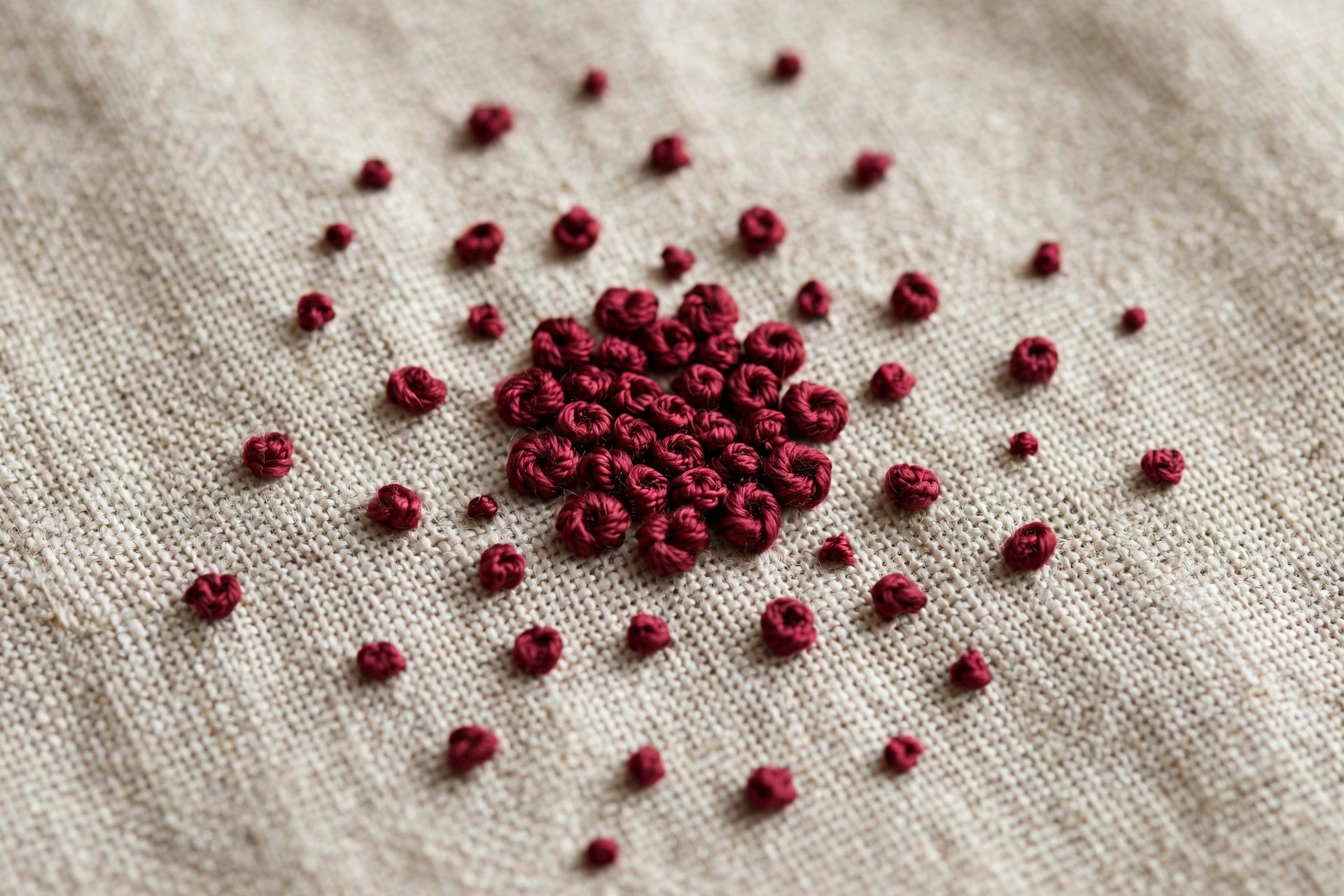 French KnotThe small wrapped bead the bullion grew from.
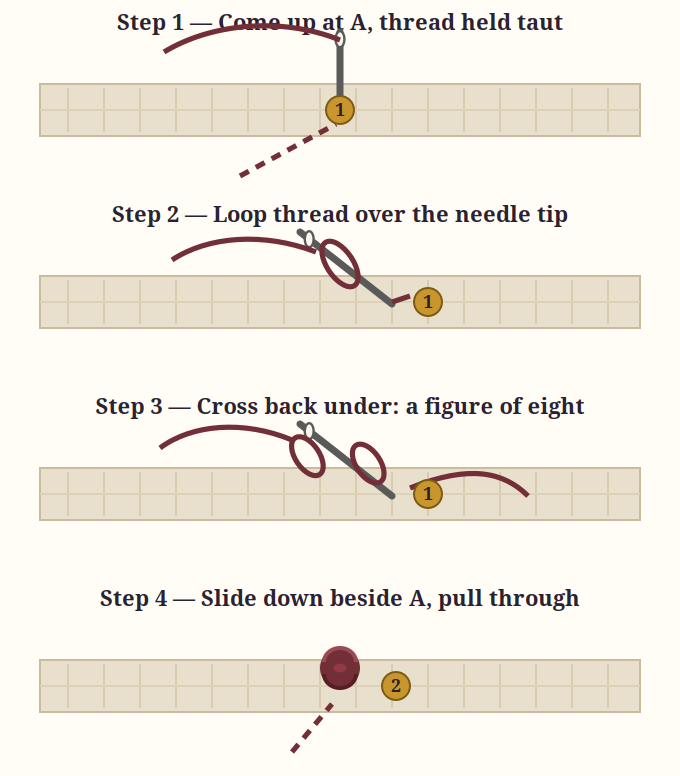 Colonial KnotThe figure-of-eight knot: taller and firmer than a French knot.
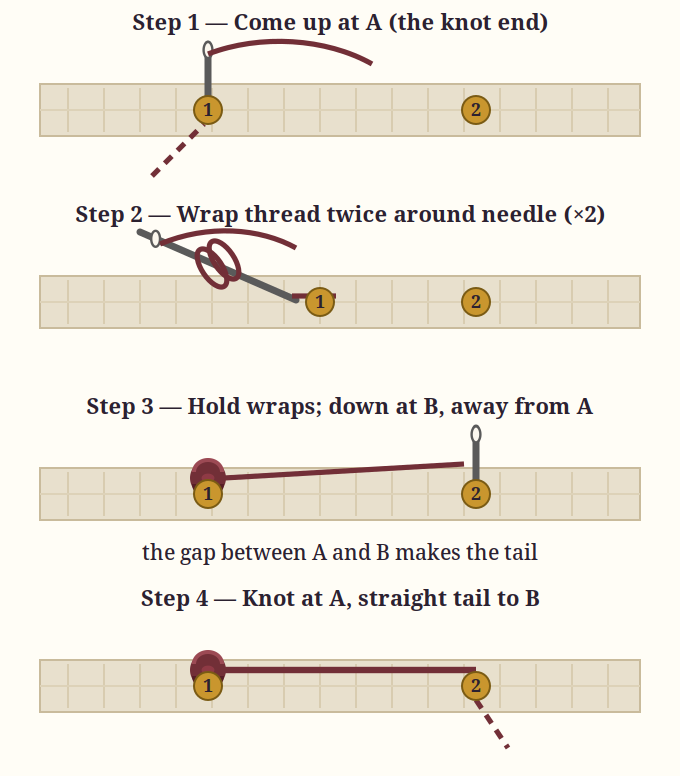 Pistil StitchA French knot on a straight tail — stamens and buds.
 Palestrina StitchTwo-loop knots tied along a line, like a row of pearls.
 Knotted StitchesThe whole family: all five knotted stitches with diagrams.
More to Explore
Search Apparel Search