Guide · Hand Embroidery Stitches
Embroidery Stitches Guide
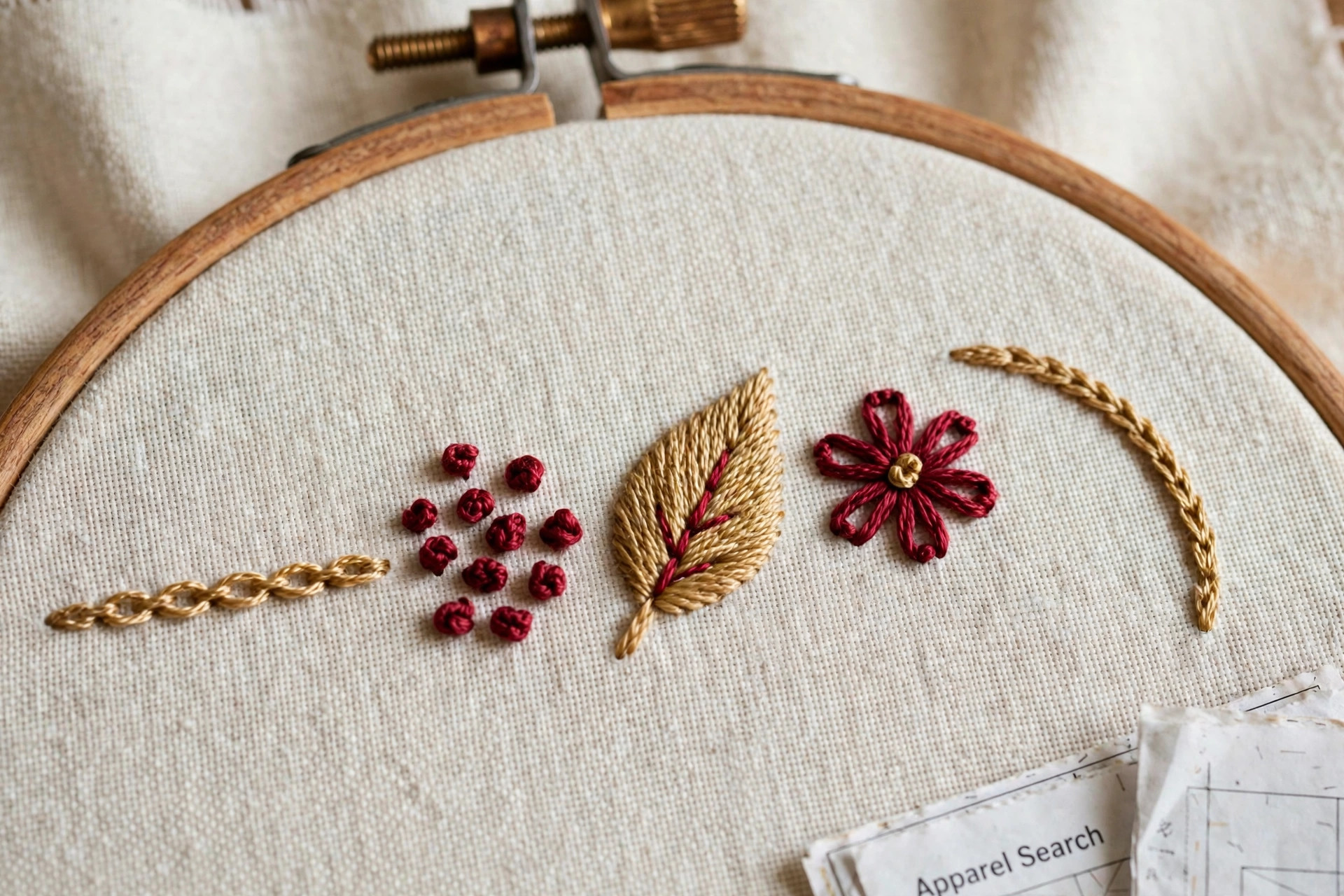
Hand embroidery has a vocabulary, and this guide teaches it whole: 49 stitches in 8 families, every stitch drawn in an original step diagram and explained in working words — how it is formed, what thread and fabric it wants, what it looks like on the surface and underneath, and what work it does best. Twelve of the most-used stitches have full guide pages of their own; the rest are worked in full on their family pages. If you have ever looked at a sampler and wondered how a stitch was made, this is where to start.
Search Apparel Search
What This Guide Is — and What “Complete” Means Here
Embroidery stitches are traditionally taught one at a time, scattered across pattern books and definition pages. Apparel Search already had good definitions for a handful of stitches, but no page on the site presented the stitches as a set — organised by family, drawn step by step, and cross-linked so a stitcher can move from the stitch in hand to its relatives. This guide is that missing set. It is the hand-embroidery companion to our Stitch & Seams Guide, which covers the sewing-machine and seam stitches of ASTM D-6193; together the two guides cover the stitches that decorate fabric and the stitches that construct garments.
A note on completeness, stated honestly. There is no standards body for embroidery stitches — no equivalent of ASTM D-6193 fixes the repertoire or the names. So this guide follows the widely used family consensus: the family classification used by the Royal School of Needlework Stitch Bank and by Sarah's Hand Embroidery family scheme, in which stitches are grouped by how they are constructed. “Complete” here means something specific and checkable: every core stitch that heads a family or is independently named in patterns is present — 49 anchored sections across the 8 families, covering 54 named stitches and variants, with variants handled inside their parent stitch's section rather than padded out into separate pages. Regional and historical names for the same stitch are noted where they matter. Stitch facts and family organisation are common knowledge shared by every embroidery reference; every word and every diagram in this guide is original to Apparel Search.
New to embroidery entirely? Work through the families in order — line stitches first, then chain, then whichever family your next project needs. Looking for one stitch? The Explore Embroidery Stitches gallery shows all 49 stitches as pictures, one click from each stitch's diagram and instructions.
The Eight Families
Line & Outline Stitches
The drawing tools of embroidery. These eight stitches make lines — fine or bold, smooth or knotted — and every design begins with them: outlines, stems, branches, lettering and borders. Running stitch and backstitch are the foundation pair every beginner learns first; stem and split stitch refine the line into a cord; Holbein stitch makes a line identical on both faces of the cloth; and whipped backstitch, Pekinese and coral stitch dress the plain line up into something richer.
Stitches in this family: Running · Backstitch · Stem ★ · Split ★ · Holbein · Whipped Backstitch · Pekinese · Coral
Chain Stitches
One idea, seven stitches: a loop of thread held in place by the next stitch. Plain chain stitch links loop into loop in a smooth, braided line; reverse and twisted chain vary the loop's direction and twist; lazy daisy detaches a single loop into a petal; feathered chain leans its links into foliage; and wheatear and rosette chain build the loop into pointed and knotted borders. If stem stitch is embroidery's pencil, chain stitch is its calligraphy pen — bolder, faster and more decorative.
Stitches in this family: Chain · Reverse Chain · Twisted Chain · Lazy Daisy ★ · Feathered Chain · Wheatear · Rosette Chain
Blanket & Buttonhole Stitches
The edge specialists. Blanket stitch and its relatives loop along an edge, binding it and decorating it in the same pass — the stitch of blanket edges, appliqué, felt work and scalloped hems. Closed blanket packs the loops into triangles, crossed blanket laces them into X shapes, the buttonhole bar throws a raised cord across a gap for cutwork, and up-and-down buttonhole works its stitches alternately above and below the line for two-way borders.
Stitches in this family: Blanket ★ · Closed Blanket · Crossed Blanket · Buttonhole Bar · Up-and-Down Buttonhole
Feather & Fly Stitches
The branching family. Feather stitch throws alternating V shapes from a central line, so a single pass grows a stem with leaves on both sides — foliage, ferns and seaweed almost draw themselves. Fly stitch detaches the V into a single Y-shaped unit; fern stitch fans three straight stitches into a plant; Cretan stitch stretches the feather between two lines into a plaited band; and chevron caps the family with a crisp geometric zigzag for borders and bands.
Stitches in this family: Feather ★ · Fly · Fern · Cretan · Chevron
Crossed Stitches
Stitches built from diagonals that cross. Cross stitch — two diagonal stitches over one square — anchors the family and carries whole counted-thread traditions on its back. Herringbone crosses its stitches along two parallel lines into a plaited lattice band, quite different from the tailor's catch stitch of the same name. Double herringbone works a second row through the first, interlacing the two into the family's densest band. Double cross stacks two crosses into one plump unit, and long-armed cross stretches the cross off-centre so a single row braids itself into a band.
Stitches in this family: Cross · Herringbone ★ · Double Herringbone · Double Cross · Long-Armed Cross
Knotted Stitches
Texture you can feel. Knotted stitches wrap the thread around the needle and pull it through into a raised knot or coil that stands off the fabric — dots, berries, flower centres and whole fields of granular texture. The French knot is the famous one; the colonial knot is its taller, firmer figure-of-eight cousin; the bullion knot stretches the wrap into a long coil; pistil stitch puts a knot on a tail; and Palestrina stitch ties its knots along a line into a heavy cord.
Stitches in this family: French Knot ★ · Colonial Knot · Bullion Knot ★ · Pistil · Palestrina
Satin & Filling Stitches
The painters of the set. Where line stitches draw, these eight stitches fill — covering shapes with smooth satin, domed padding, shaded needle-painting and woven wheels. Satin stitch lays its gleaming parallel stitches edge to edge; long and short stitch interlocks its rows so colours shade into each other; seed stitch textures by scatter alone; fishbone and leaf stitches fill leaves from a centre vein; and the woven wheel and spider web weave whole rosettes over a foundation of spokes.
Stitches in this family: Satin · Padded Satin · Long and Short ★ · Seed ★ · Fishbone ★ · Leaf · Woven Wheel ★ · Spider Web
Couching & Laid Work
The family that never pierces the fabric with its main thread. A thread, cord or metal strand is laid along the surface and stitched down by a finer thread — the only way to embroider with gold thread, thick cords and ribbon that cannot be pulled through cloth. Plain couching is the foundation; underside couching, the glory of medieval Opus Anglicanum goldwork, hides its stitches and makes the gold pattern itself flex; Bokhara and Roumanian couching turn the holding stitches into pattern; and trellis and burden stitch build whole woven fillings from laid threads.
Stitches in this family: Couching · Underside Couching · Bokhara · Roumanian · Trellis · Burden
How to Read the Step Diagrams
Every stitch in this guide is drawn in the same diagram system, so once you can read one diagram you can read all 49. Each diagram shows a small patch of work in two or three steps, read left to right:
- The cream band is the fabric, drawn as a horizontal strip of linen with its weave lines showing.
- Solid thread lies on the surface. Thread drawn in a solid wine line is on top of the fabric, where you can see it in the finished work.
- Dashed thread passes underneath. Where the thread travels behind the fabric — between coming up and going down — it is drawn dashed.
- Gold dots are the needle's entry and exit points, numbered in working order, each with a tiny label: “1 up” means the needle comes up through the fabric at point 1; “2 down” means it goes down at point 2. Follow the numbers and you follow the stitch.
- Laid threads are drawn in gold. In the couching family the thread being laid on the surface is shown in gold and the finer thread that stitches it down in wine, so the two threads' jobs never get confused.
Two honest exceptions are labelled where they occur. A few stitches are matters of judgement rather than path — the shading of long and short stitch, the scatter of seed stitch, the build-up of trellis work — and for those the diagram shows the structure (rows, distribution, frames) while the prose teaches the judgement. The caption under each such diagram says so plainly.
Choosing a Stitch by the Job
Most stitch choices reduce to five jobs. This table names the stitches experienced embroiderers reach for first; every name links to its diagram and instructions.
| The job | Reach for | Why |
|---|---|---|
| Outline a shape, stem or line | Stem stitch, split stitch, backstitch | Stem gives a smooth raised cord, split the finest solid line, backstitch the crispest edge. |
| Edge a blanket, hem or appliqué shape | Blanket stitch, chevron, buttonhole bar | These stitches bind an edge and decorate it in the same pass. |
| Fill a shape with colour | Satin stitch, long and short, fishbone, burden stitch | Satin for smooth shine, long and short for shading, fishbone for leaves, burden for woven texture. |
| Texture and dots | French knot, bullion knot, seed stitch, spider web | Knots stand off the fabric as dots and berries; seed scatters texture by density alone. |
| Lettering and monograms | Backstitch, split stitch, chain stitch | Small backstitch and split stitch turn tight corners cleanly; chain makes bold display letters. |
Thread and fabric cut across every row of that table: the same stitch in a single strand of floss is a whisper and in perle cotton or wool a shout, and a stitch that sings on evenweave linen can fight you on a loose or stretchy ground. Each family page notes the threads its stitches want.
Beyond This Guide
Definitions. This guide teaches stitches by working them. For the dictionary side of the subject, our embroidery stitch definitions survey defines embroidery terms stitch by stitch, and the embroidery definition covers the craft itself — its history, materials and place among the textile arts.
The neighbouring craft — out of scope here, on purpose. Needlepoint looks like embroidery and shares some stitch names, but it is a different craft: its stitches are counted over the grid of an open-weave canvas, not drawn freely on fabric. Needlepoint stitches — tent, brick, Parisian and their family — are covered in our needlepoint stitches definitions, and they are deliberately not counted in this guide.
Hand versus machine. Everything in this guide is worked by hand, with a needle. Machine embroidery — digitised designs stitched at speed on manufactured goods — is a separate, industrial technique with its own vocabulary of satin columns, fills and underlay; it is introduced on our machine embroidery techniques page, which links back here for the hand stitches the machine stitches are named after. And for the stitches that sew garments together rather than decorate them, the sibling Stitch & Seams Guide covers the ASTM D-6193 stitch classes and seam types in the same diagram-first way.
Common Questions
How many stitches does this guide cover?
Forty-nine anchored stitch sections across eight families, covering 54 named stitches and variants. Twelve of the most-used stitches also have their own full guide pages. The set follows the widely used hand-embroidery family classification used by the Royal School of Needlework Stitch Bank and Sarah's Hand Embroidery family scheme.
Which embroidery stitch should a beginner learn first?
Running stitch and backstitch from the Line and Outline family — they teach needle control and even spacing, and almost every other stitch builds on them. Stem stitch and chain stitch come next, then lazy daisy and the French knot for decoration.
What is the difference between hand embroidery stitches and sewing stitches?
Hand embroidery stitches are decorative: they are worked on the surface of finished fabric to draw, fill and texture a design. Sewing stitches — the lockstitches, chain stitches and overedge stitches classified in ASTM D-6193 — join pieces of fabric into seams. Some names, such as chain stitch and backstitch, exist in both worlds with different constructions. The companion Stitch and Seams Guide covers the sewing side.
Are needlepoint stitches included in this guide?
No. Needlepoint is the neighbouring canvas-work craft, worked on a counted canvas grid with its own stitch family — tent stitch, brick stitch, Parisian stitch and their relatives. Those stitches have their own definitions on Apparel Search, linked from this hub, and they are deliberately kept out of this guide's count.
More to Explore
Stitch families and names follow the widely used hand-embroidery family classification (Royal School of Needlework Stitch Bank; Sarah’s Hand Embroidery family scheme). Diagrams on these pages are original Apparel Search drawings.