French Knot · Knotted Stitches
French Knot Stitch
The French knot is a small, tight knot of thread sitting on the surface of the fabric, made by wrapping the working thread around the needle — twice for the standard knot — and pulling the needle through so the wraps settle into a neat, rounded bead. It is embroidery's most useful dot: a flower centre, an eye, a berry, a speck of texture, repeated by the dozen or the hundred.
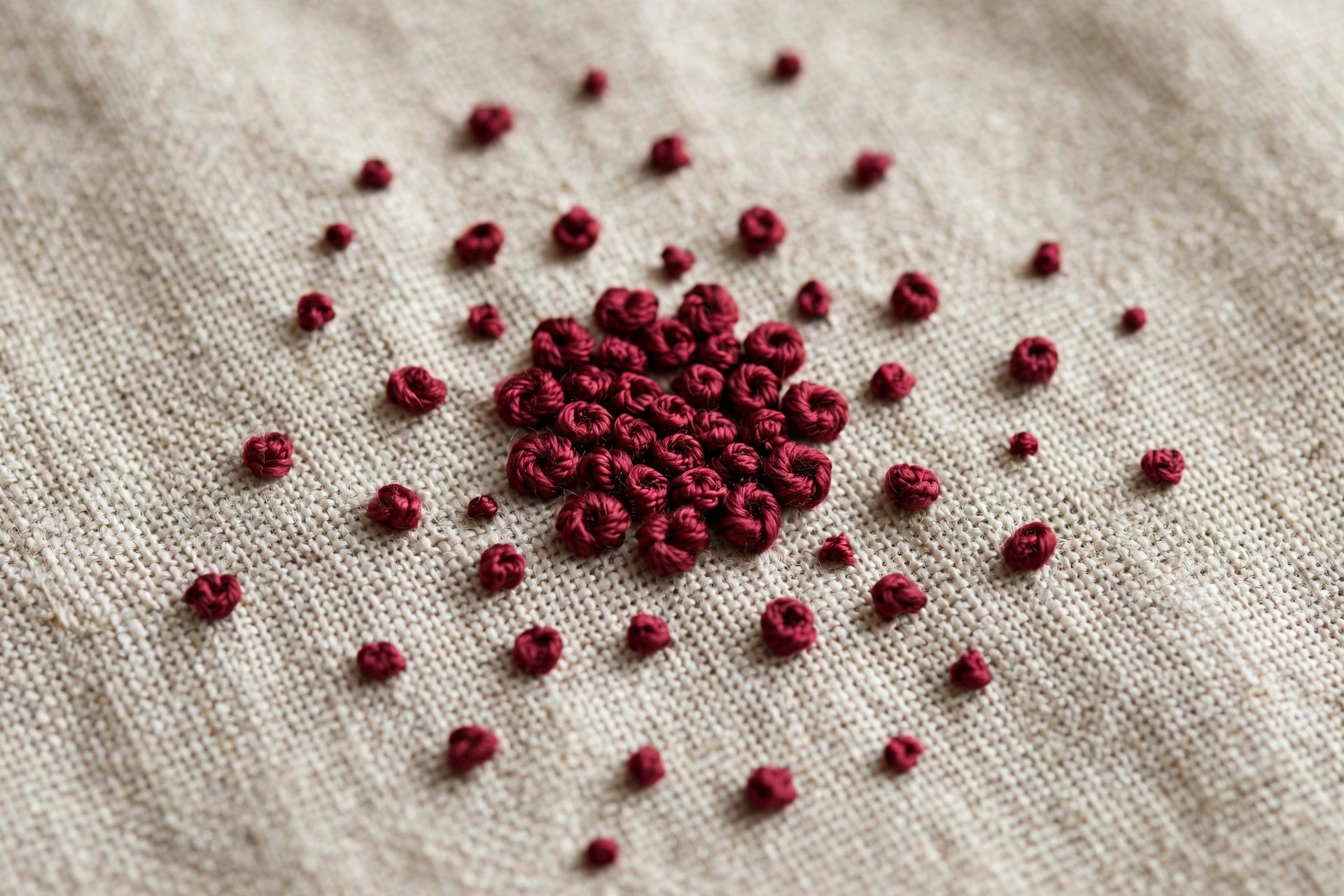
No stitch causes beginners more grief, or gives experienced stitchers more pleasure, than the French knot. It is genuinely simple — there are only four movements in it — but it is unforgiving of one particular shortcut: the wraps must be held under tension from the moment they are wound until the knot has formed. Let the tension go at the wrong second and the wraps unravel into a loose loop; put the needle back through the entry hole and the whole knot vanishes to the back of the work. Both failures are famous, both are easy to fix, and this page deals with each in turn. Master the hold, and the French knot becomes one of the most reliable stitches in the repertoire — and one of the most expressive, because a motif built from nothing but French knots, varied in size and density, can carry an entire design.
How to Work a French Knot
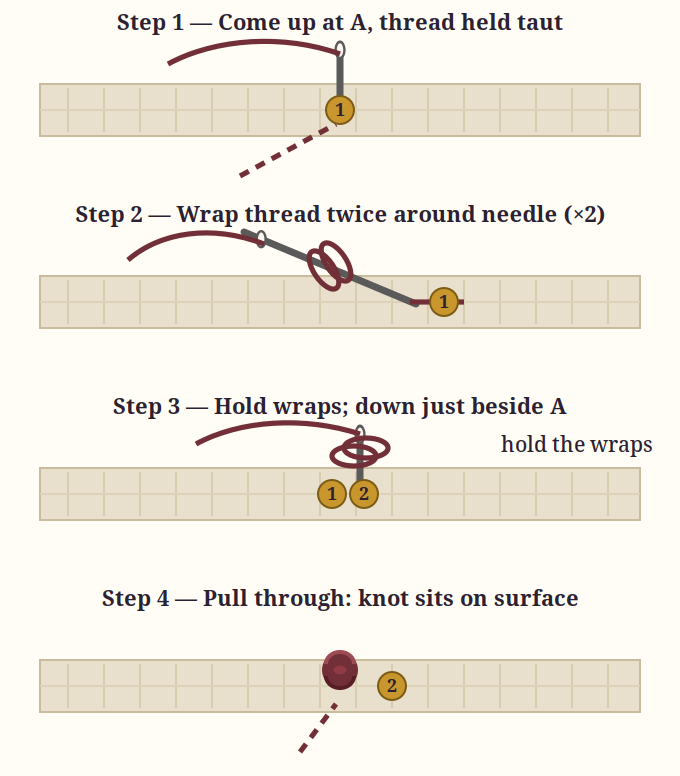
- Come up at A. Bring the needle up where the knot is to sit, and pull the thread through. Hold the working thread taut with your free hand, a few centimetres from the fabric — this hand does not let go until step 4.
- Wrap the needle twice. With the needle pointing away from the fabric, wind the taut thread around it two times, close to the fabric surface. The wraps should sit snugly side by side on the needle shaft, not stacked and not loose.
- Go down just beside A. Still holding the thread taut, put the needle tip into the fabric one or two threads away from A — never into the same hole. Push it part-way through.
- Slide the wraps down and pull through. Ease the wraps down the needle until they rest on the fabric, keep the gentle pull on the working thread so they stay tight, and draw the needle through. The wraps collapse into a compact knot sitting exactly at A. Release the thread only when the knot has formed.
French knot. The wrap frame (step 2) and the hold (step 3) are the two moments that decide the knot. Illustration by Apparel Search.
Working left-handed? Every step mirrors exactly; wrap in whichever direction keeps the thread taut for you, but keep the direction the same for every knot in a piece so the knots all lean the same way.
The Wrap-Count Method: One, Two or Three Wraps
A French knot's size is set before the needle ever goes back down — by how many times the thread circles it. This is the wrap-count method, and it is the correct way to grade knot sizes in a design. The temptation is to make a bigger knot by pulling a longer loop or using a looser wrap; resist it. Loose wraps make untidy knots of any size, while a snug extra wrap makes a bigger knot that is just as neat.
| Wraps | Finished knot | Best for |
|---|---|---|
| 1 wrap | Small, tight, low — roughly the width of the thread bundle itself, sitting close to the fabric. | Fine detail: tiny flower centres, distant texture, delicate facial features, knots in fine thread or on fine fabric where a two-wrap knot would overwhelm the design. |
| 2 wraps | The standard knot — a clear, rounded bead, about twice the thread bundle's width. | The default for almost everything: flower centres, berries, eyes, general texture. When a pattern says "French knot" without qualification, it means this one. |
| 3 wraps | Large, plump and high — noticeably bolder, with a softer, more domed profile. | Statement knots: big flower centres, foreground berries, knots that must read at a distance. Beyond three wraps the knot stops behaving — use a thicker thread instead. |
Four wraps and beyond is where French knots go wrong: the wraps can no longer slide down the needle as one tidy bundle, and the result is a lopsided tangle. If a design needs a still bigger dot, change the thread, not the count — more strands of floss, or a pearl cotton a size up, with the same two wraps. Size from the thread is stable; size from extra wraps is not.
The four-legged knot variant
The four-legged knot starts as an ordinary two-wrap French knot and then anchors it: four tiny straight stitches are worked over the finished knot, one at each diagonal, like the legs of a miniature star. The legs pin the knot down on loose-weave or slippery ground fabric, spread its footprint slightly, and give it a faint sparkle of structure — useful for knots on canvas, on very open linen, or in a thread that wants to slide. It is covered in summary on the Knotted Stitches family page.
Thread and Fabric Notes
Thread. Stranded cotton floss is the standard: two or three strands for ordinary work, all six for bold knots. Pearl cotton twists its strands into a smooth cord that wraps and slides beautifully, giving the roundest, most even knots — it is the thread of candlewicking, where knots are worked large in unbleached pearl cotton on muslin. Silk ribbon and wool both make handsome knots with their own character (wool knots are soft and matte, and very forgiving). While learning, avoid metallics and very slippery rayons: their wraps slide off the needle before you can hold them.
Needle. A milliner's (straw) needle is the French knot's best friend. Unlike a crewel needle, which swells at the eye, a milliner's needle has a shaft of even thickness from point to eye — so the wraps slide over the eye without stretching or catching. Half of all "impossible" French knots are simply a knot fighting its way over a fat needle eye.
Fabric. Any even, firmly woven ground works. The one real requirement is that the fabric's weave be tight enough that the knot cannot slip between its threads: on very open weaves, work the knot over a small foundation stitch, use the four-legged variant, or choose a bigger thread.
What a Good French Knot Looks Like
A well-worked French knot is a compact, symmetrical bead: round in plan, gently domed in profile, sitting squarely on the surface with no loop sticking out of it and no tail trailing from it. The wraps are invisible as separate turns — they have merged into the knot's smooth skin. It should resist a gentle tug and spring back when pressed. A knot that looks like a tiny figure-eight, a spiral, or a loop with a thread through it has not finished forming: one of the failure modes below has happened, and the fix is in the same table.
Troubleshooting: The Classic Failures and Their Fixes
| Failure | Why it happens | The fix |
|---|---|---|
| The knot pulls through to the back | The needle re-entered through the same hole it came up through, and the knot — smaller than the needle hole — followed it through. | Re-enter one or two fabric threads beside the entry hole, never in it. On loose fabric, add a wrap or use a thicker thread so the knot is bigger than any hole. |
| A loose loop instead of a knot | The working thread's tension was released while the needle was being pulled through, so the wraps unravelled before they could tighten. | Hold the thread taut with the free hand from wrapping until the knot has visibly formed. Pull through slowly, and slide the wraps down to the fabric before the final pull. |
| The knot is lopsided or slides off-centre | The wraps were stacked on the needle rather than side by side, or the thread was pulled sideways as the needle came through. | Lay the wraps snugly side by side near the fabric. Pull the needle straight through along its own line, and steady the knot with a fingernail as it settles. |
| The wraps tangle on the needle | Too many wraps, or wraps fighting over a swollen needle eye. | Stay at three wraps or fewer and get the size from the thread. Switch to a milliner's needle, whose even shaft lets wraps slide over the eye. |
| Knots in a group are all different sizes | The wrap count or the number of thread strands drifted between knots. | Count the wraps out loud for the first dozen knots of a session until the rhythm sets. Keep strand count constant; change size deliberately, by wrap count, only where the design grades it. |
Where French Knots Are Used
Flower centres are the classic job: a single knot, or a tight cluster of five to nine, in the middle of lazy-daisy or woven-wheel petals gives a flower its pollen-heavy heart. Yellow and ochre knots do this work in a thousand traditional designs. Texture fields are the second great use — knots packed or scattered to render sheep's fleece, curly hair, gravel, foliage, snow, stars and sea spray, where no flat stitch can match their broken, light-catching surface. French-knot-only motifs are a genre of their own: whole pictures — initial letters, silhouettes, tiny landscapes — built from nothing but knots graded by wrap count and thread shade, a pointillism in thread. And at the smallest scale, a single French knot is still the embroiderer's standard eye for birds, animals and figures, and the quickest berry, bud and seed head in the garden.
For the knotted family around it — including the pistil stitch, which is a French knot given a tail — see the Knotted Stitches family page, and browse the whole repertoire in the Explore Embroidery Stitches gallery.
French Knot or Colonial Knot?
The two stitches compete for the same jobs, and the choice is practical, not doctrinal. The French knot (this page) wraps the thread in plain circles around the needle: it is the smaller, flatter, more delicate knot, the one patterns assume, and the one that rewards a practised hold. The colonial knot crosses the thread over the needle and back under it in a figure of eight: the wrap locks, so the knot sits a little taller and firmer, survives thick and slippery threads, and almost never pulls through. If your French knots behave, keep them. If they pull through, unravel, or must be worked in pearl cotton at candlewicking size, switch to the colonial knot and the problem usually disappears. Many stitchers keep both — French for fine work, colonial for bold — and mix them knowingly, since at a glance a finished colonial knot reads as a slightly plumper French knot.
Common Questions
Why does my French knot pull through to the back of the fabric?
Because the needle went back down through the same hole it came up through, or very nearly: the knot is smaller than the hole the needle made, so it slips through. Always re-enter one or two fabric threads away from the entry hole, keep the wraps snug, and pull through slowly with the working thread held taut so the knot tightens on the surface before the needle is fully through.
How many wraps make a standard French knot?
Two wraps is the classic count and the size most patterns assume. One wrap makes a smaller, tighter, more delicate knot; three wraps make a noticeably larger, plumper one. Keep the wrap count the same across a whole motif — mixing counts is the commonest reason a field of knots looks uneven.
What is the difference between a French knot and a colonial knot?
Both are wrapped knots of about the same finished size. The French knot's thread circles the needle in plain wraps and depends on held tension as it is pulled through. The colonial knot's thread crosses over the needle and back under it in a figure of eight, which locks the wrap — so the colonial knot sits slightly taller, holds its shape more firmly, and is much less likely to pull through or unravel.
What thread works best for French knots?
Stranded cotton floss is the everyday choice — use more strands for a bigger knot rather than more wraps. Pearl (perle) cotton gives a smooth, glossy, very even knot and is the classic candlewicking-style choice at larger sizes. Avoid very slippery or fuzzy threads while learning: the wraps slide off the needle or catch, and the knot forms unevenly.
Related Stitches
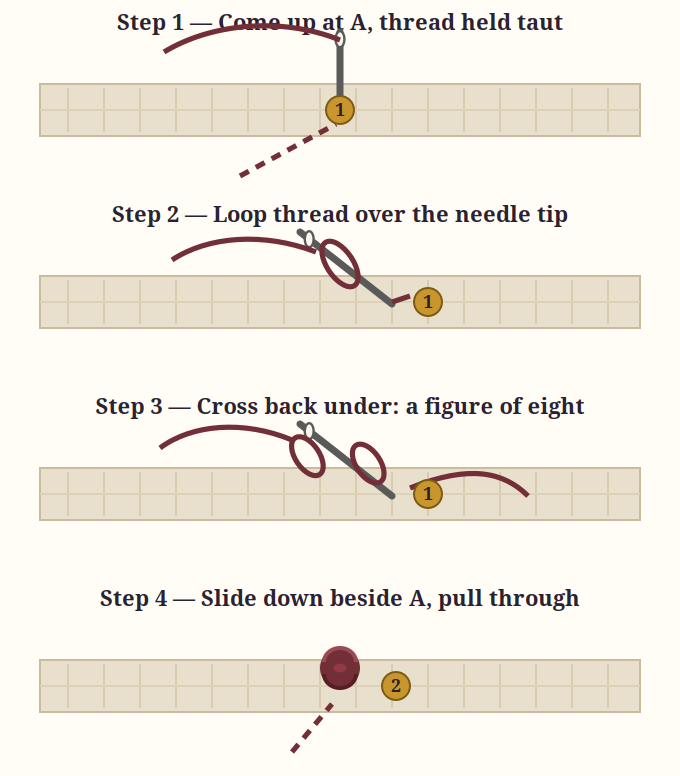 Colonial KnotThe figure-of-eight knot: taller, firmer, harder to pull through.
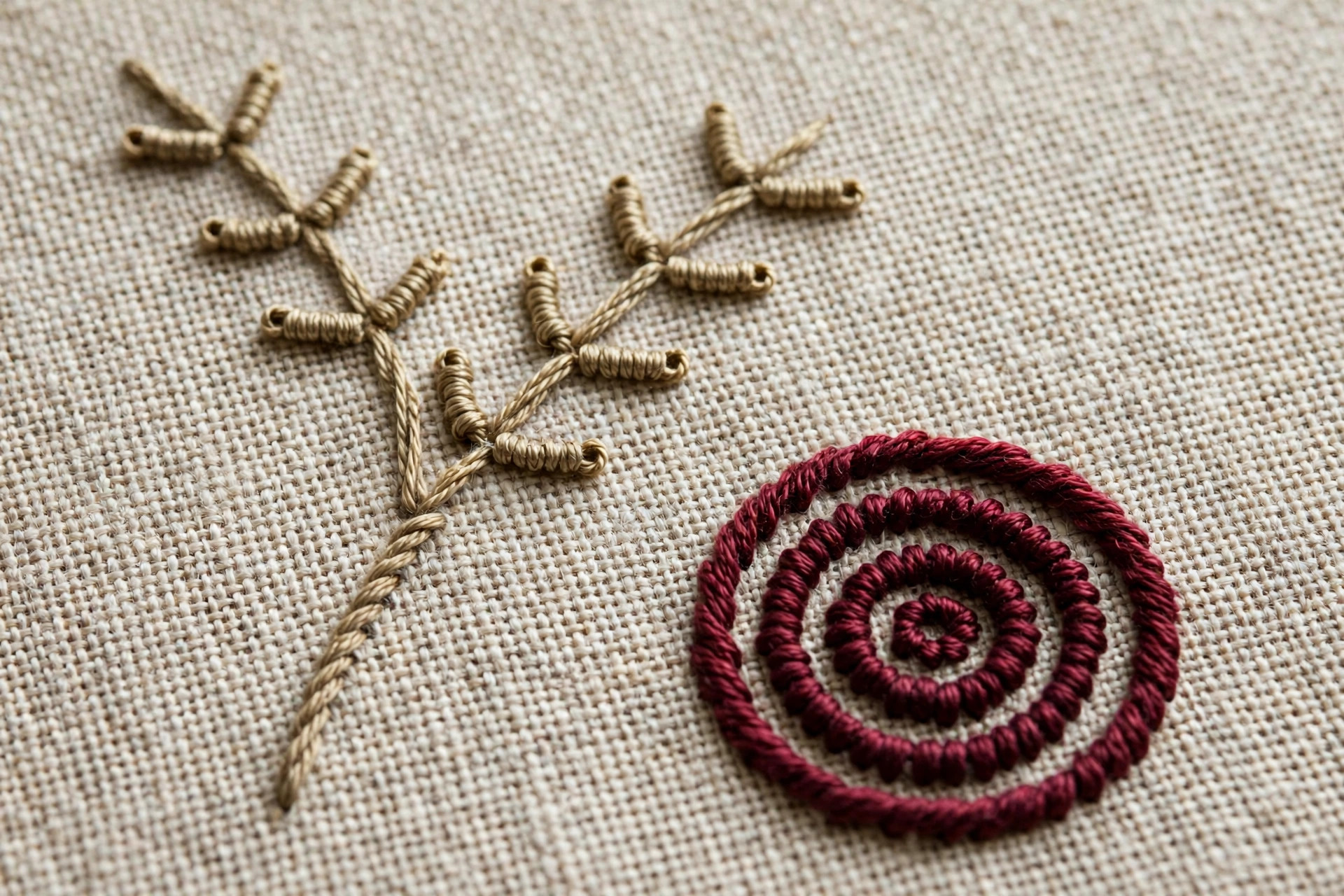 Bullion KnotThe wrap idea stretched into a long, smooth coil.
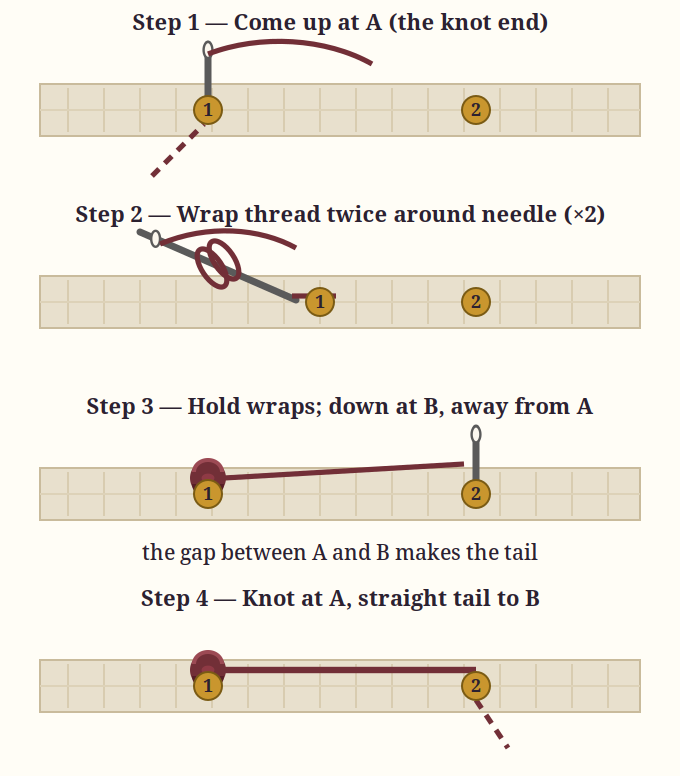 Pistil StitchA French knot on a straight tail — flower stamens and buds.
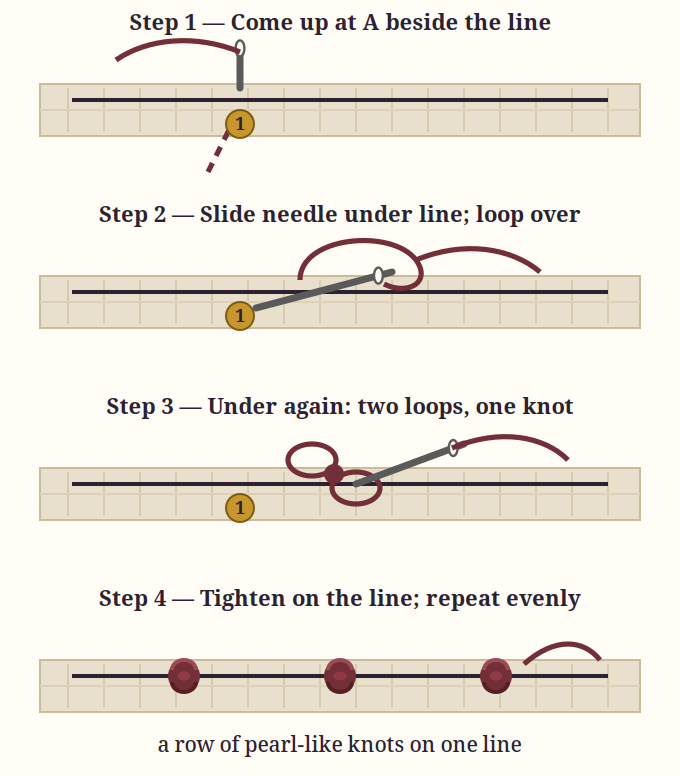 Palestrina StitchTwo-loop knots tied along a line, like a row of pearls.
 Knotted StitchesThe whole family: all five knotted stitches with diagrams.
More to Explore
Search Apparel Search