Chain Family · Detached Chain
Lazy Daisy Stitch
Lazy daisy stitch — also called detached chain stitch — is a single chain-stitch loop worked on its own and held down at its tip by one small tacking stitch. That lone loop is a ready-made petal or leaf: arrange five, six or eight of them around a centre and you have the most familiar flower in hand embroidery.
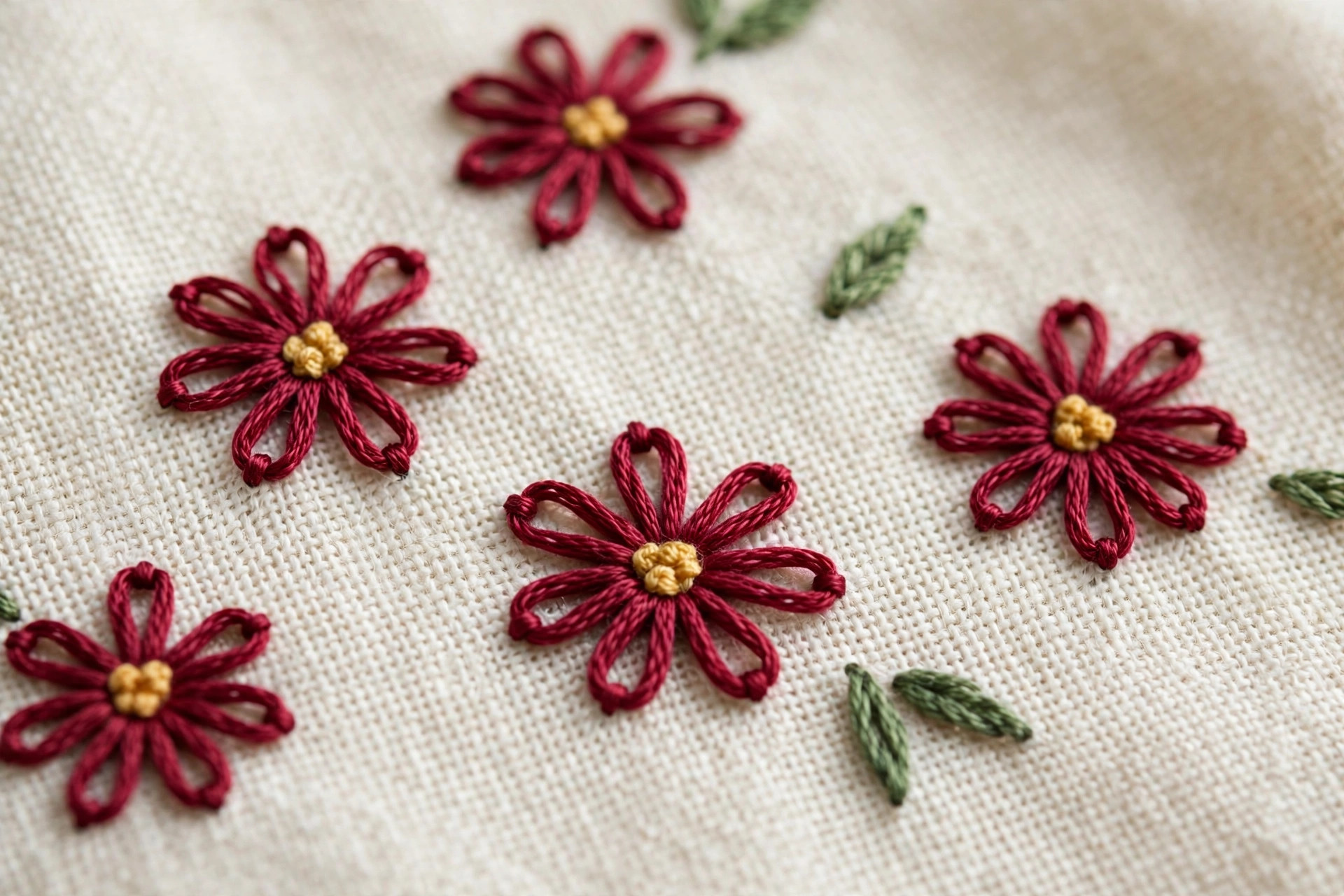
If you can work plain chain stitch, you already own two-thirds of this stitch. In chain stitch, each loop is held by the next loop; lazy daisy simply replaces that next loop with a tiny stitch over the tip. It is usually the second stitch a beginner learns, and for many embroiderers it stays the most-used shape stitch of all — because so much of the embroidered world, from daisies and lavender to leaves, raindrops, feathers and fish scales, is built from this one teardrop loop.
How Lazy Daisy Forms
- Come up at the base. Bring the needle up at the point where the petal will start — for a flower, that is at the edge of the centre, pointing outward.
- Go down at the same point. Take the needle down at the same hole, or a hair's breadth beside it, but do not pull the thread through completely. Leave a loop of thread standing on the surface, as large as the petal you want.
- Hold and shape the loop. Keep the loop open with a fingertip or lay the needle inside it. Arrange it as a plump teardrop: narrow at the base, round along its sides, coming to a soft point at the tip. The loop's length is the petal's length; its fullness is set now, not later.
- Come up inside the tip. Bring the needle up inside the loop, just short of its tip, so the emerging thread sits within the petal's outline.
- Tack the tip down. Take the needle down just outside the loop, directly over its tip, making one small stitch that pins the loop's end to the fabric. Pull it snug — enough to hold, never enough to pinch the petal's point flat.
- Fasten or move on. The stitch is complete and self-contained. Take the thread down and bring it up at the base of the next petal; a flower is simply this sequence repeated around a centre.
Lazy daisy stitch. Solid thread lies on the surface; dashed thread passes underneath; gold dots mark the numbered entry and exit points. Illustration by Apparel Search.
The whole stitch uses three needle passes and no knots on the surface. Because each loop is individually tacked, lazy daisy petals stay exactly where you put them — unlike a chain line, nothing depends on the stitch that follows, so you can scatter single petals anywhere a design wants one: a falling petal, a bud, a raindrop, a lone leaf.
Threads and Fabrics
| Element | Detail |
|---|---|
| Thread | Stranded cotton floss is the everyday choice — two or three strands for a standard petal. Use all six strands, perle cotton, or a fine wool for bold, rounded petals; a single strand for tiny, delicate ones. |
| Ribbon | Silk ribbon (2–4 mm) works the identical stitch and makes broad, soft petals effortlessly — the foundation stitch of ribbon-embroidered flowers. |
| Needle | A crewel or embroidery needle with an eye large enough to carry the thread without shredding it; for ribbon, a chenille needle. |
| Fabric | Any embroidery ground — linen and cotton are the classics. The base entry and exit share one hole, so a fabric with a visible weave helps you re-find it; on very fine or slippery grounds, enter and exit a thread's width apart instead. |
| Marking | Mark the flower centre and, for formal flowers, faint guide dots where each petal tip should land. Petals are hard to space evenly by eye alone. |
What It Looks Like
A finished lazy daisy stitch is a smooth, raised teardrop: two curved strands of thread running side by side from the base, swelling gently, and meeting at a point held by a small straight tack. On the underside there is almost nothing to see — a short pass at the base and the tack — which is why the stitch is economical with thread and kind to fine fabrics.
The petal's personality is set by two choices. Length: short loops make round, chubby petals (daisies, buds); long loops make slender, elegant ones (lavender, willow leaves, petals of lilies). Fullness: a loop pulled wide gives a petal with a visible hollow centre framed by thread; a loop kept narrow gives a solid, leaf-like shape. Neither is wrong — but every petal in one flower should match, because the eye reads a flower as a set.
Building Flowers and Using the Stitch
Petals
The classic lazy daisy flower is worked in a strict order: mark the centre, decide the petal count, then work the petals one by one around the centre like numbers on a clock — twelve o'clock first, then six, then three and nine, then fill the gaps. Opposites-first spacing is the secret of an even flower: it stops the common drift in which the first petals are generous and the last two are squeezed together. Leave the very centre empty until all petals are placed.
Flower centres
Fill the centre last. One or three French knots in a contrasting colour make the classic daisy heart; a small cluster of knots reads as a textured, pollen-heavy centre. Alternatives: a tiny ring of seed stitches, a single bead, or a small padded satin circle for a raised, smooth dome. The centre also does repair work — it covers the petals' bases, where all the entries and exits crowd together.
Leaves
A lazy daisy stitch in green, worked at an angle to a stem, is a leaf. Work leaves in opposite pairs along a stem stitch stem, or singly where a spray thins out. A longer, narrower loop makes a willow or lavender leaf; a shorter, plumper one makes a rose leaf. A second, smaller lazy daisy inside the first, in a lighter shade, gives a shaded leaf with almost no extra effort.
Grouped flowers and other uses
Whole designs grow from grouping: three flowers of descending size on curving stems make a spray; a ring of flowers makes a wreath; scattered single petals make falling blossom. Beyond flowers, the stitch is a general-purpose teardrop — buds and berries (worked small and plump), raindrops and teardrops in pictorial work, simple fish and scale patterns worked in overlapping rows, butterfly wings, and the petals of folk-art motifs on clothing, quilts and samplers. On children's clothes and linens it is often the only flower stitch used, precisely because one stitch does so much.
Variations
- Long lazy daisy: the loop stretched to two or three times its usual length — for lavender heads, willow leaves and slender petals. Tack it as usual; very long loops may need a second tiny couching stitch midway if the piece will be handled.
- Layered petals: a ring of petals with a second, smaller ring worked inside it, in a deeper or lighter shade — instant double flowers, dahlias and zinnias.
- Raised (padded) lazy daisy: work the stitch over a tiny straight-stitch foundation, or with extra thread strands, for petals that stand proud of the fabric.
- Lazy daisy in ribbon: the silk-ribbon form — broader, softer petals whose width comes from the ribbon itself. Keep the tack small so it does not pucker the ribbon.
- Detached chain as a filling: rows of small lazy daisy stitches packed in offset rows fill a shape with a scaly, petalled texture — useful for flower heads, birds and fish.
Working Notes
Strengths
- One stitch, one complete shape — no outlining or filling needed.
- Fast: a whole flower takes a minute or two once the rhythm is set.
- Self-contained: petals can be placed singly, anywhere, in any number.
- Works in thread, wool and ribbon, at almost any scale.
Watch for
- Loops pulled tight collapse into thin, stringy petals — keep the loop's fullness as you tack.
- Uneven spacing ruins a flower faster than uneven size; mark centres and use opposites-first order.
- The tacking stitch shows if it is long or a contrasting colour — keep it small and in the petal's own thread.
- Long loops can snag on handled items; keep petals modest on clothing and linens that will be washed and used.
Lazy daisy belongs to the chain stitch family: it is the chain loop, detached. Its closest relatives are plain chain (the loop, linked), twisted chain (the loop, braided) and feathered chain (the loop, leaned alternately) — all worked step by step on the family page. For flower centres, the knotted family's French knot is the usual partner.
Common Questions
Is lazy daisy the same as detached chain stitch?
Yes — they are two names for the same stitch. Lazy daisy is the older, popular name; detached chain is the descriptive name, because the stitch is a single chain loop detached from the chain line and tacked down on its own.
Why do my lazy daisy petals collapse or look thin?
Usually because the loop is pulled too tight as the needle goes down at the base, or the tacking stitch is pulled hard enough to pinch the tip. Keep a fingertip or the needle itself inside the loop while you position it, set the loop's fullness before you tack it, and pull the tack snug — never tight.
How many petals should a lazy daisy flower have?
Five to eight petals suits most flowers; six is the classic daisy count. Odd numbers tend to look more natural for casual flowers, even numbers more formal and symmetrical. Mark the centre and divide the circle before you start, so the last petal is not squeezed into a leftover gap.
Can lazy daisy be worked in ribbon or wool?
Yes. Silk ribbon embroidery uses the same stitch — the ribbon's width makes broad, soft petals with no extra effort — and wool or perle cotton give chunkier petals for folk work. Whatever the material, the three moves are identical: up at the base, down at the base holding the loop, tack the tip.
Related Stitches
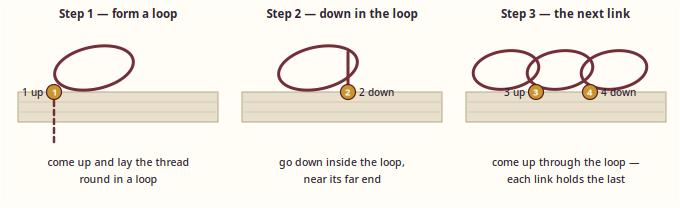 Chain StitchThe continuous line of linked loops that lazy daisy detaches.
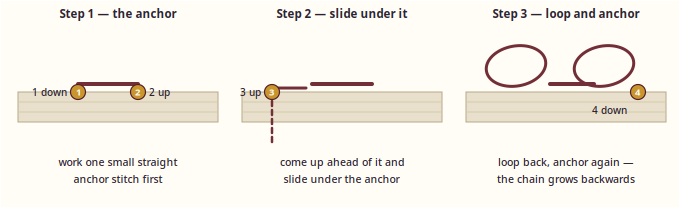 Reverse Chain StitchChain worked backwards from an anchor — the same face, a firmer line.
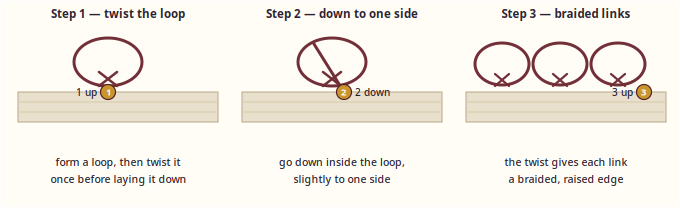 Twisted Chain StitchEach loop twisted once, for a braided, rope-like line.
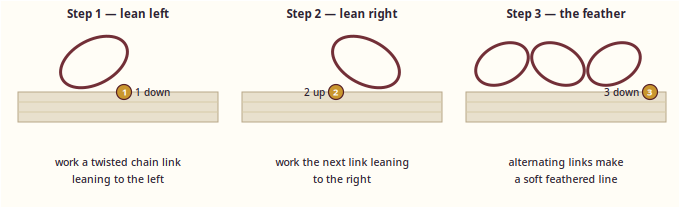 Feathered Chain StitchTwisted links leaning alternately, like a feather's barbs.
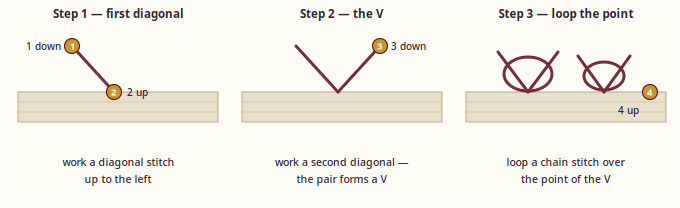 Wheatear StitchA pointed V looped with chain — the wheat-ear border stitch.
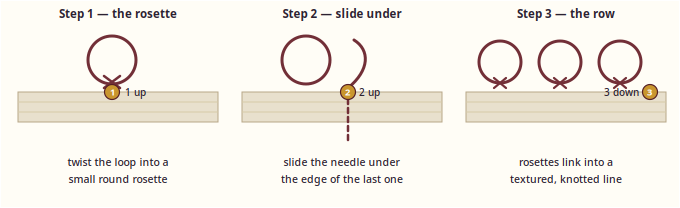 Rosette Chain StitchLoops twisted into small round, knotty rosettes.Chain Stitch FamilyAll seven chain stitches worked step by step, with diagrams.
More to Explore
Search Apparel Search