Woven Wheel · Satin & Filling Family
Woven Wheel
The woven wheel is a small rose made by weaving: straight spokes — always an odd number — are laid from a centre, and the thread then travels round and round, over one spoke and under the next, until the spokes disappear under a round, raised, woven disc.
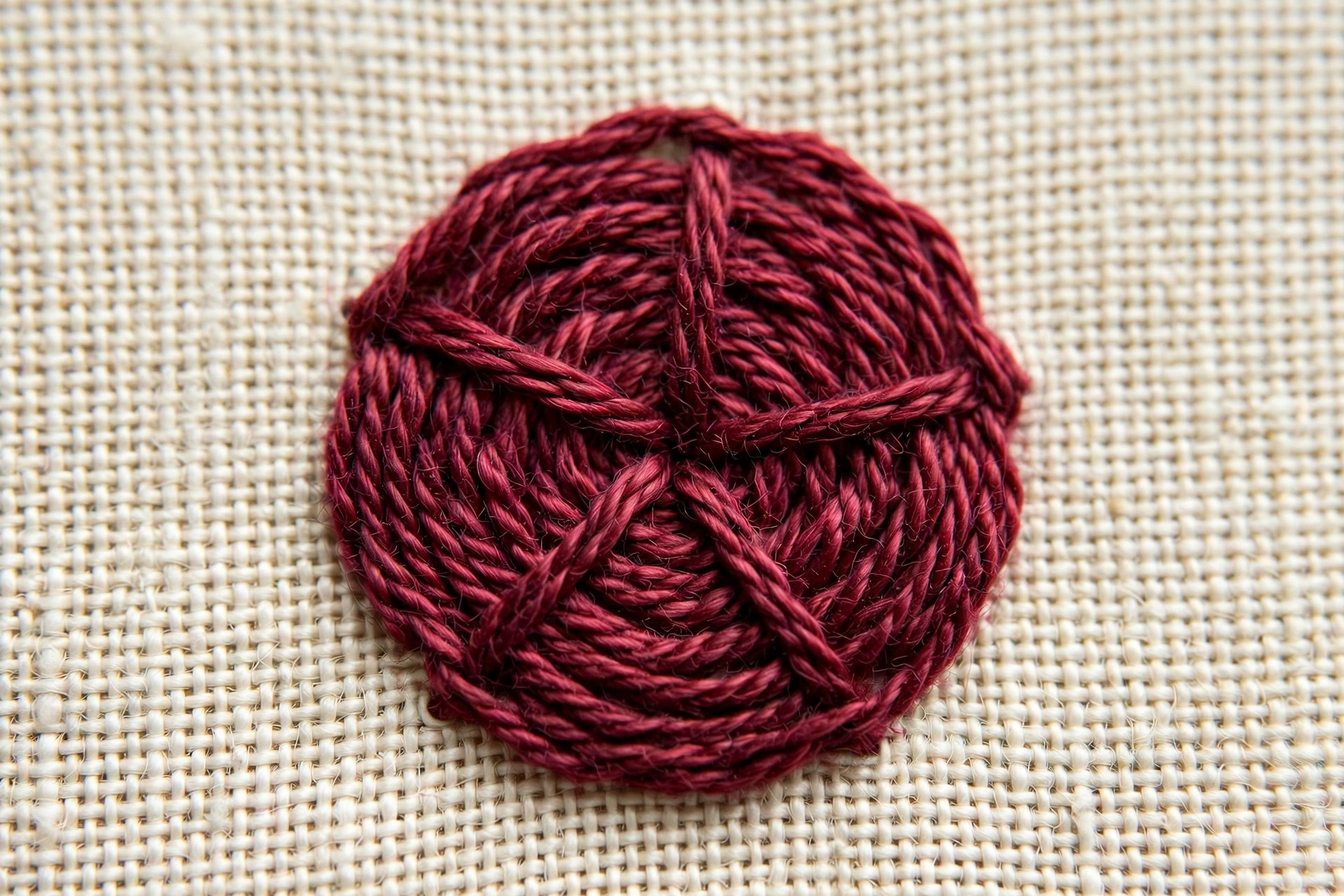
How the Woven Wheel Forms
Woven wheel step diagram. Five spokes are laid first, then the thread weaves over and under them; how snugly it sits is a matter of tension, taught in the text. Illustration by Apparel Search.
- Draw a small circle. Bring the needle up at its centre (point 1).
- Go down at the rim (point 2) to lay the first spoke. Come up at the centre again and lay further spokes until the circle is divided by an odd number — five is standard, seven for a fuller wheel. The spokes are the foundation; space them as evenly as you can, like the slices of a pie.
- Come up at the centre once more, beside any spoke, and begin to travel around the centre, passing the needle over one spoke, under the next, over, under, all the way round. Do not pierce the fabric — the weaving lives entirely on the spokes.
- Continue round and round. Because the spoke count is odd, each new round automatically passes on the opposite side of every spoke from the round before, and the weaving closes into a solid disc.
- When the disc reaches the rim — the spoke ends just covered — take the needle down through the fabric at the rim, beside a spoke, and secure the thread on the back.
A blunt needle, or the eye end of a sharp one, makes the weaving far easier: it slides under spokes without splitting them or snagging the rounds already laid.
Tension: The Lesson of This Stitch
Everything about the woven wheel except its tension can be learned from the diagram. Tension must be learned from words and from the photograph, so read this section as the stitch's real instruction.
The weaving thread should be placed, not pulled. Draw it through until it just reaches the spoke, then settle it into place with the needle tip. The natural instinct — to snug each pass down firmly — is the fault that ruins wheels: every snugged pass shortens the round by a fraction, the fractions accumulate, and the disc responds by doming, then cupping, then pulling its spokes inward until the rose sits like a tiny bowl with a puckered rim. A wheel woven at placing tension lies almost flat, with the faintest dome that reads, correctly, as the plumpness of a rose.
The second tension skill is packing. After every two or three rounds, ease the woven rounds gently toward the centre with the needle, closing any gaps before they are buried. Rounds laid over gaps tilt and stripe; rounds packed evenly build the smooth spiral surface of the photograph. If a gap appears at the rim late in the work, one extra short pass — over and under just across the gap — patches it invisibly.
Finally, watch the spokes. If they begin to bend toward each other, the weaving is too tight now, whatever the earlier rounds were like — loosen immediately, because a wheel records its whole tension history and cannot be rebalanced later.
Woven Wheel Roses
The woven wheel is loved because it is a rose already. A single wheel in a deep red or a shaded pink, ringed with two or three lazy daisy or leaf stitch leaves, is a complete flower with a raised, woven heart that no flat stitch imitates. Work the centre rounds in a darker shade and the outer rounds lighter — or the reverse — and the wheel shades itself as it grows, with no change of technique: simply change the thread as you begin a new round, carrying the join at the back of a spoke where it will not show.
Variegated thread does the same work with less thinking, melting around the wheel in a way that suits the spiral structure. For a wilder rose, stop the weaving a round or two short of the rim and let the spoke tips show as a starburst edge; for a formal one, weave exactly to the rim and add a ring of French knots around it. Wheels also multiply well — a cluster of three wheels in graded sizes, with seed stitch shadow beneath them, is a whole bouquet in an afternoon's work.
Raised and textured, woven wheels suit anything that will be seen close: brooches and buttons, the centres of larger floral designs, christening and wedding work where small perfect roses are wanted, and samplers — one wheel demonstrates spokes, weaving and tension control all at once.
Threads, Fabric and Needles
| Element | Detail |
|---|---|
| Thread | The spokes and the weaving are usually the same thread. Stranded floss (three or four strands) for a fine wheel; perle cotton for a bold, sculptural one — perle's twist gives the woven surface a beautiful rope-like grain. Silk and rayon shine like rose petals but slide on the spokes and demand slower work. |
| Spokes | Work the spokes firmly — they are the loom. If a spoke is slack the weaving will slide along it. Some stitchers work the spokes in a matching but cheaper thread when the wheel will be woven solid to the rim and the spokes fully covered. |
| Fabric | Any firm ground that holds the spoke ends. The circle must be drawn or marked — even spokes are impossible to judge freehand at small sizes. |
| Needles | A sharp needle for the spokes; a blunt tapestry needle (or the eye end of the sharp) for the weaving, so the rounds are never split or snagged. |
Where the Woven Wheel Is Used
Roses first and always: single wheels as rosebuds and small roses in floral embroidery, clusters as bouquets, wheels in crewel and stumpwork gardens. Then flower centres — a wheel at the heart of a daisy of detached chain petals gives the flower a woven, seed-head heart. Then the wider family of round raised motifs: berries (small, tightly woven, in glossy thread), wheels and suns in folk embroidery, buttons and brooch centres, and the roundels of samplers. It is also a teaching stitch — few others pack foundation, rhythm and tension into so small a space — and it anchors the woven corner of its family beside the spider web, its ribbed cousin. All eight family stitches are diagrammed together on the Satin & Filling Stitches page.
Common Problems
- Cupping: weaving pulled too tight. Place the thread; do not snug it. Ease rounds toward the centre as you go.
- Stripes radiating from the centre: an even spoke count, so the rounds stack instead of alternating. Always count the spokes — five or seven, never six.
- Spokes showing through: rounds not packed. Push each few rounds gently centreward with the needle before continuing.
- An uneven, lopsided wheel: unevenly spaced spokes. Mark the rim points before laying them; the weaving cannot correct a crooked foundation.
- Thread shredding: a sharp needle splitting earlier rounds. Weave with a blunt needle or the eye end of the sharp.
Related Stitches
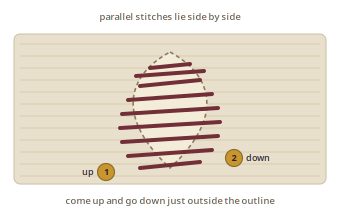 Satin StitchThe smooth, glossy filling this whole family is built around.
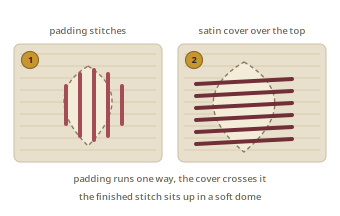 Padded Satin StitchSatin stitch raised on padding into a soft dome.
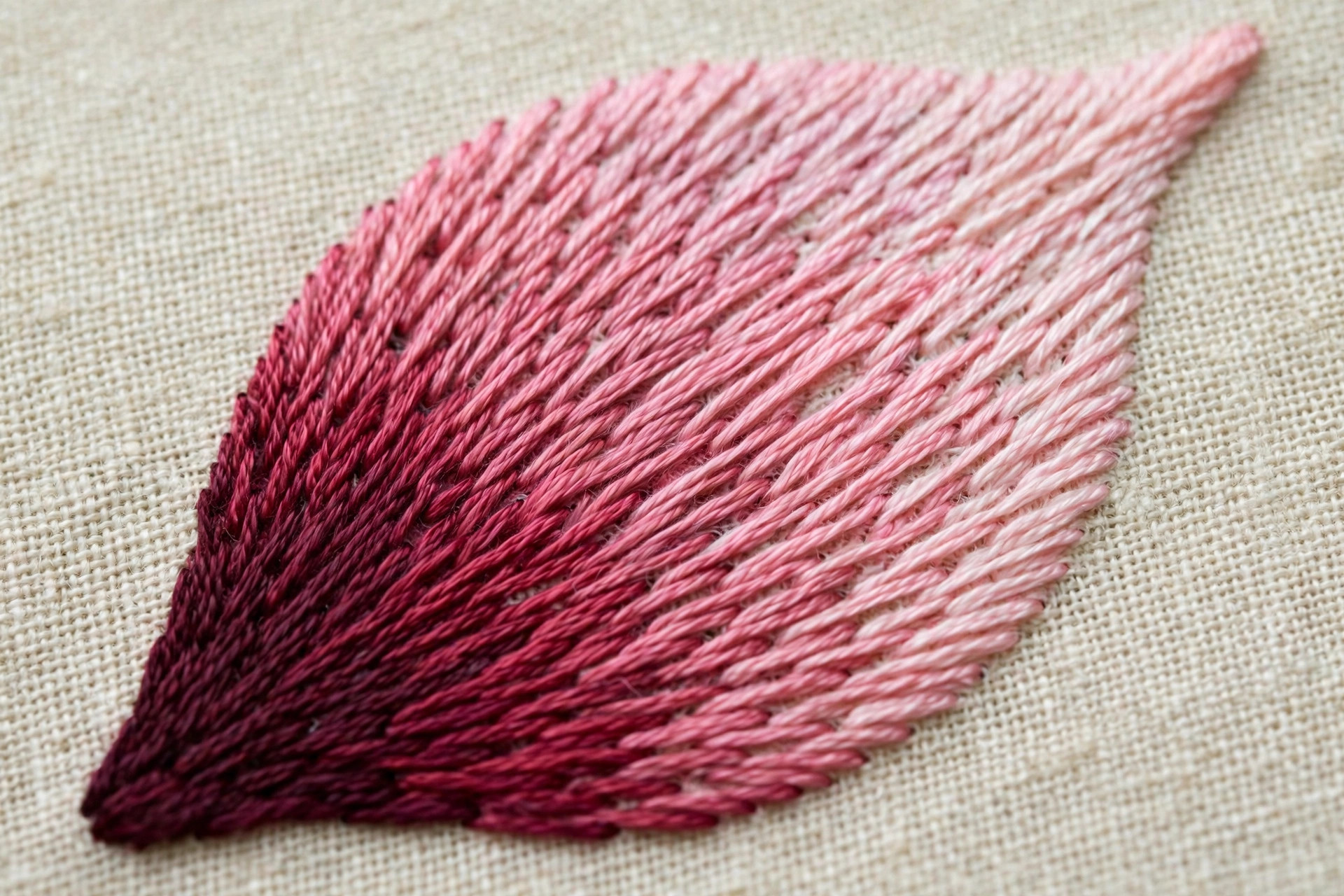 Long and Short StitchThe thread-painting stitch: rows that shade one colour into the next.
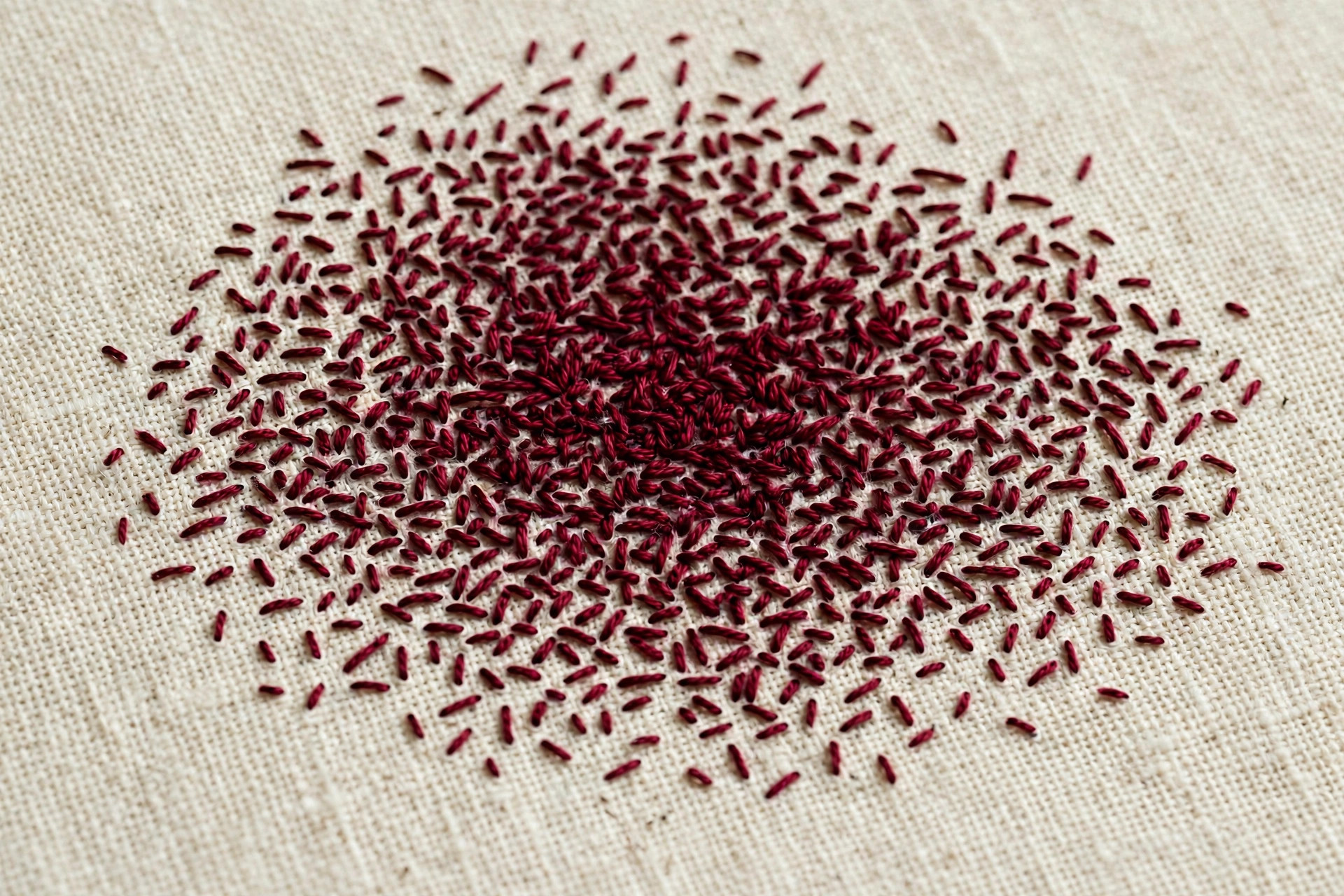 Seed StitchTiny scattered stitches that build texture and soft shadow.
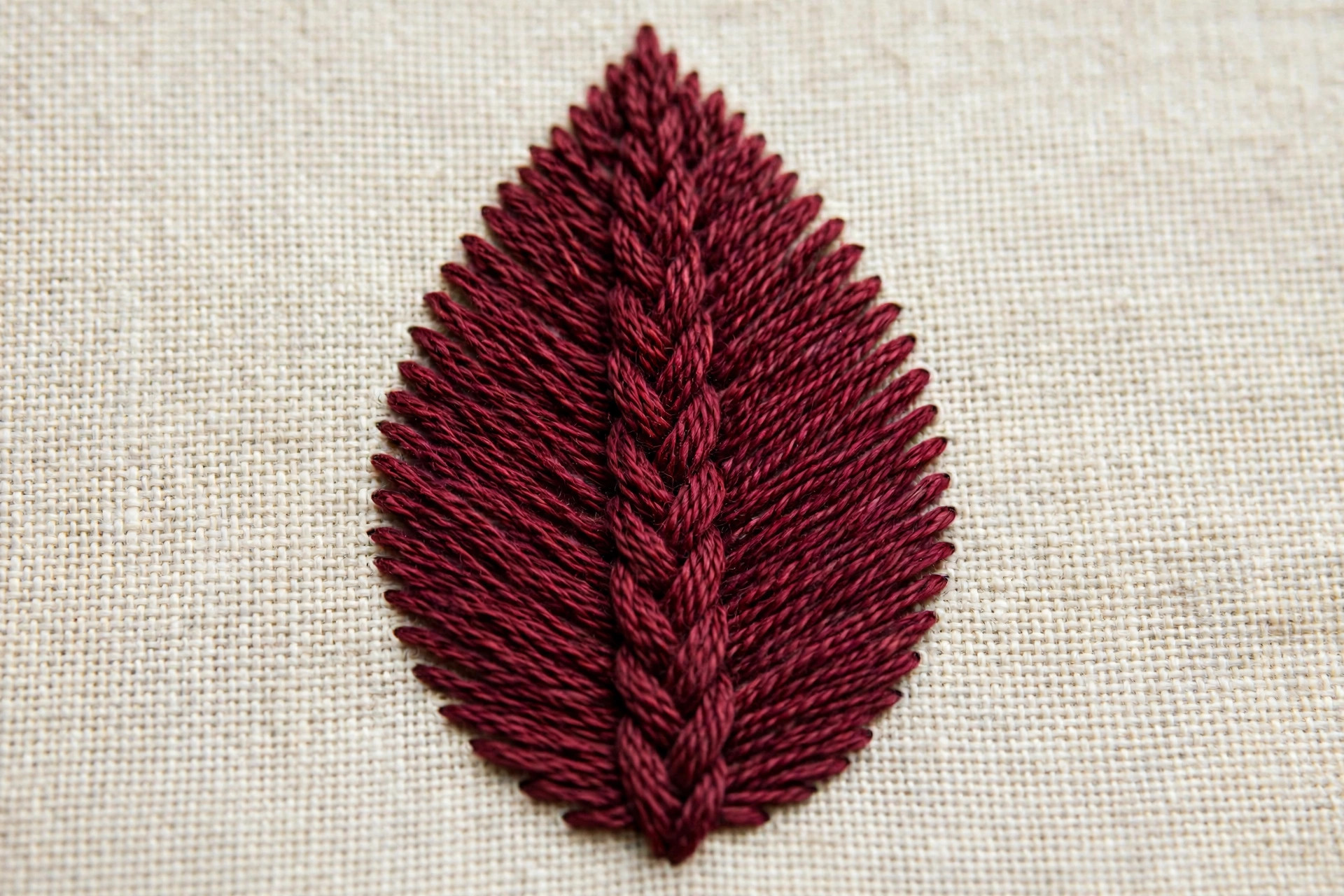 Fishbone StitchAlternating stitches crossing at the centre — the classic leaf filling.
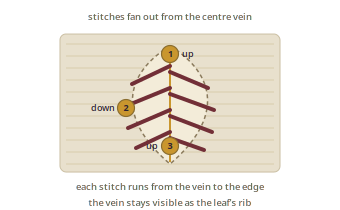 Leaf StitchStitches fanning from a centre vein to fill a leaf.
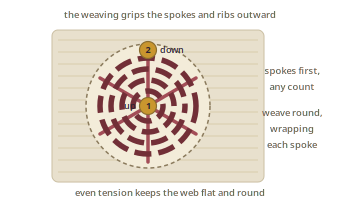 Spider Web StitchWeaving that grips its spokes and ribs outward into a web.Satin & Filling StitchesThe whole family on one page: all eight stitches with their step diagrams.
Common Questions
Why must a woven wheel have an odd number of spokes?
Because of the alternation. Weaving over one spoke and under the next only builds a continuous fabric if, when the thread comes full circle, it meets the first spoke on the opposite pass from the round before — and that happens automatically only with an odd count. With an even count the thread would pass over the same spokes on every round, the rounds would stack instead of weave, and the wheel would show radial stripes and refuse to close up. Five spokes is the standard; seven makes a fuller rose.
My woven wheel cups upward like a little bowl. What went wrong?
Tension. Each round was pulled a fraction too tight, and the small shrinkages added up until the wheel had nowhere to go but up. Weave with the thread merely placed — lay it around the spokes and settle it with the needle rather than pulling it through snugly — and ease each round down toward the centre before starting the next. A slight dome is pretty and rose-like; a cup is a fault. A finished cupped wheel can sometimes be coaxed flatter by dampening and pressing from the back, but prevention is far easier.
What is the difference between a woven wheel and a spider web stitch?
The wrap. In a woven wheel the thread simply travels over and under the spokes, so the surface is a smooth woven disc. In spider web stitch the thread wraps back around each spoke as it passes, which raises a rib at every spoke and gives a ribbed, webbed surface. Spider web also allows any spoke count, odd or even, because the wrap — not the alternation — does the work.
How big can a woven wheel be?
Comfortably up to about 2.5 cm (an inch) across. Beyond that the spokes grow long, the weaving sags between them, and the centre tends to loosen. For a larger rose, work a ring of smaller wheels, use seven or nine spokes with a thicker thread, or choose a different rose — a bullion rose or a cast-on rose carries size better.
More to Explore
Search Apparel Search