Full Guide
How to Sew Box Pleats — A Fold-by-Fold Guide
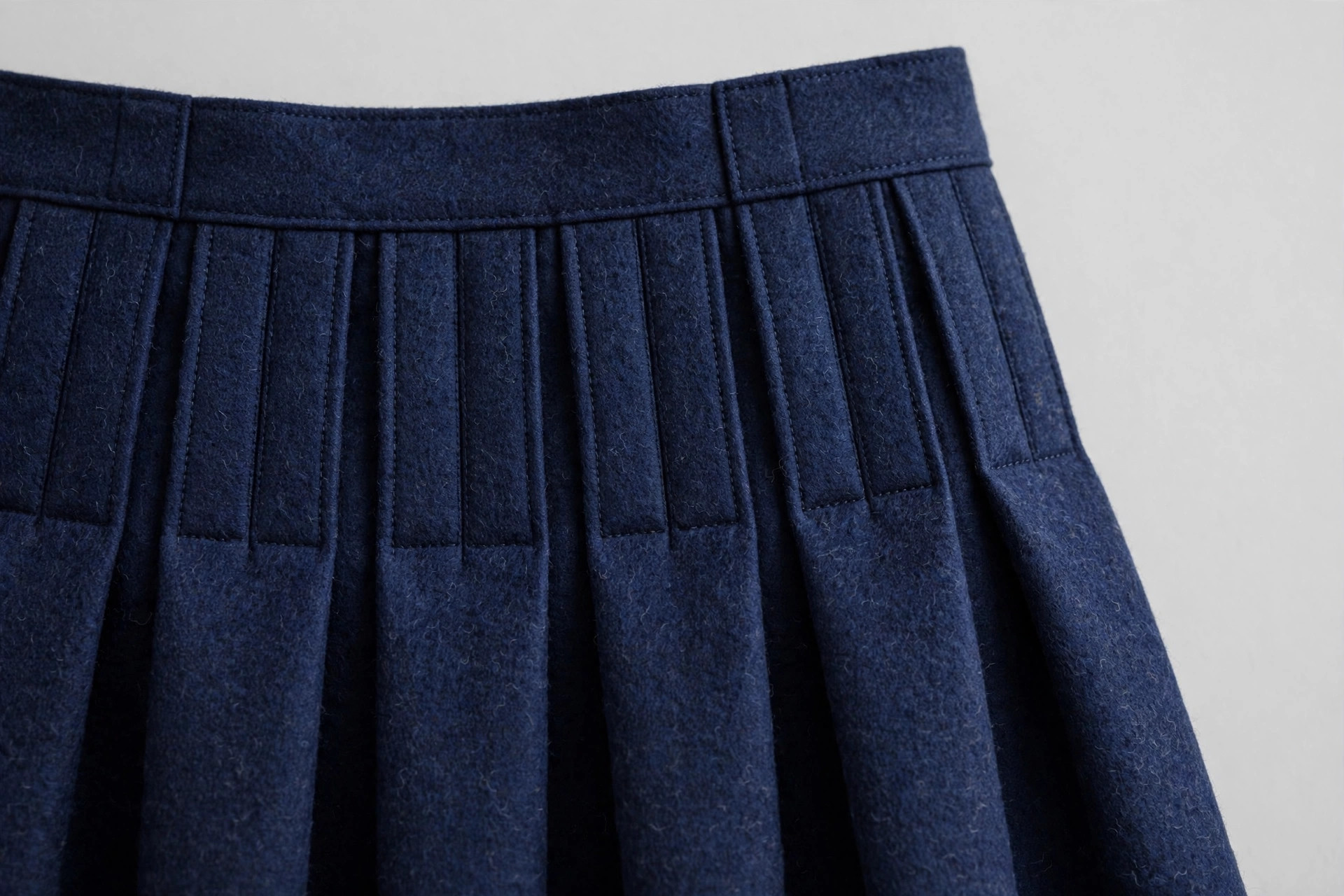
A box pleat is the tailored member of the pleat family: two folds turned away from each other so that a clean, flat panel of fabric sits on the surface with an equal depth of fullness folded away behind each edge. Repeated across a skirt it gives a structured, architectural rhythm — flat, fold, flat, fold — that flatters tailored clothing, uniforms, curtains and upholstery alike.
A box pleat is formed by folding one pleat to the left and one to the right from the centre of a flat surface panel, so the panel lies smooth on top and the two pleat depths are hidden beneath its edges. Turned the other way, with the folds meeting on the surface and the fullness underneath, the same construction becomes an inverted box pleat.
Because the surface panel is flat and highly visible, box pleats are unforgiving of uneven measuring — a panel that is a few millimetres wider than its neighbour announces itself at a glance. The good news is that the construction itself is simple, and the discipline that makes it accurate is the same one used for knife pleats: calculate first, mark both fold lines and placement lines, baste everything, and press only when the whole arrangement sits exactly right. This guide follows that order, and the numbered steps match the cross-section diagram below, so you can check your folded fabric against the drawing at every stage.
Box pleats, fold by fold
Cross-section of a box pleat showing the flat surface panel with one pleat folded away beneath each edge Illustration by Apparel Search.
- Decide the surface width and depth. Choose how wide the flat panel on the surface will be — 5 to 7.5 cm (2 to 3 inches) suits most skirts. In a full box pleat each hidden fold is as deep as half the surface width, so the two folds meet underneath at the centre of the panel. That arrangement uses three times the finished width in fabric.
- Mark the lines. For each pleat mark, in order across the fabric: the placement line where the left fold will lie, the fold line at the left edge of the surface panel, the fold line at the right edge of the surface panel, and the placement line where the right fold will lie. Between one pleat and the next, leave the flat space that separates them on the finished garment.
- Fold the left side. Lift the fabric at the left fold line and carry it outward, away from the centre of the panel, laying it down so the fold sits exactly on its placement line. The pleat depth now lies hidden beneath the surface, pointing away from the panel.
- Fold the right side. Do the mirror image on the right: lift at the right fold line, carry the fabric outward away from the centre, and lay it on its placement line. Underneath the flat panel, the two pleat depths now point away from each other, as the cross-section shows.
- Pin and check the panel. Pin through all layers at the top and at intervals down both folds. Stand back and check that the surface panel is perfectly flat, its edges parallel, and its width identical to the panel before it. Adjust now, while only pins are holding it.
- Baste and press. Baste across the top of the pleats and down each fold if the pleats are long. Press both folds firmly with an iron suited to the fibre, working from the surface first and then from underneath, and let the fabric cool flat before handling it.
- Secure the pleats. Hold the arrangement with a waistband, yoke or heading, or stitch the pleats down over the hip and release them below the stitching. Edge-stitching just inside each fold is a crisp tailored option that keeps the panel flat through wear and washing.
Work the whole run of pleats before pressing any of them. Folding and pinning every pleat first lets you distribute any small measuring difference evenly across the garment instead of discovering at the last pleat that the errors have all collected in one place.
Fabrics & behaviour
Box pleats show off fabrics with body and a willingness to hold an edge. Wool suiting, gabardine, cotton drill, denim, linen and stable blends all fold into the flat, square profile the pleat is named for. The surface panel acts like a small shelf of fabric held out by the folds beneath it, so a fabric that is too limp lets the panel sag and round over, and the pleat reads as soft gathers instead of a box. If your fabric is on the soft side, a shallower pleat depth and closer spacing give it less span to sag across, and a light interfacing in a yoke or waistband area keeps the tops disciplined.
Thick fabrics need a warning: a full box pleat stacks four layers under each edge of the panel and six where pleats meet a seam or a waistband, so bulky cloth can make the top of a skirt stand away from the body. Reduce the depth, grade the seam allowances, and press the underlayers toward the pleat rather than into the seam. Stripes are a natural partner for box pleats — fold on a stripe boundary and the panel centres itself on a stripe, which is how many plaid and striped skirts are arranged. Checks demand that the pattern matches across the panel, so mark from the pattern, not just from measurements.
In wear, box pleats open less flamboyantly than knife pleats and close again neatly, which is why they suit school skirts, kilts worn with a flat front apron arrangement, tailored day dresses, and children's clothing that must look tidy after a day of movement. They also press back into shape readily, because the flat panel tells you exactly where each fold belongs.
Variations & uses
A single box pleat at the centre back of a skirt or dress is a classic walking ease: invisible when you stand, opening when you stride. Repeated box pleats all around a skirt give the full tailored arrangement. Between the two sit many useful patterns — box pleats spaced wide apart on a plain skirt, pairs of box pleats grouped at the front of a bodice, and box pleats used as a deep decorative hem band. The double box pleat stacks two folds on each side instead of one, for extra fullness behind a narrower panel; it is diagrammed on the folded family page alongside this one.
The mirror construction, the inverted box pleat, folds both pleats toward the centre so the folds meet in a line on the surface and the fullness hides beneath. It is the standard centre-front and centre-back pleat on skirts, the pleat under the fly of some tailored garments, and a favourite on children's dresses. Because the two forms are exact opposites, patterns often combine them: box pleats around the sides of a skirt with one inverted pleat at the centre front. You can study the inverted arrangement in its own section at the inverted box pleat section of the Folded Pleats family page, and the short reference wording in the Apparel Search glossary entry on the box pleat.
Beyond clothing, box pleats head curtains with a flat, architectural finish, form the tailored folds of valances and upholstery skirts on chairs and sofas, and structure the bodies of tote bags and lampshades. The scale changes; the folding does not.
Common mistakes. Panels of uneven width are the signature box pleat fault — measure each panel against a template or a marked ruler rather than the previous pleat, so errors do not accumulate. The second fault is pressing the folds before the whole run is pinned, which locks in a drift. The third is choosing a full-depth pleat in a thick fabric and fighting the bulk at the waistband; reduce the depth instead.
Related pleats
 Knife PleatsEvery fold turned the same way — the pleat a box pleat is built from
 Inverted Box PleatsThe mirror image, with the folds meeting on the surface
 Double Box PleatsTwo stacked folds on each side for deeper fullnessKnife Pleats GuideThe full fold-by-fold guide to sewing knife pleats
If you can fold a knife pleat you are already halfway to a box pleat — the box simply pairs two of them facing away from each other under one flat panel.
Search Apparel Search
Frequently Asked Questions
What is the difference between a box pleat and an inverted box pleat?
A box pleat folds two pleats away from each other, so the fullness sits on the outside and a flat panel of fabric shows on the surface between the folds. An inverted box pleat folds the two pleats toward each other, so the folds meet at the centre on the surface and the fullness is hidden underneath. They are mirror images, and a skirt often uses both: box pleats around the body with an inverted pleat at the centre front or back.
How much fabric does a box pleat take?
A full box pleat, where each side fold is as deep as half the width of the flat surface panel, uses three times its finished width in flat fabric — the same three-to-one ratio as standard knife pleats. Shallower box pleats use less. Measure your surface width, double the depth of one fold, and add both sides together to get the exact fabric each pleat consumes.
Can box pleats be used on curtains and home furnishings?
Yes, box pleats are one of the classic curtain headings, giving flat, tailored panels with deep folds behind them. The construction is identical to garment box pleats, only the scale is larger and the pleats are usually held by the heading tape, a stitched heading or hooks rather than a waistband. The same marking discipline applies: even spacing matters more than speed.
Why do my box pleats not meet evenly at the centre?
On an inverted pleat the two folds fail to meet when the two sides were folded to slightly different depths, or when the fabric shifted during pressing. Baste the folds in place along their whole length before pressing, check the meeting point at the top, middle and bottom, and press from the centre outward. On a box pleat, uneven sides show as a surface panel that leans, and the same basting check fixes it.
Keep Exploring
See the box pleat among its folded relatives, compare it with its inverted mirror image, and then browse the full pleating guide for all seventeen types.