What Spacer Fabrics Are
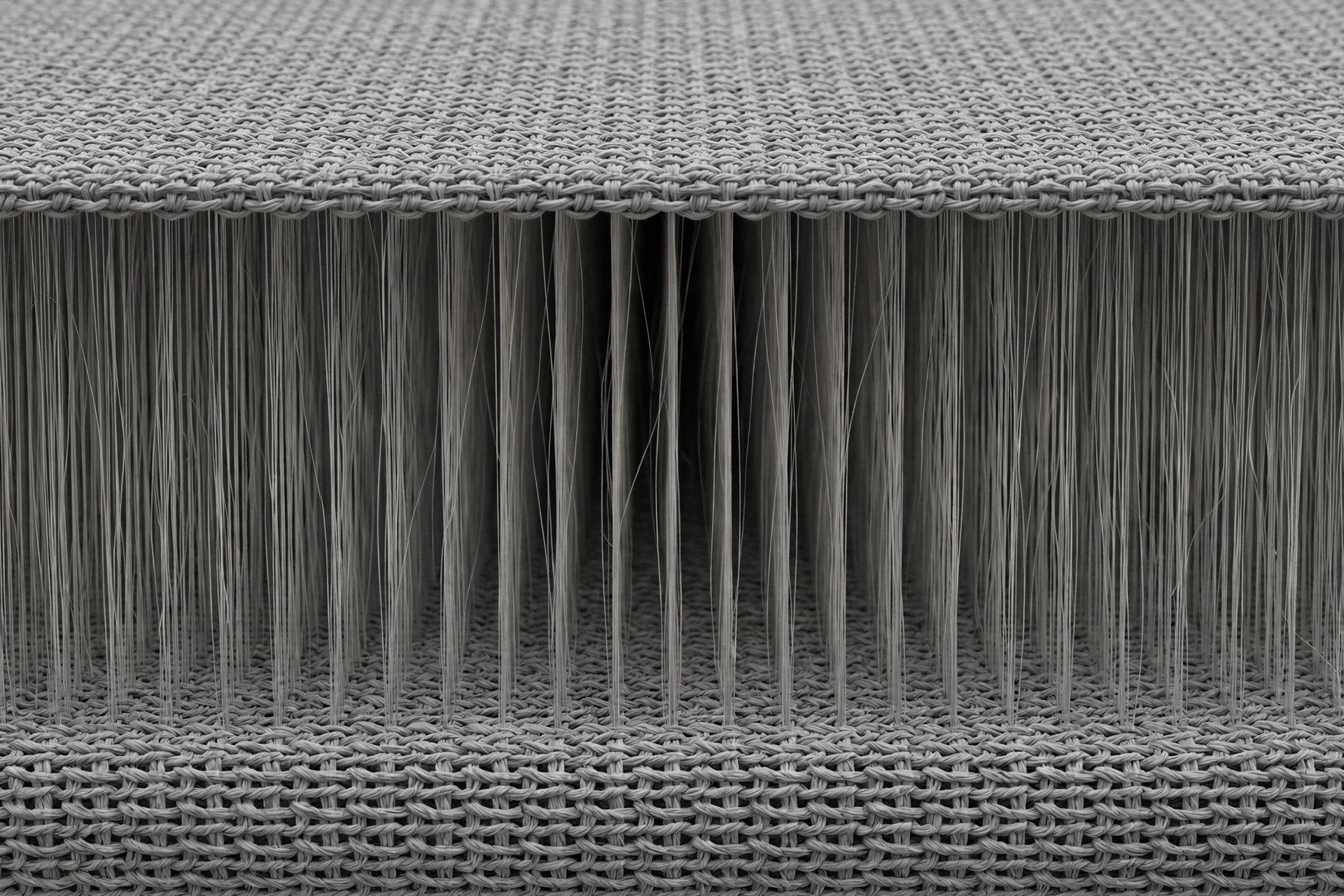
Most fabrics are surfaces. A spacer fabric is a space: two separate knitted faces, made at the same moment on the same machine, held a precise distance apart by a forest of stiff yarns knitted into both faces as it goes. Cut a piece and look at the edge — as in the photograph above — and you see the sandwich plainly: face, springy open middle, back. The middle is mostly air, yet the fabric cushions like foam, breathes like a net and springs back after compression like neither.
Spacer fabrics are the most technically ambitious structures in this series — the raschel end of the family tree in Weft vs Warp Knitting, and the natural finishing point of the structures indexed on Knit Stitches & Structures. They exist because a double-needle-bar raschel machine can knit two fabrics at once, facing each other — and because a third set of yarns can be made to commute between them.
Spacer fabric is a three-dimensional warp knit made on a double-needle-bar raschel machine: two independently knitted face fabrics connected by spacer (pile) yarns — usually stiff monofilaments — that hold the faces apart at a set thickness, creating a compressible, air-filled sandwich in a single knitting process.
How Spacer Fabrics Are Knitted
The machine is a double-needle-bar raschel: two needle bars, back to back, sharing one knitting zone. Guide bars are assigned to each face — typically two bars knitting the front face, two knitting the back face, in simple grounds such as pillar-and-inlay or a fine net related to the one on the Powernet page. The two faces are knitted simultaneously but independently; nothing yet joins them, and if the machine stopped there it would deliver two separate fabrics from one pass.
The joining is done by the spacer bars, one or two guide bars threaded with the spacer yarn — almost always a polyester or nylon monofilament, a single stiff filament rather than a bundle of fibres. In one course the spacer bar overlaps a needle of the front bar and knits the monofilament into the face layer; a course or two later it swings across the gap and knits into the back face instead. Repeated across every wale, this commuting builds the near-vertical pile of Figure 1: each spacer yarn stands between the faces like a tiny spring, slightly angled or zigzagged so it flexes rather than buckles under load.
The geometry of the pile can be tuned as well as its height. If the spacer yarn knits into the same relative wale of each face, it stands almost vertically and the fabric resists compression firmly; if it is knitted in at an offset, travelling diagonally across the gap — or if two spacer bars cross their yarns into an X pattern — the pile flexes more readily and the fabric feels softer and more drapable at the same thickness. Knitters also choose the pile density: a spacer yarn in every wale gives a firm, even spring, while spacing the yarns out saves weight and cost where full cushioning is not needed. Face yarn, pile yarn, pile angle, pile density and bar distance together give the spacer knitter an unusually complete set of engineering controls for a textile.
Thickness is a machine setting, not a finishing accident: the distance between the two needle bars — the knock-over gap — sets how far apart the faces are held while the spacer yarns are knitted in, and commercial spacer fabrics run from about 1.5 mm for bra-cup and apparel grades up to 20 mm and beyond for mattress and cushioning grades, with experimental fabrics thicker still. Face structures are chosen per job: closed, smooth faces for skin contact; open mesh faces where maximum airflow is wanted; even a different structure on each side, since the two faces have their own guide bars.
Properties
Cushioning with recovery
The monofilament pile compresses under load and springs back when it is released — foam-like pressure distribution, but the structure is knitted yarn and air, so it does not crumble or take a permanent set the way foam can.
Air and moisture flow
The open middle layer is a built-in ventilation channel. Air and water vapour move through the fabric in the plane as well as across it, which is why spacer fabrics feel dry in shoes, seats and mattresses.
Light for its bulk
Most of the volume is air. A spacer fabric delivers thickness, insulation and padding at a fraction of the weight of a solid material of the same depth.
One-piece engineering
Faces, cushioning and thickness are created in a single process — no laminating, no gluing, no foam layer to delaminate — and the fabric can be cut and sewn like a heavy cloth.
Uses
Footwear made spacer fabric famous: the engineered mesh uppers of modern trainers are very often spacer fabrics, their open faces giving ventilation and their pile giving the upper its padded, three-dimensional body. Bra cups and apparel padding use thin grades as a breathable, washable alternative to foam — the cup is moulded from the spacer fabric itself, and it survives laundering that destroys laminated foam. Mattresses and bedding use thick grades as comfort and pressure-distribution layers that sleep cooler than foam. Automotive seating and trim exploit the same air channel for climate comfort in car seats. And medical uses — orthopaedic supports, pressure-care cushions and wheelchair seating — value the combination no foam matches: measured pressure distribution, constant airflow to the skin, and full washability, all from one knitted sandwich.
Recognising a Spacer Fabric
The edge gives it away: two distinct knitted faces with a visible gap between them, bridged by fine, stiff, hair-like filaments you can see and feel. Press the fabric between finger and thumb — it compresses with a springy resistance and recovers instantly and completely. Hold it to the light and the middle layer shows as a translucent band. If a shoe upper, bra cup or mattress layer passes those three tests, it is a spacer fabric, whatever the marketing name printed on it.
Specifying a Spacer Fabric
A spacer fabric is specified first by thickness. Apparel and footwear spacers are commonly knitted between about two and eight millimetres thick; technical spacers for mattresses, seating and protection run far thicker. Thickness is set on the machine by the distance between the two needle bars, and it is the one dimension no amount of finishing can change afterwards, so it is agreed before anything else. The second specification is the spacer yarn: a stiff polyester monofilament gives a springy, resilient cushion that recovers after compression, while softer multifilament spacers give a quieter, more textile feel at the cost of some bounce-back.
The faces are specified almost independently of the middle: a closed face for a smooth skin side, an open mesh face where airflow matters, a jacquard-patterned face where the surface is the product. Buyers then check the behaviours the structure promises — compression and recovery after repeated loading, air permeability, and moisture transport through the open core. In the cutting room the fabric behaves unusually well for something so thick: the knitted faces do not fray, panels can be die-cut cleanly, and the whole sandwich can be heat-moulded into three-dimensional shapes such as bra cups and shoe tongues, which is why spacer has become the default answer wherever foam used to be specified by habit.
Common Questions
- What machine makes spacer fabrics?
- A double-needle-bar raschel machine. Its two needle bars knit the two faces simultaneously while spacer guide bars knit stiff monofilament yarns alternately into each face, holding the faces apart at the set needle-bar distance.
- How thick can a spacer fabric be?
- Commercial fabrics run from about 1.5 mm for bra cups and apparel up to 20 mm or more for mattresses and cushioning. Thickness is set by the gap between the machine’s two needle bars during knitting.
- Why monofilament for the spacer yarns?
- A single stiff filament behaves like a tiny spring: it stands upright between the faces, flexes under compression and recovers. Soft multifilament yarns would collapse flat and the fabric would lose its cushioning air gap.
- Is spacer fabric better than foam?
- For many uses, yes: it breathes, washes, distributes pressure and springs back without crumbling or delaminating, because the whole sandwich is one knitted piece. Foam is still cheaper for simple bulk padding, which is why both survive.
- Are the two faces of a spacer fabric the same?
- Not necessarily. Each face has its own guide bars, so one side can be a closed, smooth layer for skin contact while the other is an open mesh for airflow — a common arrangement in shoe uppers and medical supports.
More Knit Structures
- Knit Stitches & Structures — the parent guide to every structure in this series.
- Atlas (Warp Knit) — the progressive lap that travels, turns and travels back.
- Milanese — two atlas laps in opposition — the premium warp knit.
- Powernet — the elastic raschel net behind shapewear and bras.
- Locknit — the smooth, run-resistant two-bar tricot standard.
- Tricot — the 1-and-1 lap every warp knitter learns first.
Back to Knit Stitches & Structures
This page is one part of Knit Stitches & Structures, Apparel Search’s deep guide to the structures inside the Knitwear Construction Guide series on how knitted fabric is made.
Search Apparel Search