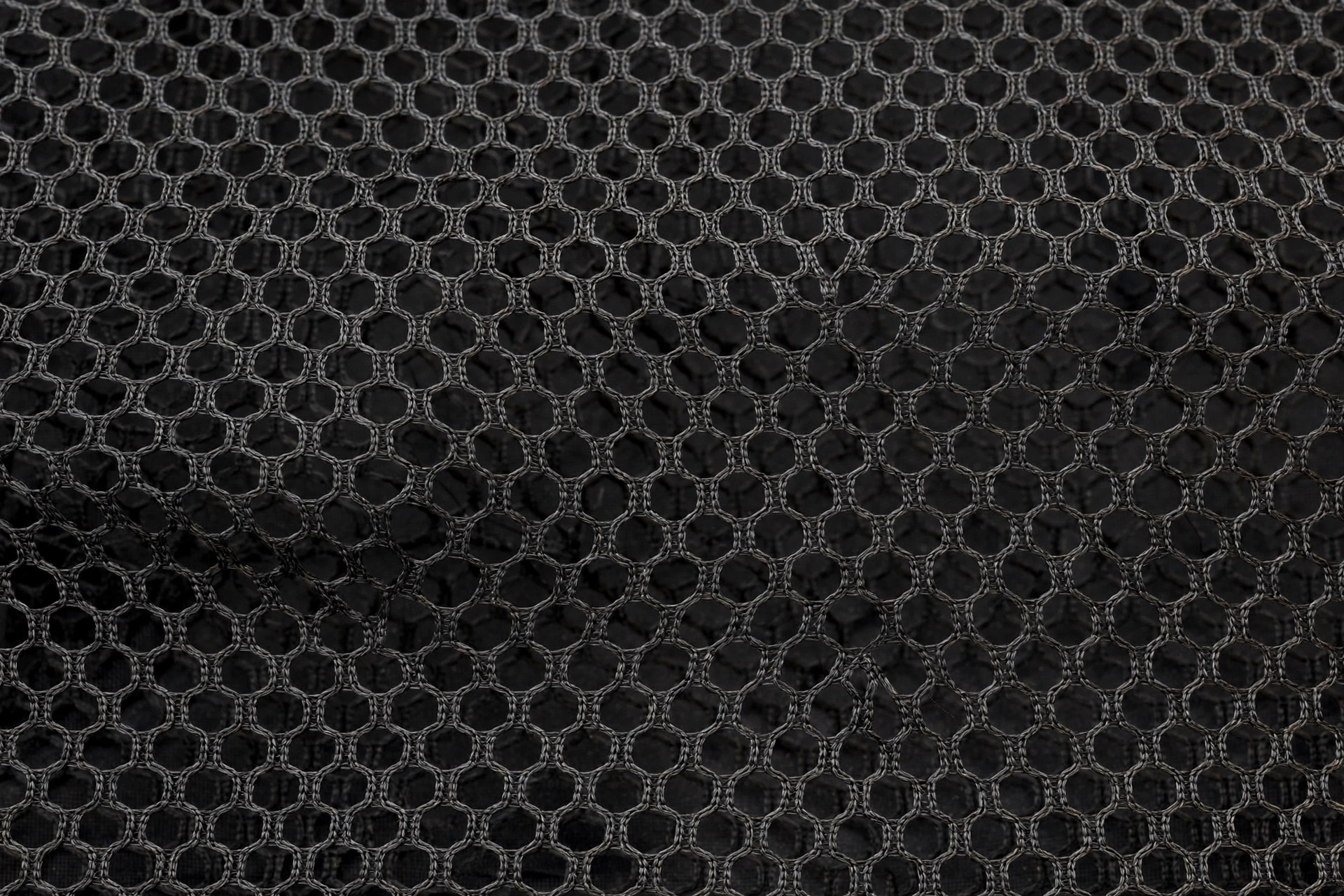
What Powernet Is
Powernet is the fabric doing the quiet work inside foundation garments: the firm, elastic net that shapes a bra wing, firms a control brief and supports a sports top without a single wire or seam of boning. It is a raschel warp knit — built on the raschel side of the family described in Weft vs Warp Knitting — in which a ground of knitted pillar stitches forms a hexagonal net and an elastane yarn is laid into the structure to give the net its power: strong, controlled stretch with firm recovery.
Among the structures indexed on Knit Stitches & Structures, powernet is the one designed around a mechanical job rather than a surface. Everything about it — the open hexagonal geometry, the laid-in elastic, the choice of raschel machine — serves one specification: how much force the fabric exerts at a given stretch, and how completely it recovers when the stretch is released.
Powernet (power net) is an elastic raschel warp knit with a hexagonal net ground of pillar stitches and a laid-in elastane yarn. It delivers firm, directional stretch and recovery — the "power" — used in shapewear, bra wings, sportswear and medical supports.
How Powernet Is Knitted
Powernet is knitted on a raschel machine, whose open needle-and-sinker arrangement handles nets and laid-in yarns far more readily than a tricot machine. The ground bar knits pillar (chain) stitches — an overlap on the same needle every course — while neighbouring bars underlap between pillars to link them into the hexagonal mesh of Figure 1. A pillar alone makes only disconnected chains; tied together at the hexagon corners, the chains become a net that is strong length-wise and can open and close across its width like a trellis.
The power comes from the second job in Figure 2. A separate guide bar carries the elastane — typically a bare or covered spandex yarn — and lays it in: it shogs behind the needles without ever overlapping to form a loop, so the elastic yarn runs in long floats through the fabric, caught and held by the ground loops at every course. Because the elastane is not knitted, it is not bent into loops that would tire it; it lies nearly straight, pre-tensioned by the machine’s feed, and pulls the net back to its knitted dimensions the moment a stretch is released. Nylon or polyester ground yarns supply abrasion resistance and dyeability around it. By changing the elastane’s draft, its inlay path — straight up a wale, or shogging across one or two needles — and the net’s density, the knitter dials the fabric’s modulus: light powernet for a bra wing, heavy powernet for a medical support, from the same basic construction.
Properties
Power
"Power" is the trade word for the force the fabric exerts as it stretches — powernet is specified by it. Firm grades shape and compress; soft grades support and smooth.
Directional stretch
The hexagon trellis and the inlay path make stretch directional: usually greatest across the width, firmer along the length. Garment engineers cut panels to aim the stretch where the body needs it.
Breathable strength
The open net moves air and moisture while the locked pillar corners carry load — strength without a solid fabric’s heat and weight.
Recovery
Laid-in elastane, held straight rather than looped, recovers almost completely and resists the bagging that knitted-in elastic suffers over time.
Uses
Powernet is sold by specification rather than by name alone. Mills describe a grade by its weight, its elastane content, and above all by its power curve — the force needed to extend it by a stated percentage across the width and along the length. A bra manufacturer ordering wing fabric wants modest width power and almost none along the length, so the wing supports without digging in; a maker of post-surgical garments wants high, closely matched power in both directions and will test every delivery against the agreed curve. This is why two fabrics that look identical on the roll can behave completely differently on the body, and why powernet, alone among the structures in this series, is routinely bought against laboratory numbers rather than a hand-feel sample.
Shapewear and foundations are powernet’s home ground: control briefs, girdles, shaping slips, bra wings and backs, and the support panels inside swimwear. Sportswear uses lighter grades for compression panels, ventilation zones and the supportive linings of sports bras, where the net’s breathability earns its place. Medical and orthopaedic supports — lumbar belts, knee and ankle supports, post-surgical garments — rely on the same directional, measurable power, and the net’s openness keeps skin cooler under a support worn all day.
Powernet vs tulle
Powernet is often confused with tulle, the other famous hexagonal net — but they are opposites in intent. Tulle is a fine, soft, essentially non-elastic net knitted for drape and volume: veils, overlays, tutus. It has no laid-in elastane and no power; stretch it and it distorts rather than recovers. Powernet is an engineering fabric: heavier yarns, locked pillar corners, elastane inlay, and stretch that is measured, directional and designed to push back. If the net is holding a garment’s shape against the body, it is powernet; if it is floating over one, it is tulle.
Recognising Powernet
Look for the regular hexagonal mesh with visibly substantial yarns at the corners, then stretch the fabric across its width: powernet resists firmly, extends evenly, and returns completely flat when released, with the hexagons closing back to their knitted shape. Cut edges do not ladder, and the fabric feels cool and dry rather than silky. In a finished garment, powernet is usually hidden — feel for the firm elastic panel inside a bra wing or control brief, and you have found it at work.
Specifying Powernet: Weight, Power and Direction
Powernet is bought on numbers, not names. The first is weight: lingerie and bra-wing powernets are commonly knitted around 180–250 grams per square metre, while firm control fabrics for girdles and orthopaedic supports run heavier, toward 300 grams and beyond. The second is elastane content, typically in the range of a fifth to a third of the fabric by weight; more elastane means more power at the same weight, but also more cost and more care in dyeing and finishing. The third is power itself — measured as the force needed to stretch the fabric by a stated amount, and the recovery when that force is released. A specification that names weight and elastane but not stretch and recovery is only half a specification.
Direction matters as much as degree. A powernet panel does its work along its direction of greatest controlled power, so pattern cutters mark the stretch direction on every panel the way a tailor marks a grain line. Cut a girdle panel ninety degrees out and the same fabric gives a different garment: firm where it should yield, yielding where it should hold. When you read a product description that promises control, what it is really describing is this page’s structure — pillar chains, locking laps and laid-in elastane — cut in the right direction and sewn under the right tension.
Common Questions
- What is the difference between powernet and tulle?
- Both are hexagonal nets, but tulle is a soft, non-elastic dress net for veils and overlays, while powernet is a firm raschel net with laid-in elastane, knitted to exert controlled, directional stretch and recovery in shapewear and supports.
- Why is the elastane laid in rather than knitted?
- A laid-in yarn lies almost straight through the fabric instead of being bent into loops, so it keeps its full elastic force, recovers more completely and lasts longer. The ground loops trap it securely at every course.
- What does "power" mean in powernet?
- The force the fabric exerts at a given extension — its modulus. Knitters set the power by the elastane draft, the inlay path and the net density, grading fabrics from light support to firm medical compression.
- Is powernet always stretchy in both directions?
- No — its stretch is deliberately directional, usually greater across the width than along the length. Garment makers exploit this, cutting panels so the greatest stretch runs where the body needs support or movement.
- Can powernet be made without elastane?
- The net ground can, but the result is a plain raschel net, not powernet: the laid-in elastane is what supplies the defining power and recovery. Some firm nets use high-twist or textured yarns for a little mechanical give, but they are not true powernet.
More Knit Structures
- Knit Stitches & Structures — the parent guide to every structure in this series.
- Atlas (Warp Knit) — the progressive lap that travels, turns and travels back.
- Milanese — two atlas laps in opposition — the premium warp knit.
- Spacer Fabrics — two faces held apart by spacer yarns on a double-needle-bar raschel.
- Locknit — the smooth, run-resistant two-bar tricot standard.
- Tricot — the 1-and-1 lap every warp knitter learns first.
Back to Knit Stitches & Structures
This page is one part of Knit Stitches & Structures, Apparel Search’s deep guide to the structures inside the Knitwear Construction Guide series on how knitted fabric is made.
Search Apparel Search