What Tulle and Raschel Nets Are
Tulle is the lightest of fabrics: a fine, soft net of tiny hexagonal meshes, familiar from bridal veils, gown overlays, ballet skirts and gift wrapping, and almost invisible when a single layer of skin-toned “illusion” tulle holds a neckline together. Most of the tulle in today’s market is knitted on raschel warp knitting machines, where the same hexagonal mesh that once came only from specialist net machines is formed course by course from just two working bars of yarn.
This page covers tulle as a knitted structure — how the mesh forms, what its raschel cousins look like, and how it differs from the older twisted net it is often confused with. It belongs to the warp-knit family set out in Weft vs Warp Knitting and is indexed from the parent guide, Knit Stitches & Structures.
Tulle (raschel net) is a fine hexagonal-mesh warp knit in which pillar chains form the uprights of the mesh and a second bar laps diagonally to tie them together, producing a sheer, stable net with almost no weight of its own.
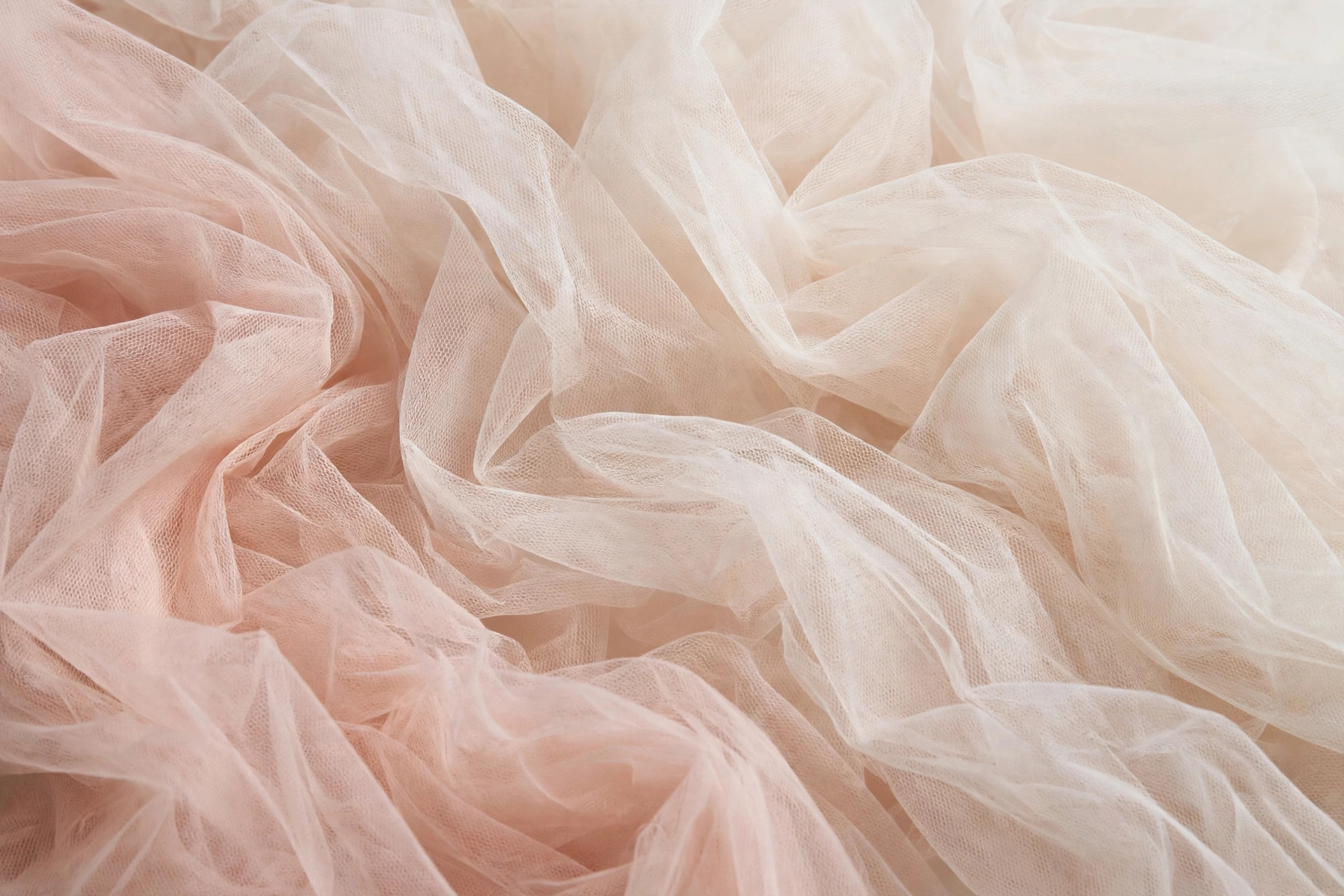
The fabric in the photograph is tulle net, shown draped so its softness and sheerness can be judged; the diagram below is the authority for its structure. Image created by Apparel Search.
How the Hexagonal Mesh Forms
The mesh is a small piece of engineering. One guide bar works a pillar lap — a chain stitch on the same needle, course after course — which builds the straight lengthwise cords of the net. A second bar laps diagonally, swinging its yarn across to a neighbouring pillar and back, course by course, so its yarns form the slanted sides of the hexagons and lock into the pillar loops at every junction. Repeat those two movements and the cloth that emerges is a field of regular hexagons: open space held in shape by yarn on all six sides.
Two bars is the minimum, and tulle shows why warp knitting is so economical with structure. Because every junction is a knitted loop locked into the next course, the net is stable in a way a knotted or glued mesh is not: cut it and it does not ladder, pull a thread and the mesh distorts but holds. The fineness is set by the machine gauge and the yarn — fine nylon or polyester monofilament and filament yarns give the classic crisp bridal tulle, while softer spun or fine filament yarns give the draping “silk tulle” handle the market asks for, even when no silk is present.
Stiffness is a finishing decision as much as a knitting one. Dress tulle is left soft; craft and millinery tulle is starched or resin-finished for body; the stiff, coarse net sold for scrubbies and tutus is the same family knitted coarser and finished harder. The mesh geometry stays hexagonal throughout — what changes is yarn, gauge and finish.
Width is one of the raschel net’s quiet advantages. Because the machine knits every wale simultaneously across its full needle bed, tulle comes off the frame in very wide, seamless sheets — wide enough for a veil to be cut in one piece or a skirt’s layers to be gathered from a single length. A bobbinet or woven net of comparable fineness is made far more narrowly, which is one reason wide bridal veils in historic net are rare and prized, while wide raschel tulle is an everyday stock item in any bridal fabric shop.
The Bobbinet Distinction: A Different Net Entirely
Honesty about names matters here, because the finest historic veiling is not knitted at all. Bobbinet is a net made on the bobbinet principle: warp threads run straight down the cloth while fine bobbin threads are twisted around them diagonally, wrapping each warp in a spiral that locks the mesh without any knitted loop. The result is a hexagonal net of legendary softness and stability — the original tulle of Tulle, France, and the standard for heirloom veils.
The two nets look alike in a photograph and behave differently in the hand and the budget. Bobbinet’s twisted junctions give it a smooth, fluid drape and a mesh that resists distortion in every direction; it is slow to make and priced accordingly. Raschel tulle’s knitted junctions give a slightly springier, more resilient mesh at a fraction of the cost, in far wider widths, and with the option of elastane versions no twist net can offer. Neither is a fake of the other: they are two technologies arriving at the same hexagonal answer, and a label that simply says “tulle” may mean either — which is why this guide keeps the distinction visible rather than letting the knitted version quietly inherit the woven one’s history.
Properties of Raschel Tulle and Nets
Sheer without weak
The hexagonal mesh spreads load across six sides, so a fabric that is mostly air still resists tearing and holds a seam better than its weight suggests.
No laddering
Knitted junctions lock the mesh: cut edges need no finishing, and a snag distorts one mesh rather than running a ladder down the cloth.
Volume from nothing
Layers of tulle trap air and build the silhouette of skirts, veils and overlays while adding almost no weight to the garment.
A finish-led handle
The same knitted net can be soft dress tulle, starched craft tulle or firm millinery net depending on yarn and finishing.
Tulle’s limits are the other side of its lightness. It has little abrasion resistance, it melts rather than burns at iron temperatures, and its meshes snag on jewellery and rough fastenings. Seams need care — a narrow seam in a single layer can pull through the mesh under strain, so load-bearing joins are usually made through a tape, a binding or several layers at once.
Net Variants and Naming Care
Illusion net is the finest, softest tulle in a skin tone, used for invisible necklines, sleeves and yokes that appear to float on the body; its mesh is fine enough to disappear at conversational distance while still holding appliqué and beading. English net is a name to handle carefully: traditionally it meant a cotton bobbinet-style net, soft and matte, prized for veils and christening wear — but the term is now also applied to soft knitted nets of similar handle, so the fibre and construction behind the name are worth checking before paying a bobbinet price for a raschel cloth. Point d’esprit is tulle with woven or knitted dots at the mesh junctions; glitter and flocked tulles add their effects in finishing, on the same knitted ground.
The elastic member of the family deserves its own mention: add elastane to the raschel net and firm it up, and tulle’s gentle mesh becomes Powernet, the supportive net inside foundation garments. Same machine, same hexagonal logic — a heavier yarn, a tighter mesh and an elastic core turn a veil fabric into a shaping fabric, which is the clearest demonstration in this series of how much of a knit’s character lives in its yarn and settings rather than its structure alone.
Where Tulle and Raschel Nets Are Used
- Bridal: veils, gown skirts and overlays, and illusion necklines and sleeves.
- Dance and occasion wear: tutus, prom and party skirts, and layered overskirts that need volume without weight.
- Craft and celebration: favour bags, table runners, gift wrap, bows and decoration, usually in starched craft tulle.
- Millinery and veiling: hat veils and fascinator bases in firmer finished nets.
- Technical nets: raschel netting for laundry bags, produce and storage nets, and protective mesh — the same structure at industrial gauges.
Working with tulle rewards patience: gather it rather than easing it, cut it with a rotary cutter for clean mesh edges, and store veils rolled rather than folded so the mesh does not take a crease. Pressed at all, it wants a cool iron and a press cloth — or better, steam and gravity.
Common Questions
- Is tulle knitted or woven?
- Both technologies exist. Most tulle sold today is warp knitted on raschel machines, with pillar chains and diagonal laps forming the hexagonal mesh. The historic fine net called bobbinet is made differently, by twisting fine threads around straight warp threads, with no knitted loops at all.
- Why is tulle mesh hexagonal?
- The hexagon is what two simple raschel movements naturally produce: straight pillar chains for the uprights and diagonal laps for the slanted sides. It is also an efficient shape, spreading stress across six sides so a very light net stays stable and resists tearing.
- What is illusion net?
- Illusion net is very fine, soft tulle in a skin-matching tone. Used for necklines, yokes and sleeves, it nearly disappears against the skin while supporting lace applique, beading or a floating edge that could not hold its place on its own.
- What is the difference between tulle and English net?
- English net traditionally means a soft cotton net of bobbinet type, matte and fluid, long used for veils. The name is now also used for soft knitted nets of similar handle, so check the fibre and construction: a knitted English-style net can be excellent, but it is not the same cloth as true cotton bobbinet.
- Does tulle fray or unravel when cut?
- Raschel tulle does not ladder or unravel, because every mesh junction is a locked knitted loop. Cut edges can be left unfinished, which is why tulle is so popular for layered skirts, veils and craft work.
More Knit Structures
- Knit Stitches & Structures — the parent guide to every machine-knit structure in this series.
- Powernet — the elastic relative of tulle, knitted with elastane for firm stretch.
- Spacer Fabrics — two raschel faces held apart by connecting pile yarns.
- Raschel Lace — pattern bars build floral motifs into a net ground like this one.
- Fall-Plate & Inlay Raschel — surface pattern and laid-in yarns on a raschel ground.
- Locknit — the smooth two-bar tricot cloth often paired with nets in garments.
Back to Knit Stitches & Structures
This page is one part of Knit Stitches & Structures, Apparel Search’s deep guide to the structures inside the Knitwear Construction Guide series on how knitted fabric is made.
Search Apparel Search