What Raschel Lace Is
Raschel lace is machine lace knitted on a raschel warp knitting machine: a fine open net ground is formed first, and extra pattern yarns are worked into that ground as the cloth is made, so the flowers, leaves and scrolls of the design are part of the fabric itself rather than embroidery added afterwards. It is the lace of modern bridal gowns, veils, lingerie and evening wear — produced in full width, at speed, in patterns from a delicate all-over sprig to a bold corded floral.
The raschel machine belongs to the warp knitting family, in which every needle is fed by its own yarns running lengthwise down the cloth. That family is introduced in Weft vs Warp Knitting, and this page sits under the parent index at Knit Stitches & Structures. What sets the raschel apart from its tricot-machine cousins is its appetite for pattern: where a tricot machine is built for smooth, closed cloth, the raschel is built for nets, laces and structures with holes in them — exactly what lace needs.
Raschel lace is a warp-knitted lace in which a ground of pillar (chain) stitches and simple laps forms a net, while additional pattern bars lay motif yarns into the ground under pattern control, building the design into the cloth course by course as it is knitted.
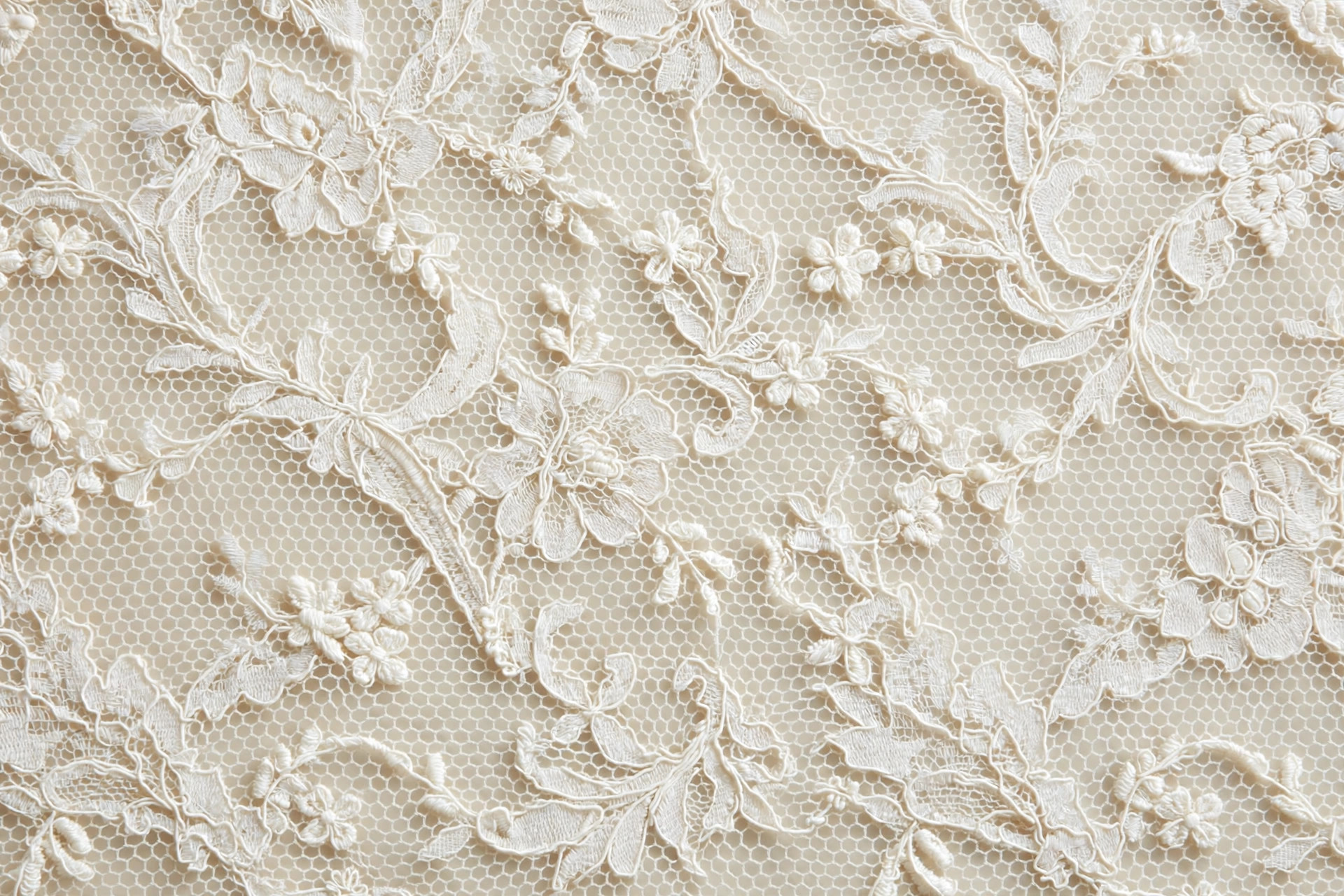
Illustrative image created for this guide — an artistic impression of raschel lace fabric, not a specific maker’s product. Image created by Apparel Search.
Inside the Raschel Machine: Ground Bars and Pattern Bars
A raschel lace machine carries its yarns on guide bars, and the bars divide into two teams. The ground bars — usually two to four of them — knit the net itself. One bar typically works a pillar or chain lap, making the strong lengthwise cords of the ground, while companion bars lap from side to side to tie the pillars together into a mesh. Change the ground laps and the net changes character: a hexagonal tulle-style mesh for a soft bridal lace, a squarer, firmer net for a guipure-look cloth, or a near-solid ground for a dense all-over pattern.
The pattern bars do the drawing. A production lace machine may carry dozens of them, each threaded with its own motif yarn and each moving sideways under pattern control — historically by a pattern chain or wheel, on modern machines electronically. A pattern bar does not usually knit its yarn into loops. Instead it lays the yarn into the ground as an inlay: the yarn is trapped between the ground loops as they form, so it can travel across the net in curves, outlines and filled shapes without ever needing to make a stitch of its own. Where several pattern yarns are laid densely side by side, the motif becomes solid; where a heavier or corded yarn is laid along an outline, the design gains the raised edge that lets a bride’s lace be cut out and appliquéd onto a gown.
Because the motif is an inlay, its path is free in a way a knitted stitch never is. The pattern bar can swing its yarn across many needles in one course, hold it along a stem for several courses, then swing it back — which is why raschel motifs have that flowing, drawn quality of vines and petals rather than the stepped, pixel-like edges of a stitch-built pattern. Compare the weft-knitted approach on Jacquard Knits, where the design is assembled loop by loop from coloured stitches: beautiful, but built on a grid. The raschel draws with a pen; the jacquard builds with tiles.
Jacquard Raschel: Pattern Without Bars
The classic raschel lace machine has one hard limit: every pattern bar moves as a unit, so a motif yarn can only go where its bar takes it, and complex designs need many bars. Jacquard raschel removes that limit. On a jacquard raschel machine, a special jacquard bar is fitted with individually controlled guides — on modern machines, piezo-electric jacquard guides that can displace each yarn by one needle space, in either direction, on every course, under electronic control. One jacquard bar can therefore do the patterning work that once needed a rack of pattern bars.
The effect on the cloth is freedom of a different order. Because each motif yarn is placed individually, the pattern is no longer tied to a bar’s shared movement: grounds and motifs can merge, a flower can grow out of the net and dissolve back into it, and dense and open areas can sit side by side with soft, shaded transitions. Piezo jacquard raschel machines are the technology behind much contemporary fashion lace — the large-scale, painterly florals of modern bridal and evening fabrics — and behind seamless and garment-shaped raschel work: narrow jacquard raschel machines knit lingerie and foundation panels with the pattern, the firm zones and the soft zones all placed by the jacquard control, so a brief or a bra panel comes off the machine already shaped and decorated, needing little more than elastic and a seam or two.
Jacquard raschel also changed the economics of design. A pattern-bar lace ties its design to physical pattern chains and bar threading, so changing it is a workshop job. An electronic jacquard design is a file: edited on screen, sampled the same day, widened or recoloured without re-threading the machine. That is why the lace market can now follow fashion’s pace — new motifs each season and short runs — on the same underlying raschel machinery described above.
Properties of Raschel Lace
A stable net ground
Warp knitting locks every loop to its neighbours in two directions, so the lace ground does not ladder or unravel when cut, and motifs can be cut out cleanly for appliqué work.
Pattern built in
The design is inlaid during knitting, not printed or embroidered on afterwards, so it cannot peel, crack or sit stiffly on top of the cloth.
Softness by yarn choice
Fine nylon or polyester grounds give a soft, draping bridal lace; add elastane in a ground bar and the same pattern becomes a stretch lace for lingerie.
Width and edge
Raschel lace is knitted in full fabric width, often with a finished scalloped edge formed at the selvedge, ready to place along a neckline or hem.
Handle follows the ground: a lace is only as soft as its net and only as firm as its motif yarns. Corded laces feel richer and hold a cut edge beautifully, but drape less fluidly than a fine chantilly-style raschel. Stretch laces recover well while the elastane is fresh, yet heat and age tire them — the elastic relative Powernet carries a much heavier elastane load in the same raschel net.
Where Raschel Lace Is Used
- Bridal wear: gown overlays, sleeves, trains and veils, where the stable ground lets motifs be cut and appliquéd over silk or illusion net.
- Lingerie and foundation garments: stretch raschel lace for bra cups, panels and trims, often knitted in narrow widths with two finished edges.
- Evening and occasion wear: all-over lace dresses, overlays and sleeves, including corded and beaded-look designs.
- Home textiles: lace curtains and table linens, one of the raschel machine’s oldest volume markets.
- Trimmings: narrow lace edgings and insertions knitted as bands for garments and linens.
In the sewing room, raschel lace is friendly cloth: it does not fray, it presses at low temperatures, and its motifs can be mirror-matched across a centre seam because the repeat is engineered, not printed. Seams should catch the net securely, and a cut motif edge is best finished by following the corded outline the machine provided.
Raschel Lace Beside the Other Laces
Raschel vs Leavers lace. Leavers lace is the historic benchmark: woven from twisted yarns, with a fineness connoisseurs still prize, at a cost and speed that confine it to the luxury end of the market. Raschel lace is knitted, far faster and more affordable, and jacquard raschel closes much of the design gap; Leavers keeps the edge in delicacy, raschel wins everywhere else.
Raschel vs crochet-look lace. Many “crochet” laces in fashion are raschel knits built from heavy inlay yarns on an open ground, imitating hand crochet and guipure at machine speed. True crochet is a hand or specialised-machine craft of knotted loops; the raschel version is a look, achieved by yarn weight and open patterning rather than crochet stitches.
Raschel vs embroidered net. Schiffli and multi-head embroidery stitch a design onto a finished net — including the tulle grounds on the Tulle & Raschel Nets page. Embroidered lace can be denser, but the stitching adds stiffness and a second process; raschel lace comes off its machine complete in one pass.
Common Questions
- Is raschel lace real lace?
- Yes. Lace is defined by its openwork patterning, not by one machine. Raschel lace is a true machine lace: its motif and net ground are formed together during knitting, in the same spirit as bobbin and Leavers laces, and it has been a mainstay of bridal and lingerie lace for generations.
- What is the difference between raschel lace and Leavers lace?
- Leavers lace is woven from twisted yarns on a Leavers machine and is prized for exceptional fineness at high cost. Raschel lace is warp knitted, much faster and more economical to produce, and modern jacquard raschel machines can approach Leavers-style designs while adding stretch versions Leavers cannot easily match.
- What does jacquard raschel mean?
- It means the pattern yarns are controlled individually rather than by shared pattern bars. Piezo-electric jacquard guides displace each yarn as needed on every course, allowing free, painterly motifs, shaded transitions between dense and open areas, and seamless or garment-shaped lace panels for lingerie and fashion.
- Does raschel lace stretch?
- Only if it is knitted to. A standard raschel lace on a nylon or polyester ground is stable with very little give. Stretch lace versions include elastane in the ground, and the amount of elastane and the ground construction decide how firm the stretch feels.
- Can raschel lace be cut without fraying?
- Yes. The warp-knitted ground locks its loops together, so the lace does not ladder or unravel at a cut edge. That is why bridal makers can cut individual motifs from raschel lace and applique them onto gowns and veils.
More Knit Structures
- Knit Stitches & Structures — the parent guide to every machine-knit structure in this series.
- Powernet — the elastic raschel net whose firm stretch supports foundation garments.
- Spacer Fabrics — two raschel faces held apart by connecting pile yarns.
- Tulle & Raschel Nets — the fine hexagonal nets knitted on the same raschel frame.
- Fall-Plate & Inlay Raschel — surface pattern and laid-in yarns on a raschel ground.
- Locknit — the smooth two-bar tricot cloth that often backs and lines lace.
Back to Knit Stitches & Structures
This page is one part of Knit Stitches & Structures, Apparel Search’s deep guide to the structures inside the Knitwear Construction Guide series on how knitted fabric is made.
Search Apparel Search