Yarn & Spinning Guide · Methods
Spinning Methods Explained
Ring, rotor, air-jet and compact: four machines that all do the same job — draft the fibers, insert twist — and produce four noticeably different yarns.
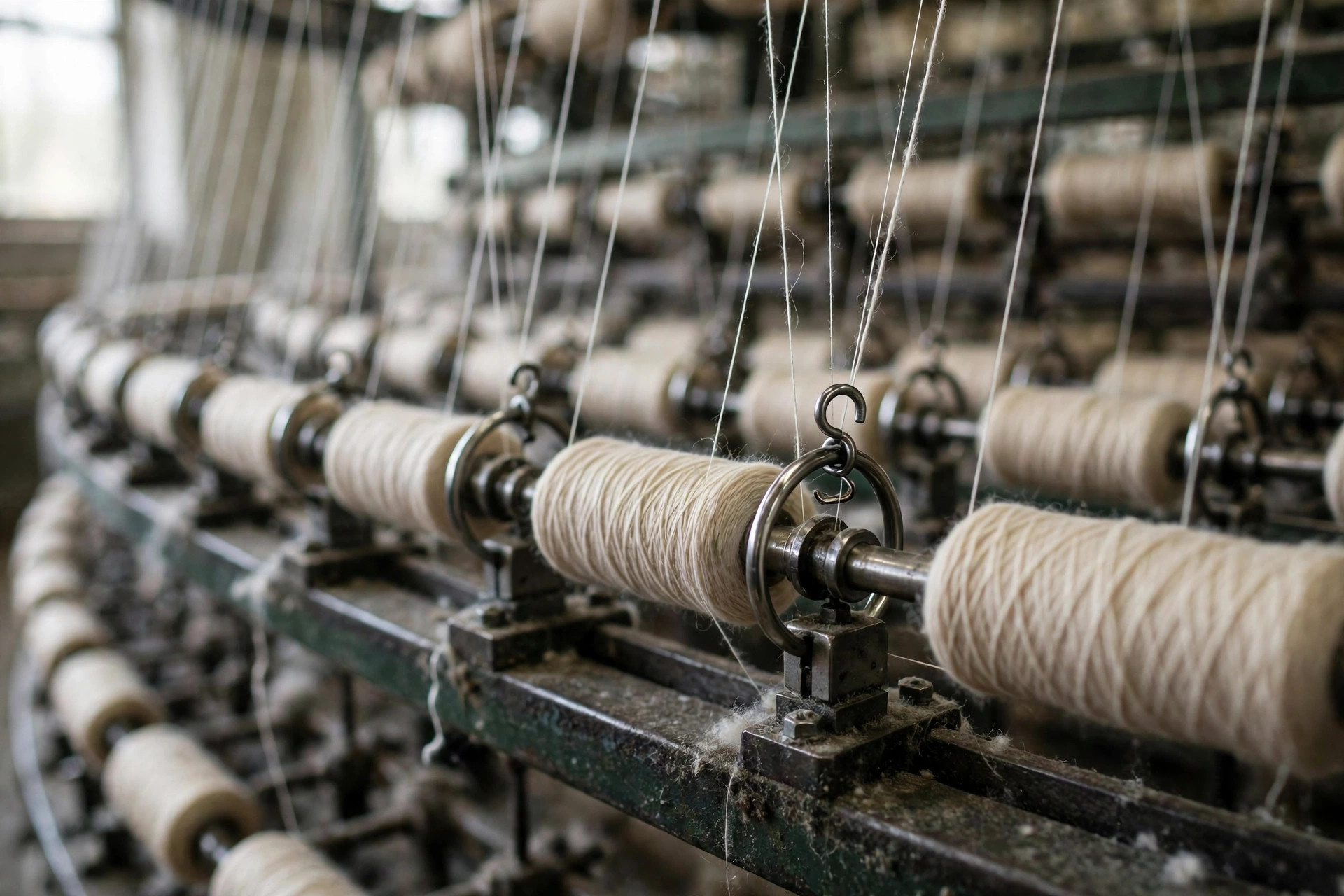
Every spinning method solves the same two problems: pull a prepared strand of fiber down to the required fineness, and insert enough twist to hold it together. The methods differ in how they twist — and that difference sets the speed of production, the finest count achievable, the yarn’s strength and hairiness, and ultimately the price of the t-shirt or sheet the yarn becomes. This page compares the four systems a buyer will meet on specifications today; it is part of the Yarn & Spinning Guide, where the types of yarn page covers what these frames produce.
Ring Spinning: The Benchmark
Ring spinning is the descendant of the nineteenth-century ring frame and still the quality benchmark. A roving is drafted between three pairs of rollers, each pair running faster than the last, until the strand reaches the target count. It then passes through a guide eye to a rotating spindle; a tiny C-shaped traveler, clipped to a fixed steel ring, lags slightly behind the spindle, and that lag both inserts the twist and winds the finished yarn onto the cop. Because the fibers are drafted under control and twisted as a continuous strand, ring-spun yarn has the best fiber alignment of any system: it can be spun to the finest counts, it is the strongest and softest yarn of its size, and it takes a high, even twist. The costs are speed and money — a ring spindle produces slowly, the small cops must be doffed and later wound, and a separate roving stage is needed. Premium shirting, fine knitwear and any label that says “ring-spun” are paying for exactly this alignment.
Rotor Spinning: The Open-End Workhorse
Rotor spinning broke the process open — hence its other name, open-end spinning. A drawn sliver feeds straight to the frame (no roving stage), where a toothed opening roller tears it into individual fibers. Air carries the fibers down a transport channel into a rotor spinning at very high speed; centrifugal force collects them in a groove around the rotor’s rim, and the yarn is drawn off from that collecting groove, twisting as it leaves. Production per position runs several times faster than ring spinning and the yarn comes off on large packages ready for use. The trade-offs are structural: fibers land in the groove less parallel, some wrap around the yarn instead of lying along it, and the practical count range stops at the coarse-to-medium band. The yarn is a little weaker and harsher than ring-spun, but very even, bulky and cheap — the default for denim, towels, fleece and basic t-shirt jersey where fineness is not the point.

Air-Jet and Vortex Spinning
Air-jet spinning replaces the mechanical twisting element with air. In the original air-jet system, drafted fibers pass through two air nozzles; the second nozzle wraps surface fibers around a parallel core, producing a yarn whose strength comes from its wrappings. Its successor, vortex spinning (the Murata MVS system), uses a swirling air vortex so the core fibers stay truly parallel while edge fibers whirl around them. Both systems are fast — vortex is the fastest production method of all — and produce yarn with strikingly low hairiness, because the surface fibers are bound down as wrappers. That makes smooth, clean fabrics with good pilling resistance and crisp printing, popular for viscose, polyester and their blends with cotton. The limits: the method needs fibers that behave well in an air stream, pure-cotton fine counts are difficult, and the yarn’s hand is firmer and less lofty than a ring-spun equivalent.
Compact Spinning: Ring, Refined
Compact spinning keeps the ring frame and fixes its one weakness. On a normal ring frame, the drafted strand spreads into a small triangle of fibers at the point where twist enters, and the edge fibers of that triangle are poorly controlled — they become the hairs on the yarn surface. A compact frame condenses the strand before twisting, using suction through a perforated apron, a lattice or a grooved roller, so the triangle all but disappears and nearly every fiber is caught into the yarn body. The result is a ring-spun yarn with measurably higher strength, much lower hairiness and a cleaner surface; fabrics made from it pill less, show sharper print definition and keep a newer appearance longer. Many “premium” and compact-labelled shirting and knit yarns are spun this way, at a cost between standard ring and the finest specialty yarns.
Choosing a Method Is Choosing a Yarn
Finest, softest, strongest: ring or compact — fine shirting, premium knits. Coarse and economical: rotor — denim, towelling, fleece. Smooth, low-hairiness, fast: air-jet/vortex — viscose and synthetic-rich fabrics. The method is printed on few labels, but its fingerprint is on every fabric the yarn becomes.
Two older and niche systems complete the picture. Friction spinning (the DREF system) assembles fibers between two rotating friction drums and is used mainly for coarse and technical yarns, including many core-spun constructions. The mule, the great nineteenth-century frame, spun intermittently and produced exceptionally soft, fine yarns; it survives only in a handful of specialty woolen mills. And whatever frame made the yarn, it still had to be prepared first — the preparation routes that feed these frames shape the yarn as much as the frame itself.
More in the Yarn & Spinning Guide
Common Questions
What is ring spinning?
Ring spinning drafts a roving between rollers, then a rotating spindle and a small traveler running around a fixed ring insert the twist and wind the yarn onto a cop. It is the oldest continuous system still in wide use, the slowest per spindle of the modern methods, and it produces the finest, strongest and softest yarns.
What is open-end (rotor) spinning?
In rotor spinning, a sliver is opened into individual fibers by a toothed roller and the fibers are carried by air into a fast-spinning rotor, where they collect in a groove and are drawn off as yarn. It skips the roving stage, runs several times faster than ring spinning, and suits coarser counts — denim, towels and basic knitwear.
Is ring-spun yarn better than open-end yarn?
For fineness, softness and strength, generally yes: ring-spun yarns can be spun finer, align their fibers better and feel softer, which is why premium t-shirts advertise ring-spun cotton. Open-end yarns are more even in bulk, cheaper to produce and perfectly serviceable for coarser, hard-wearing fabrics — the better choice depends on the product.
What is compact spinning?
Compact spinning is a refinement of ring spinning that condenses the drafted fiber strand — usually with suction through a perforated apron or lattice — just before twist is inserted. Fewer edge fibers escape, so the yarn is smoother, less hairy and stronger, and fabrics pill less and print and dye more cleanly.
Back to the Yarn & Spinning Guide
The Yarn & Spinning Guide hub maps the whole cluster — types, spinning methods, counts, twist, preparation and choosing yarns — in the order a mill thinks about them.