Yarn & Spinning Guide · Types
Types of Yarn Explained
Spun or filament? Single or ply? Plain or novelty? The family tree of yarn — and how each branch behaves once it becomes fabric.
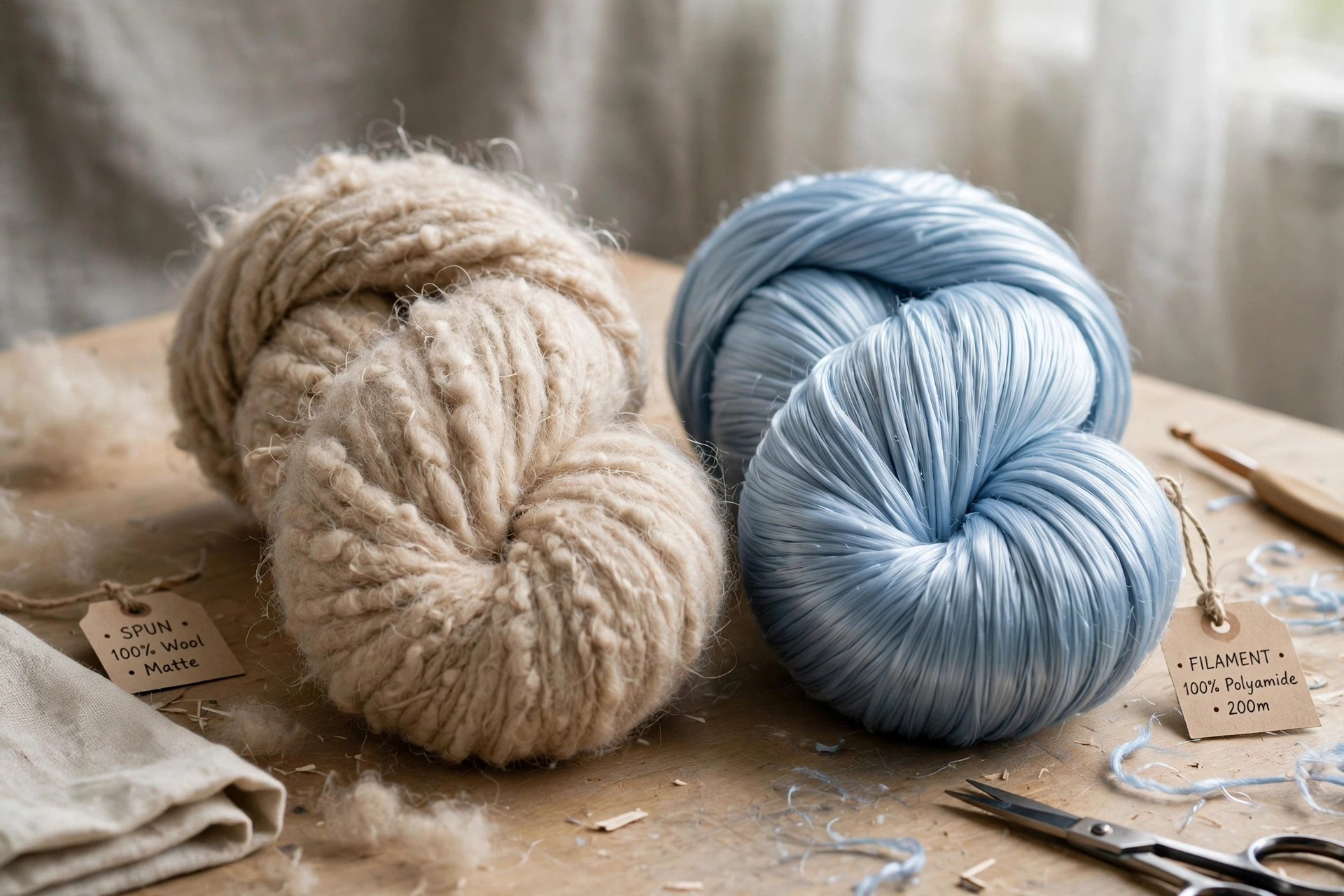
Ask what a yarn is made of and you get a fiber name — cotton, wool, polyester. Ask what type of yarn it is and you learn how it is built, which predicts far more about the fabric. This guide is the family tree; it belongs to the Yarn & Spinning Guide, where the companion pages cover how each type is spun, counted and twisted. Every yarn on a mill’s price list belongs to one of two great families — spun or filament — and is then described by its construction: single, ply or cord, plain or novelty.
Spun Yarns: Staple Fiber, Held by Twist
A spun yarn is built from short lengths of fiber — staple — overlapped and locked together by twist. Cotton, wool, flax and cut manufactured fibers all arrive as staple, and the fiber ends that work their way to the surface give spun yarns their familiar character: a matte appearance, a soft and warm hand, good cover, and a slight fuzz or hairiness. That fuzz is also the family weakness — loose surface fibers are what rub away as pilling and abrasion wear. Spun yarns dominate apparel because most natural fibers exist only in staple form, and because their softness and opacity are what most clothing wants. How the staple was prepared — carded or combed, woolen or worsted — then decides whether the spun yarn is lofty and fuzzy or smooth and sleek.
Filament Yarns: The Continuous Strand
A filament yarn is made of one or more continuous strands, each potentially miles long. Silk is the natural example — a single cocoon filament — and every manufactured fiber begins life as filament, extruded through a spinneret. A monofilament is one single filament used alone, as in fine hosiery and sheer fabrics; a multifilament yarn bundles many fine filaments together, as in linings, blouses and athletic wear. Because the fibers never end, filament yarns are smooth, even and strong for their size, and naturally lustrous unless delustered. They need little or no twist to hold together; instead producers often texture them — crimping or looping the filaments — to add bulk, cover and stretch, which is how most polyester knitting yarns are made. Where a spun yarn feels like a rope of short hairs, a filament yarn feels like a bundle of wires, and fabrics inherit the difference: filament fabrics are sleeker, cooler to the touch and more slippery, spun fabrics warmer and more matte.
Singles, Ply Yarns and Cords
Construction is the second axis of yarn type. A single (or singles yarn) is one strand exactly as it leaves the spinning frame — the default for most weaving and knitting. A ply yarn twists two or more singles together, written 2-ply, 3-ply and so on. Plying rounds the yarn out, covers its thin places, and improves strength and abrasion resistance, which is why sewing threads, sock yarns and quality shirting warps are so often plied; twisting the ply in the opposite direction to the singles’ twist also balances the yarn so knitted fabric hangs flat instead of skewing. A cord yarn twists ply yarns together once more — the construction of tire cord, ropes and heavy decorative yarns. The count notation carries the construction with it: 30/1 is a single, 30/2 a two-ply of the same single size, and the count systems guide shows how plying changes the resulting fineness.
Core-Spun Yarns: A Yarn Inside a Yarn
A core-spun yarn wraps staple fiber around a continuous core. Put an elastane filament in the middle and sheath it in cotton and you get the stretch yarn inside nearly every pair of stretch jeans: the fabric surface is pure cotton, the recovery comes from the hidden core. Put a strong filament in the core and the yarn gains strength without changing its surface — a common trick in sewing threads and workwear. Core-spinning is the clearest proof that yarn type is engineering: two materials, each doing the job it is best at, in a single strand.
Novelty Yarns: Deliberately Irregular
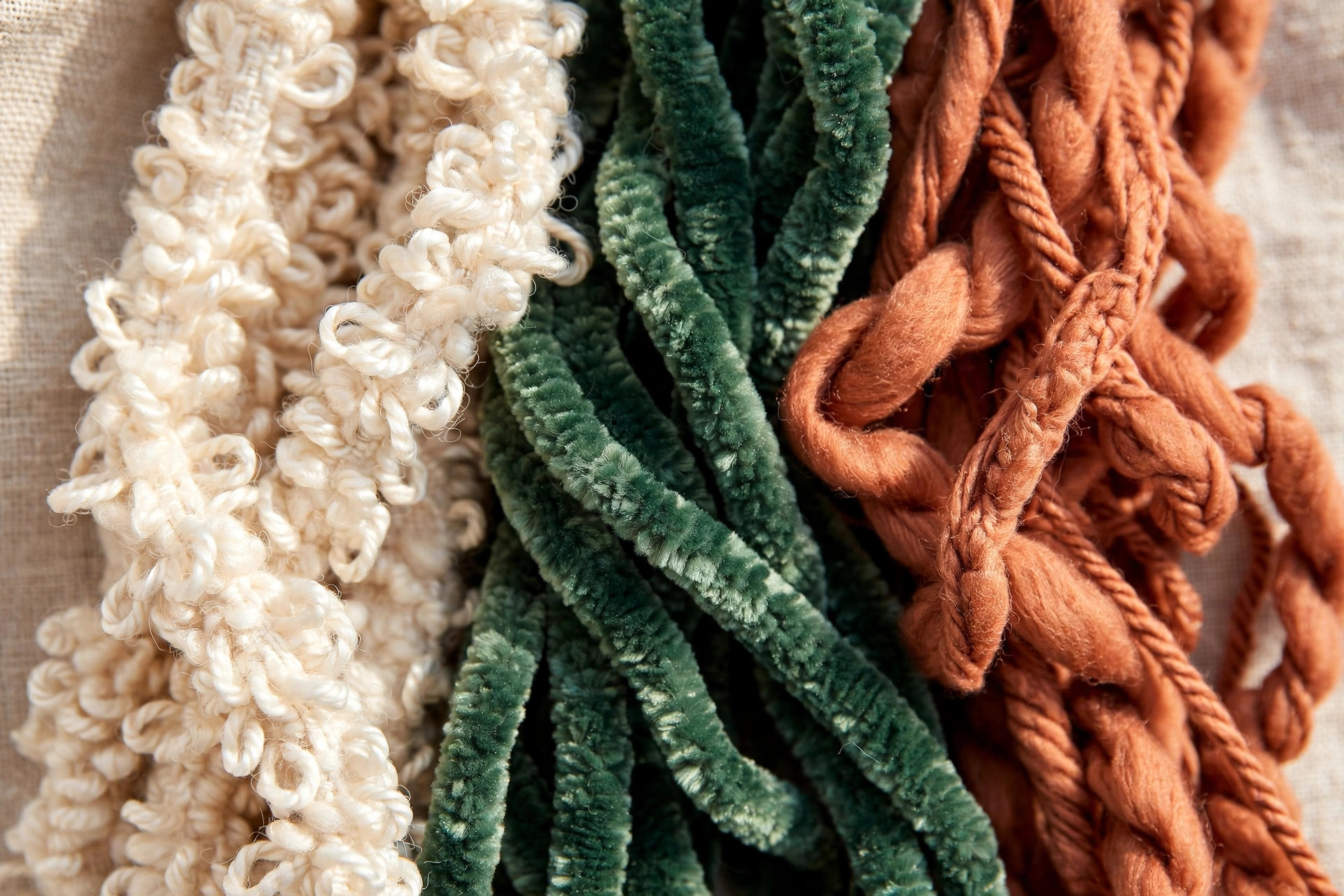
Novelty or fancy yarns break the rule that a yarn should be even. They are built from a ground yarn, an effect yarn and often a binder, twisted together so the effect survives into the cloth. The standard family: slub yarns with soft thick-and-thin places (the texture in much linen-look and casual shirting); bouclé, whose effect yarn forms loops along the strand, the classic coating and knitwear texture; chenille, a yarn with a velvet-like pile radiating from its core, soft and light-catching; knop yarns with bunches of fiber wound at intervals; snarl and loop yarns with frieze-like twists; and yarns carrying metallic strips or contrasting flecks. Novelty yarns trade durability for effect — loops snag, pile sheds — so they are placed where their texture earns its keep: fashion knits, coatings, scarves and decorative wovens. The spinning methods guide covers the frames that make the plain yarns; novelty yarns are usually assembled on special twisting machines from already-spun components.
The Two Questions That Classify Any Yarn
Ask what holds it together — twist around short staple fibers (spun) or the continuity of the filaments themselves (filament) — and how it is assembled — single, ply, cord, core-spun or novelty. Those two answers place any yarn on the family tree and predict most of its behaviour in fabric.
More in the Yarn & Spinning Guide
Common Questions
What is the difference between spun yarn and filament yarn?
Spun yarn is made from short staple fibers twisted together, which gives it a matte, slightly fuzzy surface and a soft hand. Filament yarn is made from long continuous filaments — silk or manufactured fibers extruded in continuous strands — so it is smoother, stronger for its size and often more lustrous.
What is a ply yarn?
A ply yarn is made by twisting two or more single yarns together. A two-ply (2-ply) yarn is rounder, more even and usually stronger and more abrasion-resistant than a single of the same total size, and plying in the opposite direction to the singles’ twist balances the yarn so fabric stays flat.
What is a novelty yarn?
A novelty (or fancy) yarn is deliberately irregular: it is built to create texture or pattern in the fabric. Common types include slub yarn with thick-and-thin places, bouclé with loops, chenille with a velvety pile, and yarns with knops, snarls or metallic effects.
What is core-spun yarn?
A core-spun yarn has a central core — often an elastane filament for stretch, or a filament for strength — wrapped in a sheath of staple fibers. The fabric gets the surface and hand of the sheath fiber with the performance of the core, which is how most stretch denim and stretch wovens are made.
Back to the Yarn & Spinning Guide
The Yarn & Spinning Guide hub maps the whole cluster — types, spinning methods, counts, twist, preparation and choosing yarns — in the order a mill thinks about them.