Yarn & Spinning Guide · Counts
Yarn Count Systems
Ne, Nm, tex and denier: the numbering systems that say how fine a yarn is — why two of them run backwards, and how to convert between all of them.
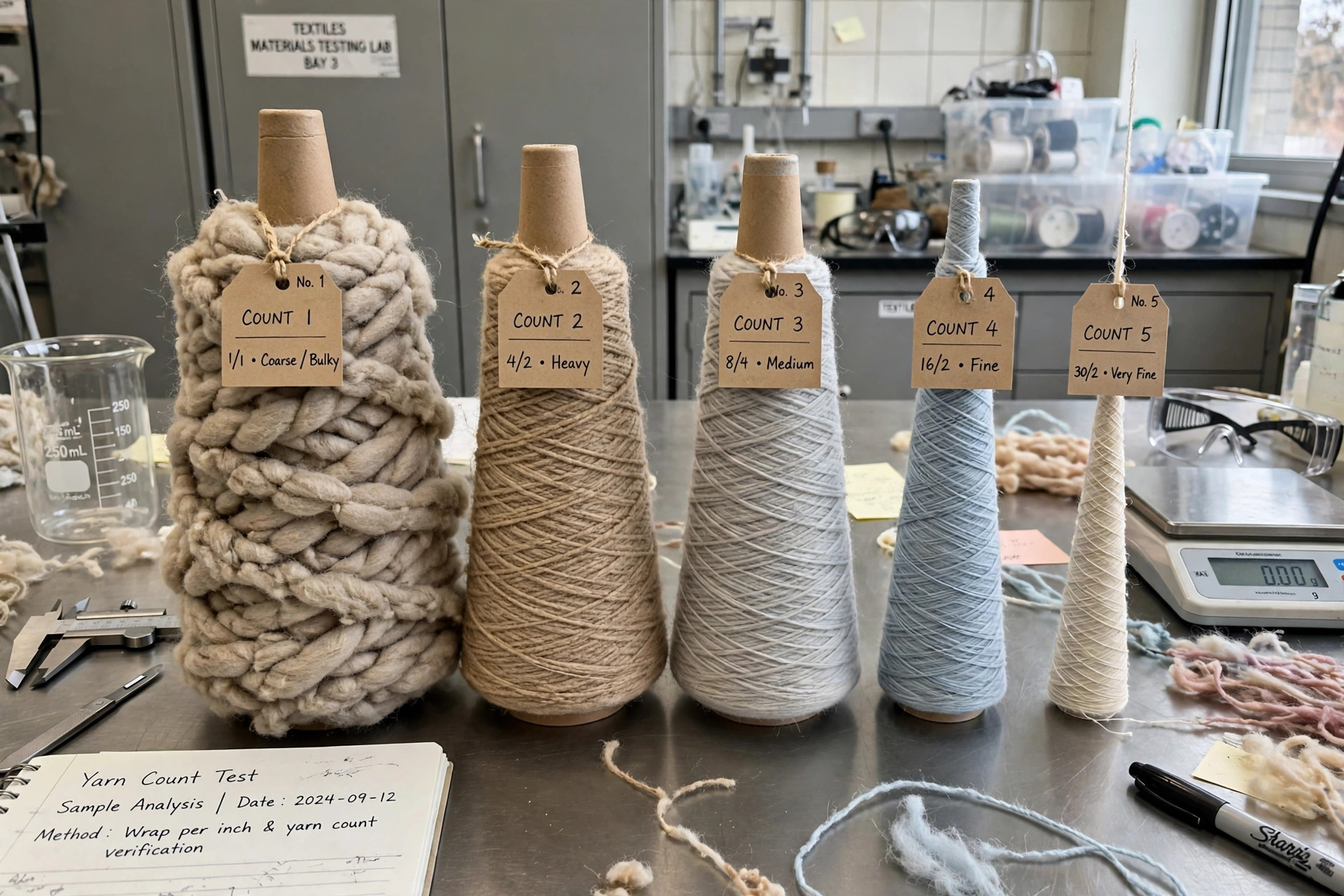
Yarn is too fine to specify by diameter — it is soft, compressible and often not even round — so the trade specifies it by linear density: the relationship between its length and its weight. That relationship is the yarn count, and it is the single most-quoted number in any yarn specification. This page, part of the Yarn & Spinning Guide, explains the systems in use, why they point in opposite directions, and how to convert between them with confidence. Apparel Search’s long-standing education pages treat the individual systems in depth — Yarn Count, Cotton Count and Thread Measurement — and this guide ties them together.
Two Families, Running in Opposite Directions
Indirect systems fix the weight and count the length. The count is the number of standard hanks that weigh one standard unit of weight — so the more hanks it takes to make up the weight, the finer the yarn, and the higher the number, the finer the yarn. The English cotton count and the metric count work this way; they grew up in the spinning mills, where yarn was sold by the hank.
Direct systems fix the length and weigh it. The count is the weight of one standard length of yarn — so the higher the number, the heavier and coarser the yarn. Tex and denier work this way; they suit laboratories and filament producers, who weigh a measured skein. Every conversion mistake in the trade comes from forgetting which family a number belongs to: Ne 40 is a fine yarn, 40 tex is a heavy one.
The Four Systems You Will Meet
Ne — English cotton count: the number of 840-yard hanks per pound. Used for cotton and cotton-type spun yarns. Nm — metric count: the number of 1,000-metre lengths per kilogram (equivalently, metres per gram). Used widely in Europe for spun yarns of all fibers. Tex — the weight in grams of 1,000 metres. The international standard for spun yarns. Denier — the weight in grams of 9,000 metres. The standard for filament yarns; its tenth-part, decitex (dtex), is grams per 10,000 metres.
The Conversion Formulas
All four systems describe the same physical yarn, so fixed constants connect them. The constant 590.5 comes from the definition of Ne itself: one hank of 840 yards (768.1 metres) weighing one pound (453.6 grams) works out to 590.5 grams per 1,000 metres — a Ne 1 yarn is a 590.5 tex yarn, and everything scales from there.
tex = 590.5 ÷ Ne and Ne = 590.5 ÷ tex
Nm = 1,000 ÷ tex and tex = 1,000 ÷ Nm
Nm = 1.693 × Ne and Ne = 0.5905 × Nm
denier = 9 × tex, so denier = 5,315 ÷ Ne
Worked example. A mill offers a combed cotton single at Ne 30. In tex: 590.5 ÷ 30 = 19.7 tex. In metric count: 1.693 × 30 = Nm 50.8. In denier: 19.7 × 9 = 177 denier. Run it backwards to check: 590.5 ÷ 19.7 = Ne 30.0. The same yarn, four labels — which is why a specification should always name its system.
| English cotton count (Ne) | Tex | Metric count (Nm) | Denier | Typical use of a cotton single |
|---|---|---|---|---|
| Ne 10 | 59.1 | 16.9 | 531 | Denim, canvas, heavy fleece |
| Ne 20 | 29.5 | 33.9 | 266 | Towels, basic knitwear |
| Ne 30 | 19.7 | 50.8 | 177 | T-shirts, jersey, sheeting |
| Ne 40 | 14.8 | 67.7 | 133 | Fine shirting, quality jersey |
| Ne 50 | 11.8 | 84.7 | 106 | Poplin, lawn, fine sheeting |
| Ne 60 | 9.8 | 101.6 | 89 | Voile, luxury shirting |

Plied Yarns and Resultant Count
When singles are plied, the count of the combined yarn — its resultant count — follows the family direction. In an indirect system, divide: a 30/2 yarn (two singles of Ne 30) has a resultant count of Ne 15, because the combined yarn is twice as heavy per hank. In a direct system, add: two 19.7 tex singles make a 39.4 tex yarn. The notation keeps both facts: the number before the stroke is the singles count, the number after it the number of plies. This is why a 2-ply Ne 30 shirting warp and a single Ne 15 yarn are close cousins in weight — the ply is rounder and stronger, but the resultant count, and therefore roughly the fabric weight, is the same. Count also feeds the twist calculation: in the cotton system, target twist is set by a multiplier applied to the square root of the count.
Older and Regional Counts
The four systems above are the living standards, but specifications and older records carry others. The worsted count counts 560-yard hanks per pound and survives in the wool trade; the woollen Yorkshire skein count uses 256-yard lengths. The thread — one turn of the reel, 55 inches in the British standard ladder — is the antique unit beneath them all, and the Apparel Search Thread Measurement page preserves the full ladder from thread to skein to hank to spindle. When an old specification quotes an unfamiliar count, the safe path is always the same: convert it to tex, the one system every other can be translated through.
More in the Yarn & Spinning Guide
Common Questions
What is yarn count?
Yarn count is the number that expresses a yarn’s fineness or coarseness — its linear density. It is measured either as length per unit weight (indirect systems such as Ne and Nm, where a higher number means a finer yarn) or as weight per unit length (direct systems such as tex and denier, where a higher number means a heavier, coarser yarn).
How do I convert Ne to tex?
Divide 590.5 by the Ne value: tex = 590.5 / Ne. So a Ne 30 cotton yarn is 590.5 / 30 = about 19.7 tex. The reverse conversion is Ne = 590.5 / tex. The constant comes from the definition of Ne — the number of 840-yard hanks that weigh one pound.
What is the difference between tex and denier?
Both are direct systems — weight per fixed length — but the fixed length differs. Tex is the weight in grams of 1,000 metres of yarn; denier is the weight in grams of 9,000 metres. Denier is therefore exactly nine times the tex value, and it is used mainly for filament yarns, while tex is used mainly for spun yarns.
What does 30/2 mean in a yarn count?
It means a two-ply yarn made from singles of count 30. In an indirect system the resultant count is the single count divided by the number of plies, so 30/2 Ne behaves as a Ne 15 yarn. In a direct system the resultant is multiplied: 19.7 tex / 2 is a yarn of about 39.4 tex.
Back to the Yarn & Spinning Guide
The Yarn & Spinning Guide hub maps the whole cluster — types, spinning methods, counts, twist, preparation and choosing yarns — in the order a mill thinks about them.