Yarn & Spinning Guide · Twist
Yarn Twist Explained
Direction, level and balance: how the spiral in a yarn decides its strength, its surface, and whether the finished garment hangs straight.
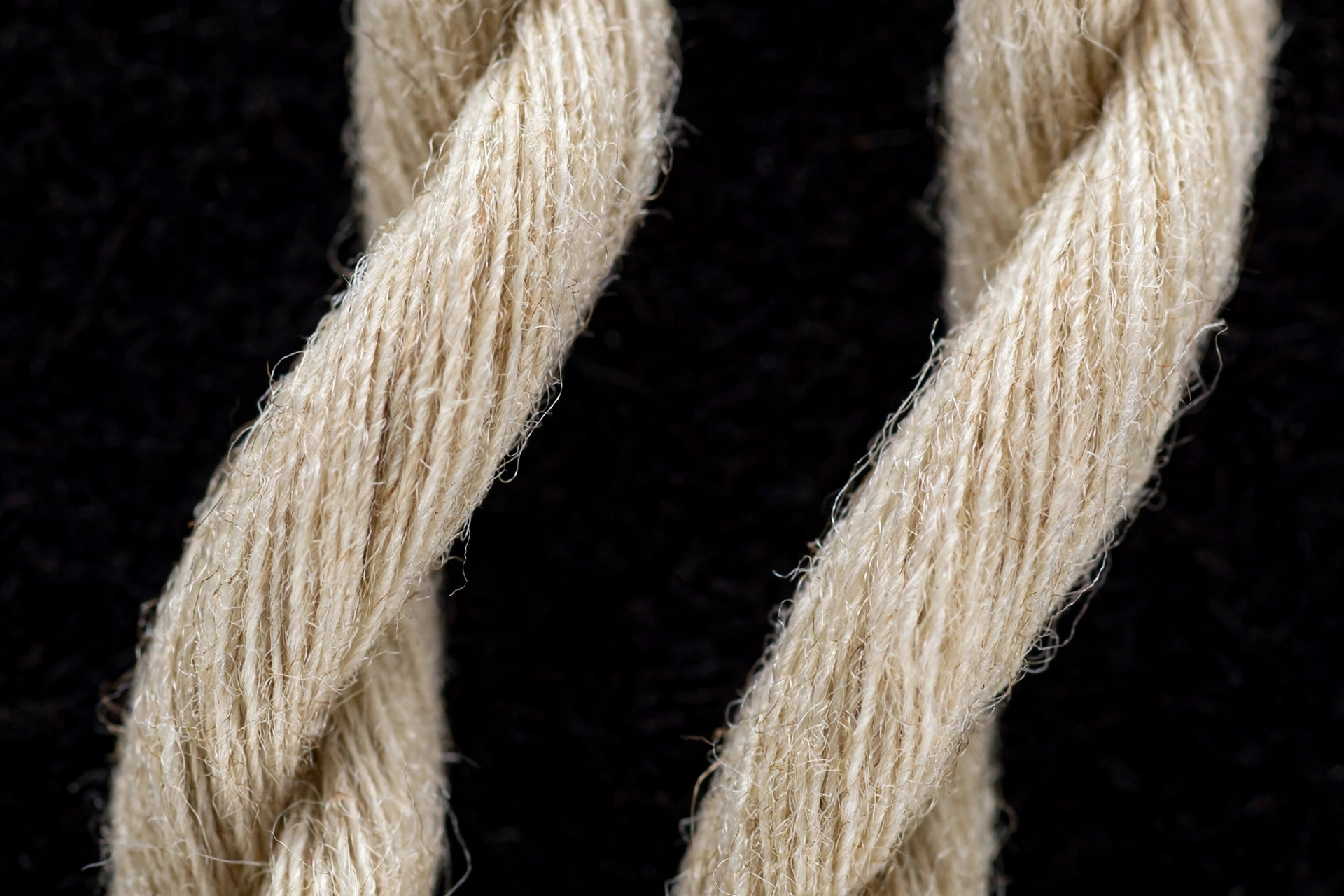
Twist is the spiral arrangement of fibers around the yarn’s axis, and it is the hardest-working variable in yarn engineering. It is inserted on the spinning frame — the spinning methods page shows how each frame does it — and it is the reason a loose bundle of short fibers can become a yarn strong enough to weave. This guide, part of the Yarn & Spinning Guide, covers twist’s three aspects: its direction, its level, and its balance.
Why Twist at All?
A strand of parallel staple fibers has almost no strength: pull it and the fibers simply slide past each other. Twist wraps the fibers helically around one another, so tension on the yarn squeezes the fibers together and friction resists the sliding. Strength climbs steeply as twist is added — then flattens, and finally falls, because at extreme twist the fibers lie so obliquely that they stop contributing their lengthwise strength, and the yarn turns hard and wiry. Every yarn is therefore spun at a compromise: enough twist for the strength its job demands, and no more than its hand can afford. Filament yarns are the exception that proves the rule — their fibers are already continuous, so they need only a whisper of twist for cohesion, or none.
Direction: S Twist and Z Twist
Twist runs in one of two directions, named for the letters they resemble. Hold a yarn vertically and examine the diagonal of its surface fibers: if the diagonals run parallel to the central stroke of the letter Z (rising from lower left to upper right), the yarn has Z twist; if they parallel the central stroke of the letter S (falling from upper left to lower right, like a backslash), it has S twist. By long convention, most singles yarns are spun Z. When singles are plied, the ply twist is normally put in the opposite direction — S around Z singles — so the two twists work against each other and the finished yarn hangs in balance. Direction also interacts with fabric structure: twill weaves, for example, can be made to show or hide their diagonal depending on whether the yarn’s twist direction reinforces or opposes the weave line, one reason the choosing yarns guide treats twist as a design tool, not just a specification.
Level: Turns Per Inch and the Twist Multiplier
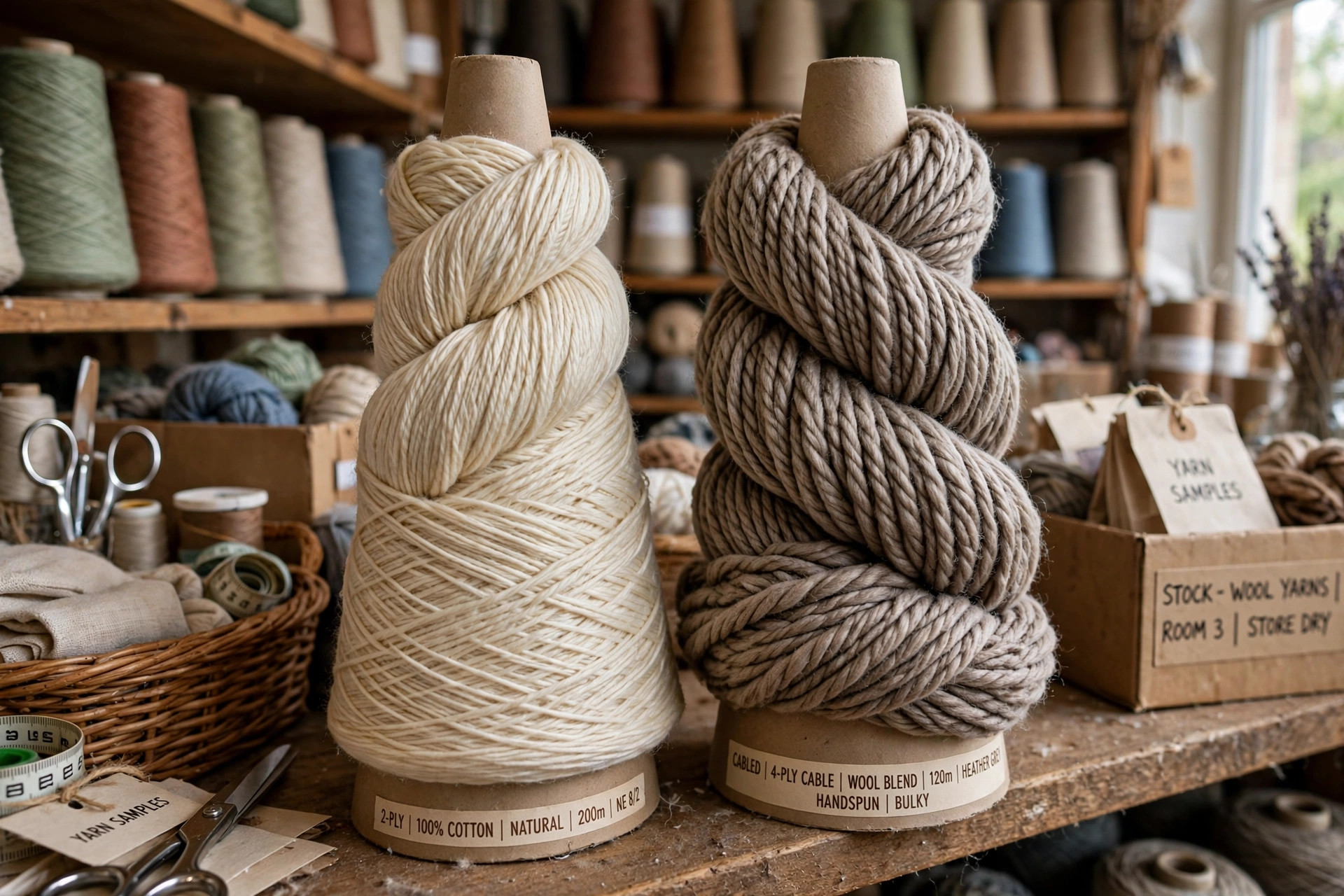
Twist level is measured in turns per inch (tpi) — or turns per metre in metric mills. But a raw tpi number misleads across counts: a fine yarn needs far more turns than a coarse one to reach the same fiber angle, because its circumference is smaller. The trade therefore specifies twist relative to count with the twist multiplier (also called the twist factor). In the English cotton system:
TM = tpi ÷ √Ne
Worked example: a Ne 30 warp yarn specified at TM 4.0 needs 4.0 × √30 = 4.0 × 5.48 = about 22 tpi. A Ne 10 yarn at the same multiplier needs only 4.0 × 3.16 = about 12.6 tpi — yet the two yarns have the same twist character, because the fiber helix angle is what the multiplier really holds constant. Typical cotton-system multipliers run from roughly 3 for soft knitting yarns to 5 and above for hard warp yarns, with crepe yarns twisted far beyond the normal range to make them lively and springy — the spring in a crepe fabric is stored twist energy. The count itself comes from the count systems page; the multiplier is meaningless until the count is known.
Balance: The Twist That Fights Back
A twisted singles yarn is a stored spring: cut a length, let the ends go, and it writhes and snarls as it tries to untwist. In yarn form this is called twist liveliness, and in single-jersey knitting it shows up as spirality — the wales lean diagonally, seams wander, and the garment twists further after washing. Mills manage it four ways: plying singles together with opposite twist so the torques cancel; combining S-twist and Z-twist yarns in one fabric; setting the twist, typically with steam, so the fibers relax into their twisted shape; or accepting the liveliness as a design feature, as in crepe and bouclé effects. Balance is the quiet reason two yarns of identical fiber, count and tpi can behave completely differently on the knitting machine — and the reason yarn specifications record direction as faithfully as level.
Reading Twist on a Specification
A complete twist entry gives level and direction together — for example, “Ne 30/1, Z twist, TM 3.6” for a soft knitting single, or “30/2, S ply twist” for the balanced ply made from it. If either half is missing, the fabric’s behaviour is only half specified.
More in the Yarn & Spinning Guide
Common Questions
What is the difference between S twist and Z twist?
Hold the yarn vertically and look at the diagonal of the surface fibers. If the diagonals slope like the central stroke of the letter Z — rising from lower left to upper right — it is Z twist; if they slope like the central stroke of an S — falling from upper left to lower right — it is S twist. Most singles yarns are spun with Z twist, and they are plied with S twist to balance them.
What does twist do to a yarn?
Twist holds the fibers together and gives the yarn its strength: as twist increases, fibers grip each other harder and strength rises — up to a point, beyond which the yarn becomes hard and loses strength. Twist also sets the yarn’s surface and character: low twist is soft and bulky, high twist is lean, smooth and lively.
What is the twist multiplier?
The twist multiplier (TM) relates twist to count so that yarns of different fineness can be given equivalent twist character. In the English cotton system, TM = turns per inch divided by the square root of the Ne count. A Ne 30 yarn at TM 4.0 therefore needs 4.0 x 5.48 = about 22 turns per inch.
Why does a knitted fabric sometimes skew or lean?
A singles yarn with active twist wants to untwist, and in single jersey that residual torque twists each stitch, so the wales lean and the garment twists after washing. Mills counter it by balancing the yarn — plying in the opposite direction, using S and Z yarns together, or setting the twist with steam or finishing.
Back to the Yarn & Spinning Guide
The Yarn & Spinning Guide hub maps the whole cluster — types, spinning methods, counts, twist, preparation and choosing yarns — in the order a mill thinks about them.