Fashion History
Apparel Search fashion summary — a short guide to fashion history.
Fashion history starts before fashion, with clothing itself. According to archaeologists and anthropologists, the earliest clothing likely consisted of fur, leather, leaves or grass draped, wrapped or tied around the body. Knowledge of that clothing remains inferential, because clothing materials deteriorate quickly compared with the stone, bone, shell and metal artifacts that survive from the same periods.
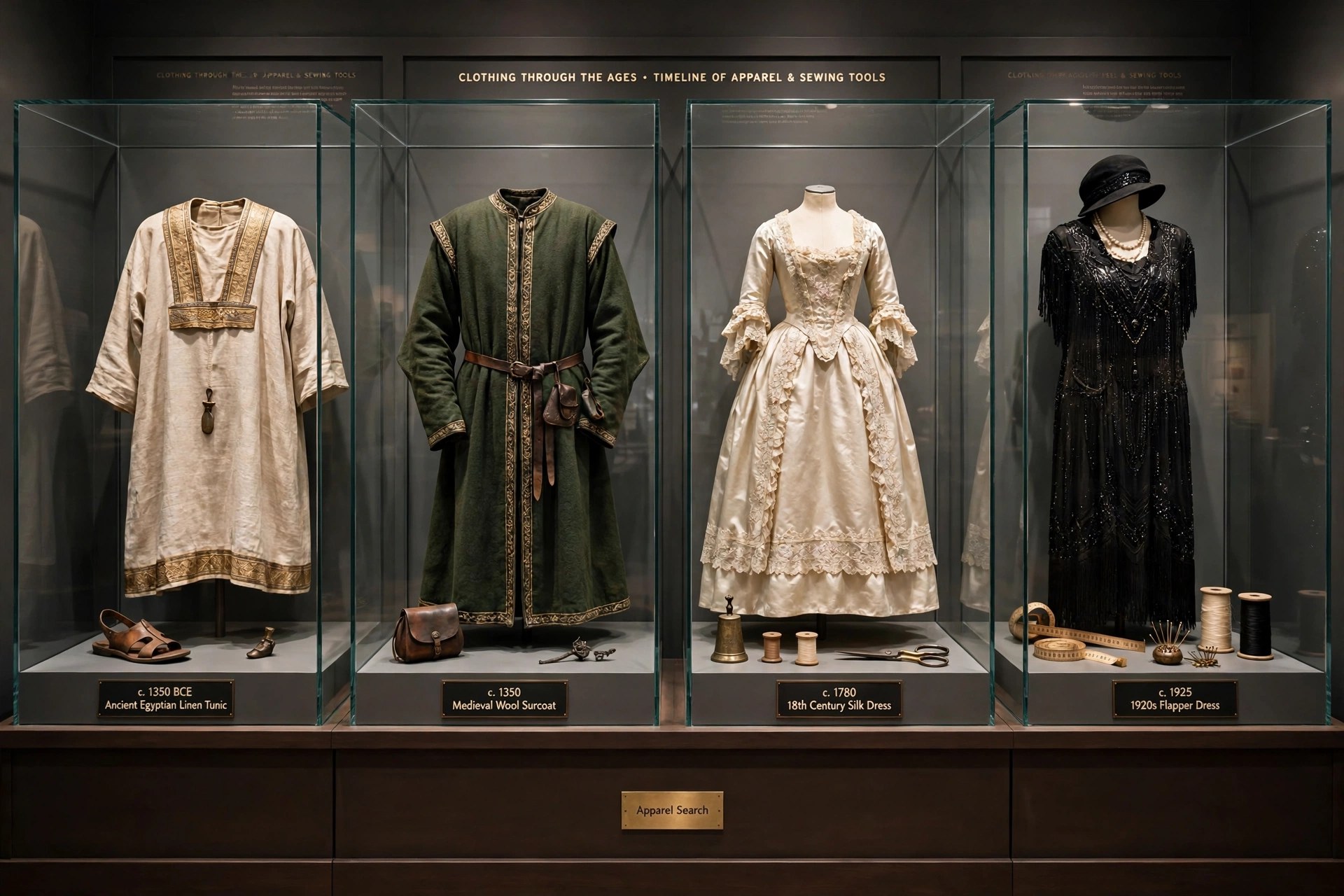
Fashion History — Explore & Resources
How Far Back Does Clothing Go?
The surviving evidence is indirect but striking. Archaeologists have identified very early sewing needles of bone and ivory dated to about 30,000 BC, found near Kostenki, Russia, in 1988 — needles imply sewn material, and sewn material implies constructed clothing rather than simple draping. Dyed flax fibres that could have been used in clothing have been found in a prehistoric cave in the Republic of Georgia dating back to 34,000 BC, suggesting that fibre preparation and even colouring are older than settled farming.
Clothing began for practical reasons that still explain much of what people wear. It protects from the elements and enhances safety during hazardous activities such as hiking, hunting and fighting. It shields the wearer from rough surfaces, rash-causing plants, insect bites, splinters, thorns and prickles by placing a barrier between skin and environment. It insulates against cold and heat, and it provides a hygienic barrier, keeping infectious and toxic materials away from the body. Protection, comfort — and more protection.
Fashion History as a Discipline
Beyond survival, clothing became one of humanity's main signalling systems: the history of fashion design is the development of an industry that designs clothing and accessories, and throughout human history fashion has signified class and status while acting as an economic and political driver. That is why historians read dress so closely — a garment records trade routes, technology, wealth and belief in a way few everyday objects match.
Modern resources have widened access enormously. Google's We Wear Culture project, built with the Google Arts and Culture programme, digitised some 3,000 years of fashion history: around 30,000 online artifacts from over 180 institutions, with hundreds of curator-written stories covering everything from the hoodie to the Sukajan jacket. Combined with era-by-era resources — western fashion history, decade guides from the 1960s onward, and histories of individual items such as women's jeans and sarongs — the subject is now open to any reader, not only to museum visitors.
Where to Study Fashion History
Fashion history can be studied at several depths. Museum collections and their online catalogues give the garments themselves, with construction details no photograph of a worn outfit can show. Decade-by-decade guides suit readers following style change over time, while single-subject histories — of jeans, of sarongs, of a fabric or a fastening — show how much social history one ordinary item can carry. The terminology and definitions resources linked from this page support both routes, defining the historical terms a reader meets along the way. The subject rewards starting anywhere: one garment's history reliably leads to the whole industry's.
Common Questions
When did clothing begin?
The exact date is unknowable because early materials decayed, but evidence points very far back: bone and ivory sewing needles from about 30,000 BC found near Kostenki, Russia, and dyed flax fibres from about 34,000 BC found in a cave in the Republic of Georgia.
Why did people start wearing clothes?
Primarily for protection: from weather, rough surfaces, plants, insects and hazards, with insulation against cold and heat and a hygienic barrier as further benefits. Status, identity and fashion developed on top of that practical foundation.
What is the We Wear Culture project?
A Google Arts and Culture project that digitised 3,000 years of fashion history — around 30,000 artifacts from over 180 institutions, with curator stories on major trends and garments such as the hoodie and the Sukajan jacket.