Apparel Search Consumer Guides
Sun-Protective Clothing for Kids
Coverage suits, legionnaire hats and swim leggings — children’s sun clothing bought by the rating label and the coverage map, in garments only a parent has to wrestle onto anyone.
Children’s sun clothing is where the UPF category is at its most practical. The garments are simple — long-sleeved swim tops, one-piece coverage suits, hats with flaps, leggings for the water — and the buying logic is the same as the adult section’s, set out in our sun-protective clothing buying guide: read the rating as a fabric measurement, then read the garment as a coverage map. This page applies both to the children’s rail, with the sizing and school-day realities that govern what actually gets worn.
Start With the Rating
Children’s sun lines are built overwhelmingly at UPF 50+ — the top labeled category, transmitting about 2 percent or less of the UV that reaches the fabric. That simplifies the shelf: the number is rarely the hard choice. What varies is everything around it — coverage, fit, closures a child can manage, and whether the garment will still be the right size in August. Buy the rating, then spend your judgment on the garment.
The Coverage Wardrobe
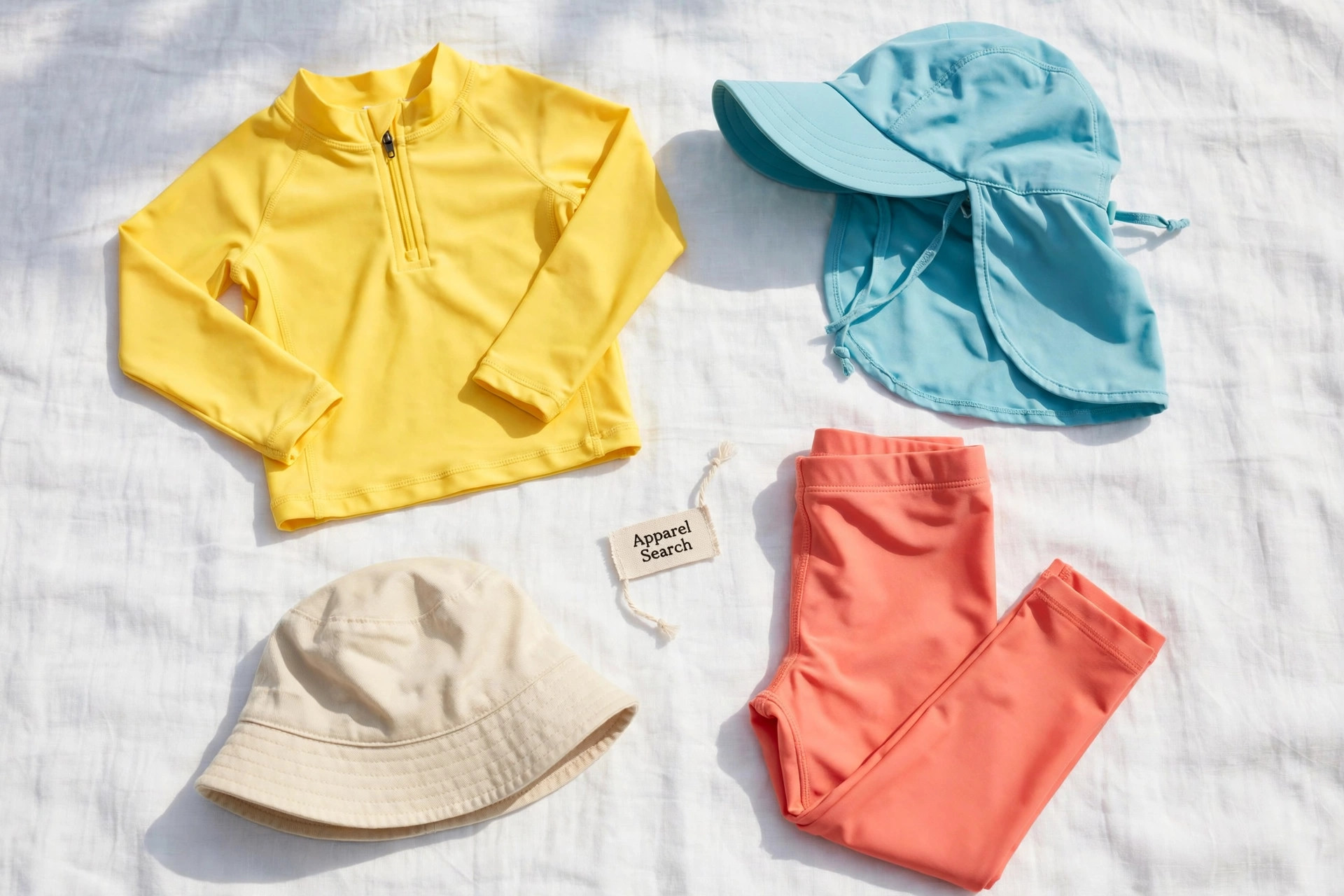
Coverage suits and rash guards. The core piece: a long-sleeved, high-necked swim top, sold as a separate or as the top half of a one-piece “sunsuit” with shorts or leggings attached. Zips beat pullovers for independent dressing; flatlock seams are the comfort specification, as our children’s swimwear guide details. Swim leggings extend the map below the waist — full-length or capri — and double as water-play trousers out of the pool. Everyday rated pieces — long-sleeved tees, hoodies and light trousers in rated wovens and knits — cover the non-swim hours: playgrounds, sidelines, hikes.
Hats: Brims and Flaps
The children’s hat shelf divides by coverage. A wide-brim hat shades face, ears and neck in one piece. A legionnaire hat — cap front, hanging flap behind — covers ears and neck more completely and stays put better in wind and water, which is why it is the standard school and camp style in sunny regions. Our children’s hats guide covers measuring and the keeping-hats-on problem in full; the sun-specific additions are a rated fabric, a chin strap or drawcord that actually works, and a flap long enough to reach the collar. The sun hats product guide covers the styles across all ages.
Sizing for Growth
Kids outgrow sun clothing on schedule, so buy the stage, not the future. True size now, with growth engineered in: drawcord hats, adjustable waists, raglan sleeves that forgive an inch, hems that look fine turned up. Resist the two-sizes-up bargain — overstretched fabric transmits more than its label says (the mechanism is on our care and durability page), and an oversized swim top is a drag-filled nuisance in the water. A garment that fits from June to September and hands down in good order beats a sloppy one bought for two summers.
School, Camp and Club Practicality
Group settings add their own specification. Many schools and camps in high-sun regions write hats into the dress code — a legionnaire or wide-brim hat is often a required item, not an accessory — so check the list before buying prettier. Then the survival details: name labels in everything (rated garments all look alike in a lost-property pile), a spare hat because hats are the most-lost garment in childhood, quick-dry fabrics that tolerate being stuffed damp into a bag, and cheap-to-replace staples for the pieces likeliest to vanish. Our kids’ swimwear guide covers the pool-side wardrobe these pieces join.
Shop Sun-Protective Clothing on Amazon
Ready to shop? Product links are kept in one place on the Apparel Search shopping guide:
Shop Clothing on AmazonThis link opens the Apparel Search shopping guide for Amazon, where the product links are kept in one place.
Common Questions
What UPF rating should kids’ sun clothing have?
The top labeled band is the practical default in this category: most children’s sun lines are built at UPF 50+, the highest category labels report. Because children’s garments are outgrown before they are worn out, a 50+ garment usually keeps its tested structure for the whole time it fits — the rating decision is simpler than the sizing one.
What is a legionnaire hat?
A cap or soft hat with a fabric flap that hangs from the back, covering the ears and the back of the neck while the brim shades the face. It is the fullest-coverage children’s hat style, common in school and camp dress codes in sunny climates, and usually made in the same rated, quick-dry fabrics as swim shirts.
Should kids’ sun clothes be bought a size up?
A little growth room is sensible — adjustable waists, longer hems and hats with drawcords earn their keep — but skip the oversized bargain. A rated fabric only performs at its tested transmission when it is not stretched drum-tight, and a baggy swim top drags in the water and rides up. True size with adjustment built in beats a size up worn sloppy.
Do kids need different sun clothes for school and camp than for the beach?
The garments overlap heavily — rated long sleeves, coverage hats, swim leggings — with two practical differences. School and camp pieces must survive being lost, swapped and laundered in bulk, so name labels and cheap-to-replace staples matter; and all-day wear pieces should be the breathable, loose-cut versions, reserving the tight swim knits for the water.
Back to the Sun-Protective Clothing Buying Guide
The full section: the ratings explained, construction factors, coverage design and label checks.