Apparel Search Consumer Guides
UPF Clothing Care and Durability
A rating is printed on new fabric — this page follows it through the wash, the pool and the seasons: inherent vs treated protection, and the wear signs that retire a garment.
Every UPF label is a measurement of a new garment. The question this page answers is what happens to that measurement across a garment’s working life — through laundry, stretching, chlorine, salt and slow thinning. The short version: a rating earned by fiber and weave is durable, a rating borrowed from a finish is not, and the fabric’s condition matters more than its birthday. This page is the care companion to our sun-protective clothing buying guide.
Two Ways a Fabric Earns Its Number
Inherent protection is built into the material: a UV-absorbing fiber such as polyester, a dense weave or knit, deep dye, sometimes UV-absorbing compounds compounded into the fiber itself. Nothing sits on the surface to wash away, so the rating lasts as long as the fabric’s structure does. Applied protection is a finish added to a finished fabric — a coating or laundry-style treatment that raises the transmission barrier. Finishes fade: each wash removes a little, the way water-repellent finishes dull over a season. Neither kind is a shortcut around the label — but they age differently, and a brand that tells you which kind it sells is telling you how the garment will age.
Washing: What the Laundry Actually Does
Laundering cuts both ways. It slowly strips applied finishes and, over many cycles, thins every fabric — both push transmission up. Yet the first washes of some cotton garments do the opposite: slight shrinkage tightens the weave and the fabric transmits a little less than it did new. Labeling standards account for the honest direction of travel by requiring ratings to be measured after a set number of washes — commonly 40 cycles in American labeling practice — so the printed number describes a garment that has already been laundered, not a showroom sample.
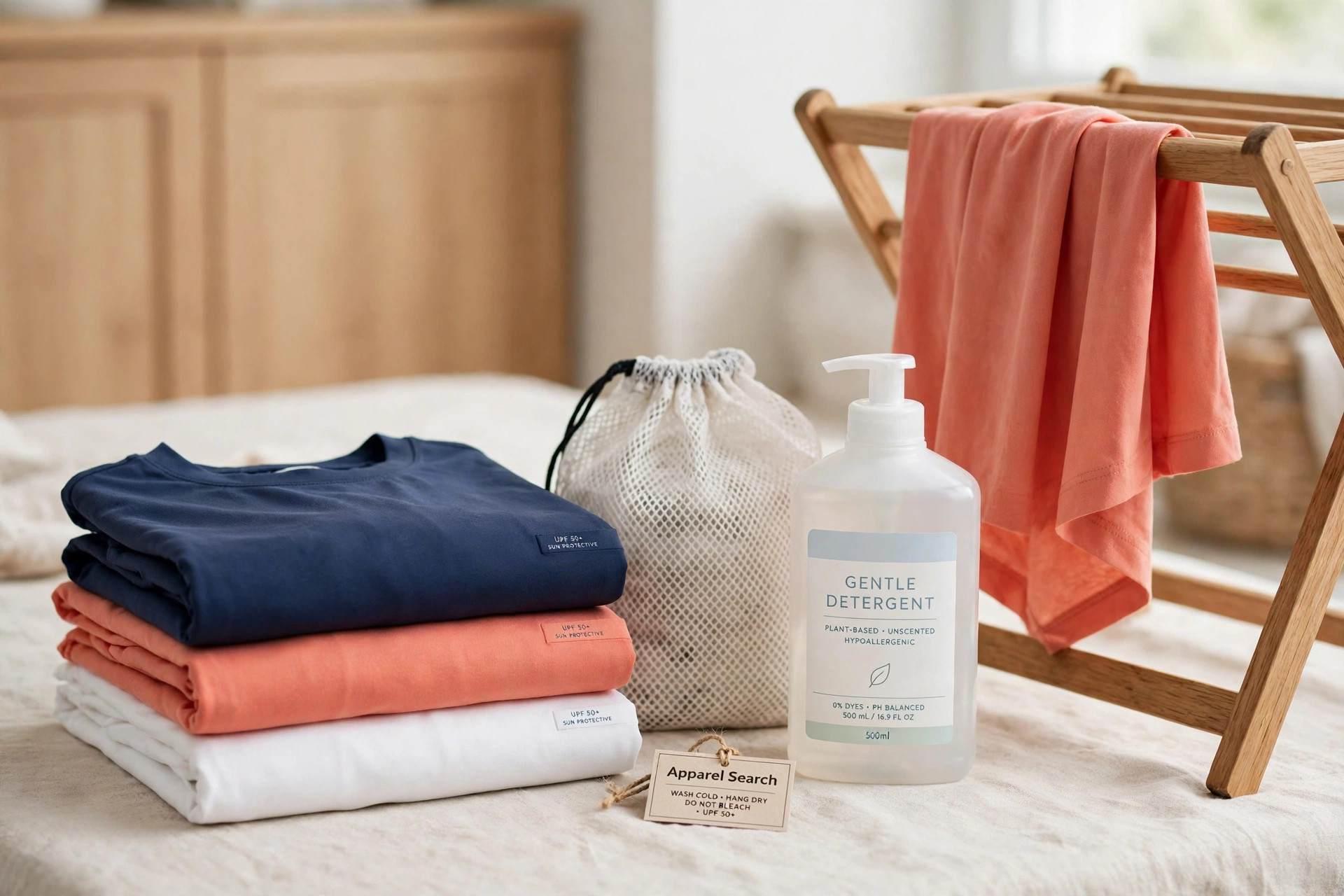
The care habits that keep a rating honest are unglamorous: wash gently in cool water, use a mesh bag for knits so they are not stretched and abraded against the load, skip harsh bleach on rated synthetics, and dry out of prolonged harsh sun — a clothesline in full summer sun is, among other things, an ultraviolet exposure test. Our laundry guide covers the machine-side detail; the swim-specific version of the same discipline runs through the men’s swimwear guide and women’s swimwear guide.
Stretching and Thinning: The Quiet Rating Killers
Transmission rises when yarns spread. A sun shirt sized too small, or worn bagged and then stretched across the shoulders, opens its weave exactly where it is pulled — the tested fabric and the worn fabric are measurably different cloth. Abrasion does the same work more slowly: pack straps, seat belts, pool edges and deck chairs polish high-friction zones thinner season by season. This is why fit is a durability feature — our buying guide treats relaxed, true sizing as part of the rating — and why a garment can be retired by its elbows while its label is still legible.
Chlorine, Salt and the Swim Rotation
Pool chemicals and salt water attack elastane and dyes first and fibers second; the visible results — fading, bagging, roughness — are all signs of a fabric whose structure is loosening, and a looser structure transmits more. Rinse in clean water after every swim, dry in shade, and rotate two garments rather than swimming one to death: the rotation rule in our kids’ swimwear guide and the adult swim guides exists for fit reasons, and it serves the rating just as well.
When to Replace
- The light test fails. Held to a bright light, the fabric shows an open, see-through structure it did not have when new.
- Thin or shiny patches appear at shoulders, elbows, seat or strap lines.
- The fit has changed permanently — bagged out, or now stretched tight where it once lay relaxed.
- Elastane has given up: crackling fibers, loss of snap, a garment that stays stretched after washing.
Any one of these means the cloth now being worn is no longer the cloth that was measured. Replace the garment — and if it was a favorite, note what it was: the replacement shop starts from the buying guide’s label checks.
Common Questions
Does UPF wash out?
It depends on how the rating was built. Protection that comes from the fiber and weave themselves has nothing to wash out — the fabric is the rating. Ratings that lean on an applied finish can fade gradually with repeated laundering, the way water-repellent finishes do. Labels and brand care notes usually say which kind you bought; when they do not, treat the garment gently and retire it when it thins.
How many washes does a UPF rating survive?
Labeling standards typically require the rating to hold after a set number of laundering cycles — commonly 40 in American practice — before the number may be printed. That is a floor the fabric passed in testing, not a countdown printed on the garment: real garments fade by thinning, stretching and abrasion, not by reaching a magic wash count.
Does chlorine damage UPF clothing?
Chlorine attacks the garment more than the number. It degrades elastane, fades dyes and thins fibers over a season of pool use, and a thinner, baggier fabric transmits more than it did. Rinsing in clean water after every swim is the single habit that slows all of it — the same rule the swim guides give for every suit.
When should a sun shirt be replaced?
When the fabric tells you: visible thinning, a weave you can easily see light through, shiny worn patches, permanent bagging at elbows and knees, or a fit that now stretches drum-tight across the shoulders. Any of those means the cloth being tested by the sun is no longer the cloth that earned the label.
Back to the Sun-Protective Clothing Buying Guide
The full section: the ratings explained, construction factors, coverage design and label checks.