Traditional Dress by Country · Iran
The Chador and Manteau of Iran
Dress in Iran today is a conversation between law, faith, fashion and region, conducted in three main garments: the chador, the full cloak worn by many religious women; the rusari, the headscarf; and the manteau, the coat that most urban women wear over their clothes. This guide explains each garment factually and respectfully, sets them in the long history of Persian dress from the Qajar court to the present, and introduces the rich regional dress — Baluchi, Kurdish, Turkmen and more — that thrives beneath the national picture.
The Garment
Dress in Iran: Cloak, Scarf and Coat
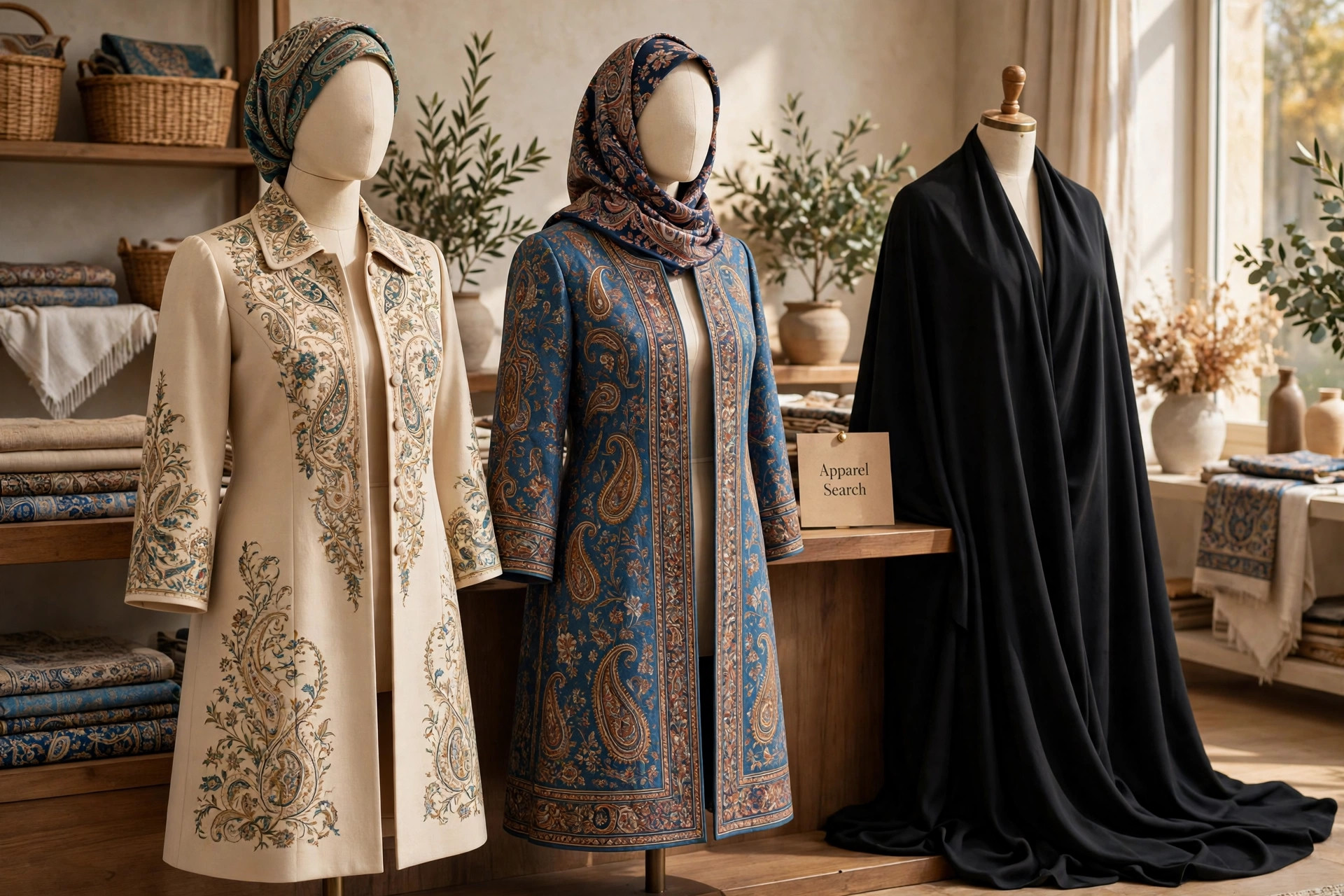
Three garments organise how most Iranian women dress in public. The chador is the oldest of the three: a single great semicircle of cloth, thrown over the head and held closed around the body, the outdoor dress of Iranian women for centuries and today the choice of many religious women and the expected dress at shrines and in religious cities such as Qom and Mashhad. The rusari is the headscarf — a square of cloth, printed or plain, draped and pinned or knotted — and the manteau is the modern coat that, with trousers or a long skirt and a rusari, forms the standard urban outfit.
Since the early 1980s, Iranian law has required women to observe hijab in public — hair covered, and loose clothing over arms and legs — and these three garments are how that requirement is met, interpreted through fashion, region, generation and personal belief. The result is not a uniform: manteaus follow international fashion in cut and colour within the rules, Tehran street style is closely watched and endlessly discussed, and the chador itself ranges from plain black crepe to versions with sleeves, fastenings and subtle patterning designed for practical modern life.
Beneath and beside the national dress code, Iran's regions and peoples — Kurds, Baluch, Turkmen, Azeris, Lurs, Arabs of the south and others — keep traditional dress of great richness, worn daily in some regions and for weddings and festivals everywhere. This guide treats the national garments first, then the history and the regions.
Anatomy
The Parts of the Outfit
The contemporary Iranian outfit, and the garments around it:
- Chador
- A semicircular cloak, usually black in a matte crepe for public wear, worn over everything and held closed by hand; modern versions may add an elastic headband, ties or sleeves. White and floral chadors are worn at home for prayer (chador namaz).
- Rusari — the headscarf
- A square or oblong scarf folded diagonally and draped over the hair, secured under the chin or with a pin. Silk rusari are luxury items; cotton and viscose serve daily wear; prints follow fashion closely.
- Maghnaeh
- A sewn, pull-on head covering that fits over the head and covers hair, neck and shoulders in one smooth piece — standard for school uniforms and many workplaces.
- Manteau — the coat
- The public overcoat, buttoned or open over clothes, from long and loose to knee-length and shaped; worn with trousers, jeans or a long skirt. Seasonal fabrics run from summer linen blends to winter wool.
- Men's dress
- Iranian men dress in the international manner — suits, shirts and trousers — with regional traditional dress (Kurdish baggy trousers and sash, Baluchi dress, Turkmen coats and hats) worn in its home regions and for occasions.
- Regional women's dress
- Baluchi needlework dresses, Kurdish sequined velvet outfits, Turkmen red dresses with silver jewellery, southern dress with its distinctive face coverings and embroidered trousers — summarised in the table below.
Variations
Regional Dress: A Country of Many Wardrobes
Iran is a mosaic of peoples, and its regional dress is correspondingly rich. A short map:
| Region / people | Dress character | Notes |
|---|---|---|
| Kurdish (west) | Women: long dresses with sequined velvet vests and wide skirts; men: baggy trousers, sash and jacket | Among the most colourful dress in Iran, kept for weddings, festivals and daily wear in Kurdistan |
| Baluchi (southeast) | Dresses covered in fine geometric needlework at the chest, sleeves and pockets, with matching headscarf | Baluchi embroidery is a celebrated craft, each pattern family recognisable |
| Turkmen (northeast) | Deep red dresses, embroidered collars, silver jewellery and distinctive headdresses | Women's dress signals age and status; men's tall sheepskin telpek hats are famous |
| Qashqai and Lur (southwest) | Layered skirts, bright scarves and coin ornaments for women | Nomadic heritage kept in festival and wedding dress |
| South coast / Arab communities | Embroidered trousers, light veils and face coverings of local form | Dress adapted to the Gulf climate, distinct from the plateau styles |
These regional wardrobes are living dress, not costume: in Kurdistan and Baluchistan especially, traditional clothing is ordinary daily wear for many people, and everywhere it returns in full splendour at weddings, where a bride's regional dress may be the most labour-intensive garment in the room.
Cloth and Pattern
Cloth, Print and Needlework
The chador's cloth is chosen for behaviour, not display: a matte, opaque crepe that drapes heavily and does not slip, in black that must hold its depth through years of washing. Prayer chadors reverse the palette — white and pale florals on light grounds. The rusari, by contrast, is a fashion fabric: silk squares with Persian miniature, floral and geometric prints are made by Iranian houses and international ones alike, and a fine silk rusari is a standard gift.
Iran's textile heritage runs deep — it is one of the world's oldest cloth cultures, famous for carpets, for the block-printed cottons (qalamkar) of Isfahan, for termeh brocade woven in Yazd, and for the embroideries that carry regional dress: Baluchi needlework above all, its dense geometric patterns worked in counted stitches. The modern garment industry that produces manteaus and scarves at scale is profiled on our Iran clothing industry page, and the short reference version of the cloak itself is our definition of chador.
Living Dress
Dress in Iran Today
Walk through Tehran and the variety within the rules is the story: long black manteaus and short colourful ones, silk scarves draped loosely and maghnaehs worn neatly, chadors in the religious quarters and near the shrines. Other cities have their own registers — Qom and Mashhad more conservative and chador-wearing, the Caspian towns and the south more relaxed in colour and cut. Fashion is a real industry within the framework: Iranian designers show manteau and scarf collections, seasonal colours are debated, and winter brings a national wardrobe of wool coats, boots and heavier scarves.
Occasions dress up within the same system. At private celebrations and women-only gatherings, dress is as glamorous as anywhere in the region — evening gowns, elaborate hair and jewellery — while public wedding photographs show the manteau-and-scarf version. For Nowruz, the new year in March, new clothes are traditional for the whole family, and the manteau and rusari bought for the holiday are chosen with the same care as a festival outfit anywhere. Visitors to Iran follow the same public rules, and a light scarf and a loose coat are the traveller's version of the national outfit.
Wearing
Wearing Basics
A chador is worn by settling its centre point on the head over the rusari, so the cloth falls evenly around the body, and holding it closed at the front — experienced wearers manage bags, children and shopping while keeping the cloak gathered with one hand or the help of its elastic and ties. A rusari is folded into a triangle, placed so the folded edge frames the face, and the ends crossed and pinned, knotted or tucked under the chin; the maghnaeh simply pulls on and is adjusted at the face opening. The manteau is worn as any coat, over the day's clothes, and the outfit is completed by trousers or a long skirt. At mosques and shrines, the chador is expected — many provide loan chadors at the entrance for visitors — and shoes are removed, as in sacred places across the region.
Keeping
Care and Storage
Black chador crepe asks for gentle washing to keep its depth of colour — cool water, mild soap, shade drying — and benefits from hanging rather than folding, since it is a single large piece that creases along fold lines. Silk rusari are hand-washed or dry-cleaned and stored flat; everyday scarves are washed with the family laundry and kept folded in a drawer, often in considerable numbers. Manteaus are cared for as coats — brushed, aired and cleaned by fabric. Embroidered regional pieces, Baluchi needlework above all, should be washed rarely and gently, stored flat away from light, and treated as the heirlooms they are: a fine dress represents months of a maker's work.
Acquiring
Buying and Collecting
Tehran's Grand Bazaar and the great bazaars of Isfahan, Mashhad and Tabriz are the places to buy: whole arcades deal in scarves and manteaus, from everyday cotton rusari to silk squares printed with Persian art, and chador cloth is sold by the metre in specialist shops, with tailors nearby to hem it. Regional dress and embroidery are best bought in their home regions or from reputable dealers in the bazaars — judge Baluchi work by the fineness and evenness of its stitching, and termeh and qalamkar by their weave and print quality. Visitors buying a rusari as a gift should choose silk for ceremony and a generous size; it is the most portable piece of Iranian dress and the one most likely to be worn for years.
Common Questions
Common Questions
What is a chador?
A chador is a large, semicircular cloak, traditionally black for wear outside the home, that covers the wearer from head to feet. It is worn over the headscarf and clothes, has no fastenings, and is held closed by the hands or with the help of an elastic band or ties. Many religious women in Iran wear the chador by conviction; it is also the required or expected dress in mosques, shrines and some official settings. Lighter, patterned chadors are worn at home for prayer.
What is a manteau?
A manteau is a coat — its name comes from the French manteau — worn by Iranian women as their outer garment in public. It covers the arms and body over ordinary clothes and is worn with a headscarf. Manteaus range from long, loose and dark to shorter, fitted and colourful, changing with fashion, season and the wearer's taste within the framework of Iran's dress rules.
What is the difference between a rusari and a maghnaeh?
Both are Iranian headscarves. A rusari is a square or rectangular scarf, folded and draped over the hair and fastened or held under the chin — the everyday scarf most women wear, in every fabric and print. A maghnaeh is a sewn, pull-on hood-style covering that slips over the head and covers the hair, neck and shoulders in one piece; it is common for schoolgirls, offices and formal or religious settings because it stays neatly in place.
What are the dress rules for women in Iran?
Since the years after the 1979 revolution, Iranian law has required women in public to observe hijab: covering the hair and wearing loose clothing that covers the arms and legs. In practice this is most commonly met by a rusari or maghnaeh with a manteau and trousers or a long skirt; the chador is worn by many women by choice and is expected in religious places. Enforcement and fashion have both varied over the years, and styles differ noticeably between cities, neighbourhoods and generations.
What did Persian dress look like historically?
Persian dress has ancient roots — the draped and belted robes and trousers of the Achaemenid and Sasanian worlds were famous in antiquity. In the Qajar era (1789–1925), court women wore short fitted jackets over full, wide skirts — a silhouette that famously absorbed influence from European ballet costume — with the chador as outdoor dress, while men wore long coats, sashes and tall hats. Regional dress, from Baluchi embroidery to Kurdish velvet and sequins, continues alongside national dress today.
Keep Exploring
More to Explore
In This Series
Traditional Dress by Country
The series hub — every country guide, from the hanbok of Korea to the kilt of Scotland, as each is published.
Visit the hub ↑Iran Clothing Industry
Iran's apparel and textile industry directory — carpets, textiles and garment making in one of the world's oldest cloth cultures.
Explore ↑Go Deeper
Search Apparel Search