Traditional Dress by Country · Türkiye
The Kaftan of Türkiye
The kaftan is the great robe of the Ottoman world: a long, front-opening coat of silk brocade that sultans wore in layers, that the court gave as its highest mark of favour, and whose name now travels the world's fashion runways. This guide explains the full Ottoman outfit — kaftan, shalvar trousers, cepken jacket, sash, turban and fez — the brocades of Bursa that clothed a court, and the regional folk dress of Türkiye that keeps the tradition alive.
The Garment
What a Kaftan Is
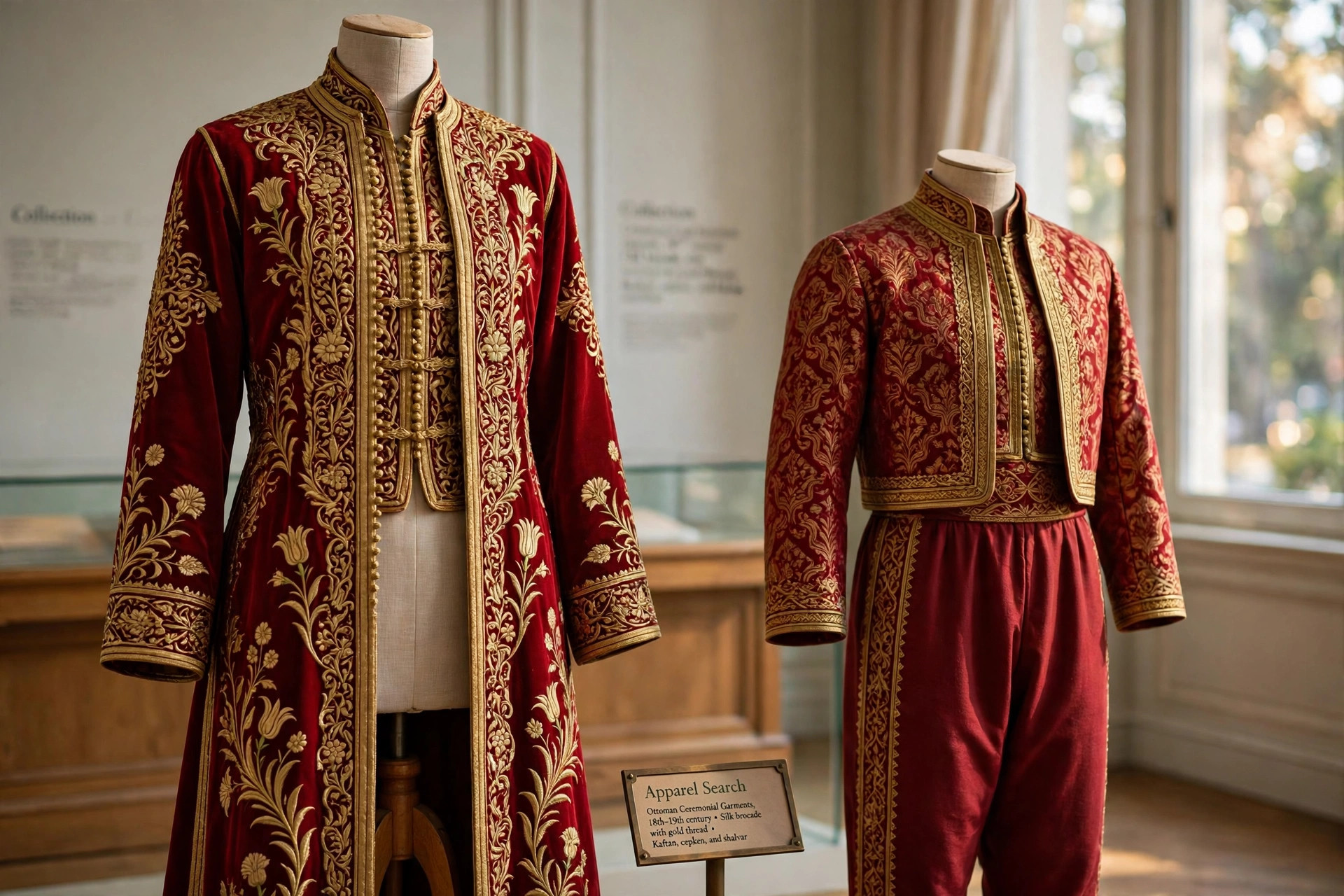
The kaftan is a robe built for ceremony: ankle-length, straight-cut, opening down the front, with long sleeves that could be slit, lined in fur or contrasting silk, and worn — at the Ottoman court — in splendid layers. Robes of this family were worn from the Balkans to Persia, but it was the Ottoman court in Istanbul that raised the kaftan to an art and an instrument of state. The sultan's kaftans were woven in the imperial workshops from silk brocade shot with gold and silver; to receive a kaftan from the sultan — a robe of honour — was among the highest marks of favour an official could be given.
Beneath the ceremony, the outfit was practical and universal. Men and women of every class wore versions of the same system: a shirt, full shalvar trousers, an outer robe or short jacket, a sash at the waist carrying a dagger, purse and tools, and head dress that announced who you were. Wealth changed the cloth, not the cut — a farmer's wool kaftan and a sultan's brocade one are recognisably the same garment.
The system began to change in the nineteenth century, when Mahmud II's reforms dressed officials in frock coats, trousers and the fez, and the Republic completed the move to Western dress in the 1920s. What survives intact is the folk and ceremonial layer — and an imperial wardrobe, preserved at Topkapı Palace, that is one of the wonders of textile history.
Anatomy
The Parts of the Outfit
Ottoman dress was a layered system. Its principal pieces:
- Kaftan
- The long outer robe, front-opening and ankle-length. Court examples are silk brocade, often lined with fur or bright silk; everyday kaftans were wool or cotton. Sleeves could be long and trailing for ceremony or slit and looped back for work.
- Entari
- The long dress worn by Ottoman women, similar in cut to the kaftan and worn open over a chemise and shalvar, in patterned silk or cotton with a belt or sash at the waist.
- Shalvar
- Full, baggy trousers gathered at the ankle, worn by both sexes under robes and dresses — comfortable for riding, working and sitting cross-legged, and still part of rural and folk dress.
- Cepken
- The short, fitted jacket, often richly braided, worn by men over the shirt — the signature jacket of Aegean zeybek costume — and in women's folk dress as a cropped velvet jacket.
- Kuşak — the sash
- A wide sash wound at the waist over robe or jacket, holding the outfit together and carrying a man's dagger, tobacco pouch and purse before pockets existed.
- Turban and fez
- Head dress carried the strongest signals. The turban — cloth wound on a cap — varied by rank and trade for centuries; from 1829 the red felt fez replaced it in official life, and the brimmed hat replaced the fez after 1925.
- Footwear
- Soft leather slippers and shoes with upturned toes (yemeni), and embroidered socks within them; wooden bath clogs for the hammam.
Variations
Court Silk and Regional Folk Dress
Two wardrobes share the kaftan's story. The first is the court's:
| Dress | Character | Notes |
|---|---|---|
| Imperial kaftan | Silk brocade with gold and silver thread, fur-lined, in patterns of carnations, tulips and cloud bands | Preserved at Topkapı; the summit of Ottoman weaving |
| Robe of honour (hil'at) | A kaftan presented by the sultan | Given to reward officials and honour ambassadors — diplomacy you could wear |
| Bindallı | Bride's dress of velvet embroidered in gold thread with floral sprays | Still worn at henna nights and traditional weddings |
| Zeybek dress (Aegean) | Short cepken jacket, short shalvar, sash and headgear | The costume of the zeybek folk dance and its efe heroes |
| Black Sea dress | Striped woollens, aprons and distinctive headscarves | Regional women's folk dress of the northern coast |
| Southeastern dress | Bright shalvar outfits, embroidered vests and coin jewellery | Folk dress of the southeast, worn for dance and weddings |
Regional folk dress in Türkiye is a map in cloth: every province keeps its own combination of jacket, trouser, apron, embroidery and head dress, maintained today chiefly by folk dance troupes, festivals and weddings — and judged, at competitions, on the correctness of exactly these details.
Cloth and Pattern
Bursa Silk and the Brocades
The Ottoman court dressed from Bursa, the first Ottoman capital and the empire's silk city, where raw silk from Persia and later local sericulture fed looms weaving the great brocades: kemha, silk brocade with metal thread; çatma, brocaded velvet; and seraser, cloth of gold. Their patterns are the Ottoman visual language — carnations, tulips, hyacinths and pomegranates, saz leaves and cloud bands — drawn at a scale meant to be read across a throne room.
The industry was regulated like a mint: the court set standards for thread and weave because the kaftans it produced carried the state's prestige. Bursa still weaves silk today, a thread of continuity inside the vast modern Turkish textile and garment industry profiled on our Türkiye clothing industry page. The kaftan's modern fashion life — the loose robe as resort and evening dress — is covered in our women's kaftan guide.
Living Dress
Ottoman Dress in Türkiye Today
Daily Türkiye dresses in the international manner, but the old system surfaces wherever celebration calls for it. The night before a wedding, the henna night, brings out the bindallı — the bride in embroidered velvet, kaftan-cut, under a red veil. Boys' circumcision celebrations dress their small heroes in miniature ceremonial outfits with cape, sash and sceptre, sold as complete sets in every bazaar. Folk dance troupes keep the regional costumes exact, and their performances are the living museum of Turkish dress.
The kaftan also works for its living in tourism and fashion: Ottoman-style robes are made for hotels, ceremonies and export, kaftan nights are staged in Istanbul, and the cut returns to international runways so regularly that it needs no revival. In the Grand Bazaar and the old han workshops, tailors still cut kaftans, cepken and shalvar to order — the same streets that have sold them for five centuries.
Wearing
Wearing Basics
The traditional order of dress runs from the skin out: shirt or chemise, shalvar drawn up and tied at the waist, then the robe or entari, then the sash wound firmly over it — the sash is structural, gathering the loose layers into a working silhouette — and finally the cepken or jacket where the regional costume calls for one, and head dress last of all. A court kaftan was worn over at least one under-robe, its front edges meeting rather than overlapping, sometimes fastened with a jewelled belt or buttons at the waist. Anyone wearing the costume today — for dance, weddings or ceremony — should follow the regional pattern exactly: in folk dress, the details are the meaning, and troupes and tailors are strict about them.
Keeping
Care and Storage
Historic kaftans are among the most fragile textiles in any museum: silk brocade with metal thread cannot be washed, is weakened by its own weight, and fades in light, which is why Topkapı displays its robes in rotation, in low light, supported flat or on padded forms. Modern ceremonial kaftans and bindallı in velvet and gold embroidery deserve a gentler version of the same care — dry cleaning by a specialist, storage flat or rolled with acid-free tissue, never hung by the shoulders for long, and kept from damp, which tarnishes metal thread. Shalvar and cotton folk pieces are hardier: wash cool, dry in shade, and store the whole regional outfit together so no piece is lost.
Acquiring
Buying and Collecting
Istanbul's Grand Bazaar and the shops around it sell kaftans at every level, from printed cotton robes to hand-finished silk and velvet ceremonial pieces; Bursa, fittingly, is the city for silk. For folk costume, buy from the tailors and dance-costume specialists who supply the troupes — they know the regional patterns and will fit cepken and shalvar properly. Antique Ottoman textiles are a serious collecting field: buy only from reputable dealers, expect paperwork for fine pieces, and inspect brocade for the brittleness and splitting that age brings to weighted silk. A modern bindallı or a well-made silk kaftan, bought from a good workshop, is the accessible heirloom.
Common Questions
Common Questions
What is a kaftan?
A kaftan (caftan) is a long, front-opening robe with long sleeves, worn across the Ottoman world for centuries by sultans, courtiers and ordinary people alike. Ottoman court kaftans were made of silk brocade woven with gold and silver thread, worn layered over other robes, and presented by the sultan as robes of honour. The cut — straight, ankle-length, fastened at the front — is the ancestor of the kaftans still worn from Morocco to Central Asia.
What are shalvar and a cepken?
Shalvar are the baggy trousers of Ottoman and Turkish dress: very full through the leg, gathered or cuffed at the ankle and drawn in at the waist, worn by men and women. A cepken is the short, fitted jacket worn over the shirt or kaftan, often braided and embroidered — the cropped jacket of Aegean zeybek dress and of folk costume across Türkiye.
Why did Ottoman men stop wearing the turban and start wearing the fez?
For centuries the turban — cloth wound around a cap, its size and style signalling rank and profession — was Ottoman head dress. In 1829 Sultan Mahmud II's dress reforms made the fez, a brimless red felt cap, the standard headgear for officials and soldiers, as part of a wider modernisation of Ottoman dress; the fez in turn was replaced by brimmed hats under the Turkish Republic's 1925 Hat Law. Both survive today mainly in traditional and ceremonial dress.
Where can you see real Ottoman kaftans?
The finest collection is in Istanbul's Topkapı Palace Museum, which preserves hundreds of imperial kaftans — including enormous ceremonial robes in brocade with gold thread — because the palace kept sultans' garments as relics. They are displayed in rotation, since silk brocade fades in light. Other major museums of Islamic and textile art hold Ottoman kaftans, but Topkapı's collection is unmatched.
Is the kaftan still worn in Türkiye today?
Not as daily dress — modern Türkiye wears Western clothing — but the kaftan and its companion garments live on in folk dance costume, at henna nights and traditional weddings where brides wear the embroidered velvet bindallı, in circumcision costumes for boys, and in the kaftan's second career as world fashion: the loose robe is a permanent resort and evening silhouette, covered in our women's kaftan guide.
Keep Exploring
More to Explore
In This Series
Traditional Dress by Country
The series hub — every country guide, from the hanbok of Korea to the kilt of Scotland, as each is published.
Visit the hub ↑Türkiye Clothing Industry
Türkiye's apparel and textile industry directory — one of the world's great garment exporters, heir to the Bursa silk tradition.
Explore ↑Go Deeper
Search Apparel Search