Traditional Dress by Country · Nepal
The Daura Suruwal and Gunyu Cholo of Nepal
Nepal speaks through two outfits. The man's daura suruwal — a tunic closed with five ties and no buttons, crowned by a cap woven in bright geometry — is the dress of officials, grooms and parliament. The woman's gunyu cholo — a wrapped skirt and fitted velvet blouse — is festival dress and, in the hills, everyday dress still. This guide explains both garments piece by piece, the famous dhaka cloth that signs them, the many regional wardrobes around them, and how they are worn, kept and bought today.
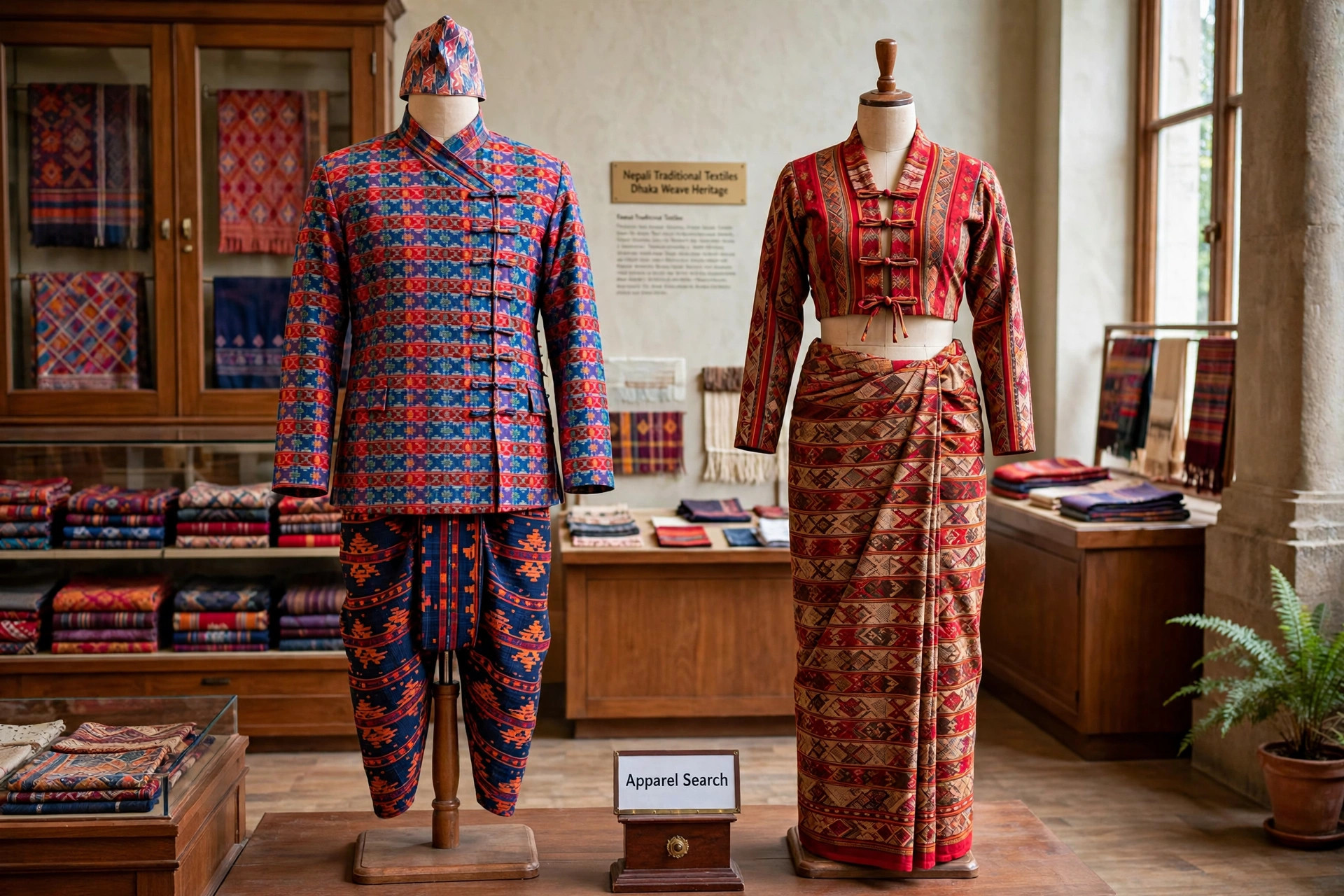
The Garment
What the Daura Suruwal and Gunyu Cholo Are
Nepal dresses its identity in two paired outfits. For men, the national dress is the daura suruwal: a double-breasted, wrap-front tunic called the daura, worn over tapered trousers called suruwal, and completed in formal settings by a patterned cap, the dhaka topi or the black Bhadgaunle topi. For women, the counterpart is the gunyu cholo: a long wrap skirt or sari-like cloth, the gunyu, worn with a fitted, cropped blouse, the cholo, and a shawl or sash across the torso. Together the two outfits are recognised across Nepal — in government offices, at weddings and festivals, and in official portraits — as the dress that says, before a word is spoken, that the wearer is Nepali.
The daura is unlike any neighbouring tunic, and its details are deliberate. It has no buttons. Instead it closes with ties — traditionally five ties, the pancha kachal — and its front crosses and wraps in a pleated style said to echo older court and military dress of the Kathmandu Valley and the hill kingdoms that were unified into modern Nepal in the eighteenth century. The collar is closed and round, without a lapel or an open neck, a modest, neat finish that suits both the cool hill climate and formal use. The suruwal below it are roomy through the seat and thigh and taper closely to the ankle, a practical cut for walking steep paths and sitting cross-legged, drawn in at the waist with a cord.
The gunyu cholo answers it on the women's side. The gunyu is a length of cloth wrapped and pleated at the waist to form a long skirt, sometimes worn in the manner of a sari with an end carried over the shoulder. The cholo is a tailored blouse, often of velvet or brocade for festive wear, tied or fastened at the front, with sleeves that mark it as unmistakably Nepali rather than a sari blouse borrowed from India. Over it a woman may add a patuka, a sash wound at the waist, a shawl for warmth and ceremony, and — for married women in many communities — the red glass-bead pote necklace and vermilion in the hair parting that signal married status.
Neither outfit is a museum costume. The daura suruwal was for decades the required dress for government employees and remains the standard formal dress for officials, politicians and grooms. The gunyu cholo is worn daily by many women in hill and rural communities and festively by far more. Both garments also sit within a much wider Nepali wardrobe — the Newar, Gurung, Magar, Tharu, Tamang, Limbu and many other communities of this exceptionally diverse country each keep their own dress — but the daura suruwal and gunyu cholo are the pair the nation itself chose as its common symbol.
Anatomy
The Parts of the Outfits
Each outfit is a small system of named pieces. From the skin out, for men:
- Daura — the tunic
- A knee-length or hip-length wrap-front top with long sleeves and a closed round collar. It fastens with cloth ties rather than buttons — traditionally five — and its overlapping front is arranged in neat pleats. Plain cotton serves for everyday wear; brocade, velvet trim or fine handloom cloth raises it to ceremony.
- Suruwal — the trousers
- Tapered trousers, generous above and narrow at the ankle, held by a drawstring waist. The cut gives freedom to stride, climb and sit on the floor while keeping a clean, close line below the daura.
- Topi — the cap
- The boat-shaped dhaka topi, woven in geometric dhaka patterns, is the everyday and festive cap; the plain black Bhadgaunle topi, associated with Bhaktapur, is the more formal choice with official dress. A Nepali man in a daura suruwal without a topi looks, to local eyes, only half dressed.
- Waistcoat, coat and patuka
- A waistcoat or a Western-style jacket or blazer is commonly layered over the daura for office and ceremony, and a patuka sash may be wound at the waist — handy in its older, working form for carrying small tools or a khukuri knife.
- Gunyu — the women's wrap skirt
- A long cloth wrapped, pleated and secured at the waist, falling to the ankle. Cotton prints serve daily life; silk, brocade and bordered cloth serve festivals and weddings.
- Cholo — the blouse
- A fitted, cropped blouse, traditionally tied at the front, in velvet, brocade or printed cotton. Its cut and front-tying construction distinguish the outfit from the sari ensembles worn across the border.
- Shawl, sash and jewellery
- A shawl across the shoulders or torso adds warmth and formality. Married women's red pote bead necklaces, gold earrings and bangles complete festive dress; coin necklaces and community-specific ornaments appear by region and group.
Variations
One Nation, Many Wardrobes
Nepal's geography — plains, hills and high Himalaya stacked within a short distance — and its many ethnic communities mean the national pair is only the most visible layer of Nepali dress. Understanding the variations explains what you will actually see:
| Community / region | Dress | Notes |
|---|---|---|
| Newar (Kathmandu Valley) | Haku patasi for women; daura suruwal and topi for men | The black sari-like haku patasi with its red border is the classic Newar women's dress, worn with a shawl and distinctive jewellery at festivals such as Indra Jatra. |
| Gurung and Magar (western hills) | Gunyu cholo with heavy shawls; men in kachhad wrap and waistcoat | Hill communities closely associated with Gurkha regiments; women's velvet cholo and patterned shawls are festive staples. |
| Tharu (Terai plains) | Distinctive wrap skirts, blouses and silver jewellery | The hot southern plains dress more lightly, in styles quite separate from hill dress. |
| Tamang, Sherpa and mountain peoples | Woollen wraps, aprons and layered dress | Married Tamang and Sherpa women are known for striped woven aprons; heavy wool answers the high-altitude cold. |
| Limbu and Rai (eastern hills) | Mekhli and draped cloths, dhaka weaves | The east is a heartland of dhaka weaving, and its patterns travel nationwide on topi, shawls and sashes. |
What unites these wardrobes is cloth made at home or in the community — handloom weaving is not a hobby in Nepal but a living household craft, and the dhaka patterns discussed below are its most famous product.
Cloth and Pattern
Dhaka: The Cloth That Signs the Outfit
If one textile signs Nepali dress, it is dhaka — a handwoven cotton (sometimes cotton-silk) cloth patterned in the loom with bright geometric designs: stepped diamonds, zigzags and temple-like motifs in red, pink, orange, black and white on a contrasting ground. Dhaka is woven on handlooms, traditionally by women, with the pattern built thread by thread using an extra-weft technique that makes genuine dhaka slow to produce and easy to recognise by its slightly raised, tapestry-like surface.
The cloth's best-known home is Palpa in the western hills, whose dhaka — Palpali dhaka — supplied caps to the court and remains the prestige name; the eastern hills around Dhankuta and Tehrathum are the other great weaving region. From the loom, dhaka becomes topi caps first of all — the patterned cap is so identified with the cloth that the two share a name in everyday speech — and then shawls, sashes, waistcoats, bags, and the borders and blouses of women's dress. A groom's or official's outfit is very often finished with dhaka at the head and shoulders, which is why the hero image for this guide sets the woven cap beside the gunyu cholo: the pattern is the signature.
Dhaka also carries a lesson in reading quality. Handloom dhaka shows its pattern cleanly on both faces and feels substantial; printed imitations copy the geometry onto flat cloth and are quickly spotted. Colours and motifs vary by weaving family and district, and connoisseurs read them the way others read tartans. Beyond dhaka, Nepali dress draws on plain handloom cottons for daily wear, velvet and imported brocade for festive cholo, wool from the mountains for wraps and the famous pashmina — the fine goat-down shawl cloth woven in Kathmandu for centuries and exported worldwide — for luxury shawls.
Living Dress
When the Outfits Are Worn Today
The daura suruwal is Nepal's official formal dress. Government officials wear it for state functions, politicians wear it to parliament and on the campaign trail, and it is the expected dress for a groom and for men at formal ceremonies. For years it was the prescribed uniform of civil servants, and its association with public life remains strong: to put on the daura suruwal and topi is to present oneself as a representative of the nation, not merely as a private person. National leaders receive foreign guests in it, and Nepali diplomats abroad wear it as a deliberate statement.
The gunyu cholo lives a double life. In hill villages it is still everyday dress — practical, warm and home-woven — while in cities it is festive and cultural dress: worn for the great Dashain and Tihar festivals in autumn, for weddings, for cultural programmes and school and university celebrations, and by dancers performing Nepali folk dances, for whom the swirling gunyu and velvet cholo are the visual signature of the performance. Young women who wear jeans all week will put on a gunyu cholo for Teej, the women's festival, when red dress fills the temples.
Both outfits also travel. Nepal's large diaspora wears them at community festivals from London to New York, and they appear wherever Nepali culture is presented abroad. Behind the wearing stands a real economy of weavers, tailors and cloth merchants — the industry our Nepal clothing industry page profiles, from Kathmandu's garment trade to the handloom households whose dhaka looms supply the caps in this guide.
Wearing
Wearing Basics
The daura is put on by wrapping the front panels across the body and securing the five ties, then arranging the overlap into its characteristic pleats so the front lies flat and symmetrical; the closed collar should sit neatly at the throat. The suruwal are drawn up and tied at the waist, their tapered legs falling cleanly to the ankle. The topi is set straight — a tilted cap reads as carelessness in formal settings — and a waistcoat or jacket, if worn, goes over the daura last. Shoes are ordinary formal shoes; the outfit is one of the world's traditional dresses that has fully made its peace with the modern shoe.
For the gunyu cholo, the gunyu cloth is wrapped firmly at the waist, pleated at the front and secured so the skirt hangs straight to the ankles; the cholo is tied or fastened at the front and should fit closely, as the silhouette depends on the contrast between the fitted blouse and the full wrapped skirt. A patuka sash wound at the waist both secures the wrap and finishes the line. The shawl is draped across the torso or shoulders according to the occasion, and festive jewellery — pote beads for married women, earrings, bangles — completes the dress. As with most wrapped garments, a first wearing is best done with the help of someone who grew up with the dress; the adjustments are small but they are everything.
Keeping
Care and Storage
Everyday cotton daura suruwal and gunyu cholo are straightforward: wash gently, dry in shade to protect colours, and iron the daura's pleats back into order before hanging or folding. The pieces that demand care are the woven and festive ones. Dhaka cloth should be washed rarely and gently — hand washing in cool water, or dry cleaning for caps and shawls you value — because its raised woven pattern and bright dyes are its whole worth; a dhaka topi is best kept on a stand or stuffed lightly to hold its boat shape, away from damp and direct sun. Velvet and brocade cholo are dry-cleaned and stored folded with tissue, not hung, so the shoulders do not stretch.
Nepal's monsoon makes storage a real discipline: cloth must go away completely dry, be aired on fine days, and be checked for mildew and insects, with natural repellents such as dried neem or camphor used in the storage chest as households have long done. Pashmina and fine wool shawls are folded, never hung, and rested between wearings. Treated this way, good dhaka and festive outfits serve for decades and are handed down — a mother's gunyu cholo cloth and a father's topi are ordinary family inheritances.
Acquiring
Buying and Collecting
Kathmandu is the natural place to buy. The tourist and local markets around Thamel, Asan and the old city sell dhaka topi, shawls and cloth by the metre, and tailors across the city will sew a daura suruwal to measure in days — the normal way Nepali men acquire one, since the fit of the wrap front and pleats benefits from a tailor who makes them constantly. For dhaka itself, seek out the Palpali name and handle the cloth: true handloom dhaka is patterned through the cloth, slightly textured, and priced accordingly; printed lookalikes are much cheaper and should be priced as what they are. Women's gunyu cholo sets are sold ready-made in festive fabrics, and better pieces are tailored from chosen cloth.
Collectors look for older handloom dhaka with fine, dense patterning, antique topi, and the regional weaves and jewellery of the hill communities. Buy through reputable shops, ask where a piece was woven, and be wary of 'antique' claims for cloth that is clearly new. As a visitor's purchase, a dhaka topi or shawl is ideal: light, unmistakably Nepali, and genuinely of the place when it comes off a handloom. Wearing a daura suruwal or gunyu cholo as a respectful guest — at a festival or a Nepali cultural event, properly tied and complete — is welcomed; the outfits are national dress, and Nepalis are generally pleased to see them understood rather than treated as costume.
Common Questions
Common Questions
What is the national dress of Nepal?
Nepal's national dress is the daura suruwal for men — a tie-fastened wrap tunic worn with tapered trousers and a dhaka or black topi cap — and the gunyu cholo for women, a wrapped long skirt worn with a fitted blouse. Both are worn for official functions, festivals and weddings, and the men's outfit is the standard formal dress of government officials.
Why does the daura have ties instead of buttons?
The daura traditionally closes with five cloth ties, called pancha kachal, rather than buttons. The tie-fastened, pleated wrap front is the garment's defining construction, inherited from the older court and hill dress from which the daura developed, and the five ties are often given symbolic readings in Nepali tradition.
What is dhaka cloth?
Dhaka is Nepal's famous handwoven cotton cloth, patterned in the loom with bright geometric designs using an extra-weft technique. Palpa in the western hills is its best-known source. Dhaka is made above all into the boat-shaped topi cap, and also into shawls, sashes, waistcoats and women's blouses and borders.
What is a gunyu cholo?
The gunyu cholo is the traditional Nepali women's outfit: the gunyu is a long cloth wrapped and pleated at the waist into an ankle-length skirt, and the cholo is a fitted, cropped blouse, often of velvet or brocade for festive wear, traditionally tied at the front. It is worn daily in many hill communities and festively across the country.
When do Nepali men wear the daura suruwal today?
Today the daura suruwal is Nepal's formal and official dress: government officials wear it for state functions, politicians wear it to parliament, grooms wear it at weddings, and it is the expected dress for formal ceremonies. With its patterned dhaka topi it functions much as a suit and tie does elsewhere — the dress of public and ceremonial life.
Keep Exploring
More to Explore
In This Series
Traditional Dress by Country
The series hub — every country guide, from the hanbok of Korea to the kilt of Scotland, as each is published.
Visit the hub ↑Nepal Clothing Industry
Nepal's apparel and textile industry directory — from Kathmandu's garment trade to the handloom households weaving dhaka.
Explore ↑Search Apparel Search