Traditional Dress by Country · Pakistan
The Shalwar Kameez of Pakistan
Some national dresses are kept for ceremonies. Pakistan's is kept for everything. The shalwar kameez — a long tunic over loose, ankle-gathered trousers — is what the country works, prays, marries and governs in, signed in each province by its own embroidery: Sindhi mirror-work, Balochi needlework, Punjabi colour, Pashtun tailoring. This guide explains the outfit piece by piece, the ajrak and bandhani cloths behind it, and how a garment of Central Asian origin became the daily dress of a nation.
The Garment
What the Shalwar Kameez Is
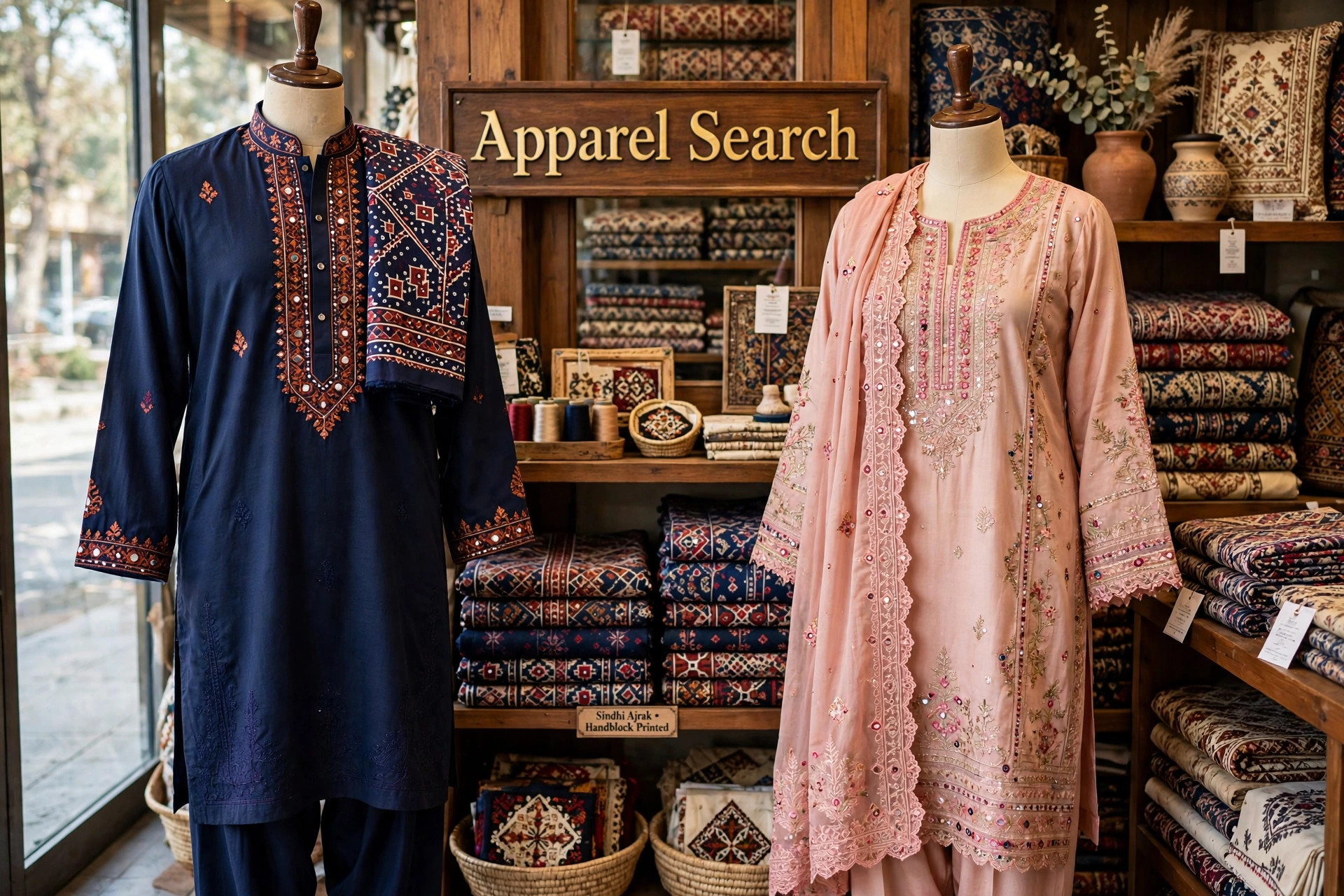
The shalwar kameez is the national dress of Pakistan and the everyday dress of most of its people: a long tunic, the kameez, worn over loose, drawstring trousers, the shalwar, that gather at the ankle. Men and women both wear it — the same two-piece idea, tuned very differently. A man's shalwar kameez is plain, sober and tailored like a uniform of daily life, in white, cream, grey, brown or muted blue. A woman's is a field for colour, print and embroidery, completed in public and formal settings by a dupatta, a long scarf draped over the head, shoulders or chest. No other garment in Pakistan crosses every boundary of province, class, age and occasion as this one does.
The pairing is old. Loose trousers worn under a tunic came into South Asia from Central Asia and Persia over many centuries — the words themselves tell the journey, shalwar arriving through Persian and kameez from the Arabic qamis — and the combination settled across the Indus plain and the northwest long before Pakistan existed. Under the Mughal Empire the tunic-and-trouser dress of court and camp refined itself in the cities of Lahore and Delhi; in the nineteenth and twentieth centuries it became the common dress of the Muslims of the northwest, and at independence in 1947 it was adopted, almost without debate, as the new nation's own dress.
Its genius is practical. Pakistan's plains are among the hottest inhabited places on earth, and the shalwar kameez answers the climate: the loose shalwar lets air move, the long kameez shades the body, cotton and lawn fabrics breathe, and the whole outfit can be washed daily and dried in hours. It also answers the culture's strong code of modesty — the cut covers fully while allowing complete freedom to work, ride, pray and sit on the floor. A farmer in Sindh, a Karachi office worker, a Peshawar shopkeeper and a Lahore bride at her mehndi are all, recognisably, wearing the same garment.
That unity is deliberately worn. Politicians wear the shalwar kameez with a waistcoat as the national formal dress — the look associated above all with the country's founder, Muhammad Ali Jinnah, whose sherwani and shalwar set the template for official dress. Schoolchildren wear it as uniform, office workers as standard dress, and on Fridays and at Eid it appears in its freshest, whitest form in every mosque courtyard in the country.
Anatomy
The Parts of the Outfit
The outfit has three core pieces and a wardrobe of additions:
- Kameez — the tunic
- A long shirt reaching to the knee or below, with long sleeves and a round or band collar. Men's kameez are buttoned at the front placket and cut straight, with side slits for movement; women's are cut in far more variety — straight, flared, A-line or tailored — with necklines, cuffs and hems carrying the embroidery and trim of the season.
- Shalwar — the trousers
- Very loose trousers, pleated or gathered into a drawstring waist (naara) and narrowing to a cuffed or open ankle (paincha). The volume of cloth is the point: cool, modest and comfortable for sitting cross-legged. Regional cuts vary, from the extraordinarily wide Balochi shalwar to the narrower urban styles.
- Dupatta — the scarf
- For women, a long rectangle of chiffon, cotton or silk, draped over the head, across the shoulders or over the chest, and an essential part of formal and public dress. The dupatta often carries the outfit's richest border or embroidery, and dyeing the dupatta to match is a whole craft of its own.
- Waistcoat and sherwani
- Men add a waistcoat — plain, or embroidered for weddings — for formality and in cool weather; the long, buttoned sherwani coat is the groom's and statesman's garment for the highest occasions.
- Topi, pagri and footwear
- The embroidered Sindhi topi, the Pashtun turban (pagri), the Baloch turban and the simple prayer cap each place a man regionally at a glance. Footwear runs from Peshawari chappal sandals to the curled-toe khussa shoes of festive dress.
Variations
Four Provinces, Four Accents
Ask a Pakistani where an outfit comes from and they will read the embroidery. Each province signs the shared garment in its own hand:
| Region | Signature | Notes |
|---|---|---|
| Sindh | Ajrak prints, mirror-work embroidery, the Sindhi topi | The block-printed ajrak — deep indigo, crimson and black geometric patterns — is Sindh's gift cloth, presented to honoured guests; women's dress carries fine mirror and thread embroidery. |
| Punjab | Phulkari-style embroidery, bright colours | Punjabi women's dress is the most exuberantly coloured; embroidered dupattas in the phulkari tradition of the wider Punjab, with darning-stitch floral work, are festive treasures. |
| Balochistan | Very wide shalwar, dense chest embroidery, large turbans | Balochi women's dresses carry some of Pakistan's finest needlework — geometric embroidery with mirrors and a distinctive embroidered pocket panel — while men's shalwar are cut exceptionally full. |
| Khyber Pakhtunkhwa | Waistcoats, turbans, embroidered caps | Pashtun dress pairs the shalwar kameez with woollen waistcoats and shawls in winter; women's festive dress uses bright embroidery and coin and bead ornament. |
Karachi and Lahore add the urban layer: Pakistan's fashion industry treats the shalwar kameez as its canvas, and the seasonal 'lawn' collections — printed summer suits sold by the country's big textile houses — are a national retail event each spring.
Two further variations deserve note. In the northern areas — Gilgit-Baltistan and Chitral — mountain dress layers woollen waistcoats, embroidered caps and the famous Chitrali woollen cap (pakol-style caps are worn across the northwest) over the basic outfit, answering a Himalayan climate the plains cut was never designed for. And across all provinces, age and occasion tune the garment: school and college uniforms standardise it for the young, office wear keeps it plain and pressed, and the embroidered, silk and velvet versions kept for weddings may be worn only a handful of times in a year yet represent the largest clothing investment a family makes. The shalwar kameez is thus less a single outfit than a system — one pattern of dress, endlessly re-expressed by region, weather, wealth and the calendar.
Cloth and Pattern
Embroidery, Ajrak and Bandhani
Cotton is king: in lawn, the fine, breathable cotton that is Pakistan's summer staple, in cambric and khaddar for winter, and in silk, chiffon and velvet for formal and bridal wear. Over that cloth, Pakistan lays one of the world's richest embroidery cultures. Sindhi embroidery runs from mirror-work (sheesha) to fine interlacing stitches; Balochi needlework builds dense geometric fields that can take months on a single dress front; Swat and Hazara add their own counted stitches; and the phulkari tradition of the Punjab covers dupattas in silk-thread flowers. Much of this work is still done by women in the home, and a bride's trousseau traditionally displays her family's embroidery skill.
Pattern also comes from the block and the knot. Ajrak, the resist block-print of Sindh, is printed with wooden blocks in a long sequence of indigo and madder dyeings — a cloth of honour, given to guests and worn at celebrations. And in Sindh, as across the desert border in India, dyers practise bandhani tie-dyeing, tying thousands of tiny knots so the cloth emerges patterned in dotted fields; our World Textiles guide to bandhani tie-dye follows that technique knot by knot, and Pakistani brides wear bandhani dupattas in red, green and yellow as gladly as Indian ones do. For the wedding layer of all this dress — the sherwani, the bridal lehenga and shalwar kameez, the mehndi colours — see our guide to Pakistani wedding attire, the companion to this page in our Wedding Traditions series.
Living Dress
When It Is Worn Today
The honest answer is: constantly. The shalwar kameez is not Pakistan's ceremonial costume but its default clothing — the dress of school, office, market, mosque and home for the great majority of Pakistanis, men and women. Western dress exists, mainly among urban men, but the national dress never needed reviving because it never went away. Friday prayers and the two Eids bring out new or best outfits as a matter of religious and social custom; weddings run for days in embroidered and silk versions; and funerals and formal visits call for the plainest white or muted dress, the garment adjusting its register to the day.
Formally, the shalwar kameez with waistcoat is the dress of the state: presidents, prime ministers and parliamentarians wear it as national formal dress, and it is Pakistan's diplomatic dress abroad. The fashion industry built on it is one of the country's economic pillars — the textile and garment sector profiled in our Pakistan clothing industry page — and its designers show shalwar kameez collections at fashion weeks in Karachi and Lahore that are followed like national news. Abroad, Pakistan's diaspora wears it daily and festively from Birmingham to Toronto, and the Eid shalwar kameez is a fixture of those cities' streets.
Wearing
Wearing Basics
The shalwar is tied at the waist with its drawstring, the gathers distributed evenly, and the ankle cuffs sitting just above the shoe. The kameez goes over it, buttoned at the placket; the side slits should fall at the hip so the tunic moves freely when sitting. Proportions are the whole art: the kameez length, the fullness of the shalwar and the fit at the shoulder are what tailors argue about, and most Pakistanis have their outfits stitched to measure by a local tailor — the neighbourhood darzi — rather than bought ready-made, though ready-to-wear has grown fast in the cities.
For women, the dupatta completes the outfit: draped over the head for prayer and formal or conservative settings, across the shoulders or chest for everyday public dress, and arranged to show its border at weddings. A waistcoat, for men, should sit over a pressed kameez for formal wear; a sherwani is buttoned fully and worn with a narrow shalwar or churidar. White outfits are kept white by the simple national discipline of frequent washing — a fresh, bright shalwar kameez is a point of pride, and a creased or dingy one is noticed.
Keeping
Care and Storage
The everyday outfit is built for the wash: cotton shalwar kameez are washed frequently — daily in summer is normal — dried in sun and shade, and ironed or starched to the crispness formal wear demands. The care goes to the decorated pieces. Embroidered and mirror-work garments are washed gently inside out, or dry-cleaned, so threads and mirrors are not torn; silk and velvet formal wear is dry-cleaned and stored folded away from light. Ajrak and other natural-dyed cloths are washed separately in cool water, since their indigo and madder will bleed at first and fade if sunned carelessly.
Bridal and heirloom embroidery — a mother's Balochi dress front, a phulkari dupatta — is stored folded in cotton cloth, aired periodically, and kept from damp and insects during the monsoon months, when mildew is the great enemy of every wardrobe in the region. Dupattas of chiffon and silk are rolled or folded with tissue to protect their borders. Well kept, the embroidered pieces outlast their makers and are handed down as the family's portable wealth — which, historically, is exactly what fine needlework was.
Acquiring
Buying and Collecting
Pakistan may be the easiest country in the world in which to buy its national dress. Every city has its bazaars of unstitched suit lengths — the two- and three-piece fabric sets from which most women's outfits begin — and its tailors to stitch them; Karachi's Tariq Road and Zainab Market, Lahore's Anarkali and Liberty Market, and the embroidery bazaars of Multan, Bahawalpur and Hyderabad are the famous hunting grounds. Ready-made brands now sell complete outfits in malls and online, and the spring lawn launches are the best time to see the national dress treated as high fashion.
Collectors and visitors should look for the handwork: a genuine ajrak, printed by hand in Sindh with its characteristic deep indigo ground; Balochi and Sindhi embroidered fronts and dupattas; hand-embroidered Sindhi topis; and khussa shoes and Peshawari chappals from their home cities. Ask whether embroidery is hand or machine work — both are sold, at very different prices — and handle the cloth: handwork is irregular in the way only hands are. Wearing a shalwar kameez as a visitor is entirely normal in Pakistan; it is the dress of the country, worn respectfully and completely — with the dupatta for women in conservative settings — it is received as courtesy, not costume.
Common Questions
Common Questions
What is a shalwar kameez?
A shalwar kameez is Pakistan's national dress: a long tunic (kameez) worn over loose drawstring trousers (shalwar) that gather at the ankle. Men wear it plain and sober; women wear it in colours, prints and embroidery, completed by a dupatta scarf. It is the everyday dress of most Pakistanis as well as the country's formal national dress.
What is a dupatta?
A dupatta is the long scarf that completes a woman's shalwar kameez. Made of chiffon, cotton or silk, it is draped over the head, shoulders or chest according to the setting — over the head for prayer and conservative occasions, across the shoulders for everyday dress — and it often carries the outfit's finest border or embroidery.
What is ajrak?
Ajrak is the traditional resist block-printed cloth of Sindh, patterned in deep indigo, crimson, black and white geometric designs built up through many printings and dyeings with wooden blocks. It is a cloth of honour in Sindh — presented to respected guests, worn as shawls and turbans, and used at celebrations and ceremonies.
How is the Pakistani shalwar kameez different for men and women?
The two-piece structure is the same, but the expression differs. Men's shalwar kameez are plain, straight-cut and sober in colour, sometimes with a waistcoat or, at weddings, a sherwani. Women's are made in printed lawn, embroidered and formal fabrics in many cuts and colours, and are worn with a dupatta. Regional embroidery — Sindhi, Balochi, Pashtun and Punjabi — appears mainly on women's dress.
Can visitors wear a shalwar kameez in Pakistan?
Yes, and many do. The shalwar kameez is the ordinary dress of the country, widely available ready-made or tailored in days, and wearing it respectfully is welcomed. Women visitors are advised to include the dupatta and to dress more conservatively in rural and religious settings, as local women do.
Keep Exploring
More to Explore
In This Series
Traditional Dress by Country
The series hub — every country guide, from the hanbok of Korea to the kilt of Scotland, as each is published.
Visit the hub ↑Pakistan Clothing Industry
Pakistan's apparel and textile industry directory — one of the world's great cotton garment economies.
Explore ↑Pakistani Wedding Attire
The wedding layer: the groom's sherwani, the bride's embroidered finery, and the green and yellow of the mehndi.
Read ↑Go Deeper
Search Apparel Search