Wedding Attire Around the World · Pakistan
Wedding Attire in Pakistan
A Pakistani wedding dresses its bride three times: in yellow and green for the mayoun and mehndi, in deep red and gold for the baraat, and in pale pastel for the walima — while the groom answers in kurta and waistcoat, then in a turbaned sherwani. This guide walks the whole wardrobe, event by event. Pakistan’s wedding dress stands on the shalwar-kameez and dupatta tradition profiled at our Traditional Dress by Country hub; this page is about what that tradition becomes at a wedding.
The Shape of It
Three Celebrations, Three Wardrobes
A Pakistani wedding is not one party but a sequence — most often three main celebrations across three days, with smaller gatherings of song and preparation in the days before. At its religious and legal heart is the nikah, the marriage contract signed before witnesses and recorded in a nikahnama; around it, families have built a festival of colour, music and food in which each event has its own mood and, crucially for this guide, its own clothes. Nobody wears the baraat outfit to the mehndi. The wardrobe is planned as a set, event by event, colour by colour.
Underneath every one of those outfits stands one tradition: the shalwar kameez — the long tunic and loose trousers worn across Pakistan — and the dupatta, the long scarf that is draped, pinned, carried over the head and worked as heavily as the dress beneath it at a wedding. Pakistan has no separate guide in our Traditional Dress series yet, and that is honest to the garment itself: here the everyday national dress and the wedding dress are the same cloth, raised to its highest pitch. The shalwar kameez becomes the embroidered kurta of the mehndi; its bridal descendants — the lehenga, the gharara, the sharara — carry the baraat. Our Pakistan clothing industry page profiles the mills, embroiderers and export workshops behind the cloth, and our Traditional Dress by Country hub places Pakistan's wedding dress among its neighbours.
Event by Event
Mayoun, Mehndi, Baraat, Walima
Mayoun and mehndi — yellow, green and turmeric
The celebrations open small and at home. At the mayoun, women of the family apply ubtan — a paste of turmeric, gram flour and oils — to the bride, for glow and for blessing. She traditionally wears yellow, plainly: a simple yellow shalwar kameez that the turmeric is welcome to stain, and in older custom she then stayed at home until the wedding itself. The mehndi that follows is the wedding's most colourful night. Henna artists pattern the bride's hands and feet while both families, dressed in greens, yellows, oranges and fuchsia, sing, drum and perform rehearsed dances. The bride wears a lehenga, gharara or sharara in bright colour — festive, lighter than what is coming, and cut to sit in for hours while the henna dries. The groom's side holds its own mehndi in kurta and waistcoat, answering her colours without matching them.
Baraat — the wedding day
The baraat is the groom's procession: he arrives at the bride's family's celebration with his party, music and dancing around him, and the evening ends with the rukhsati (below). This is the day of the heaviest, richest and most formal dress of the whole wedding — the bride in deep red, the groom in full sherwani — and it is the subject of the bride and groom sections that follow. The nikah itself is often held on the baraat day, sometimes earlier; dress for it is modest and formal, with the bride's head covered by her dupatta.
Rukhsati — the farewell
When the feast ends, the bride leaves her parents' home in the rukhsati, one of the most emotional moments of a South Asian wedding. In many families the Quran is held above her head as she walks out, as a blessing for her new life, and she leaves still wearing the full baraat outfit — which is why that outfit must survive not just photographs but tears, embraces and a journey. Her sisters, meanwhile, may have hidden the groom's shoes earlier in the evening: the joota chupai, returned only after playful negotiation.
Walima — the second great look
A day or so later, the groom's family hosts the walima, the wedding feast that welcomes the bride. Custom gives the walima outfit to the groom's family, and its character is the baraat's deliberate opposite: where the baraat was deep red and dense with gold, the walima look is paler and cooler — pastel, powder blue, ivory, champagne, silver or soft lilac, in a lighter lehenga, a pishwas frock-dress or, increasingly, a gown. The bride is dressed by her new family, in their colours, and the contrast between the two great portraits — red and gold, then ice and silver — is the visual story of the whole wedding.
The Bride
Deep Red at the Baraat
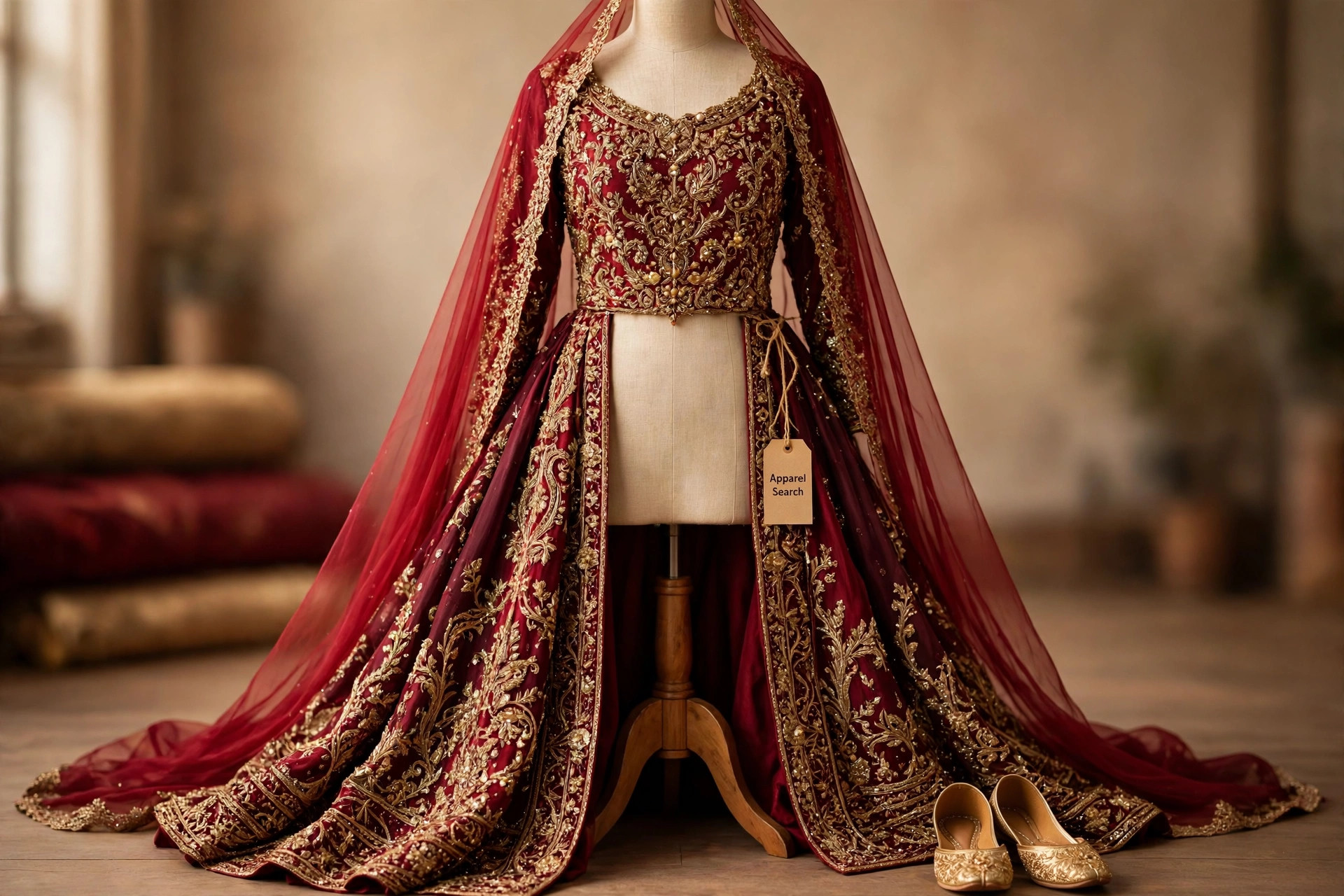
The classic Pakistani bridal colour is deep red to maroon, worn at the baraat in the heaviest embroidery of the wedding. Red carries prosperity, love and celebration, and against it the gold work — zari thread, coiled dabka wire, sequins and stones — reads at its richest. Three silhouettes carry it, all of them built from the shalwar-kameez family:
- The lehenga
- A long flared skirt, a fitted blouse and a dupatta — the most common baraat choice today, and the canvas for the densest embroidery. Bridal lehengas are worked for weeks by hand and are famously heavy; brides plan their evening around the weight.
- The gharara
- The heritage silhouette: wide trousers fitted to the knee, then flaring in a gathered burst below it, worn with a short kurta and dupatta. The knee seam — the gota join — is often banded in gold. A farshi gharara trails so long it is carried over the arm.
- The sharara
- Wide trousers that flare from the hip rather than the knee, easier to move and dance in, and a favourite for the mehndi as well as for brides who want the trouser silhouette with less ceremony than the gharara.
Whichever silhouette she chooses, the dupatta completes the baraat look: heavily bordered, often with a second lighter dupatta beneath, and draped over the head for the nikah and the rukhsati — the image by which a Pakistani bride is known. Embroidery is matched across the set, and the outfit is traditionally kept, re-worn at family weddings and sometimes reworked for a daughter. Regional dress answers the national pattern in its own accents — Sindhi ajrak patterning, Baloch embroidery worked dense and bright, Pashtun dress with its own cuts and caps — but the three-event colour story, yellow-green to red to pale, holds across the country.
The three silhouettes also divide by generation and taste, and a family choosing between them is choosing how to tell its own story:
| Silhouette | Construction | Character |
|---|---|---|
| Lehenga | Flared skirt, fitted blouse, dupatta | The contemporary default — the fullest skirt and the largest embroidery field |
| Gharara | Trousers fitted to the knee, flaring below a banded join; short kurta | The heritage choice, tied to Lucknow and Hyderabad court dress and to family heirloom sets |
| Sharara | Trousers flaring from the hip; short kurta or peplum top | The movement choice — mehndi dancing, and brides who will not sit still for their own wedding |
| Pishwas | A long, flared frock-dress over trousers | An increasingly chosen walima and nikah silhouette — covered, flowing and photographically soft |
Embroidery decides the price and the calendar more than silhouette does. A baraat set worked in dabka and naqshi across skirt, kurta and dupatta borders is measured in weeks of a workshop's time, which is why bridal orders open so early — and why a mother's baraat outfit, re-fitted and re-bordered, remains a living option rather than a sentimental one.
The Groom
Sherwani, Kullah and Khussa
The groom's baraat dress is the formal answer to the bride's red: the sherwani, a long tailored coat buttoning to a high collar, worn over a kurta with shalwar or churidar trousers. Bridal sherwanis are embroidered at collar, cuff and placket to answer the bride's work without copying it, in ivory, gold, maroon or deep green as often as in black. On his head he wears a turban or pagri, often built around a stiff embroidered cap, the kullah, in a colour chosen against the sherwani; a veil of flower or tinsel strands, the sehra, may be tied over it by his sisters before the procession sets out. On his feet are khussa — curled-toe embroidered leather shoes, the groom's counterpart to the bride's worked dupatta border, and the very shoes his sisters-in-law will hide for ransom during the evening. For the mehndi he is in kurta and an embroidered waistcoat; for the walima, most grooms change into a tailored suit or a lighter, plainer sherwani that answers the bride's paler outfit — the couple's second portrait, deliberately cooler than the first.
Jewelry
Gold From Forehead to Ankle
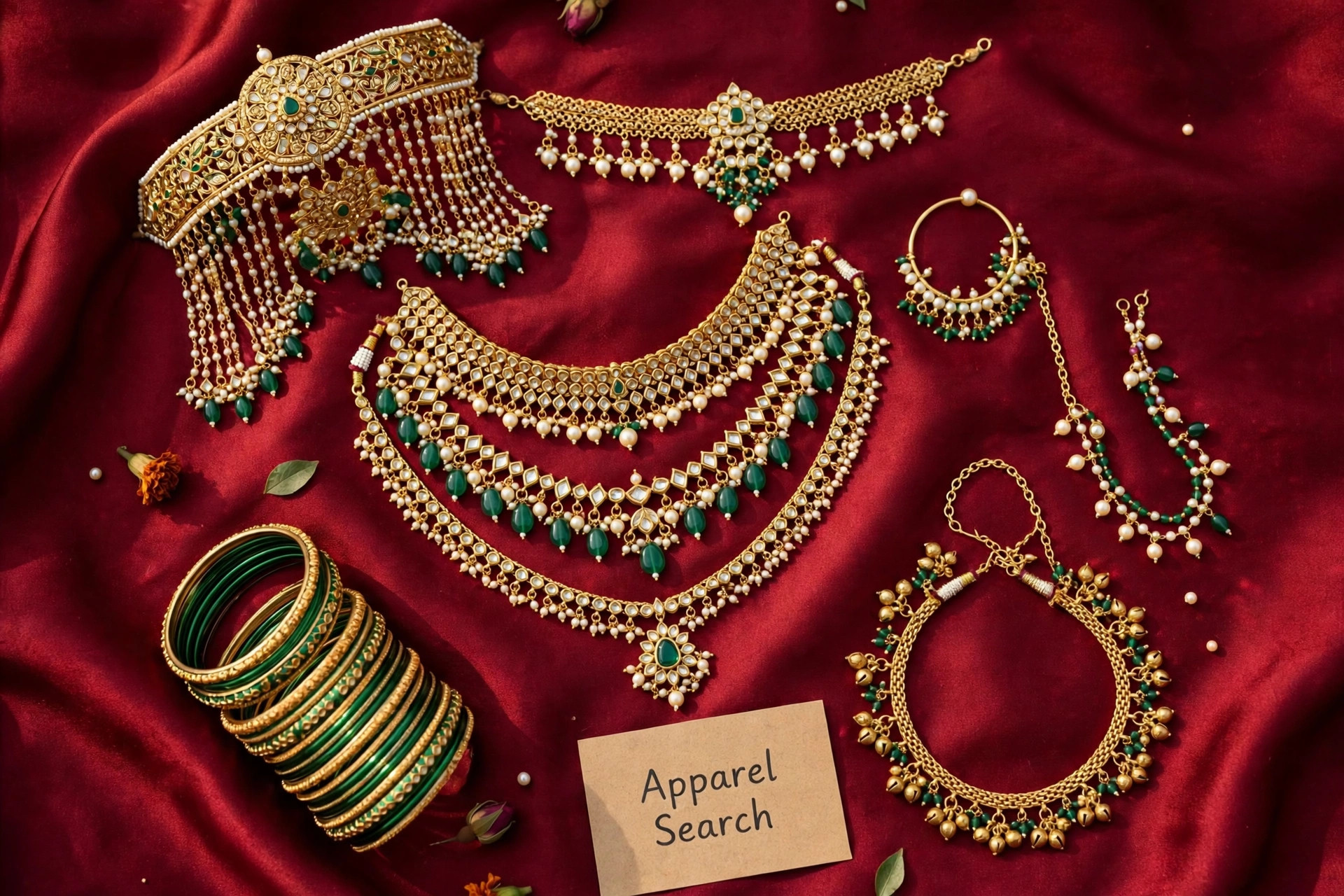
Pakistani bridal jewelry is a full architecture, built up to its maximum at the baraat and refined down for the walima. Its vocabulary is worth learning piece by piece:
- Jhoomar / passa — the signature
- The fan- or crescent-shaped ornament worn at the side of the head, cascading with pearls, stones and chains. Of Mughal inspiration, the jhoomar — also called a passa — is the piece most distinctly associated with the Pakistani bride, traditionally worn on the left side.
- Matha patti and tikka
- The matha patti frames the hairline in chains, often with a central pendant; the simpler tikka is a single pendant on a chain following the centre parting. A bride may wear the full matha patti at the baraat and a tikka alone at lighter events.
- Nath — the nose ring
- The bridal nath is a large gold ring, often pearl- or stone-set, joined by a fine chain to the hair. Smaller naths are everyday jewelry in Pakistan; the baraat version is deliberately oversized.
- Satlani / satlar — the layered necklaces
- Pakistani brides layer the neck: a close choker, a mid-length necklace and a long rani haar, the queen's necklace. The fullest traditional form is the satlani or satlar — a necklace of multiple strands, classically seven — worn with the shorter pieces so the whole chest is a graded field of gold, kundan or polki work.
- Bangles and payal
- Stacks of bangles — green-and-gold and red sets are both bridal classics — and, at the ankle, the payal, its small bells sounding as the bride walks. Henna, not jewelry, finishes the hands and feet.
Much of the set is family gold, given by both families and worn alongside new pieces; the walima set, from the groom's family like the outfit, is usually lighter and more modern — statement earrings and a single necklace where the baraat had seven strands.
Acquiring
Buying the Wedding Wardrobe
Bridal shopping in Pakistan is a campaign run from its two great fashion capitals. Lahore, the cultural heart of Punjab, and Karachi, the commercial port city, hold the designer studios, the bridal bazaars and the embroidery workshops between them, and families travel to both. A baraat outfit is ordered months ahead: designer bridal couture is made to measure, with fittings across the season, and the hand embroidery alone — dabka, naqshi, gota, resham threadwork — can occupy a workshop for weeks on a single lehenga.
The budget is spread by design across the three events. The baraat outfit takes the largest share; the walima outfit comes from the groom's family; the mehndi outfit is lighter in every sense. Jewelry is planned with the outfits, not after them, because neckline and embroidery metal decide the set — gold-worked outfits take gold jewelry, silver- and pastel-worked walima dresses increasingly take white-metal and stone sets. Diaspora families order the same wardrobes from abroad, through designer studios' overseas appointments and video consultations, and fly in for final fittings in wedding season, which peaks in the cooler months.
Today
The Modern Mix
The three-event structure has absorbed modern fashion without surrendering to it. The walima is where change arrives first: pastel and ivory walima brides are now a convention of their own, fusion gowns — the lehenga skirt under a Western bodice, the trail added to a pishwas — fill the walima rails, and grooms answer in suits as readily as in sherwanis. Celebrity weddings, covered exhaustively by Pakistani media and social feeds, are often credited with each season's turn — a star's pastel walima or pared-back baraat is in the bazaars within months — though the direction of travel is consistent whoever leads it: the baraat stays red, heavy and traditional, and experimentation moves to the days around it. The mehndi, meanwhile, has become the fashion playground: themed colours for the whole guest list, coordinated family outfits, choreographed dances rehearsed for weeks. Guests navigating all of this from the other side will find our guide to dressing as a wedding guest a useful companion — the first rule at a baraat being, everywhere, not to wear the bride's red.
Common Questions
Common Questions
How many outfits does a Pakistani bride wear?
At least three main ones — one for the mehndi, one for the baraat and one for the walima — and often a fourth, simpler yellow outfit for the mayoun before them. Each event has its own colours: yellow and green for the mayoun and mehndi, deep red for the baraat, and a paler, cooler outfit, often pastel, blue or ivory, for the walima.
What is the difference between the baraat and the walima?
The baraat is the wedding day itself: the groom arrives in procession, the feast is hosted by the bride's family, and the evening ends with the rukhsati, the bride's farewell from her parents' home. The walima is the reception hosted by the groom's family a day or so later to welcome the bride — and her walima outfit, traditionally given by the groom's family, is paler and lighter than her baraat dress.
What is a gharara, and how is it different from a sharara?
Both are wide bridal trousers worn with a short kurta and dupatta. A gharara is fitted to the knee and then flares in a gathered burst below it, with a banded join at the knee. A sharara flares from the hip all the way down, with no knee join, which makes it easier to move and dance in.
What does a Pakistani groom wear?
For the baraat, a sherwani — a long, tailored, buttoned coat — over a kurta and shalwar or churidar, with a turban or kullah cap and curled-toe khussa shoes. For the mehndi he wears a kurta with an embroidered waistcoat, and for the walima usually a tailored suit or a lighter sherwani.
What is a jhoomar?
The jhoomar, also called a passa, is the fan- or crescent-shaped headpiece a Pakistani bride wears at the side of her head, cascading with pearls, stones and chains. Of Mughal inspiration, it is the most distinctly Pakistani piece of the bridal set, worn alongside the matha patti forehead chain, the nath nose ring and layered necklaces at the baraat.
Keep Exploring
More to Explore
In This Series
Wedding Attire Around the World
The series hub — wedding dress country by country, from China's qun kua to Scotland's tartan, as each guide is published.
Visit the hub ↑Traditional Dress by Country
The series hub — every country guide, from the kimono of Japan to the kilt of Scotland, as each is published.
Visit the hub ↑Go Deeper on Pakistan
Pakistan Clothing Industry
Pakistan’s textile, embroidery and apparel industry — the sector behind the bridal workshops of Lahore and Karachi.
Explore ↑Dupatta Guide
The dupatta as a garment to buy and wear — the scarf that completes every Pakistani bridal silhouette.
Read ↑Bridal Necklaces
Bridal necklaces at the Western jewelry counter — a counterpoint to the layered satlani set.
Read ↑Attending a Wedding?
Search Apparel Search