Wedding Attire Around the World · Korea
Wedding Attire in Korea
A modern Korean wedding dresses its couple twice. For the main ceremony — usually a short, polished service in a wedding hall — the bride wears a Western white gown and the groom a suit. Then, for the pyebaek, the intimate family bowing ceremony that follows, both change into the most colorful dress in Korean life: the bridal hanbok, a red skirt and green jacket under an embroidered ceremonial robe, crowned with the small jokduri. This guide walks through both wardrobes — the hall look, the hanbok layer by layer, the groom's dress, the famous blue-and-pink hanbok of the two mothers, and the rite the clothes were made for. For the garment itself, begin with our hanbok of Korea guide; this page is about what happens to it at a wedding.
The Shape of It
Two Ceremonies, Two Wardrobes
Korea's wedding dress makes sense once you see that a Korean wedding is really two ceremonies sharing one day. The first is the public one: a Western-style service, typically held in a commercial wedding hall on a tight schedule, with the bride in a white gown, the groom in a suit or tuxedo, and several hundred guests. The second is the pyebaek — traditionally the bride's formal presentation to the groom's family, held days after the wedding at his parents' home, and today usually folded into the wedding day itself, in a private room at the hall while the guests eat. It is for the pyebaek that the hanbok comes out, and the pyebaek hanbok is not ordinary festive dress: it is court dress, descended from the ceremonial robes of the Joseon dynasty (1392–1910), when Neo-Confucian ritual set the forms that Korean weddings still follow.
That double structure explains the day's rhythm of changes. The bride may wear one gown for the ceremony and another for the reception photographs before she ever reaches the hanbok; the couple's parents, meanwhile, wear hanbok from the start — the mothers most visibly of all. Underneath the celebration sits one of Asia's great textile industries, the silk, embroidery and rental trades that our Korea clothing industry page profiles from the business side. But the clothes themselves answer to an older logic: color as balance. Red and blue-green, yang and yin, bride and groom, her family and his — a Korean wedding is dressed as a set of pairs in harmony, and nowhere is that clearer than in the two mothers, whose hanbok colors announce which family is which before a word is spoken.
The Day, Dressed
From Wedding Hall to Pyebaek Room
The hall ceremony — white, by choice
Most Korean couples marry in a wedding hall, and the main ceremony follows the Western pattern Korea adopted over the twentieth century: the bride in a white dress — rented, very often, from the hall's own dress shop as part of a studio-dress-makeup package — and the groom in a dark suit or tuxedo. The service is brief and tightly produced, often under half an hour, with the next wedding waiting its turn. Nothing about this is a rejection of tradition; it is simply the public half of a day whose private half is dressed entirely differently.
The mothers open the ceremony
The most traditional figures at the hall ceremony are not the couple but their mothers. Both women wear hanbok, and at many ceremonies they walk in together to light the candles that open the wedding — the bride's mother traditionally with a red candle, the groom's mother with a blue one. Their dress is the day's first statement of the color code the whole wedding follows, and it is covered in its own section below.
The pyebaek — the rite the hanbok is for
After the ceremony, the couple change and withdraw with their closest family for the pyebaek. Seated on cushions behind a low table set with symbolic foods, before a painted screen, the parents receive the newlyweds' deep bows — bows that begin standing and end with foreheads pressed to hands on the floor. The couple offer cups of wine, traditionally cheongju; the parents share advice and blessings, return cups of their own, and give envelopes of money. Then comes the moment everyone waits for: the parents throw jujubes — Korean dates — and chestnuts toward the bride, who tries to catch them in the spread skirt of her hanbok. The fruits symbolize children, and the number caught is said, half in jest and half in earnest, to predict how many the couple will have; in some tellings the dates stand for sons and the chestnuts for daughters. A ritual piggyback — the groom carrying his bride, and sometimes his mother-in-law, around the room — often ends the rite in laughter. Originally the pyebaek belonged to the groom's family alone, the bride's formal welcome into her new household; many modern couples now bow to both sets of parents, and some skip the rite altogether — it survives as a choice, which is part of why the clothes worn for it are chosen so deliberately.
The Bride
Red Chima, Green Jeogori, and the Robes Above Them
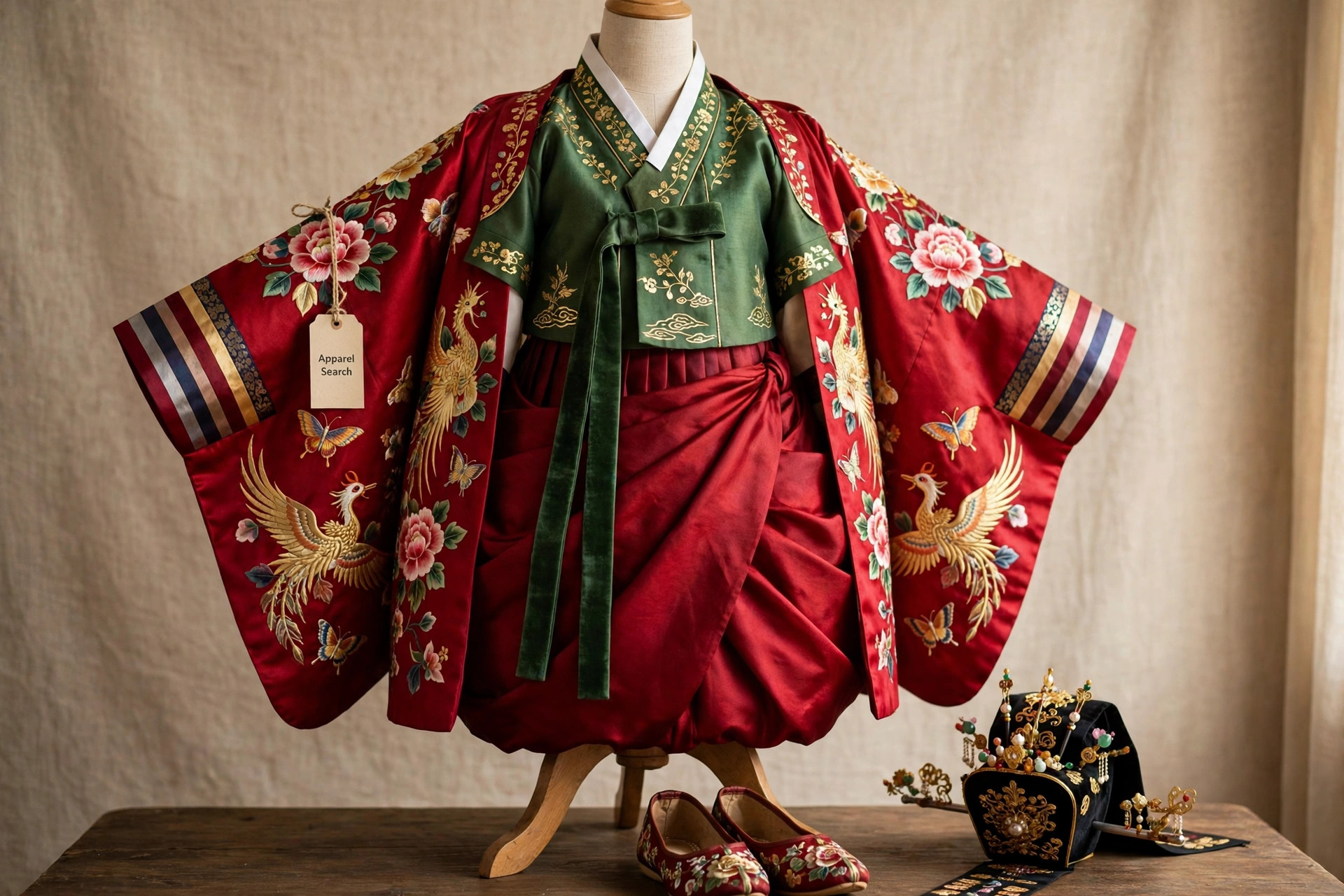
The foundation of the bridal outfit is the everyday architecture of the hanbok raised to festival pitch: a chima, the long wrap skirt, tied high on the chest so the silhouette falls in one full bell from under the arms, and above it the short jeogori jacket, closed not with buttons but with long ribbon ties, the goreum, knotted in a bow at the front. For a wedding, the classic pairing is a red chima with a green or yellow-green jeogori — sometimes the jacket is yellow — and the pairing is a meaning before it is a look. Red is the color of yang: vitality, celebration, protection, the energy said to ward off ill fortune on the day a bride most needs guarding. Green answers it as the color of youth, growth and harmony. Together with the groom's blue, the couple dress the Confucian ideal the ceremony itself enacts — two opposite energies balanced into one household. The skirt and jacket are embroidered or woven with the wedding's vocabulary of wishes: peonies for wealth and honor, lotus for purity, butterflies for love and longevity, phoenixes for grace and rank.
Over this foundation, for the pyebaek and the formal portraits, goes the layer that makes a bridal hanbok unmistakable — a ceremonial robe with wide, striped sleeves and long white cuffs (hansam) that extend the hands into the deep bows. Two robes share the role:
- Wonsam — the court robe
- The wonsam was the ceremonial over-robe of queens, royal women and high-ranking court ladies of the Joseon court, open at the front, its long sleeves banded in stripes of color. Rank once spoke through its color and pattern — yellow with dragons for an empress, red with phoenixes for a queen, green with flowers for a princess — and bridal wonsam are still usually green, embroidered or woven with phoenix, peony and floral roundels. Because a fully embroidered hwarot was so costly, commoner brides historically often married in a wonsam instead, and it remains the more commonly worn of the two robes today.
- Hwarot — the heirloom robe
- The hwarot (also written hwalot) is the great embroidered bridal robe: red outside, blue inside — the yin-yang pairing of husband and wife carried in a single garment — its surface worked all over with peonies, lotuses, phoenixes, butterflies, waves and rocks, and with auspicious characters wishing the couple fortune and many children. It began as a robe of royal women in the Goryeo and Joseon eras before passing to commoner brides, for whom one robe might serve a whole community or descend through a family for generations, re-worn, repaired and re-lined — an heirloom in the fullest sense. It is the heaviest, richest and most formal thing a Korean bride can wear, and today it is almost always rented rather than owned.
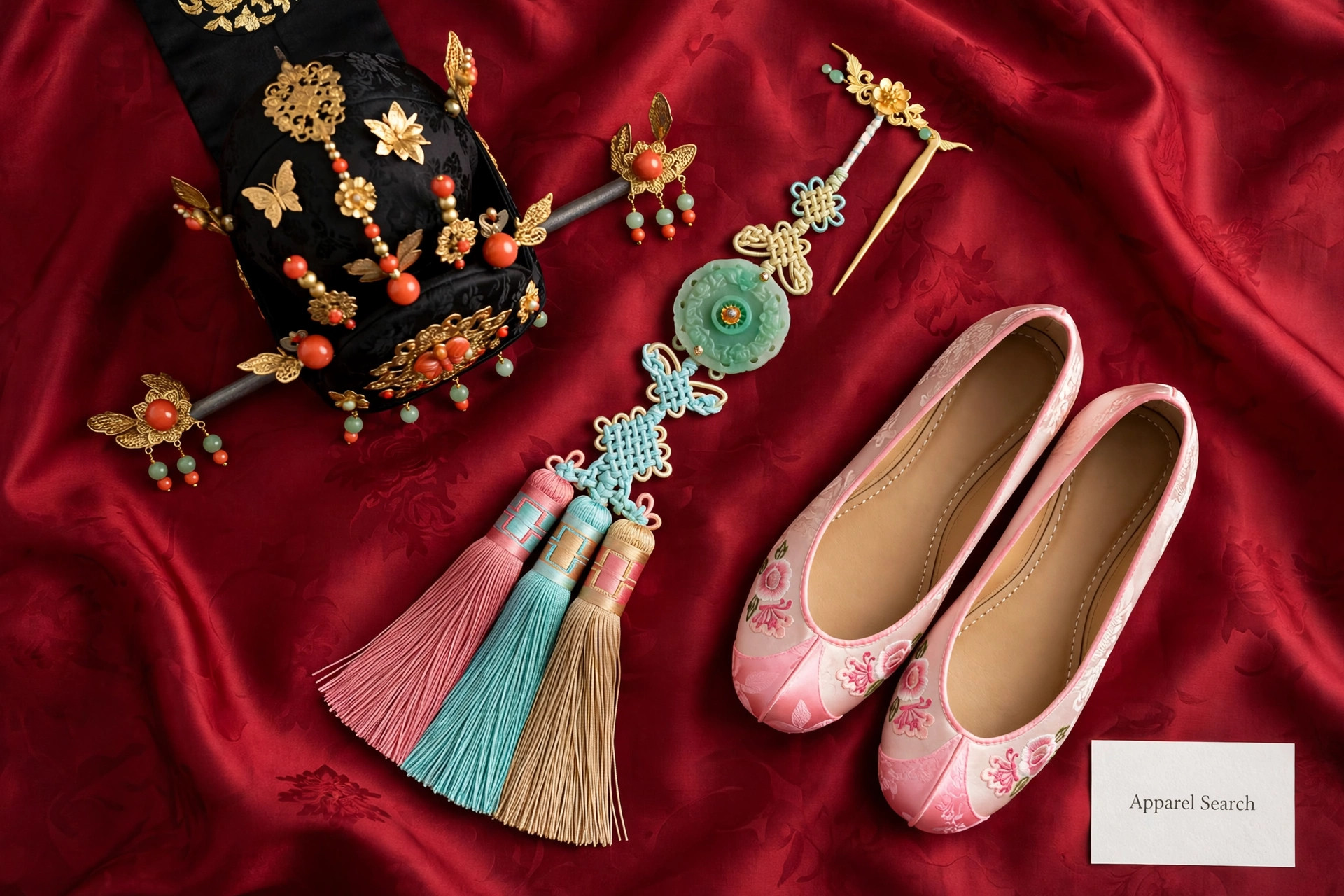
The hair completes the silhouette. The bride's hair is drawn into a low bun fixed with the binyeo, the long ornamental hairpin that traditionally marked a married woman, and over it sits the jokduri: a small, stiff black crown, lacquered and decorated with gold, coral, jade and amber ornaments, sometimes exchanged for the larger floral hwagwan. A long decorated ribbon, the daenggi, hangs down the back. Red dots — yeonjigonji — are traditionally painted on the bride's cheeks and forehead, a touch of bridal makeup said to signify youth and purity and to turn away bad luck. On her feet, over white padded beoseon socks, go kkotshin: silk shoes whose upturned toes and surfaces are embroidered with flowers — the name means, simply, flower shoes.
The Groom
The Groom's Hanbok: Layers and an Official's Robe
The groom's everyday-formal hanbok is built like the bride's but trousered: a longer jeogori over baji, the roomy trousers traditionally tied at the ankle, with a sleeveless jokki vest over the jacket and, outdoors or in cold weather, the long durumagi overcoat. His colors answer hers a register lower — where she wears red and green, he traditionally wears blue tones, the yin to her yang, in silk that may be deep indigo, soft blue or, in modern sets, ivory and pastel. For photographs and the hall's family greetings, this layered set is what most grooms wear when they wear hanbok at all; at the main ceremony itself he is usually in his suit.
For the pyebaek, tradition dresses him more grandly — not as a bridegroom in the Western sense but as a Joseon official receiving a bride into the state of marriage. The formal pyebaek groom wears a gwanbok-style official's robe, the round-collared dopo overcoat and the winged black samo hat of a government official, sometimes described as the dress of a low-ranking official of the dynasty; the humbler everyday alternative is the black horsehair gat, the wide-brimmed hat of Joseon gentlemen, worn with the durumagi. Either way the message is the same one the bride's court robe sends: this rite is conducted in the dress of the old court, because the family it creates was once a matter of state. Modern rental sets usually offer the groom a dignified version of the same layers — jeogori, baji, vest and overcoat in a color chosen to sit well beside the bride's red and green without competing with it.
The Mothers, and the Small Things
Blue for His Mother, Pink for Hers
Ask a Korean wedding guest who is who, and the answer is worn by the mothers. By a convention the Korean government's own cultural site, Korea.net, explains through yin and yang, the groom's mother wears hanbok in shades of blue — light blue, navy, mint — and the bride's mother wears shades of red — in practice pink, coral, rose or red. The pairing is so famous that it has become the wedding's informal seating plan made visible: blue side, pink side. Guests who wear hanbok are expected to avoid copying the two colors, and the mothers themselves coordinate early, because a mother's hanbok is the one wedding garment in the modern Korean wedding that is still commonly made to measure rather than rented — it will be worn again at the next child's wedding, at sixtieth birthdays and at grandchildren's first-birthday parties, so it is bought as a long-term piece of family dress.
The bride's own jewelry, in the Western sense, is slight — the hanbok tradition puts its ornament in the hair and at the waist instead. Chief of the small things is the norigae: a pendant of knotted silk cords, hung from the jeogori's ribbon or the skirt's waistband, combining a carved ornament — jade, amber, coral or silver — with elaborate knots and long tassels. Norigae were the most varied personal ornament of the Joseon era, carrying wishes in their motifs — bats and butterflies for luck and love, gourds and fruits for many children — and a bridal norigae in triple strands is still the finishing touch of the pyebaek outfit. With it go the binyeo in the bun, the jokduri above it, and the embroidered kkotshin below: a bride's jewelry box, worn all at once, none of it on her hands.
Acquiring
Renting the Robes, Keeping the Hanbok
Korean wedding hanbok runs on rental, and the system is built into the day itself. Wedding halls and their attached shops supply the pyebaek as a package — the room, the table, the screen, a helper to conduct the rite, and the couple's ceremonial dress: her hwarot or wonsam, jokduri and accessories, his official-style robe or hanbok set. Couples also rent from the hanbok shops of Seoul's great traditional shopping districts, where wedding sets are a specialty and staff dress the couple layer by layer — no small service, since a hwarot over layered silk has a set order and real weight. The white gown for the hall ceremony is usually rented the same way, as part of the studio-dress-makeup bundles most couples buy.
What is bought rather than rented tells you what Koreans expect to wear again. The mothers' hanbok, as above, are tailored and kept. A couple's own good hanbok — hers in colors she can wear at family festivals for years, his layered set — may be made to measure as wedding gifts from parents, joining the household's store of formal dress for New Year, Chuseok and family rites. And Seoul's rental culture now extends well beyond weddings: the same city that rents a bride her hwarot rents visitors a hanbok by the hour for palace visits, which has quietly kept the cutting, embroidery and repair trades behind the wedding robes in everyday work.
Today
The Modern Mix
The modern Korean wedding is not tradition diluted; it is tradition scheduled. The full Joseon rite that once unfolded over days at the bride's home has been compressed into a hall timetable — a twenty-minute white-gown ceremony, a meal, a thirty-minute pyebaek in a side room — and the clothes have been compressed with it, each tradition kept by being given its slot. Some couples now hold the pyebaek for both families, some hold it before the ceremony, some — Korea.net itself notes it is now optional, a matter of the couple's own values — leave it out and keep only the mothers' hanbok as the day's traditional dress. Designer hanbok, meanwhile, has moved the other way: modern bridal hanbok in ivory, blush and white, cut with the same silhouette but aimed at the main ceremony itself, lets a bride marry in hanbok in front of all her guests rather than only her family.
What has not changed is the color logic. A Korean wedding still announces itself in red answered by green and blue, a bride's mother in pink and a groom's mother in blue, dates and chestnuts flying toward a red skirt. If you are attending one rather than starring in it, our guide to dressing as a wedding guest covers the guest's side of the dress code — including why you should leave the pink and the blue to the mothers.
Common Questions
Common Questions
What does a Korean bride wear?
Twice over, usually: a Western white gown for the main wedding-hall ceremony, and a hanbok for the pyebaek family ceremony afterwards. The bridal hanbok is a red chima skirt with a green or yellow-green jeogori jacket, worn under a ceremonial robe — a green wonsam or a red, richly embroidered hwarot — with a jokduri crown, a binyeo hairpin, norigae pendants and embroidered kkotshin shoes.
What is the pyebaek?
The pyebaek is the traditional Korean family ceremony held after the wedding, in which the newlyweds, dressed in ceremonial hanbok, bow deeply to the groom's parents — and, in many modern weddings, to the bride's parents too. The couple offer wine, the parents give advice, blessings and money, and finally throw jujubes (Korean dates) and chestnuts for the bride to catch in her skirt; the number caught is said to predict the couple's children.
Why do the two mothers wear blue and pink hanbok?
By a famous convention explained through yin and yang, the groom's mother wears hanbok in shades of blue and the bride's mother wears shades of red — in practice pink, coral or rose. The pairing balances the two families visually, tells guests at a glance which mother is which, and is why guests wearing hanbok avoid those two color families.
What is the difference between a wonsam and a hwarot?
Both are wide-sleeved ceremonial robes worn over the bridal hanbok, descended from Joseon court dress. The wonsam is an open-fronted court over-robe, usually green for brides, embroidered or woven with phoenix and floral patterns. The hwarot is the heavier heirloom robe — red outside with a blue lining, embroidered all over with peonies, phoenixes, butterflies and auspicious characters — once royal dress, later the treasured bridal robe passed down through families. Today both are usually rented.
What does a Korean groom wear?
A suit or tuxedo for the main hall ceremony. In hanbok, he wears a longer jeogori jacket over loose baji trousers, with a jokki vest and a durumagi overcoat, traditionally in blue tones answering the bride's red. For the pyebaek he may wear the formal dress of a Joseon official — a gwanbok-style robe with a winged samo hat — or a gat, the wide-brimmed horsehair hat of Joseon gentlemen.
Keep Exploring
More to Explore
In This Series
Wedding Attire Around the World
The series hub — wedding dress country by country, from China's qun kua to Scotland's tartan, as each guide is published.
Visit the hub ↑Korea — The Hanbok
The base garment behind this page: the hanbok's parts, colors and making, explained in the Traditional Dress series.
Read ↑Go Deeper on Korea
Korea Clothing Industry
Korea's apparel and textile industry directory — the sector behind the wedding silks and the Seoul rental trade.
Explore ↑Hanbok Guide
Hanbok as clothing to buy and wear — styles, fabrics and what to look for.
Read ↑Attending a Wedding?
Search Apparel Search