Wedding Attire Around the World · Philippines
Wedding Attire in the Philippines
Most wedding guides begin with the bride. A Filipino wedding is the rare case where the groom's garment can outshine hers: a shirt of translucent pineapple-leaf cloth, hand-embroidered like lace, worn untucked and glowing over dark trousers. The bride answers in the great Filipiniana silhouettes — the butterfly-sleeved terno, the Maria Clara dress with its pañuelo — and between them, during the Catholic ceremony, sponsors step forward to pin a veil over both, loop a cord around their shoulders and place thirteen coins in the groom's hands. This guide walks the whole wardrobe. For the barong as a garment in itself, begin with our barong Tagalog of the Philippines guide; this page is about what it, and everything else, does at a wedding.
The Shape of It
A Ceremony Dressed by Many Hands
A Filipino wedding is, in most families, a Catholic wedding: a nuptial Mass in a parish church, often one with centuries of Spanish-era stone behind the altar. Around the couple stands an unusually large cast, and the cast is dressed as carefully as the couple. Before the day there is the pamamanhikan, the formal visit in which the groom's family calls on the bride's to ask for her hand and settle the wedding plans over a meal — the first occasion on which the two families appear, and dress, as one party. On the day itself, the principal sponsors — the ninongs and ninangs, godparents chosen as witnesses and lifelong mentors — process in formal dress, the men very often in barongs of their own. Behind them come the secondary sponsors, whose roles are not decorative: each pair will physically dress the couple during the Mass, adding the veil, the cord and the candles described below.
That is the distinctive thing about Filipino wedding dress: part of it is put on during the wedding, by other people, as the ceremony itself. The garments the couple arrive in — his barong, her terno or gown — are only the first layer. The veil pinned across both of them, the cord looped over their shoulders and the coins poured into joined hands complete the outfit in front of the congregation, and those pieces are then kept, often for life. After the Mass comes a reception built for scale — Filipino weddings are famously generous with guests — with feasting, the money dance in which guests pin bills to the couple's clothes as they dance, and, in many families, a change of dress for the couple into evening wear. The weaving and garment trades behind all of it are profiled on our Philippines clothing industry page.
The Ceremony
The Veil, the Cord and the Coins
The veil — two people under one cloth
The ceremony veil is not the bride's own veil, though she may wear one of those too. It is a second, long veil, carried by the veil sponsors — usually a chosen couple — who pin one side over the bride's head or shoulder and drape the rest over the groom's shoulder, so that the two kneel joined under a single piece of cloth. The meaning usually given is unity: the couple clothed as one, under God's protection. In dress terms it is a remarkable moment — a garment whose whole purpose is to be worn by two people at once, and whose placement has to work over a piña terno on one side and a barong collar on the other, which is why sponsors rehearse the pinning and why couples are advised to test the veil's length and grip beforehand.
The cord — the yugal
Over the veil, the cord sponsors lay the yugal: a cord — silk, satin, beaded, or made as a long rosary — looped around the couple's shoulders in a figure-eight, the infinity sign. It stands for everlasting fidelity, a bond with no end, and it stays on through the rest of the rite. Cords are bought as keepsakes, sometimes embroidered or personalised, and like the veil they become part of the couple's stored wedding things rather than disposable props.
The arras — thirteen coins
The coins have their own small procession: a coin bearer carries the arras (also spelled arrhae) to the altar in a pouch, box or on a tray — thirteen coins, traditionally gold or silver in colour. The priest blesses them, and the groom takes them and pours or places them into the bride's cupped hands: his pledge to provide for the family, and her acceptance of the shared stewardship of what they build. The thirteen are often read as Christ and the twelve apostles, or as a coin for each month of the year and one more for luck. Either way, the set is kept — arras sets pass down families much as rings do.
The Bride
The Terno, the Maria Clara, and the Sleeves That Say Philippines
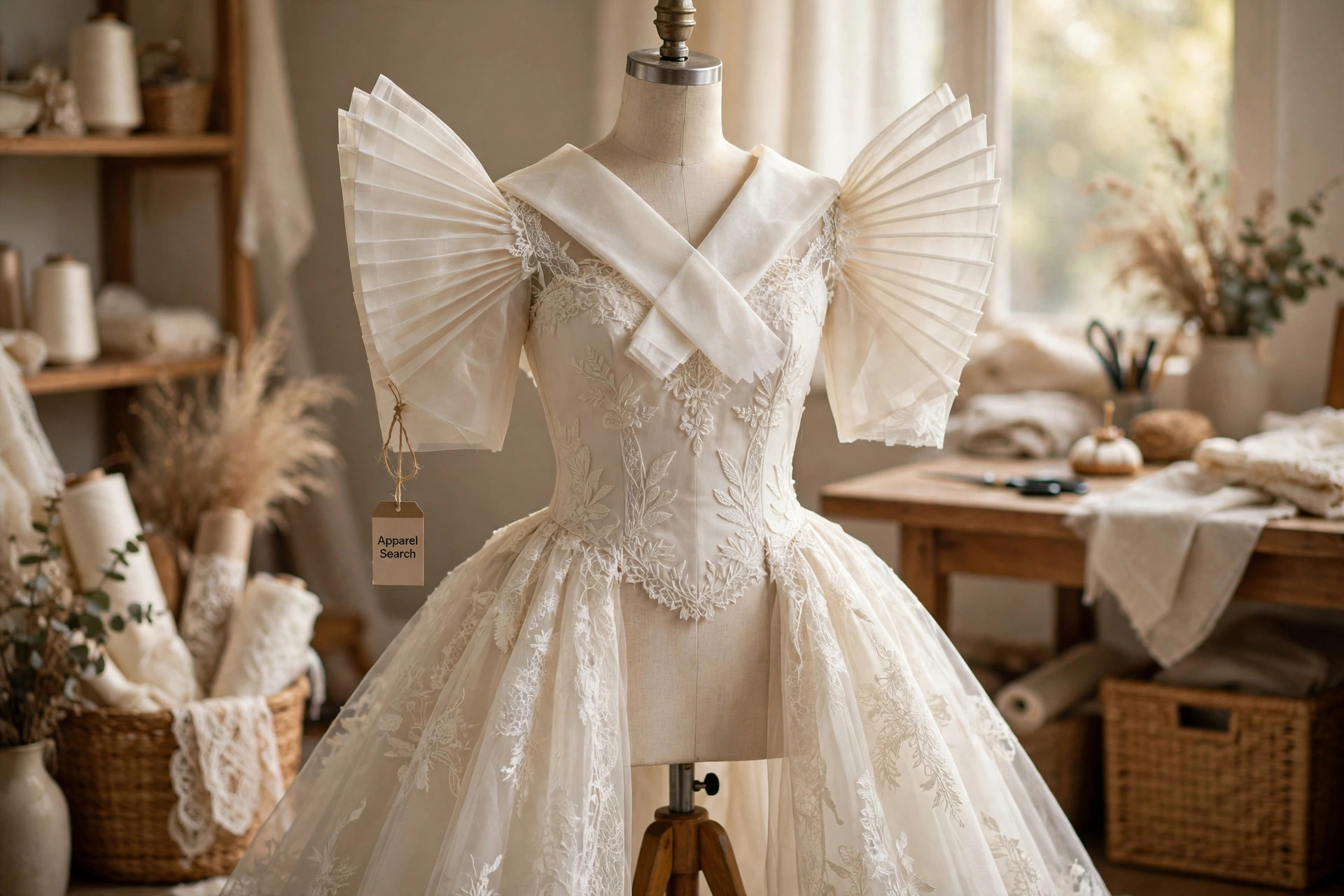
The modern Filipino bride often marries in a white Western-style gown — but if she wants the dress to say Philippines, she reaches for one of the Filipiniana silhouettes, and above all for the sleeve. The terno is defined by its butterfly sleeves: short, stiff, pleated sleeves that rise from the shoulder and stand away from the arm like folded wings, traditionally stiffened with starched net so they hold the shape unaided. The word terno is Spanish for a matching set — the blouse, shoulder cloth and skirt were once cut and embroidered to match — and the unified one-piece terno gown was popularised in the first half of the twentieth century, in a form credited to the designer Ramon Valera. By the later twentieth century the meaning had narrowed to the sleeves themselves: add butterfly sleeves to a gown and it is a terno, whatever the skirt does.
The older, fuller silhouette is the Maria Clara dress, named for the heroine of José Rizal's 1887 novel Noli Me Tangere. In its traditional form it is an ensemble of four parts: the camisa, a collarless blouse of sheer piña or jusi with wide sleeves; the saya, a long skirt; the pañuelo, a starched square of cloth folded over the shoulders — originally a modesty layer over the camisa's low, translucent neckline, and a field for embroidery in its own right; and the tapis, a shorter overskirt wrapped at the waist. In piña and lace, with the pañuelo pinned by a brooch, it remains a formal bridal choice — the most traditional thing a Filipina bride can wear. Its country cousin, the balintawak, shortens the sleeves and the skirt, lightens the mood, and survives today in shorter, festive and cocktail versions.
| Region | The bridal dress | Signature details |
|---|---|---|
| Luzon — the classic form | The terno or Maria Clara in piña and lace | Butterfly sleeves, the starched pañuelo, Lumban hand embroidery; the groom in a piña barong to match |
| The Visayas | The kimona with a patadyong skirt | A loose, sheer blouse worn with the woven tube skirt of the islands; lighter and less courtly than the Luzon terno |
| Ilocos | Woven cloth in the inabel tradition | Hand-loomed cotton from Ilocos looms appears in regional dress and wedding accents — the north's own weaving answering piña |
What unites the regional forms is the cloth and the needlework: piña and jusi, embroidery and lace, the same materials as the groom's barong — so that a traditionally dressed Filipino couple is, quite literally, wearing the same craft from opposite sides of the altar.
The Groom
The Groom's Barong: the Shirt That Outshines
Here is the reversal at the heart of Filipino wedding dress. In most of the world the groom dresses down into a dark, quiet suit so the bride can shine. The Filipino groom wears the barong Tagalog — and a wedding barong, in translucent cloth covered with hand embroidery, is one of the most luminous garments any groom anywhere wears. He is not competing with the bride; the tradition simply never asked him to be plain. The full garment — its history, fibres and making — is covered in our Traditional Dress guide to the barong; at a wedding, these are the parts that matter:
- The barong itself
- A long-sleeved shirt buttoning down the front, with a dress-shirt collar, side slits at the hem and embroidered panels down the chest — the pechera — and around the cuffs. It is always worn untucked, its straight hem falling over the trousers, over a plain white undershirt, the camisa de chino, which shows through the sheer cloth and sets off the embroidery. Dark formal trousers — black is the classic partner — and dress shoes complete it. Our men's barong Tagalog guide covers fit and grades as menswear.
- The fabrics — piña above all
- Wedding barongs follow a clear hierarchy. At the top is piña, woven from pineapple-leaf fibre: hand-scraped, hand-knotted, loomed by hand, feather-light with a soft lustre — the heirloom cloth, and the groom's first choice where the budget allows. Below it, jusi — traditionally banana fibre, now often silk or blends — gives a similar polished sheer at a friendlier price, and most grooms in fact marry in jusi; organza versions sit between and beyond. Philippine wedding guides commonly quote piña wedding barongs from about ₱25,000 upward, with heavily embroidered pieces far beyond that, against roughly ₱5,000–15,000 for jusi — the gap is the handwork, and it is visible across a church.
- The embroidery — calado
- The barong's decoration is not printed or appliquéd but worked into the cloth itself. In calado, threads of the woven fabric are drawn out and the remaining threads stitched into lace-like openwork — floral and geometric patterns that float in the sheer ground. The craft's capital is Lumban, in Laguna, whose embroiderers supply much of the country's finest barong and terno work. A groom's barong carries the fullest embroidery of any man's in the room; groomsmen match him in cloth and pattern at one deliberate step down, and the ninongs wear fine barongs of their own.
Why does the groom shine here? Partly climate — the barong is formal dress engineered for tropical heat, where a wool suit is a punishment — and partly history: the barong is the national dress, worn by presidents at inaugurations, so a groom in piña is not dressing up as anything. He is wearing the most formal garment his country makes.
Jewelry
Gold That Is Handed Down
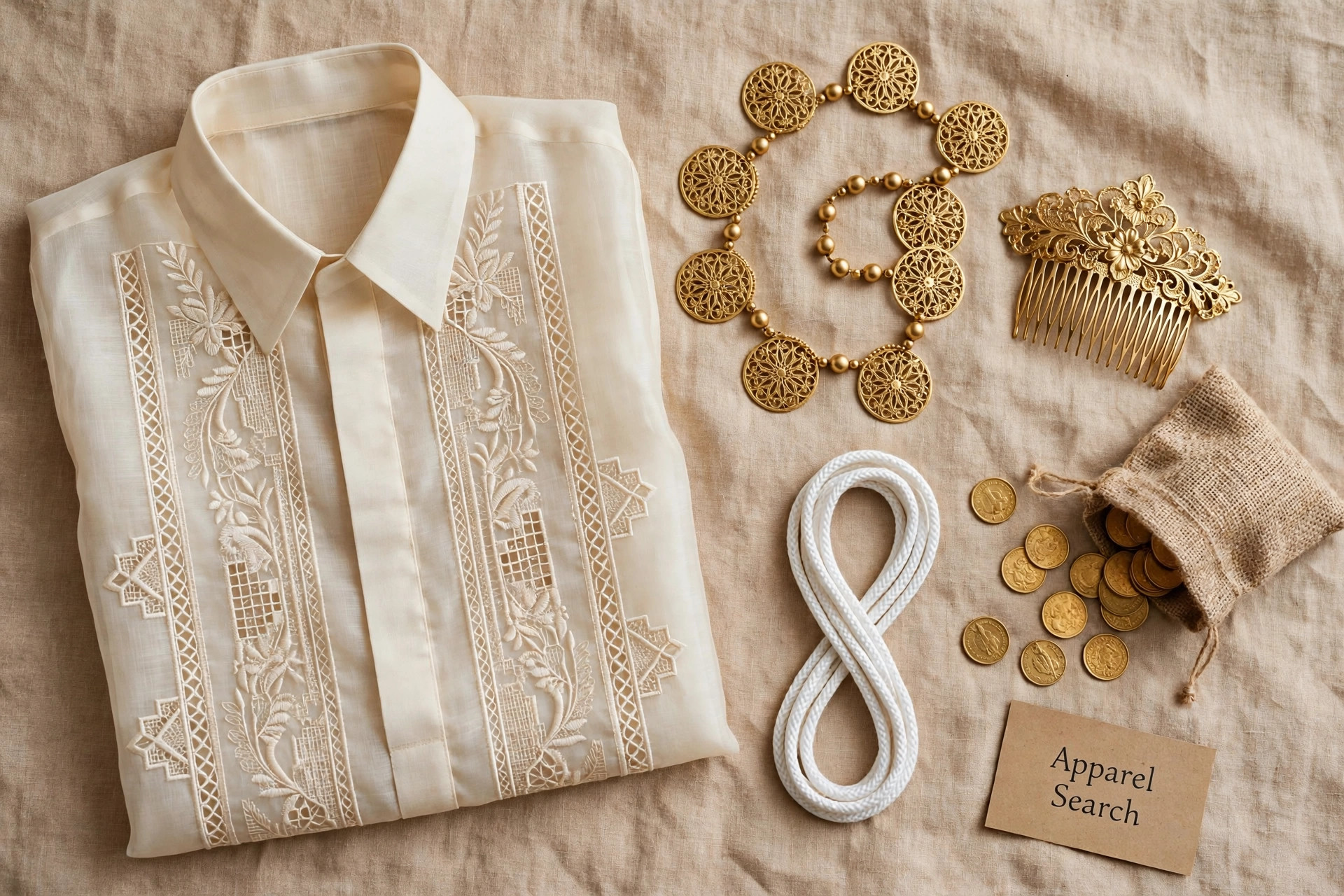
Filipino bridal jewelry is heirloom jewelry. Its emblem is the tambourine necklace — tamburin — a necklace of small hollow gold beads, smooth, textured or worked in filigree, sometimes strung rosary-fashion with a larger ornate pendant bead. The technique is the point: fine gold wire twisted and soldered into openwork that looks woven rather than cast, a craft with pre-colonial roots layered with Spanish colonial goldsmithing, and one kept alive by a small number of master plateros, notably in Meycauayan, Bulacan, the historic centre of Filipino jewelry-making. A tambourine necklace is worn at baptisms, debuts, weddings and anniversaries across a lifetime and then handed on — grandmothers' tamburins at granddaughters' weddings are a Filipino commonplace.
With it go the peineta combs — ornate hair combs, traditionally in gold or gold-worked metal with repoussé decoration, worn in the bride's upswept hair — filigree earrings, and, in the modern pairing, Philippine South Sea pearls. The groom's jewelry is quieter: a watch, perhaps cufflinks against the barong's cuffs, and the ring. For the Western counterpoint in bridal gold, see our bridal necklaces guide. But the deeper truth of the Filipino wedding is that its most-kept jewelry is not worn to the ceremony at all: it is the arras set and the cord, blessed at the altar and stored with the family's important things.
Acquiring
Buying the Wedding Wardrobe
A wedding barong is bought on a timeline. Bespoke makers — measuring the groom, cutting the cloth, embroidering to order — commonly need four to eight weeks, and the best-known Manila makers book out months ahead in peak wedding season; a piña piece, whose cloth itself is hand-loomed before a needle touches it, needs longer still. Ready-to-wear barongs in jusi and organza are sold across the Philippines, in department stores and market districts such as Divisoria and Greenhills in Manila, and can be bought and altered within the week. Between the two sits rental: barong rental is an ordinary part of Philippine wedding planning, used most often to dress a whole line of groomsmen and sponsors identically, while the groom buys — or borrows from his father — the one piña piece that will be kept.
The embroidery has an address. Lumban, Laguna, is the barong embroidery capital, and couples who care about calado buy Lumban work, whether through a Manila tailor or from Lumban makers directly; the town's name on a barong functions the way a weave's name does on a sari. The bride's side mirrors the groom's: a bespoke terno or Maria Clara is commissioned from a designer or dressmaker, often in the same piña the groom wears, while modern terno-sleeved gowns are made by the country's bridal designers to order. And because piña keeps — it is stored flat or on padded hangers, away from light, and cleaned by specialists — the wedding barong and terno are bought as the first heirlooms of the new family, not as costumes for a day.
Today
The Modern Mix
Contemporary Filipino wedding dress plays with the code rather than abandoning it. Grooms wear colored barongs — black embroidery on ivory, deep-toned cloth, even fully dark barongs for evening receptions — and the barong coat, a structured, lined layer in piña or cocoon silk worn over the shirt, gives grooms a silhouette closer to a suit jacket for church formality. Groomsmen are colour-matched as a line, a step below the groom. Brides, meanwhile, have made the terno sleeve the national signature of modern Filipiniana: butterfly sleeves added to sleek Western gowns, detachable terno sleeves and boleros that convert a strapless dress for the ceremony and come off for the reception, sleeves worked in lace, beading or the same calado as a barong. Destination and diaspora weddings — in Tagaytay gardens, on Boracay sand, in churches in California and Toronto — carry the pairing worldwide, and the veil, cord and arras travel with it, rehearsed by sponsors who may be performing the rite for the first time in a generation. If you are attending rather than starring, our Wedding Guest Attire section covers what to wear from the other side — including to weddings exactly like this one.
Common Questions
Common Questions
What does a Filipino groom wear?
Most often a barong Tagalog — a long-sleeved, embroidered shirt of sheer piña, jusi or organza cloth, worn untucked over a plain white undershirt (the camisa de chino) with dark formal trousers and dress shoes. For a wedding, the groom wears the most formal version in the room: ideally piña, with the fullest hand embroidery, a step above his groomsmen and the principal sponsors, who wear barongs of their own.
What is a terno?
The terno is the Philippines' formal dress for women, defined by its butterfly sleeves: stiff, pleated sleeves that stand up from the shoulder like folded wings, traditionally stiffened so they hold their shape on their own. The name comes from the Spanish for a matching set — the blouse, shoulder cloth and skirt once matched — and today almost any formal gown, from a full bridal dress to a cocktail sheath, becomes a terno when the butterfly sleeves are added.
What are the veil, cord and arras in a Filipino wedding?
They are three symbolic acts performed by secondary sponsors during the Catholic ceremony. The veil sponsors pin a long veil over the bride's head and the groom's shoulder, for unity under God's protection. The cord sponsors lay a cord — the yugal — over both sets of shoulders in a figure-eight, for an everlasting bond. And the groom gives the bride the arras, thirteen coins blessed by the priest, as a pledge to provide for the family they are founding.
Why is the barong Tagalog worn untucked?
Because that is how the garment is made to be worn: the barong has a straight, often embroidered hem designed to be seen, falling over the trousers rather than tucked into them. Its sheer cloth is worn over an opaque undershirt, and the whole effect — embroidery floating over the white camisa de chino beneath — depends on the shirt hanging free. Tucking a barong in is the one styling error everyone notices.
What is piña cloth?
Piña is cloth woven from the fibres of pineapple leaves — scraped, knotted and loomed by hand, a tradition centred on Aklan weaving. It is feather-light, naturally lustrous and slightly amber in tone, and it is the most prestigious fabric in Filipino dress: the cloth of heirloom barongs, wedding ternos and the Maria Clara dress. Because every stage is handwork, a fine piña barong takes weeks to months to make and is priced — and kept — accordingly.
Keep Exploring
More to Explore
In This Series
Wedding Attire Around the World
The series hub — wedding dress country by country, from China's qun kua to Scotland's tartan, as each guide is published.
Visit the hub ↑Philippines — The Barong Tagalog
The groom's garment in full: piña and jusi cloth, calado openwork, and the terno and baro't saya that share its fibres, in the Traditional Dress series.
Read ↑Go Deeper on the Philippines
Philippines Clothing Industry
The Philippines' apparel and textile industry directory — the sector behind the piña weaving and Lumban embroidery trades.
Explore ↑Definition of Barong Tagalog
The short Apparel Search definition of the barong and its key terms.
Read ↑Terno Guide
The terno as clothing to buy and wear — butterfly sleeves, fabrics and styling.
Read ↑Men's Barong Tagalog Guide
Barongs as menswear: piña and jusi fabrics, embroidery grades and how to choose one.
Read ↑Attending a Wedding?
Search Apparel Search